Answer:
Catfish are not a single aquarium job title. Corydoras are shoaling sand-foragers, loricariids are armoured grazers or wood-feeders, synodontis are African omnivores, and pimelodids are active predators. Match adult size, oxygen demand, substrate, and water chemistry: a 3 cm otocinclus and a 60 cm common pleco have almost nothing in common except whiskers.
Siluriformes, the catfishes, is one of the largest orders of freshwater fishes, and the aquarium trade samples only a narrow but extraordinarily varied slice of it: Corydoras aeneus (bronze corydoras) sifting sand with sensory barbels, Pterygoplichthys multiradiatus (common pleco) grazing wood and algae as a future half-metre animal, and Pimelodus pictus (pictus catfish) crossing open water with long maxillary barbels like fishing lines.
I have kept catfish in planted aquaria for more than three decades, from blackwater corydoras tanks with leaf litter and conductivity below 80 µS/cm to high-flow loricariid systems where oxygen demand, not pH, is the limiting husbandry variable. The lesson is consistent: "catfish" is a taxonomic order, not a care sheet.
Taxonomy
Siluriformes contains more than 3,000 described species, with ongoing revision in several families. Aquarium species cluster in a few families.
| Family | Aquarium examples | Diagnostic theme | Husbandry implication |
|---|---|---|---|
| Callichthyidae | bronze corydoras, panda corydoras, pygmy corydoras | Bony scutes, paired barbels, intestinal air breathing | Keep in groups on sand; never solitary |
| Loricariidae | bristlenose pleco, royal pleco, otocinclus | Armoured plates and ventral sucker mouth | High fibre diets, oxygen, wood or biofilm according to genus |
| Mochokidae | synodontis petricola, featherfin synodontis | African, often strong-spined, many social or crepuscular | Robust tanks; some suit Rift cichlid water |
| Pimelodidae | pictus catfish | Long-whiskered South American predators | Large, covered tanks; tankmates too large to swallow |
| Siluridae | glass catfish | Scaleless, laterally compressed transparent body | Soft stable water; schooling, low stress |
Callichthyids and loricariids are armoured in different ways. Corydoras carry two rows of bony scutes and still root through the substrate with mobile barbels. Loricariids are flattened, ventral-mouthed fishes that attach to surfaces in current. The ecological difference matters more than the armour: corydoras are social substrate foragers; plecos and otocinclus graze surfaces, rasp wood, or browse aufwuchs.
Identification
The basic catfish characters are barbels, reduced or absent scales in many lineages, and a tendency toward nocturnal or substrate-oriented feeding. In aquarium practice, identification must go further because trade names are unreliable.
The most consequential error is the common pleco problem. A 6 cm juvenile sold for a 50-litre aquarium may be a Pterygoplichthys species capable of 45–60 cm. The high dorsal fin, spotted armour, heavy body, and rapid faecal output are early warnings. By contrast, an adult bristlenose pleco usually remains 10–14 cm and has a broader, blunter head with adult male facial tentacles.
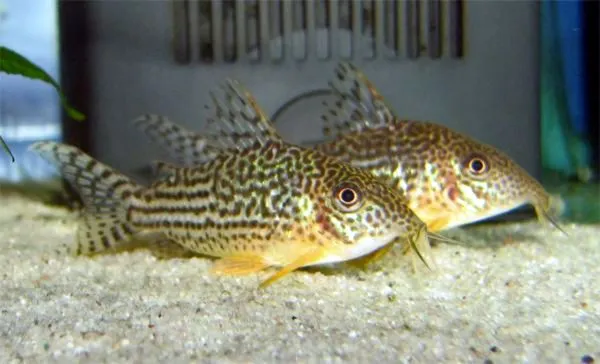
Corydoras also suffer from name drift. The familiar "julii cory" in shops is usually julii corydoras in name only; most are Corydoras trilineatus. True C. julii has finer, discrete spotting on the head and is less common in export. C. trilineatus has a more reticulated head pattern and a stronger lateral stripe. This is not pedantry: correct identification prevents unrealistic breeding claims and helps aquarists understand origin and water preference.
Behaviour & Ecology
Corydoras are shoaling fish with a social logic that becomes visible only in groups. Six is a bare minimum; eight to twelve produces better feeding confidence and more natural resting clusters. They feed by probing sand and detritus with barbels, taking small invertebrates, worms, insect larvae, and organic particles. Their accessory respiration is often misunderstood. Many species gulp air and absorb oxygen through the posterior intestine; occasional surface dashes are normal, but repeated frantic gulping points to low dissolved oxygen, gill damage, or high temperature — the cory catfish gasping diagnostic covers each cause.
Loricariids vary widely. Otocinclus are small biofilm grazers that do poorly in sterile new aquaria. Panaque and Panaqolus rasp wood, not because wood is nutritionally rich by itself, but because gut microbes and associated biofilm allow them to exploit a fibrous resource few fishes can use. Royal pleco and clown pleco aquaria should contain real bogwood, visible fibre in faeces, and strong filtration.
Synodontis are not small corydoras with African passports. Synodontis petricola from Lake Tanganyika suits hard, alkaline water and rockwork; featherfin synodontis becomes a substantial, assertive catfish that dominates small bottom zones. Pimelodids such as pictus catfish are active nocturnal predators and should be planned like fast characins with mouths, not like cleaners.
Water Chemistry & Habitat
Catfish span blackwater streams, Andean foothill torrents, floodplain lagoons, and Rift lakes. No single parameter range is honest. The table below gives useful aquarium targets, not universal rules.
| Group | Temperature | GH | KH | pH | Conductivity |
|---|---|---|---|---|---|
| Most corydoras | 22–26 °C | 2–10 °dH | 0–5 °dH | 6.0–7.4 | 80–300 µS/cm |
| Warm corydoras such as sterbai | 25–28 °C | 2–8 °dH | 0–4 °dH | 6.0–7.2 | 80–250 µS/cm |
| Common bristlenose | 23–27 °C | 3–15 °dH | 1–8 °dH | 6.2–7.8 | 120–450 µS/cm |
| Otocinclus | 22–26 °C | 2–10 °dH | 0–5 °dH | 6.0–7.4 | 80–250 µS/cm |
| Tanganyikan Synodontis | 24–27 °C | 10–18 °dH | 8–14 °dH | 7.8–8.8 | 500–900 µS/cm |
| Glass catfish | 24–27 °C | 1–8 °dH | 0–3 °dH | 6.0–7.2 | 50–220 µS/cm |
Substrate is not cosmetic. Corydoras need fine rounded sand; the substrate selection decision determines barbel health. Loricariids need hard surfaces with biofilm and secure caves. Glass catfish need dim, planted open water, where java fern and anubias nana give cover without demanding bright light.
Aquarium Husbandry
Plan from adult size and waste production. A small corydoras species in a 75-litre planted aquarium is plausible; a common pleco in the same tank is not. Catfish generally dislike unstable cycling because many feed at the substrate where decomposing waste accumulates. A mature filter, undetectable ammonia and nitrite (0 mg/L), nitrate preferably below 20 mg/L, and high dissolved oxygen are baseline conditions. If the aquarium is new, read cycling a new aquarium before adding bottom dwellers.
Feeding must reach the fish without fouling the substrate. Corydoras need sinking carnivore or omnivore foods, not leftovers after tetras have eaten. Loricariids need vegetable matter, aufwuchs, protein in moderation, and wood where the genus demands it — pleco diet expectations vs reality explains why algae alone rarely satisfies a mature loricariid. Synodontis and pictus catfish need meaty foods; vegetable wafers do not make them safe for tiny tankmates.
Tankmates should be selected by temperature, chemistry, and behaviour. Corydoras fit many peaceful South American communities with tetras, but not with fin-nipping, boisterous, or highly territorial fish. Synodontis petricola belongs with Tanganyikan cichlids and rockwork; see the complete cichlids guide and frontosa for the water-chemistry context. Avoid mixing blackwater glass catfish with hard-water livebearers simply because both are labelled peaceful.
Physiology That Affects Care
Catfish physiology explains many aquarium rules that otherwise sound like preference. Barbels are sensory organs supplied with taste buds and nerves; they are not decorative whiskers. A corydoras with shortened barbels has lost part of its feeding apparatus. The usual cause is not one sharp stone but a combination of abrasive substrate, trapped food, and high bacterial load at the feeding surface. Fine inert sand kept lightly stirred by normal foraging is safer than coarse gravel that hides decay.
Armour also changes handling. Loricariids and mochokids carry strong pectoral and dorsal spines that snag nets and can puncture bags. Move large plecos and synodontis in rigid containers under water where possible. Never pull a tangled catfish backwards through mesh; cut the net if necessary. Scaleless or weakly scaled species such as glass catfish and pimelodids are more sensitive to rough handling and some medications, so dosage caution and quarantine observation are important.
Air breathing in callichthyids is often misread. Occasional surface gulps by corydoras are normal accessory respiration via the posterior intestine. A whole group repeatedly racing upward every few seconds is a warning. Check temperature, filter flow, surface agitation, nitrite, and gill irritation before assuming the behaviour is charming. Warm water, heavy feeding, and low night-time plant oxygen can combine into morning distress.
Feeding Guilds
The phrase "bottom feeder" hides incompatible diets. Corydoras take small animal foods and fine organic material. They need protein-rich sinking foods, but not large piles of fatty feed. Otocinclus browse soft algae and microbial film almost continuously, but otocinclus feeding failure becomes the more likely outcome when biofilm runs out and substitutes are refused. Panaque and Panaqolus rasp wood and associated biofilm, producing fibrous waste. Synodontis are opportunistic omnivores with a strong taste for insect larvae, crustaceans, eggs, and prepared foods. Pimelodids are predators.
| Feeding guild | Examples | Correct foods | Common error |
|---|---|---|---|
| Sand-sifting micro-predator | Corydoras | Sinking tablets, daphnia, worm foods, fine granules | Expecting them to eat algae |
| Biofilm grazer | Otocinclus, Chaetostoma | Mature algae film, vegetables, vegetable wafers | Adding to sterile new aquaria |
| Wood rasper | Royal and clown plecos | Bogwood, high-fibre wafers, vegetables | Feeding too much animal protein |
| Omnivorous crevice catfish | Synodontis | Sinking pellets, insect larvae, crustaceans | Treating as a passive cleaner |
| Active predator | Pictus catfish | Meaty sinking foods, robust tankmates | Housing with small tetras or shrimp |
Feed after watching competition. In a busy community, surface fish may intercept all food before it reaches catfish. Conversely, large plecos can monopolise a single vegetable slice and prevent smaller fish from feeding. Multiple feeding points and night observation solve more problems than changing brands.
Stocking by Aquarium Type
A 60-litre soft planted aquarium can support pygmy corydoras or otocinclus if mature; it cannot support common plecos, pictus catfish, or featherfin synodontis. The corydoras vs otocinclus role comparison covers which suits a given soft-planted setup best. A 120-litre sand-bottom South American community can house bronze, panda, julii-type, or sterbai corydoras depending on temperature. A 250-litre warm riverine tank opens space for pictus catfish if small tankmates are excluded. A Tanganyikan rock aquarium suits synodontis petricola because the chemistry, rockwork, and feeding style align.
Planted aquaria need special judgement. Bristlenose plecos usually coexist with tough rhizome plants, but hungry adults rasp soft leaves. Royal plecos remodel wood-heavy layouts and produce waste that may overwhelm delicate aquascapes. Corydoras can uproot newly planted foreground stems while foraging, though established plants are usually safe. Catfish are not anti-plant; they simply interact with the substrate and hardscape more physically than mid-water schooling fish.
Buying and Quarantine
Buy catfish with rounded bellies, intact barbels, clear eyes, and steady respiration. Avoid corydoras with red bellies, clamped fins, or eroded mouths; avoid otocinclus with sunken abdomens; avoid plecos with hollow eyes or pinched heads. A fish that has survived poor handling may still die weeks later from starvation and bacterial damage.
Quarantine should be calm and mature, not bare in the sense of biologically sterile. Use seeded sponge filters, hides, and species-appropriate food. For corydoras, a thin layer of clean sand reduces stress. For plecos, include wood or caves. For glass catfish, provide cover and a group whenever possible. Observe for two to four weeks before adding to a display aquarium, especially when the display contains established fish that cannot easily be medicated.
Notable Species
- Bronze corydoras (Corydoras aeneus) — hardy, adaptable shoaling corydoras and a good first callichthyid.
- Panda corydoras (Corydoras panda) — cool, soft-water cory with eye-mask pattern and sensitivity to dirty substrate.
- Pygmy corydoras (Corydoras pygmaeus) — tiny mid-water shoaler that behaves unlike most bottom-bound corydoras.
- Sterbai corydoras (Corydoras sterbai) — warm-tolerant cory often paired with discus-style temperatures.
- Julii corydoras (Corydoras julii) — frequently misidentified; most shop fish are C. trilineatus.
- Common pleco (Pterygoplichthys multiradiatus) — large, messy loricariid responsible for many adult-size shocks.
- Bristlenose pleco (Ancistrus spp.) — the most practical small pleco for ordinary aquaria.
- Royal pleco (Panaque nigrolineatus) — wood-rasping specialist needing large quarters and heavy filtration.
- Otocinclus (Otocinclus vittatus and relatives) — true algae grazer that requires mature biofilm and careful acclimation.
- Glass catfish (Kryptopterus vitreolus) — transparent schooling silurid for soft, stable planted tanks.
- Pictus catfish (Pimelodus pictus) — active long-whiskered predator for larger covered aquaria.
Common Confusions
| Confusion | Reliable separator | Husbandry consequence |
|---|---|---|
| Corydoras julii vs C. trilineatus | True julii has fine separate head spots; trilineatus has reticulation and stronger lateral stripe | Do not assume wild julii provenance from a shop label |
| Common pleco vs bristlenose | Pterygoplichthys grows 45–60 cm; Ancistrus usually 10–14 cm | Tank size differs by hundreds of litres |
| Otocinclus vs small pleco | Otocinclus lacks heavy pleco body and stays around 4 cm | Otos need groups and biofilm, not caves and wood rasping |
| Synodontis petricola vs featherfin | Petricola smaller, spotted, Tanganyikan; featherfin larger with sail-like dorsal | Petricola suits hard cichlid systems; featherfin outgrows small communities |
| Glass catfish vs dyed glass fish | True Kryptopterus vitreolus is naturally transparent and not dyed | Avoid any artificially coloured fish |
A Note on Temperature Compromise
Temperature compromise is one of the quiet causes of catfish losses. A tank kept at 28 °C for warm cichlids may be tolerable for sterbai corydoras but stressful for panda corydoras, rubber-lip plecos, and many otocinclus shipments. Conversely, a cool high-flow tank that suits Chaetostoma is not a home for glass catfish. Choose the catfish after the aquarium's thermal identity is settled. Changing a heater setting is easy; changing oxygen demand, bacterial growth rate, and fish metabolism is not. This is why mixed-origin catfish collections usually work only when the keeper chooses a narrow, compatible subset rather than one fish from every appealing group.
Disease and Medication Cautions
Catfish are frequently described as medication-sensitive, a statement too broad to be useful but important enough not to ignore. Scaleless and weakly scaled species can react badly to harsh dye-based or copper-based treatments, and loricariids may suffer when oxygen falls during medication. The safer approach is prevention: quarantine, correct temperature, low dissolved waste, and rapid removal of decaying food. If treatment is required, identify the disease first and aerate strongly. Guessing with successive medications is especially hard on bottom dwellers because many compounds concentrate in mulm and low-flow zones.
Salt also deserves caution. Short controlled salt treatments have legitimate uses for some external parasites, but permanent salt in a freshwater catfish aquarium is poor practice. Corydoras, otocinclus, glass catfish, and many loricariids evolved without chronic salinity. If a livebearer community requires mineral-rich alkaline water, select catfish that tolerate those minerals rather than adding salt and hoping soft-water species adapt.
Ethical Trade Choices
The best catfish purchase is often the fish not bought. Refuse common plecos for small aquaria, dyed glass fish, emaciated otocinclus, and unidentified "monster catfish" juveniles. Ask for adult size in centimetres, not adjectives. If the seller cannot distinguish bristlenose from Pterygoplichthys or true julii from trilineatus, use the fish's morphology rather than the label.
Captive-bred corydoras, bristlenose plecos, and some synodontis reduce pressure on wild stocks and arrive better conditioned. Wild-caught fish are not inherently unethical, but they demand honest acclimation and species knowledge. The aquarist's obligation is to match the animal's adult ecology, not to make the purchase fit an existing tank.
See Also
- The Complete Tetras Guide — compatible schooling fish for many soft-water catfish aquaria.
- The Complete Cichlids Guide — cichlid water chemistry and territoriality before adding bottom fish.
- Water Hardness: GH & KH Explained — interpreting °dH, KH stability, and conductivity.
- Cycling a New Aquarium — essential before adding substrate-feeding fish.
- Substrate Selection — sand, gravel, aquasoil, and barbel-safe choices.
- The Complete Anabantoids Guide — useful contrast for air-breathing physiology in unrelated fishes.
Frequently Asked Questions
Are catfish good cleaner fish?
Catfish do not replace maintenance. Corydoras eat sinking food and small invertebrates, plecos graze biofilm or wood, and pictus catfish eat meaty foods. All add waste. Treat them as livestock with species-specific diets, not as janitors.
What substrate is safest for corydoras?
Fine, rounded sand is safest. Sharp gravel abrades barbels and traps decomposing food where corydoras feed. Keep nitrate below 20 mg/L and vacuum lightly so the upper sand layer remains aerobic.
Why do plecos outgrow aquariums so often?
The trade name common pleco is often applied to Pterygoplichthys that reach 45–60 cm. Juveniles are sold at 6–8 cm for small tanks, then become large, messy, territorial fish requiring hundreds of litres.
Can catfish live with cichlids?
Some can. Synodontis petricola suits hard alkaline Tanganyikan systems; bristlenose plecos often tolerate peaceful neotropical cichlids; corydoras suit dwarf cichlids only where temperature and substrate match. Avoid small catfish with predatory cichlids.
Sources & References
- Burgess, W.E. (1989). An Atlas of Freshwater and Marine Catfishes. T.F.H. Publications.
- Sands, D. (1984). A Fishkeeper's Guide to South American Catfishes. Salamander Books.
- Evers, H.-G. & Seidel, I. (2005). Mergus Wels Atlas. Mergus Verlag.
- FishBase — Siluriformes species accounts. https://www.fishbase.se/
- Fricke, R., Eschmeyer, W.N. & Van der Laan, R. Catalog of Fishes. California Academy of Sciences.