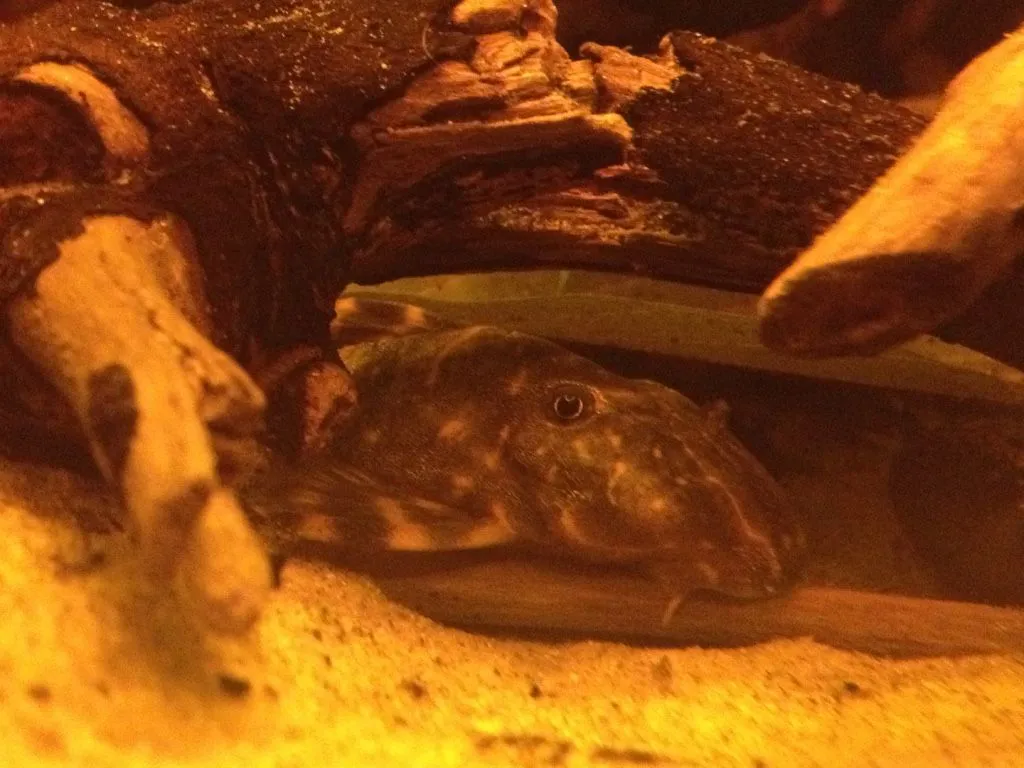
Answer: The clown pleco (*Panaqolus maccus*) is a small wood-feeding loricariid, usually 8–10 cm, suited to mature aquaria with bogwood and caves. It is not an efficient glass-algae cleaner. Keep at 24–28 °C, GH 2–12 °dH, pH 6.2–7.5, with high fibre foods and clean oxygenated water.
Panaqolus maccus (clown pleco) is an aquarium catfish whose care is defined by adult size, feeding surface, and oxygen demand. The label "pleco" or "algae eater" is too crude; the difference between a small biofilm grazer and a half-metre wood-and-detritus machine is the difference between a successful aquarium and a welfare problem.
Part of the Complete Catfish Guide.
Identification
The body is dark with irregular pale orange to tan bands, a rounded head, and the rasping mouth typical of small Panaqolus. The compact size separates it from juvenile royal plecos and common plecos.
| Requirement | Target |
|---|---|
| Adult size | 8–10 cm |
| Social plan | Single fish do well. Pairs or small groups need multiple narrow caves and broken sight lines. |
| Temperature | 24–28 °C |
| GH / KH | GH 2–12 °dH; KH 0–6 °dH |
| pH / conductivity | pH 6.2–7.5; 80–350 µS/cm |
| Aquarium | 75 litres for one; 120 litres for a pair with several caves |
Identification should be made before purchase, not after the fish has outgrown the tank. Compare similar loricariids such as bristlenose pleco, royal pleco, and rubber-lip pleco and reject vague labels such as "algae pleco" when adult size is not supplied.
Origin & Habitat
Native to Venezuelan and Colombian drainages with submerged wood, root tangles, and moderate flow. It spends much of the day under wood and emerges at dusk.
Wild habitat translates directly into aquarium engineering. A fish from warm floodplain wood tangles needs different current, food, and shelter from a fish from cool stony streams. Matching that ecology is more reliable than chasing a generic community-tank recipe.
Aquarium Husbandry
Build the aquarium around wood, caves, and gentle current. Plants are optional; rhizome plants tolerate the shaded, wood-heavy layout. Avoid sterile new tanks with no biofilm.
Use 75 litres for one; 120 litres for a pair with several caves. Keep ammonia and nitrite at 0 mg/L and nitrate preferably below 20 mg/L. If the aquarium is new, mature it first; cycling a new aquarium explains why catfish added too early often decline even when other fish appear unaffected. If hardness must be adjusted, use the principles in water hardness explained rather than pH-down routines.
Substrate is less important for sucker-mouthed loricariids than for corydoras, but layout still matters. Caves must fit the fish, wood must not collapse, and food must be retrievable before it rots. The general trade-offs are covered in substrate selection.
Tankmates & Behaviour
Single fish do well. Pairs or small groups need multiple narrow caves and broken sight lines.
Tankmates should be chosen by mouth size, temperament, and chemistry. Peaceful characins from the complete tetras guide often work in soft-water systems. For cichlid aquaria, consult the complete cichlids guide; a bottom position does not protect a catfish from territorial attacks.
Diet
Offer wood, high-fibre wafers, blanched vegetables, and occasional frozen foods. Protein should be supplementary, not the core diet. It browses biofilm but rarely cleans visible algae fast enough to satisfy owners who bought it as a tool.
Do not confuse rasping with cleaning. A healthy grazing catfish turns plant, wood, algae, and prepared food into substantial waste. Filtration and water changes must match that conversion. For vegetable foods, offer small portions and remove leftovers before they sour.
Breeding
Males trap females in caves for spawning and guard egg clutches. Fry emerge able to rasp wood and biofilm, but they need very clean water and fine vegetable foods.
Where breeding is realistic, provide secure caves or surfaces, excellent oxygen, and stable water. Where it is unrealistic, do not use failed breeding as evidence of poor care; many large or imported loricariids have reproductive requirements not easily reproduced in home aquaria.
Common Problems
Clown plecos are often invisible by day. That is not a problem if body condition remains good. Check at night and watch faeces and belly profile rather than expecting display behaviour.
Quarantine new loricariids and observe faeces, belly shape, respiration, and grazing behaviour. A fish that clings motionless but loses body mass is not resting; it is declining.
Visibility and Expectations
Clown plecos are often sold to aquarists who expect a small decorative pleco visible on the front glass. Many individuals are crepuscular and spend daylight wedged under wood. That secrecy is normal, provided the fish emerges to feed and keeps a gently rounded belly. A red torch after lights-out is more informative than staring at an empty cave at noon.
Because they are small, clown plecos fit well in planted wood layouts where a royal pleco would be destructive. They still need the same conceptual care: real wood, fibre, caves, and clean water. Do not keep them in sterile minimalist tanks with a single ornament labelled as wood.
Buying, Quarantine, and Observation
Select specimens with intact fins, clear eyes, steady breathing, and a body profile appropriate to the species. For corydoras, inspect barbels and the underside of the mouth; for loricariids, look for sunken bellies or hollow eyes; for active predatory catfish, reject individuals with abraded snouts from crashing into glass. A fish that is cheap because it looks thin is rarely a bargain.
Quarantine should reproduce the display tank's basic conditions rather than being an empty punishment box. Use seeded filtration, cover, and the correct first foods. Watch the fish feed at least several times before release. If it will not eat in a quiet quarantine tank, it will not improve in a competitive community. Early correction is easier than recovering a catfish after several weeks of hidden weight loss.
See Also
Frequently Asked Questions
How large does the clown pleco get?
Expect 8–10 cm. Buy for adult size, not the juvenile size normally seen in shops.
What water parameters should I use?
Use 24–28 °C, GH 2–12 °dH, KH 0–6 °dH, pH 6.2–7.5, and conductivity around 80–350 µS/cm. Oxygen and stability are as important as pH.
Is the clown pleco an algae cleaner?
It may graze algae or biofilm, but it is livestock, not equipment. Provide the correct staple diet and remove waste through normal maintenance.
Can it live with cichlids?
Only with compatible size, temperature, and water chemistry. Territorial or predatory cichlids can injure or eat catfish, while hard-water Rift systems suit only selected species.
Sources & References
- Burgess, W.E. (1989). An Atlas of Freshwater and Marine Catfishes. T.F.H. Publications.
- Sands, D. (1984). A Fishkeeper's Guide to South American Catfishes. Salamander Books.
- Evers, H.-G. & Seidel, I. (2005). Mergus Wels Atlas. Mergus Verlag.
- FishBase species account. https://www.fishbase.se/
- Fricke, R., Eschmeyer, W.N. & Van der Laan, R. Catalog of Fishes. California Academy of Sciences.