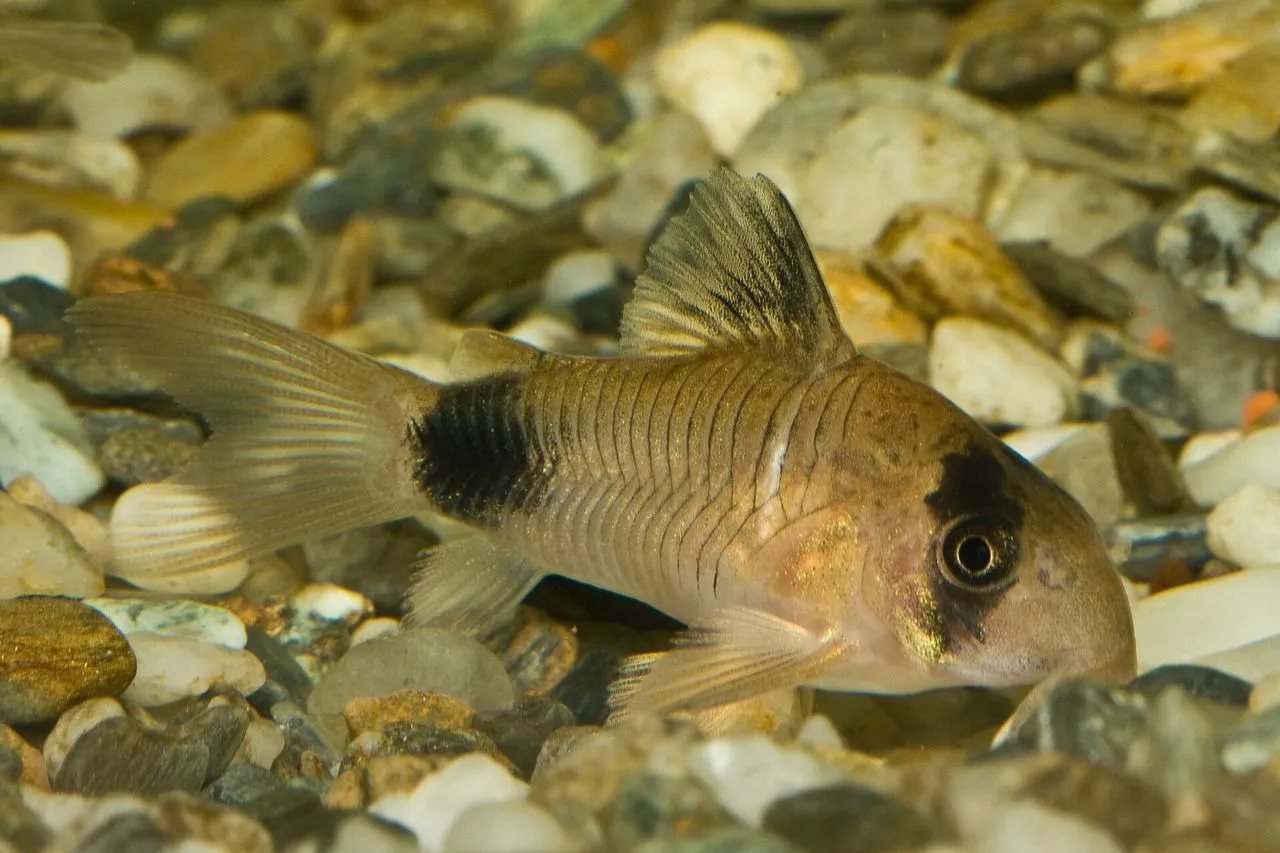
Answer: *Corydoras* spp. and *Otocinclus* spp. are routinely sold together as 'cleanup crew', but they fill different ecological roles. Corydoras are omnivores that scavenge detritus, leftover food, and micro-organisms from the substrate. Otocinclus are specialist grazers that eat soft algae film and biofilm from plant leaves, wood, and glass. Corydoras do not eat algae meaningfully. Stocking the wrong fish leaves the problem unresolved and the fish poorly fed.
Corydoras spp. are sold in almost every aquarium shop as cleanup crew. So are Otocinclus spp. They share shelf space, appear together in care guides, and get recommended in the same breath. They are not doing the same job.
Corydoras scavenge what falls: detritus, uneaten food, and the micro-organisms that colonise the substrate surface. Otocinclus graze what grows: the thin layer of biofilm and soft algae that coats plant leaves, wood, and glass in a mature aquarium. Putting corydoras in a tank with an algae problem, or otocinclus in a tank with accumulating substrate waste, resolves neither. The cleanup expectation fails, and the fish go underfed.
Part of the Complete Catfish Guide.
At a Glance
| Attribute | Corydoras spp. | Otocinclus spp. |
|---|---|---|
| Family | Callichthyidae | Loricariidae |
| Species in trade | ~170, mostly captive-bred | ~20, mostly wild-caught |
| Feeding role | Substrate scavenger, omnivore | Biofilm and soft algae grazer, herbivore |
| Eats leftover food and detritus | Yes | No |
| Eats soft algae and biofilm | No | Yes |
| Sourcing | Robust; captive-bred dominant | Fragile; 95%+ wild-caught |
| Post-import mortality | Low | 30–50% documented |
| Tank maturity required | Cycled; any established tank | Minimum 2–3 months with biofilm |
| Substrate | Fine sand essential | Less critical |
| Temperature | 22–26 °C (varies by species) | 22–26 °C |
| GH / pH | GH 2–12 °dH; pH 6.0–7.5 | GH 2–10 °dH; pH 6.0–7.4 |
| Minimum group | 6 | 6 |
| Beginner-friendly | Yes | Only in mature, established tanks |
Corydoras in Practice
The genus Corydoras contains roughly 170 described species. The ones most often found in shops: bronze corydoras (C. aeneus), panda corydoras (C. panda), pygmy corydoras (C. pygmaeus), and sterbai corydoras (C. sterbai). All are captive-bred, arrive in reasonable condition, and adapt well to any established community aquarium. That robustness is one of the chief reasons corydoras outperform otocinclus as a first catfish for a newer tank.
Their ecological role is substrate-level scavenging. Using chemosensory barbels, they locate and consume detritus, sinking pellets, frozen bloodworm, and the micro-organisms that colonise the top layer of the substrate. A group of eight actively working corydoras makes a measurable difference to how quickly uneaten food disappears. They are not surface grazers, and they cannot eat what grows on glass or leaves.
Feed them deliberately: sinking omnivore tablets, frozen bloodworm or daphnia in small amounts, and fine granules offered after the surface fish have quietened down. A group left to subsist on scraps will slowly lose condition. The repeated keeper error is treating them as self-feeding scavengers rather than fish that need deliberate feeding. The species-level differences in size, temperature range, and group dynamics are covered in the profiles for bronze corydoras and pygmy corydoras.
Substrate is the most overlooked requirement. Corydoras barbels are sensory organs in constant contact with whatever is underfoot, and coarse gravel damages them steadily. Fine rounded sand is the correct choice. The practical trade-offs are in substrate selection.
Otocinclus in Practice
Otocinclus vittatus, O. cocama (zebra otocinclus), and relatives are small sucker-mouthed loricariids from South American streams. At 3.5–5 cm, they spend the bulk of their time rasping biofilm, diatoms, and soft green algae from flat surfaces: plant leaves, wood, glass, and smooth hardscape. This is an entirely different feeding zone from corydoras, and the two do not compete.
The real difficulty with otocinclus is sourcing. Almost all specimens sold in the UK are wild-caught, collected from the Amazon basin and shipped through a long supply chain before reaching a shop. Post-import mortality of 30–50% in the first two weeks is well documented in the trade even under competent care. Fish that look merely slim at the point of purchase may have already exhausted reserves during transit.
Two practical points follow. First, acclimate carefully: drip acclimation over at least 90 minutes, matching temperature and conductivity before release. The full protocol is at acclimating new fish. Second, buy only fish with visibly rounded bellies that are actively grazing in the shop tank. A motionless, hollow-bellied specimen is not a bargain.
The requirement that most often catches keepers out is tank maturity. Otocinclus need an aquarium that has been running for at least two to three months, with biofilm established on anubias leaves, wood, and glass. A newly cycled tank, however clean, lacks that grazing surface. The fish appear to forage normally for one to two weeks, then decline and die from starvation that began before purchase. Supplement immediately with blanched courgette or algae wafers; tank algae alone is rarely sufficient for a group of six. The full care profile is at otocinclus.
What Each One Actually Eats
| Food type | Corydoras | Otocinclus |
|---|---|---|
| Sinking pellets and leftover food | Yes | No |
| Detritus in the substrate | Yes | No |
| Micro-organisms in substrate surface | Yes | No |
| Brown diatom film (glass, leaves, wood) | No | Yes (primary food in maturing tanks) |
| Soft green film algae | No | Yes |
| Biofilm on leaves, wood, glass | No | Yes (constant grazing) |
| Blanched courgette or spinach | Yes | Yes |
| Hair algae | No | No |
| Black beard algae | No | No |
| Green spot algae | No | No |
Neither fish addresses hair algae, black beard algae, or green spot algae. Those require parameter correction rather than livestock changes. Algae diagnosis and control covers the appropriate response.
Cohabitation: Combining Both
Corydoras and otocinclus do not compete. Their feeding zones barely overlap: corydoras work the substrate surface and the mid-water sinking trajectory; otocinclus work vertical and horizontal hard surfaces. A planted tank running both has both roles covered without conflict.
Parameters are compatible. The practical overlap is 22–26 °C, GH 2–10 °dH, pH 6.0–7.4, and nitrate below 20 mg/L. This suits both genera without compromise, and both benefit from well-oxygenated water and regular water changes.
Sequence matters. Cycle the tank, add corydoras once it has matured, and let the aquarium run for two to three months before introducing otocinclus. The corydoras group will have established confident feeding behaviour by then, which also helps newly arrived otocinclus settle. Both species are safe with shrimp colonies and peaceful alongside small tetras, rasboras, and gouramis.
Which to Choose
The decision is usually straightforward:
- Algae on the glass and plant leaves: buy otocinclus, into a mature tank with biofilm already present on surfaces.
- Leftover food accumulating on the substrate: buy corydoras, into any established cycled aquarium with a sand base.
- Both problems: both fish address different things and coexist without conflict.
The one situation where neither is the right starting point is a tank under three months old. Cycle it first, add corydoras, and bring in otocinclus once the biofilm is present.
Common Mistakes
- Buying corydoras to clear algae. They will not. A corydoras group in a tank with soft green algae on the glass will make no visible difference to the algae. Address it through lighting, nutrient control, and appropriate livestock.
- Buying otocinclus to scavenge leftover food. Their mouths are built for rasping flat surfaces. Uneaten sinking food will continue to decompose, and the otocinclus will still need separate feeding.
- Adding otocinclus to a new or recently cycled tank. No biofilm means no food. The fish appear active, decline over two weeks, and die from starvation. Cycling a new aquarium explains why clean water parameters alone do not protect catfish in an immature tank.
- Groups smaller than six for either species. Solitary and paired corydoras feed poorly and hide. Solitary otocinclus show the same pattern and, in some cases, attempt to latch onto slow-moving tankmates, a stress behaviour rather than aggression.
- Coarse gravel with corydoras. Barbel erosion is the most common corydoras health problem after starvation. Fine rounded sand is not optional for a fish whose primary sense organ is in constant contact with the substrate.
Frequently Asked Questions
Do corydoras eat algae?
Not in any meaningful quantity. Corydoras are omnivores that scavenge detritus, sinking food, and micro-organisms from the substrate. They may occasionally pick at surfaces but are not algae specialists and will not clear algae from glass or plant leaves.
Are otocinclus good at scavenging leftover food?
No. Otocinclus have small sucker mouths adapted for rasping flat surfaces, not for collecting sinking pellets or food chunks from the substrate. Leftover food will still decompose in a tank stocked only with otocinclus.
Can corydoras and otocinclus live together?
Yes. They occupy different feeding zones: corydoras work the substrate while otocinclus graze surfaces. Both are peaceful, share similar temperature and pH ranges, and will not compete directly for food. Many planted community tanks keep both to excellent effect.
Why are otocinclus harder to keep than corydoras?
Sourcing. Corydoras in the trade are almost entirely captive-bred and arrive in reasonable condition. Otocinclus are predominantly wild-caught, and post-import mortality of 30–50% is well documented even under competent care. They also require a mature tank with established biofilm, adding a planning step that corydoras do not.
Which should a beginner buy first?
Corydoras. They are captive-bred, robust, and forgiving of minor parameter swings. Otocinclus require a mature tank, careful acclimation, and supplemental feeding from day one. Get corydoras established first, then add otocinclus once the aquarium has several months of biofilm growth.
Sources & References
- Burgess, W.E. (1989). An Atlas of Freshwater and Marine Catfishes. T.F.H. Publications.
- Sands, D. (1984). A Fishkeeper's Guide to South American Catfishes. Salamander Books.
- Evers, H.-G. & Seidel, I. (2005). Mergus Wels Atlas. Mergus Verlag.
- FishBase species accounts: Corydoras and Otocinclus. https://www.fishbase.se/
- Practical Fishkeeping: Keeping Otocinclus catfish in the aquarium. https://www.practicalfishkeeping.co.uk/features/articles/keeping-otocinclus-catfish-in-the-aquarium