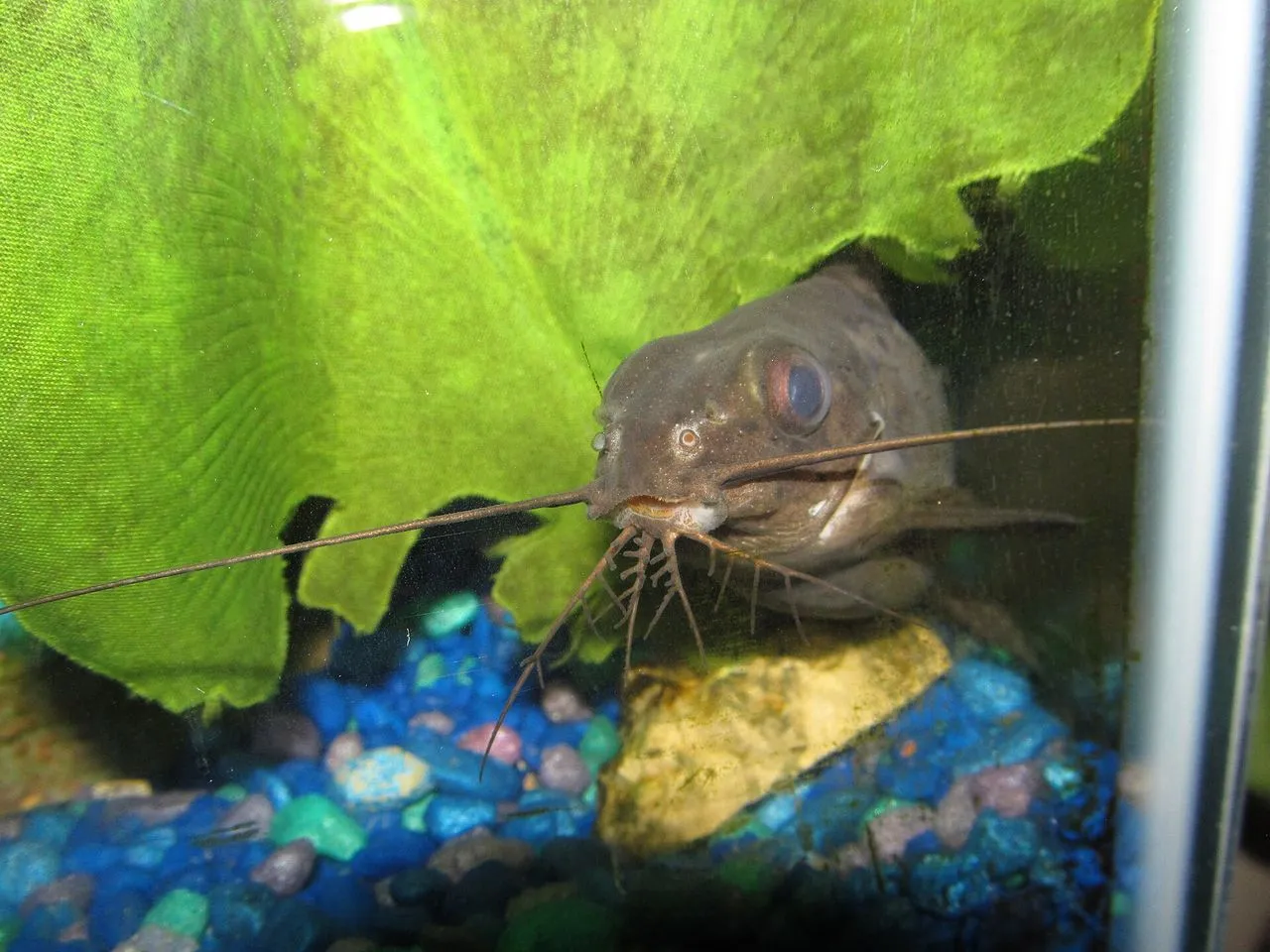
Answer: The featherfin synodontis (*Synodontis eupterus*) is a robust African catfish reaching 18–25 cm, with an extended sail-like dorsal fin in adults. It is hardy but too large and assertive for small communities. Keep at 24–27 °C, GH 5–20 °dH, pH 6.8–8.2, with caves, open floor space, and sturdy tankmates.
Synodontis eupterus (featherfin synodontis) is a catfish that should be chosen for a specific aquarium design, not added as an afterthought. Its adult size, activity pattern, and water chemistry determine whether it becomes a long-lived display animal or a hidden source of stress and predation.
Part of the Complete Catfish Guide.
Identification
Juveniles are attractively spotted; adults develop a tall feathered dorsal fin, stronger body depth, and more assertive presence. The size and dorsal profile separate it from the smaller Tanganyikan petricola group.
| Requirement | Target |
|---|---|
| Adult size | 18–25 cm |
| Social plan | Often kept singly. Groups require large aquaria with several shelters because adults can dominate bottom territories. |
| Temperature | 24–27 °C |
| GH / KH | GH 5–20 °dH; KH 3–12 °dH |
| pH / conductivity | pH 6.8–8.2; 200–700 µS/cm |
| Aquarium | 250 litres for one adult; larger for groups |
Compare with synodontis petricola, pictus catfish, and common pleco before purchase. Similar trade names conceal very different adult sizes and behaviours.
Origin & Habitat
This West and Central African mochokid uses rivers and floodplain habitats with wood, roots, and shelter. It is more chemistry-tolerant than Tanganyikan species but still needs clean oxygenated water.
Habitat should be translated into structure and chemistry. Rock crevices, shaded plants, open swimming lanes, or hard alkaline water are not interchangeable decorations. They are the conditions under which the fish feeds and avoids stress.
Aquarium Husbandry
Provide caves large enough for the adult fish, smooth wood, dim retreats, and a cover. Avoid delicate bottom fish that will be displaced. It can work with medium cichlids if space is adequate, but it is not a nano-community choice.
Keep the aquarium mature, covered where needed, and well oxygenated. Add the fish only after cycling a new aquarium is complete. For mineral management, especially in Tanganyikan or soft-water systems, use water hardness explained rather than unstable chemical shortcuts.
Substrate should match behaviour. Predatory or mid-water catfish need safe open lanes and no sharp decor; rock-dwelling synodontis need caves; delicate schooling forms need plants and shade. Substrate selection gives the broader husbandry context.
Tankmates & Behaviour
Often kept singly. Groups require large aquaria with several shelters because adults can dominate bottom territories.
Tankmate selection is not simply a question of aggression. Mouth size, night activity, temperature, hardness, and feeding speed all matter. For mixed soft-water communities, the complete tetras guide is a useful starting point. For African rock setups, the complete cichlids guide gives the territorial and chemical context.
Diet
An omnivore with a strong appetite: sinking pellets, prawns, mussel, insect larvae, earthworm pieces, and some vegetable matter. Overfeeding rich food causes obesity and water-quality problems.
Feed deliberately after observing where the fish actually forages. Catfish that feed at night may starve in bright community tanks even when food is added daily. Remove uneaten meaty foods promptly; they foul water faster than plant-based foods.
Breeding
Regular home breeding is uncommon. Sexing is unreliable without experience, and the space required for mature adults limits planned attempts.
Breeding information for many catfish is less complete than for cichlids or livebearers. Treat reliable spawning reports as species-specific rather than assuming one catfish pattern applies to another family.
Common Problems
The most common mistake is buying a 5 cm juvenile for a peaceful small tank. Adults become substantial, nocturnal, and food-dominant.
Quarantine new specimens and watch respiration, body mass, fin condition, and feeding confidence. Catfish often conceal decline until reserves are low, so early observation matters.
Adult Behaviour Notes
The featherfin synodontis changes more with age than many buyers expect. Juveniles are patterned, secretive, and easy to underestimate. Adults are heavy-bodied, confident, and capable of controlling a cave network or feeding station. That shift is not aggression in the cichlid sense, but it changes the social balance of the tank.
Plan shelter for the adult outline, not the juvenile. A cave that fits at purchase may become a trap later. Leave open approaches so the fish does not scrape its dorsal fin, and avoid delicate long-finned tankmates that rest near the bottom at night.
Buying, Quarantine, and Observation
Select specimens with intact fins, clear eyes, steady breathing, and a body profile appropriate to the species. For corydoras, inspect barbels and the underside of the mouth; for loricariids, look for sunken bellies or hollow eyes; for active predatory catfish, reject individuals with abraded snouts from crashing into glass. A fish that is cheap because it looks thin is rarely a bargain.
Quarantine should reproduce the display tank's basic conditions rather than being an empty punishment box. Use seeded filtration, cover, and the correct first foods. Watch the fish feed at least several times before release. If it will not eat in a quiet quarantine tank, it will not improve in a competitive community. Early correction is easier than recovering a catfish after several weeks of hidden weight loss.
Final Suitability Check
Before purchase, describe the aquarium in adult terms: final fish size, night behaviour, oxygen demand, and the smallest tankmate. If any answer depends on the catfish staying juvenile, hiding harmlessly, or eating only leftovers, choose a different species. A correct match looks uneventful: the fish feeds daily, holds weight, and behaves predictably for years.
See Also
Frequently Asked Questions
How large does featherfin synodontis get?
Expect 18–25 cm. Plan the aquarium around adult size and adult behaviour, not juvenile shop size.
What water parameters are appropriate?
Use 24–27 °C, GH 5–20 °dH, KH 3–12 °dH, pH 6.8–8.2, and conductivity around 200–700 µS/cm. Keep ammonia and nitrite at 0 mg/L.
Is featherfin synodontis peaceful?
Peaceful is conditional. It will not behave like a territorial cichlid, but it may dominate food, hide if kept incorrectly, or eat fish that fit in its mouth.
What is the main beginner mistake?
The main mistake is ignoring the species' natural water chemistry, social need, or adult size. Catfish are often sold as utility fish when they require specialist planning.
Sources & References
- Burgess, W.E. (1989). An Atlas of Freshwater and Marine Catfishes. T.F.H. Publications.
- Evers, H.-G. & Seidel, I. (2005). Mergus Wels Atlas. Mergus Verlag.
- FishBase species account. https://www.fishbase.se/
- Fricke, R., Eschmeyer, W.N. & Van der Laan, R. Catalog of Fishes. California Academy of Sciences.