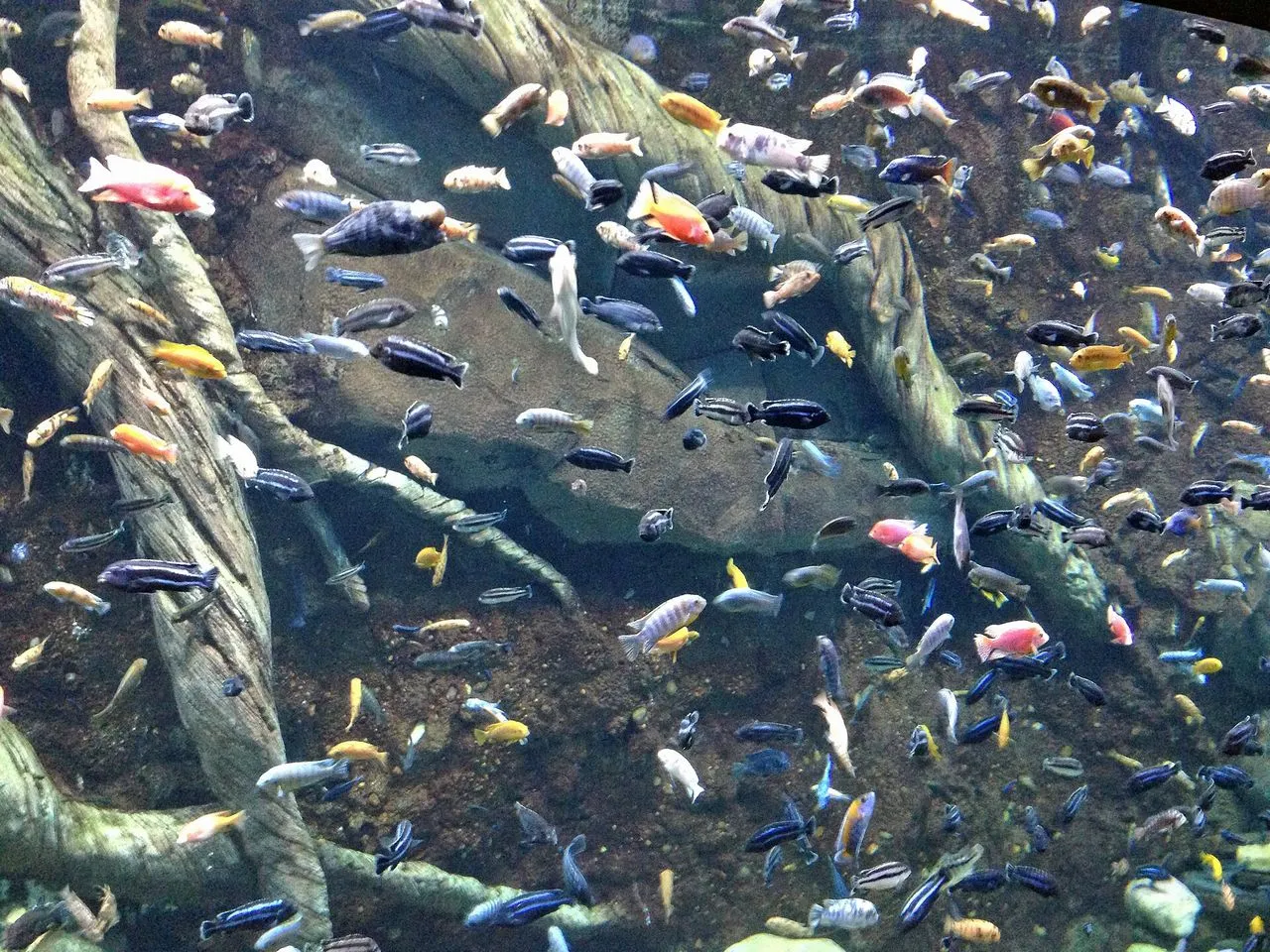
Answer: Choose cichlids by water chemistry and temperament before color. Rift lake species need hard, alkaline water and rock territory. Many South American dwarfs need warmer, softer, cleaner water. Central American species often need more space because pair bonding turns into territorial defense.
Best first step: Pick the cichlid group first: Malawi mbuna, Tanganyikan specialists, South American dwarfs, or Central American pair formers.
Avoid: Do not mix hard-water African cichlids with soft-water South American species just because they look compatible in the shop tank.
Cichlidae is not a tidy aquarium family. It is a family of arguments: hard alkaline rift lakes against tannin-stained Amazon channels, mouth-brooding females against stone-guarding pairs, cooperative shell-bed colonies against solitary predatory bruisers such as oscar. A keeper who treats "cichlid" as one husbandry category will eventually injure fish. A keeper who reads cichlids through geography, social system, and breeding mode has one of the most rewarding fish families available to home aquaria.
I am Dr. Helena Marlow, an ichthyologist whose doctoral work followed speciation along the rocky littoral of Lake Tanganyika. That fieldwork still shapes my aquarium advice. Tanganyikan fish do not forgive casual water chemistry, Amazonian dwarfs do not forgive nitrate and heat neglect, and Central American substrate spawners do not forgive cramped territories.
Taxonomy
Cichlidae belongs within Cichliformes and contains well over 1,700 described species, with many additional forms awaiting formal description or disputed as geographic variants. FishBase and the Catalog of Fishes are the most practical current references for names; older aquarium books are still valuable for behaviour but may use superseded genera. Loiselle's The Cichlid Aquarium remains a useful husbandry synthesis because it organised the family around behaviour and habitat rather than shop categories.
The aquarium trade presents three broad biogeographic groups. African Rift cichlids include Lake Malawi mbuna such as electric yellow cichlid and demasoni cichlid, Lake Tanganyika species such as frontosa and Tropheus duboisi, and many riverine West African species not covered in this category. Neotropical cichlids include Amazon and Orinoco species such as discus, angelfish, German blue ram, Bolivian ram, Apistogramma cacatuoides, Apistogramma agassizii, severum, and green terror. Central American cichlids include convict cichlid, jack Dempsey, and firemouth cichlid, a group adapted to more variable mineral conditions and stronger seasonal disturbance.
Systematics has changed repeatedly. Cichlasoma once absorbed many American cichlids now placed in Amatitlania, Rocio, Thorichthys, Heros, Andinoacara, and other genera. Lake Malawi mbuna have also moved: the demasoni cichlid is now commonly treated as Chindongo demasoni, not the older Pseudotropheus demasoni. In dwarf cichlids, Römer's Cichlid Atlas and South American Dwarf Cichlids remain important aquarium references, but formal species limits in Apistogramma are still active.
The rift lakes deserve special caution because their species flocks are young, diverse, and often locality-structured. A blue fish from one Malawi reef is not interchangeable with a blue fish from another reef simply because both enter the trade under one common name. Tanganyika is even less forgiving of casual lumping. Konings documented how rocky-shore forms can replace one another across short stretches of coast where boulder size, depth, sediment, and wave exposure change. During my doctoral work on Tanganyikan rocky-littoral speciation, the most useful lesson for aquarium keeping was modest: locality is not collector vanity. Locality can encode diet, aggression, adult colour, and mate recognition.
The American genera create a different problem. Selective breeding and long aquarium history have produced angelfish, discus, severums, rams, and oscars that may be several generations removed from wild fish. Farmed lines can be more tolerant of moderate tap water, but they do not cease to be cichlids with inherited temperature and mineral preferences. A tank-bred discus may survive at GH 8 °dH; that does not make the condition optimal for breeding, immune stability, or long-term colour. Scientific names establish ancestry, while the breeder's line establishes the practical margin around that ancestry.
| Group | Typical water | Breeding emphasis | Aquarium implication |
|---|---|---|---|
| Lake Malawi mbuna | GH 12–20 °dH, KH 8–14 °dH, pH 7.8–8.6 | Maternal mouth-brooding | Rockwork, overstocking by design, vegetable-rich diet |
| Lake Tanganyika rocky shore | GH 12–22 °dH, KH 10–18 °dH, pH 8.2–9.0 | Mouth-brooding or substrate care | Stable alkalinity, territory mapping, long-term colonies |
| Amazon/Orinoco | GH 0–6 °dH, KH 0–3 °dH, pH 4.5–7.0 | Pair substrate spawning, cave spawning | RO water, warm clean conditions, low conductivity |
| Central America | GH 6–18 °dH, KH 4–12 °dH, pH 7.0–8.2 | Pair substrate spawning | Robust filtration, line-of-sight breaks, breeding aggression planning |
Identification
Cichlids are laterally compressed percomorph fishes with a single nostril on each side of the head, interrupted lateral-line canals, and specialised pharyngeal jaws used to process food. The aquarium keeper can usually recognise the family by posture and behaviour before counting scales: cichlids inspect surfaces, defend chosen sites, threaten with lateral displays, and direct care toward eggs or fry.
Within the family, identification is more practical when linked to body plan. Discus and severums are deep-bodied leaf mimics from South America. Angelfish are vertically expanded ambush browsers. Mbuna are compact rock-grazers with chisel-like mouths and fast territorial strikes. Frontosa are heavy-headed deep-water predators. Rams and Apistogramma are small benthic dwarfs with intense sexual signalling. Large American cichlids, including oscars, jack Dempseys, and green terrors, combine strong jaws, high intelligence, and a willingness to redesign the substrate.
Shop names are unreliable. "Assorted African cichlid" may mean incompatible Malawi mbuna, peacocks, haps, or hybrid fish. "Blue ram" may refer to hormone-coloured mass-bred Mikrogeophagus ramirezi. "Severum" may hide several Heros species and line-bred colour strains. Latin names, locality data, and credible breeders matter more in this family than in almost any other common aquarium group.
Behaviour & Ecology
Parental care defines Cichlidae. Every cichlid lineage shows some form of egg, larval, or fry care, even if the details differ sharply. Substrate spawners clean a surface, lay adhesive eggs, fan them, and move wrigglers to pits. Mouth-brooders carry eggs and fry inside the buccal cavity, often with the female fasting for weeks. Cave spawners such as Apistogramma place eggs on the roof or wall of a cavity, with the female guarding fry while the male patrols a wider territory.
Social organisation follows ecology. Pair bonds dominate many neotropical and Central American species; a compatible pair of discus or firemouths may cooperate for multiple spawnings. Harem polygyny is common in Apistogramma, where one male controls several cave-holding females if the tank is large enough. Lek-like male display and intense rock-territory competition appear in Tropheus and other Tanganyikan algae grazers. Cooperative brood care is best known from Neolamprologus in Lake Tanganyika; although not one of the satellites here, it illustrates why this lake became central to behavioural ecology.
Aggression is not a defect. It is a normal tool for resource control. The task is to choose a species whose social system fits the aquarium volume. A 60-litre tank can suit a pair of Apistogramma cacatuoides if the water is soft and the sightlines broken — see the apistogramma vs blue ram comparison for which dwarf cichlid fits that smaller footprint best. The same volume is abusive for a young oscar, inadequate for demasoni unless managed as a dense species colony, and chemically wrong for most Lake Tanganyika fish unless buffered carefully.
The family's behaviour also explains why individual temperament seems so variable. A young angelfish in a dealer's tank is often a schooling juvenile; the same fish at eighteen months may be one half of a pair defending a slate, filter intake, or Amazon sword leaf — the pair-bond mechanism behind angelfish chasing tankmates. A convict cichlid may appear manageable until a cave is chosen, after which the pair's defensive radius can occupy most of a 120-litre aquarium. A demasoni kept as a trio is not "meaner" than the species norm; it has simply been placed in a social arrangement that concentrates attacks on two visible targets. Cichlids punish crude stocking rules because their behaviour is conditional.
Signals matter. Lateral displays, gill flaring, jaw locking, tail beating, sand shifting, fin clamping, colour loss, and exaggerated stillness are all readable if watched before feeding. A cichlid that eats strongly but hides between meals is not thriving. A subordinate mbuna holding position high in the water column is often avoiding rock-territory attacks below. A ram breathing rapidly in clean-looking water — or retreating into ram cichlid hiding behaviour despite good parameters — may be suffering from temperature mismatch or dissolved-solid stress. A discus losing colour in an otherwise stable tank follows the same logic: social rank pressure, a temperature swing, or accumulating dissolved solids. Behaviour is an early diagnostic tool, not decoration.
Breeding modes and aquarium consequences
| Breeding mode | Examples | What the keeper must provide |
|---|---|---|
| Open substrate spawning | Oscar, severum, green terror | Large flat stones, stable pairs, removal plans for tankmates |
| Vertical substrate spawning | Discus, angelfish | Broad leaves, cones, slate, warm clean water, low disturbance |
| Cave spawning | Apistogramma species, convicts | Multiple caves, leaf litter, visual barriers, female refuge space |
| Maternal mouth-brooding | Malawi mbuna, frontosa, Tropheus | Stable groups, low harassment, holding-female refuges or separate rearing tanks |
Mouth-brooding is especially easy to mishandle. A female carrying eggs cannot feed normally, and repeated stripping by keepers can turn a natural reproductive strategy into chronic stress. In Malawi colonies, removing every holding female may destabilise the hierarchy; leaving every fry release in the display may overpopulate the tank. The correct choice depends on the species and the keeper's ability to house juveniles. No cichlid should be bred casually unless there is a plan for surplus fish.
Water Chemistry & Habitat
The largest husbandry error in cichlids is mixing geography. African Rift lakes are mineral-rich and alkaline. Lake Tanganyika is especially stable: pH commonly sits above 8.5, with high carbonate alkalinity and conductivity that can exceed 500 µS/cm in aquarium replication. Konings' Tanganyika Cichlids in Their Natural Habitat is valuable because it ties behaviour to exact shoreline structures: boulder fields, surge zones, shell beds, and deeper sediment slopes. Malawi mbuna occupy rock and aufwuchs-rich shallows; Konings' Malawi volume describes how strongly diet and aggression follow those grazing stations.
Neotropical cichlids occupy a broader chemical range. Blackwater discus localities may have GH near 0–2 °dH, KH below 1 °dH, pH 4.5–6.0, and conductivity under 50 µS/cm. Many tank-bred discus tolerate moderate mineral content better, but breeding still improves in low-conductivity water. Rams from the Orinoco llanos need warmth: 27–30 °C for Mikrogeophagus ramirezi. Bolivian rams tolerate cooler, more mineralised foothill and floodplain water. Severums and angelfish sit between these extremes, doing well around GH 2–8 °dH, pH 6.0–7.2, provided nitrate remains low. The discus vs angelfish for soft-water community breakdown is worth reading if the choice is between those two species for a community centrepiece.
Central American cichlids see seasonal changes, limestone influence, and harder water than Amazon dwarfs. Convicts, jack Dempseys, and firemouths usually do well at GH 8–16 °dH, KH 4–10 °dH, pH 7.0–8.0, and 24–27 °C. They are not blackwater fish, although they still require stable nitrogen management. For the chemistry behind these ranges, the care article on GH and KH is more useful than pH chasing.
Aquarium Husbandry
Begin with water, adult size, and social system. A cichlid tank is not stocked by inches of fish. It is stocked by territories, filtration load, oxygen demand, and the consequences of breeding. The complete care guide and cycling a new aquarium should be considered prerequisite reading before any large or expensive cichlid purchase.
Quarantine deserves unusual emphasis with this family. Many cichlids arrive through high-density export chains where parasites, fin damage, and social stress are already present but not yet visible. A four-week observation tank with matched temperature and chemistry prevents a single imported ram, mbuna, or discus from turning a mature display into a medication problem. Quarantine also lets the keeper verify diet: a Tropheus that refuses vegetable foods, a discus that eats only live worm, or a frontosa that cannot compete at feeding time is easier to correct before territory has been established.
That quiet month is often cheaper than replacing a bonded pair and rebuilding trust in the tank.
For African Rift tanks, stable alkalinity matters more than decorative exactness. Use aragonite, limestone, or commercial mineral salts only when they produce measurable GH/KH values, not because the label says "cichlid". Mbuna tanks require rockwork from base glass upward, vegetable-rich feeding, and a stocking plan that spreads aggression. Tanganyikan tanks require the same chemical stability but usually less chaotic stocking; frontosa, Tropheus, shell-dwellers, and synodontis catfish each occupy different spatial and social niches. Synodontis petricola is a natural cross-category companion for many Tanganyikan layouts, though it is too busy for delicate dwarf cichlids.
For neotropical tanks, mineral control is often the limiting factor. RO water, peat or leaf litter where appropriate, low nitrate, and high oxygen at warm temperatures are essential for discus, rams, and many Apistogramma. Cross-category companions should match chemistry. Cardinal tetras suit warm soft discus and ram aquaria; hard-water livebearers do not. Plants such as Amazon sword fit the South American visual structure but should not be used to justify neglecting open swimming space.
Large American cichlids need volume and filtration. Oscars, green terrors, severums, jack Dempseys, and adult convicts can move substrate, uproot plants, and produce heavy waste. External filtration or large sponge arrays, weekly water changes of 30–50%, and nitrate kept preferably below 20 mg/L are practical targets. Decorations must be stable enough not to collapse when a pair excavates beneath them.
Notable Species
- Discus (Symphysodon spp.) — warm, soft-water Amazon cichlids famous for compressed shape and parental skin-feeding.
- Angelfish (Pterophyllum scalare) — vertically expanded Amazon cichlid; tank-bred forms are hardy but still soft-water leaning.
- Oscar (Astronotus ocellatus) — large intelligent predator; requires large aquaria and disciplined filtration.
- Convict cichlid (Amatitlania nigrofasciata) — Central American pair-former; easy to breed, difficult to stop breeding.
- Jack Dempsey (Rocio octofasciata) — territorial Central American species with metallic adult colour.
- Firemouth cichlid (Thorichthys meeki) — bluff-displaying Central American cichlid, milder than many relatives.
- German blue ram (Mikrogeophagus ramirezi) — small Orinoco cichlid requiring high temperature and clean soft water.
- Bolivian ram (Mikrogeophagus altispinosus) — cooler and more forgiving dwarf cichlid.
- Apistogramma cacatuoides and A. agassizii — cave-spawning dwarf cichlids with harem tendencies.
- Electric yellow cichlid and demasoni cichlid — Malawi mbuna representing the peaceful and difficult ends of rock-grazer keeping.
- Frontosa and Tropheus duboisi — Tanganyikan specialists demanding stable alkaline water and long planning.
Common Confusions
| Confusion | Reliable separator | Husbandry consequence |
|---|---|---|
| Discus vs severum | Discus are rounder, smaller-mouthed, warmer-water specialists | Severums tolerate cooler, larger community setups; discus need heat and softness |
| Angelfish vs Pterophyllum altum | Altum has deeper body, steeper forehead, taller fins, usually wild soft-water origin | True altums are far more demanding than farmed scalare |
| German blue ram vs Bolivian ram | German blue ram is smaller, warmer, brighter; Bolivian ram has lyre tail and cooler tolerance | Temperature mismatch shortens ram lifespan |
| Electric yellow vs yellow hybrids | True Labidochromis caeruleus has cleaner yellow body and black dorsal edge | Hybrid mbuna may be more aggressive and less predictable |
| Frontosa vs C. gibberosa | Locality and head/body proportions matter; trade names are inconsistent | Both need large Tanganyikan systems, but mixing local forms is poor practice |
See Also
- Discus — full profile of Symphysodon care, blackwater chemistry, and skin-feeding fry.
- Tropheus duboisi — Tanganyikan algae-grazer with diet-linked bloat risk.
- The Complete Tetras Guide — soft-water schooling companions for South American cichlids.
- The Complete Catfish Guide — bottom-dwelling companions, including Tanganyikan synodontis.
- Water Hardness: GH and KH Explained — chemistry background for African and blackwater tanks.
- Reverse Osmosis Water — practical remineralisation for discus, rams, and dwarf cichlids.
Quick answer: how to choose a cichlid tank
Start with the water you can keep stable, not with the fish you like most in the shop. If your tap water is hard and alkaline, Malawi and many Tanganyikan setups are easier to maintain. If your water is soft, dwarf cichlids, rams, and some South American species are a better biological fit. Tank size then decides which species stay realistic.
Test GH, KH and pH before buying fish
Cichlid mistakes often begin with untested tap water. Before choosing species, measure pH, ammonia, nitrite, nitrate, and hardness; the API Freshwater Master Test Kit covers the core nitrogen and pH checks, while GH/KH testing adds the hardness picture. Use those numbers to decide whether you are building a rift lake tank, a blackwater tank, or something in between.
As an Amazon Associate, we earn from qualifying purchases, at no extra cost to you.
Frequently Asked Questions
What is the main difference between African and South American cichlids?
Water chemistry and social ecology. African Rift cichlids usually require hard alkaline water with GH 12–22 °dH and pH 7.8–9.0. Most Amazon and Orinoco species require softer, more acidic water, often GH 0–6 °dH and pH 4.5–7.0.
Are cichlids aggressive?
Cichlids are territorial rather than uniformly aggressive. Discus, angelfish, rams, and severums can be peaceful in correct groups. Mbuna, breeding convicts, demasoni, and many large Central American species require deliberate territory and stocking management.
Do all cichlids care for their young?
Yes. Parental care is family-defining. Some species guard eggs and fry on a substrate; others mouth-brood eggs and fry. Cave-spawning dwarf cichlids often divide duties between a fry-guarding female and a territory-patrolling male.
Can different cichlid types be mixed?
Some combinations work within the same chemistry and temperament band, but mixing African Rift cichlids with Amazon soft-water species is poor practice. A tank should be designed around one water system and one compatible social structure.
Are cichlids beginner fish?
Some are, but the family is too varied for one answer. Bolivian rams and electric yellow cichlids can work for careful beginners with the right tank. Tropheus, discus, many large Central American species, and aggressive mbuna mixes are poor first choices unless the keeper understands water chemistry and territory management.
Sources & References
- Loiselle, P.V. (1994). The Cichlid Aquarium. Tetra Press.
- Konings, A. (2007). Tanganyika Cichlids in Their Natural Habitat. Cichlid Press.
- Konings, A. (2007). Malawi Cichlids in Their Natural Habitat. Cichlid Press.
- Römer, U. (2006). Cichlid Atlas. Mergus Verlag.
- FishBase — Cichlidae family treatment. https://www.fishbase.se/
- Catalog of Fishes — Fricke, Eschmeyer & Van der Laan, California Academy of Sciences.