Answer:
Tetras are small characiform fishes best chosen by water chemistry and social behaviour rather than colour alone. Cardinals, rummynose, neons and glowlights are genuine schoolers; many Hyphessobrycon species shoal and display. Blackwater species need low GH, low KH and stable conductivity, while tank-bred community species tolerate moderate mineral content.
Paracheirodon axelrodi (cardinal tetra) is the fish that made blackwater community aquaria famous: a centimetres-long characiform whose red lateral band is brightest in water that would look chemically austere to a livebearer keeper. Tetras are not one tidy family in the aquarium sense. The trade name gathers Characidae and several related characiform lineages, most of them South American, a few African, and all united more by small size, adipose fins, forked tails, and mid-water social living than by a single husbandry formula.
I have kept blackwater characins for three decades, including wild cardinal shipments that lost colour at 180 µS/cm and recovered only after careful dilution to 55–70 µS/cm. That experience matters because the common advice "soft, acidic water" hides the practical difference between a tank-bred neon tetra that thrives in neutral tap water and a wild cardinal that weakens in the same tank.
Taxonomy
Tetras belong to the order Characiformes, an assemblage that includes South American Characidae, African Alestidae, and several smaller families revised repeatedly since Géry's 1977 synthesis. Weitzman and Vari's work on characiform relationships clarified many generic boundaries, while the Catalog of Fishes continues to track name changes that the aquarium trade adopts slowly. For aquarists, the most relevant genera are Paracheirodon, Hemigrammus, Hyphessobrycon, Moenkhausia, Pristella, Aphyocharax, Hasemania, Thayeria, Gymnocorymbus, and the African alestid Phenacogrammus.
The familiar neon line contains Paracheirodon innesi and cardinal tetra, both from soft northern South American waters. Hemigrammus includes the glowlight tetra and the trade's rummynose complex, especially rummynose tetra. Hyphessobrycon is broader and more behaviourally varied: ember tetra, lemon tetra, black neon tetra, bleeding-heart tetra, and serpae tetra are not interchangeable simply because they share a genus.
Identification
Most aquarium tetras share compressed bodies, an adipose fin behind the dorsal fin, small jaws, and a forked caudal fin. Identification becomes difficult because juvenile fish in shops are pale, stressed, and often sold under broad trade names. The safest approach is to separate body shape, lateral stripe, fin colour, and swimming posture.
| Group | Typical body | Best diagnostic character | Husbandry implication |
|---|---|---|---|
| Paracheirodon | Slim, torpedo-like | Blue-green lateral stripe with red lower band | Soft water improves colour; wild cardinals are TDS-sensitive |
| Hemigrammus | Slender to moderate | Caudal pattern or luminous body stripe | Strong schooling in rummynose and glowlight forms |
| Hyphessobrycon | Variable, often deeper | Humeral spot, fin colour, body flush | Behaviour ranges from peaceful to nippy |
| Moenkhausia | Deeper, reflective scales | Scale iridescence and adult size | Needs space and mature planted cover |
| Alestidae | Larger African characins | Large scales, extended male fins | Requires longer aquaria and excellent oxygenation |
Do not use colour alone. A stressed cardinal can look like a dull neon; a young black neon has little of the adult satin stripe; a shop tank of serpae-type fish may contain several closely related red Hyphessobrycon forms. Body proportion and caudal markings remain more reliable under poor light.
Behaviour & Ecology
Schooling and shoaling are often used as synonyms in aquarium writing, but the distinction affects welfare. Schooling is synchronised movement as one body, with fish matching speed and orientation. Shoaling is loose aggregation: individuals remain near one another but forage, spar, and display independently. Cardinals, neons, glowlights and rummynose tetras are true schoolers under normal aquarium conditions. Lemon, bleeding-heart, serpae, black skirt, diamond and Congo tetras are better described as shoalers, although they regroup tightly when startled.
The difference is visible in tank design. True schoolers need open mid-water lanes at least 60–90 cm long for small species and 120 cm for rummynose. Shoalers need more broken sight lines: stems, wood, swords and shaded pockets so males can display without constant contact. A dozen serpae in a bare tank become fin nippers; a dozen in a planted 90 cm tank spend more energy on one another and less on tankmates.
Most tetras scatter adhesive eggs among plants or leaf litter and show no parental care. Eggs are small, light-sensitive in several blackwater species, and eaten readily by adults. This contrasts sharply with cichlid parental care in the complete cichlids guide, which is why tetra breeding setups usually rely on marbles, mesh, moss, dim light and adult removal.
Water Chemistry & Habitat
Amazon, Orinoco and Guianas habitats include blackwater igarapés, clear tributaries, seasonally flooded forest, marginal lagoons, and savanna streams. The most colourful small tetras often come from tannin-stained water with almost no carbonate buffering: GH 0–3 °dH, KH 0–1 °dH, pH 4.5–6.5, conductivity 20–100 µS/cm, temperature 24–29 °C. Blackwater is not dirty water. It is low in dissolved minerals, high in humic substances, dimly lit, and biologically stable.
Tank-bred fish complicate the picture. Farmed neons and black skirts may be raised for generations at GH 6–12 °dH and pH 6.8–7.6. They adapt better to moderate tap water than freshly imported wild cardinals, which can fade, clamp, and develop opportunistic infections when conductivity rises above roughly 120 µS/cm. If tap water is hard, reverse-osmosis water and careful remineralisation are more reliable than bottled pH reducers. The chemistry behind GH and KH is covered in water hardness explained.
| Biotope style | Suitable species | Practical target |
|---|---|---|
| Northern South American blackwater | Cardinal, rummynose, ember, glowlight | GH 0–4 °dH, KH 0–1 °dH, pH 5.2–6.6, 40–100 µS/cm, 26–28 °C |
| Soft planted community | Neon, black neon, lemon, diamond | GH 3–8 °dH, KH 1–4 °dH, pH 6.2–7.2, 100–250 µS/cm, 24–27 °C |
| Moderate community | X-ray, black skirt, bloodfin | GH 5–12 °dH, KH 2–6 °dH, pH 6.8–7.8, 180–400 µS/cm, 22–26 °C |
| Large river display | Congo, bleeding-heart, penguin | GH 3–10 °dH, KH 1–5 °dH, pH 6.2–7.4, 24–27 °C |
Aquarium Husbandry
A tetra aquarium should be designed around group size before species count. Ten cardinals are better than three cardinals, three lemons and four black neons. For small species, a 60 cm tank is workable for embers or neons; rummynose, black skirts, penguins and serpae deserve 90 cm; Congo tetras and bleeding hearts need 120 cm or more. Mature filtration matters more than turnover rate. Characins dislike ammonia and nitrite, and many imports arrive with weak reserves, so a fully cycled tank is non-negotiable. See cycling a new aquarium before adding delicate wild stock.
Planting should combine open lanes with security. Amazon sword rosettes, floating plants, fine-leaved stems and driftwood produce the broken light under which colour improves. Corydoras, small loricariids and peaceful dwarf cichlids can be excellent companions. Sterbai corydoras suits warm cardinal and discus-style tanks; discus, angelfish and German blue ram are classic soft-water companions, provided mouth size and temperature are respected.
Quarantine is especially important. Neon tetra disease, caused by Pleistophora hyphessobryconis, produces fading colour, lumpy or distorted musculature, abnormal swimming and progressive wasting. It is incurable and affects more than neons. Treatment is humane euthanasia of affected fish, strict quarantine of co-housed fish, and disinfection of equipment used between tanks. Many ailments mislabelled as neon tetra disease are bacterial or environmental, but true microsporidian infection should not be medicated in the display aquarium.
Stocking by Behaviour Rather Than Colour
The common retail habit of choosing one small red tetra, one blue tetra and one silver tetra gives the keeper colour variety but denies the fish the social scale that makes them behave normally. A better plan is to choose one focal school, one bottom group and perhaps one calm surface or dwarf cichlid element. In a 90 cm soft-water planted aquarium, fifteen cardinals with eight sterbai corydoras and a pair of German blue ram is biologically clearer than six cardinals, six lemons, six black neons and six rummynose crowded into the same mid-water level.
For true schoolers, the number of same-species companions is the welfare variable most often underestimated. Six neons meet the old shop minimum; fifteen neons show the directional turns, confidence and feeding response that make the species worth keeping. Rummynose are even more explicit. In small groups they hover nervously near cover; in groups of twenty in a long tank they form a coherent band whose nose colour tells the aquarist more about dissolved waste and oxygen than many casual test-strip readings.
Shoaling species need a different kind of generosity. Serpae tetra, black-skirt tetra, silver-tip tetra and bleeding-heart tetra use the group as a social arena. Males display, chase briefly, reset positions and repeat. If the group is too small, that energy lands on angelfish fins, gourami feelers or the weakest tetra — see fin nipping in tetras for why group size is the primary lever. If the group is large and the tank has broken sight lines, the same fish become active rather than destructive.
| Tank length | Better tetra choices | Avoid |
|---|---|---|
| 45–60 cm | Ember, glowlight, carefully chosen neon groups | Congo, bleeding-heart, black skirt, bloodfin |
| 75–90 cm | Neon, cardinal, black neon, lemon, x-ray, serpae with care | Congo and large diamond groups |
| 120 cm+ | Rummynose, Congo, bleeding-heart, diamond, penguin, bloodfin | Tiny embers with large predatory cichlids |
Acclimation and Quarantine
Tetras suffer badly from the two shortcuts that look harmless in shops: rapid transfer between waters of different conductivity and addition to tanks that are only cosmetically mature. A fish moved from 60 µS/cm import water to 350 µS/cm tap water experiences osmotic stress even if the pH number appears similar. Drip acclimation is useful for wild cardinals and rummynose when conductivity differs greatly, but prolonged dripping in cold, ammonia-containing bag water is also risky. The practical method is to test bag conductivity and temperature, match the quarantine tank beforehand when possible, and keep the transfer clean and brief.
A quarantine tank for tetras does not need decoration, but it should not be sterile in function. Mature sponge filtration, a dark background, floating plant cover, a few inert hiding structures and subdued light reduce panic. Four weeks is a sensible observation period. During that time watch feeding response, schooling cohesion, faeces, muscle shape and breathing. The first week reveals shipping injury and osmotic stress; later weeks reveal wasting diseases and low-level infections.
The disease most associated with tetras is Pleistophora hyphessobryconis, traditionally called neon tetra disease. The name is too narrow. The microsporidian can affect several characins, and suspected cases should be handled as a population risk. A single fish with a pale patch after fighting is not a diagnosis; a fish with progressive colour loss, irregular swimming, muscle distortion and wasting despite feeding is more concerning. There is no reliable cure — neon tetras dying one by one covers how to separate true NTD from bacterial and environmental causes. Removing the affected fish, euthanising when signs are advanced, and preventing cross-contamination between nets and tanks protects the remaining stock better than repeated broad-spectrum medication.
Planted and Blackwater Design
A good tetra tank is not simply brown water with leaves. It is a controlled low-mineral system with biological stability. In blackwater aquaria, carbonate hardness may be near zero, which means pH can shift if water changes, substrate, stones or remineralisers are careless. Use inert sand, tested wood and botanicals, and remineralise reverse-osmosis water to a known GH rather than chasing colour with random leaf additions. Tannins are useful, but conductivity and nitrogen compounds decide survival.
Planted tanks give tetras security and use dissolved nitrogen, but plant choice must match water chemistry. Amazon sword tolerates warm soft water and makes excellent vertical cover when fed at the roots. Cryptocoryne wendtii handles moderate light and provides low cover, though sudden parameter changes can trigger melt. Fine-leaved stems and mosses protect fry and give small species feeding surfaces rich in microfauna. Floating plants dim the light, but they must be thinned so oxygen remains high at night.
Substrate colour changes behaviour. Pale gravel under bright light makes many tetras hover low and fade; dark sand with overhead cover encourages mid-water swimming. Flow should be sufficient to prevent dead spots but not so forceful that fish spend the day bracing. Rummynose and bloodfins appreciate more current than embers or glowlights. Congo tetras require both oxygen and length, not turbulent blasting.
Choosing Tank-Bred or Wild Fish
Tank-bred tetras are not automatically inferior. Farmed neons, black skirts, x-ray tetras and many black neons adapt well to ordinary community aquaria when farms and wholesalers maintain health. They may lack the razor colour of wild fish at first, but their tolerance of GH 6–10 °dH and neutral pH makes them better choices for aquarists who will not use reverse osmosis. The ethical keeper chooses the fish that matches the water they can provide consistently.
Wild fish remain important where captive production is limited or where collection supports managed local livelihoods, but they deserve more exact care. Wild cardinals from the Rio Negro are accustomed to extremely low mineral content and warm shaded water. Wild rummynose imports show stress through the nose before other signs appear. Wild-caught does not mean fragile in the wild; it means adapted to conditions that ordinary tap water may not resemble.
Ask suppliers about origin when possible. "Tank-bred" and "wild" should change acclimation, quarantine and target conductivity. If origin is unknown, choose the conservative middle: mature quarantine, moderate dimness, no aggressive tankmates, and gradual adjustment only after the fish are feeding strongly.
Notable Species
- Neon tetra (Paracheirodon innesi) — tank-bred lines tolerate moderate water; still vulnerable to Pleistophora and poor quarantine.
- Cardinal tetra (Paracheirodon axelrodi) — larger red band, most vivid in very soft acidic blackwater.
- Rummynose tetra (Hemigrammus complex) — the best small-characin indicator of water quality; red nose fades quickly under stress.
- Ember tetra (Hyphessobrycon amandae) — tiny orange shoaler for mature nano and blackwater planted tanks.
- Glowlight tetra (Hemigrammus erythrozonus) — Essequibo species with a copper-gold lateral stripe suited to dim aquaria.
- Lemon tetra (Hyphessobrycon pulchripinnis) — yellow fins and visible sex differences in a peaceful planted community fish.
- Black neon tetra (Hyphessobrycon herbertaxelrodi) — not a close neon relative; robust, elegant and underrated.
- Diamond tetra (Moenkhausia pittieri) — iridescent Venezuelan species needing mature water and space.
- X-ray tetra (Pristella maxillaris) — transparent-bodied, adaptable, and among the more mineral-tolerant tetras.
- Congo tetra (Phenacogrammus interruptus) — African alestid with spectacular male finnage and a need for long tanks.
Common Confusions
| Confusion | Reliable separator | Husbandry consequence |
|---|---|---|
| Neon vs cardinal | Cardinal red runs nose to tail; neon red covers rear half only | Cardinals are warmer and more TDS-sensitive |
| Rummynose names | H. bleheri has more extensive head red than H. rhodostomus | Care is similar; both need pristine soft water |
| Black neon vs neon | Black neon is Hyphessobrycon, with black-white stripe, not blue-red | More tolerant of moderate hardness |
| Serpae vs peaceful red tetras | Serpae has dark humeral mark and nippy behaviour | Avoid slow-finned companions |
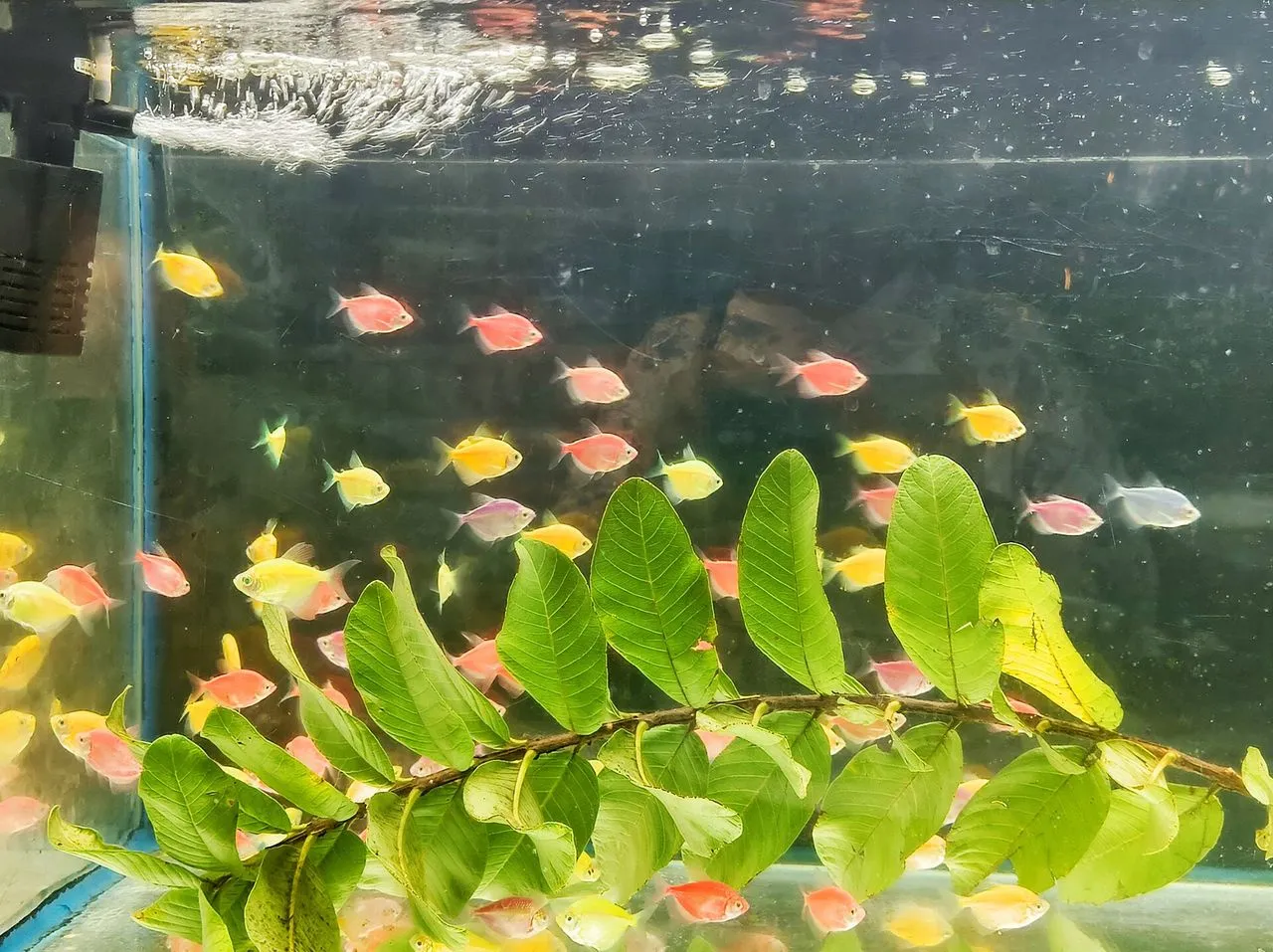
| Black skirt vs dyed forms | Natural fish are silver-black; fluorescent forms are altered strains | Choose natural lines when welfare matters |
See Also
- Neon tetra — classic Paracheirodon profile with disease notes.
- Cardinal tetra — wild-origin blackwater care and TDS management.
- Rummynose tetra — schooling behaviour and nose-colour stress signals.
- The Complete Care Guide — cycling, quarantine and maintenance foundations.
- The Complete Catfish Guide — bottom-dwelling companions for tetra aquaria.
- The Complete Cichlids Guide — soft-water cichlid companions and predation cautions.
Frequently Asked Questions
Are tetras schooling fish or shoaling fish?
Both patterns occur. Cardinals, neons, rummynose and glowlights form coordinated schools when comfortable or alarmed; many Hyphessobrycon and Moenkhausia species are looser shoalers that hold territories, display, and regroup without swimming as a single unit.
Do all tetras need soft acidic water?
No. Blackwater species such as cardinal, rummynose, ember and glowlight tetras show best colour and longevity at GH 0–4 °dH, KH 0–2 °dH, pH 5.0–6.8. Tank-bred neons, black skirts, x-ray tetras and bloodfins tolerate moderate hardness.
How many tetras should be kept together?
Small schooling species should be kept in groups of at least ten, with twelve to twenty giving better behaviour. Larger or nippier species such as bleeding hearts, serpae and black skirts need eight or more so social pressure remains within the group.
What is neon tetra disease?
Neon tetra disease is caused by the microsporidian Pleistophora hyphessobryconis. It is incurable, spreads to several characins, and should be managed by removing and euthanising affected fish, quarantining exposed stock, and avoiding shared nets or water between tanks.
Sources & References
- Géry, J. (1977). Characoids of the World. T.F.H. Publications.
- Baensch, H.A. & Riehl, R. (1991). Aquarium Atlas, Vol. 1. Mergus Verlag.
- FishBase — Characiform species treatments. https://www.fishbase.se/
- Fricke, R., Eschmeyer, W.N. & Van der Laan, R. Catalog of Fishes. California Academy of Sciences.