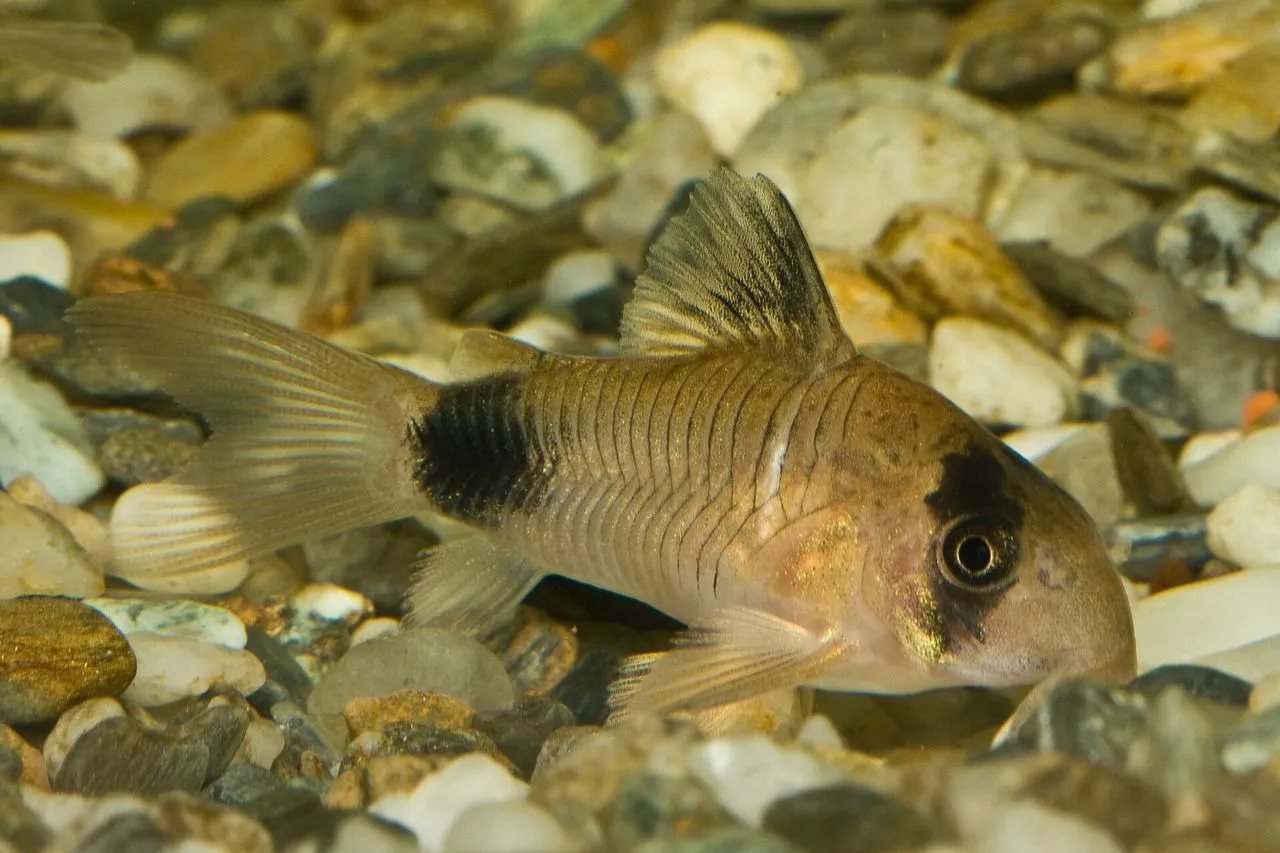
Answer: The panda corydoras (*Corydoras panda*) is a 5 cm Peruvian cory with a black eye mask, dorsal blotch, and caudal spot. It is peaceful but less forgiving than bronze corydoras: keep eight or more on fine sand at 21–25 °C, GH 1–8 °dH, pH 6.0–7.2, and very low waste.
Corydoras panda (panda corydoras) is a freshwater catfish best understood through its adult size, feeding surface, and social behaviour rather than the shop label "bottom feeder". In aquaria it reaches 4.5–5 cm and does best when the whole tank is designed around clean substrate, stable water, and enough conspecifics to behave normally.
Part of the Complete Catfish Guide.
Identification
The pattern is compact and diagnostic: black over the eye, black in the dorsal fin, and a black caudal-peduncle patch on a pale beige body. Females are rounder when viewed from above; males are slimmer and more angular.
| Character | Practical observation |
|---|---|
| Adult size | 4.5–5 cm |
| Best group | Eight or more; larger groups feed more boldly |
| Temperature | 21–25 °C |
| GH / KH | GH 1–8 °dH; KH 0–4 °dH |
| pH / conductivity | pH 6.0–7.2; 50–220 µS/cm |
| Minimum aquarium | 75 litres for eight; stable mature filtration matters more than depth |
Good identification prevents two common mistakes: buying a fish that will not fit the aquarium, and copying a care sheet written for a superficially similar species. Compare closely with bronze corydoras, julii corydoras, and pygmy corydoras when choosing stock.
Origin & Habitat
Ucayali system in Peru, particularly cooler foothill-influenced tributaries. Wild habitat is cooler than many Amazon community assumptions, with soft water, clean sand, leaf litter, and seasonal current. The species does poorly in warm, stale tanks maintained for tropical display fish at 28 °C.
Natural habitat is not a decorative theme. It tells the aquarist what the fish contacts all day: sand or rock, leaf litter or current, shaded margins or open water. For this species the useful aquarium translation is mature biological filtration, no detectable ammonia or nitrite, nitrate preferably below 20 mg/L, and a feeding zone that stays clean between meals.
Aquarium Husbandry
Keep panda corydoras in 75 litres for eight; stable mature filtration matters more than depth. Use the parameter range in the table, and avoid sudden swings in hardness or temperature. If tap water is very hard, blending with reverse-osmosis water is safer than repeated acid dosing; the chemistry behind that choice is covered in water hardness explained.
For corydoras-like substrate feeders, fine rounded sand is strongly preferable to coarse gravel. Gravel traps food below reach, abrades barbels, and creates bacterial pockets exactly where the fish pushes its mouth. The practical substrate trade-offs are covered in substrate selection. In planted tanks, shaded cover from anubias nana or java fern helps nervous fish forage in daylight without requiring high light.
Filtration should be mature rather than violent. Surface movement, clean mechanical media, and regular water changes are more useful than a high turnover number that blasts food away. Add this fish only after the aquarium is cycled; cycling a new aquarium is the relevant care reference.
Tankmates & Behaviour
Panda corydoras are sociable but initially shy. A larger group and shaded cover make them visible in daylight. They pair well with small tetras, but boisterous barbs and large cichlids outcompete them.
Suitable tankmates are peaceful fish that share temperature and hardness needs. Small characins from the complete tetras guide are often better companions than boisterous barbs or territorial cichlids. If cichlids are present, check the water chemistry and territorial pattern in the complete cichlids guide before assuming a bottom fish will be ignored.
Diet
Small sinking foods are essential because their mouths are modest. Rotate micro-pellets, frozen cyclops, daphnia, tubifex from safe sources, and finely broken tablets. Rich food improves condition; excess food damages the substrate.
Feed after the surface fish have slowed down, or use several small feeding points so the group is not crowded into one corner. A thin-bodied fish with a pinched belly is already losing condition. Conversely, tablets left to dissolve for hours create the bacterial load that damages barbels and gills.
Breeding
Spawning resembles other Corydoras: a T-position, small batches of adhesive eggs, and placement on glass, moss, or broad leaves. Cooler rainwater-style changes after conditioning often work. Fry require infusoria or powdered fry food before baby brine shrimp.
Conditioning means clean water and varied food, not simply more food. Spawning aquaria should be easy to inspect, with an air-driven sponge filter, fine sand or bare glass, and removable spawning mops or broad leaves. Fry are sensitive to stale micro-food, so small daily water changes are safer than heavy feeding.
Common Problems
The usual losses are heat stress, immature filters, and bacterial substrate. Surface-gasping in panda corys is often the first visible sign — heat, low oxygen, and gill damage are the three most common causes. If barbels shorten, review sand hygiene before blaming genetics. Quarantine new fish; small corydoras often arrive thin after export.
Quarantine is worthwhile even for hardy-looking specimens. Many catfish are transported thin, crowded, and underfed. Observe breathing rate, barbel condition, belly profile, and willingness to take food before adding them to a display aquarium.
Buying, Quarantine, and Observation
Select specimens with intact fins, clear eyes, steady breathing, and a body profile appropriate to the species. For corydoras, inspect barbels and the underside of the mouth; for loricariids, look for sunken bellies or hollow eyes; for active predatory catfish, reject individuals with abraded snouts from crashing into glass. A fish that is cheap because it looks thin is rarely a bargain.
Quarantine should reproduce the display tank's basic conditions rather than being an empty punishment box. Use seeded filtration, cover, and the correct first foods. Watch the fish feed at least several times before release. If it will not eat in a quiet quarantine tank, it will not improve in a competitive community. Early correction is easier than recovering a catfish after several weeks of hidden weight loss.
See Also
Frequently Asked Questions
How many panda corydoras should be kept together?
Keep a real group. For normal-sized corydoras and comparable social catfish, eight or more is a sensible target; for tiny or strongly schooling species, ten to fifteen is better. Solitary catfish often feed poorly and hide continually.
What water parameters suit panda corydoras?
Use 21–25 °C, GH 1–8 °dH, KH 0–4 °dH, pH 6.0–7.2, and conductivity around 50–220 µS/cm. Stability, oxygen, and clean substrate are as important as the exact pH.
Can panda corydoras live in a new aquarium?
No. Add them only after ammonia and nitrite have stayed at 0 mg/L and the filter has matured. Substrate-feeding catfish are exposed directly to decomposing food and bacterial films in immature tanks.
What is the most common husbandry mistake?
The repeated mistake is treating the fish as a cleaner instead of feeding and housing it deliberately. Provide correct substrate, group size, oxygen, and targeted food.
Sources & References
- Burgess, W.E. (1989). An Atlas of Freshwater and Marine Catfishes. T.F.H. Publications.
- Evers, H.-G. & Seidel, I. (2005). Mergus Wels Atlas. Mergus Verlag.
- FishBase species account. https://www.fishbase.se/
- Fricke, R., Eschmeyer, W.N. & Van der Laan, R. Catalog of Fishes. California Academy of Sciences.