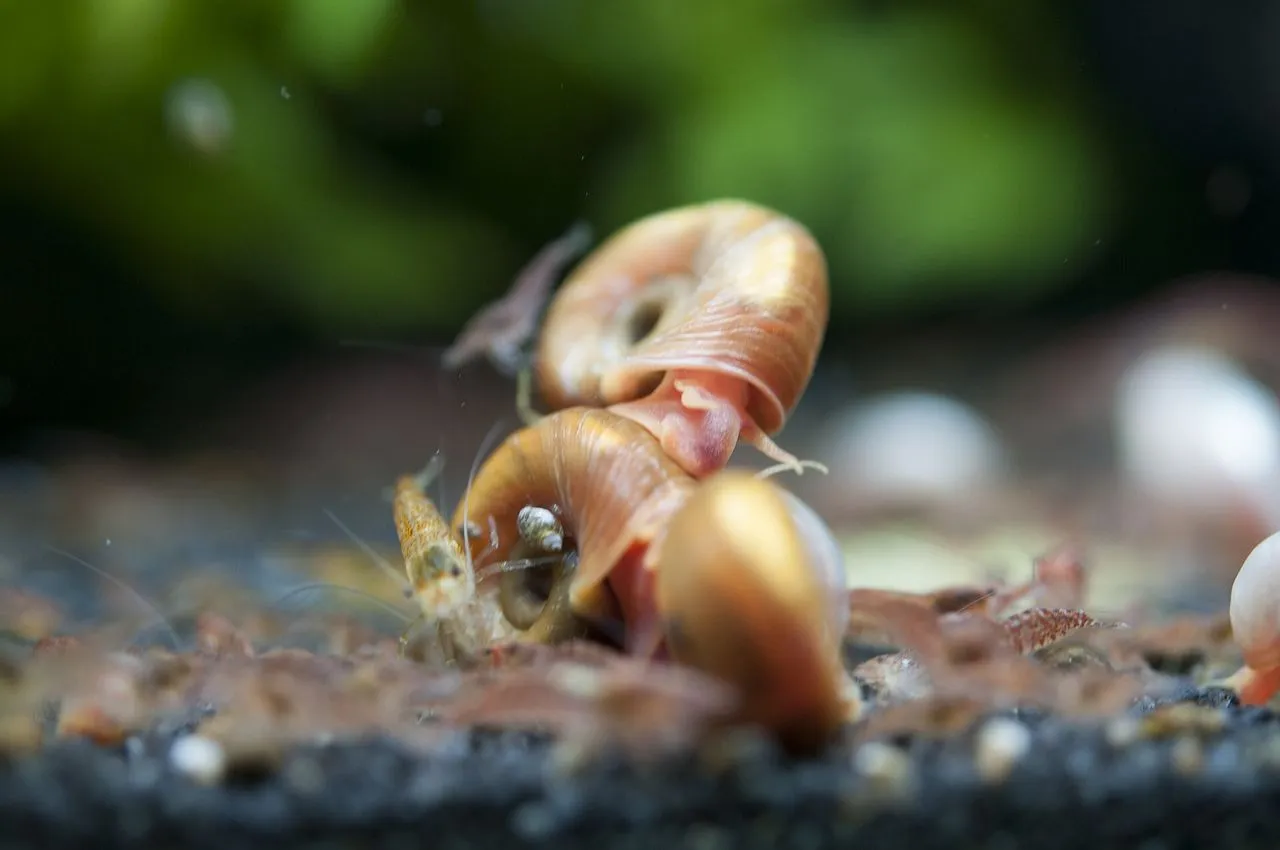
Answer: Cherry shrimp is a Neocaridina colour line kept at GH 6–14 °dH, KH 2–8 °dH, pH 6.8–7.8, TDS 150–350 ppm, conductivity 250–600 µS/cm, 20–24 °C. It reaches 2.5–3 cm. Its value is not rarity but resilience. Red colour is maintained by line selection; mixing with yellow or blue lines produces olive-brown descendants. Avoid copper, immature tanks, and abrupt TDS changes; use mature plants or moss so juveniles and moulting adults have constant grazing cover.
Neocaridina davidi, the cherry shrimp, is a Neocaridina colour line that reaches 2.5–3 cm and comes from Taiwan and adjacent East Asian streams in the wild form, with red aquarium lines maintained by selective breeding. Aquarium success depends less on chasing a perfect pH than on keeping minerals, dissolved solids, and feeding pressure consistent from week to week.
Part of the Complete Shrimp & Snails Guide.
Identification
The first identification step is to ignore colour as a species marker unless the animal is a naturally patterned snail or fan shrimp. In shrimp, trade colour often reflects a selected line rather than a separate taxon. In snails, shell shape, coiling direction, aperture position, and behaviour are more useful than the sales label. For cherry shrimp, the useful field marks are body size, posture while feeding, and the way the animal uses surfaces in the tank.
| Character | Cherry shrimp | Frequent confusion |
|---|---|---|
| Adult size | 2.5–3 cm | Juvenile animals of larger species may be mis-sold |
| Chemistry band | GH 6–14 °dH, KH 2–8 °dH, pH 6.8–7.8, TDS 150–350 ppm, conductivity 250–600 µS/cm, 20–24 °C | Similar-looking stock may need very different KH or salinity |
| Feeding posture | Grazes or feeds according to its natural group | Stress feeding in the open often signals poor conditions |
| Breeding clue | Watch eggs, berried females, or juvenile appearance | Absence of young may be normal for saline-larval species |
Its value is not rarity but resilience. Red colour is maintained by line selection; mixing with yellow or blue lines produces olive-brown descendants. If the shop label conflicts with body structure, body structure wins. A transparent shrimp with long arms is not the same proposition as a small atyid grazer. A conical snail with predatory behaviour should not be treated as a harmless substrate stirrer.
Origin & Habitat
Wild origin matters because it predicts mineral tolerance, current, and reproductive mode. This species or line is associated with Taiwan and adjacent East Asian streams in the wild form, with red aquarium lines maintained by selective breeding. Aquarium strains may be several generations removed from wild animals, but selective breeding does not erase osmoregulation. A line-bred shrimp can be more tolerant than wild stock and still fail if moved abruptly from 120 ppm TDS to 320 ppm TDS.
In natural systems, invertebrates spend most of their time on surfaces. Wood, leaf litter, stones, plant roots, and microbial films provide more food than obvious flakes. That is why new tanks with sterile décor often lose shrimp and snails despite acceptable ammonia and nitrite readings. Mature surfaces are the larder. Mosses such as java moss or Christmas moss, and tough epiphytes such as Anubias nana, supply grazing area and shelter without demanding disruptive maintenance.
Aquarium Husbandry
Use the following target range for routine keeping: GH 6–14 °dH, KH 2–8 °dH, pH 6.8–7.8, TDS 150–350 ppm, conductivity 250–600 µS/cm, 20–24 °C. For shrimp, match new water for TDS and temperature before water changes. For snails, maintain enough GH and KH for shell growth. A weekly change of 15–25% is safer than occasional large corrections unless nitrate or contamination forces emergency action.
Filtration should be mature and animal-safe. Sponge filters are ideal for dwarf shrimp and snail nursery tanks. Canister or hang-on intakes need a pre-filter sponge. Fan feeders need an additional requirement: directional flow across a perch. A current of at least 10 cm/s past wood or stone lets bamboo and vampire shrimp feed with open fans; without that, they walk the bottom and slowly starve.
Copper deserves explicit attention. Medication containing copper, source water from copper plumbing, and some fertilisers can kill shrimp and damage snails at concentrations far below fish danger levels. If a display ever needs copper treatment, remove invertebrates to a separate cycled container and do not return them until water changes and adsorbent media have reduced residues.
Tankmates & Behaviour
Tankmates should be chosen by mouth size. Chili rasboras, ember tetras, pygmy corydoras, and otocinclus are among the better companions for many small invertebrates. Even these fish may eat newborn shrimp. Sparkling gourami is one of the safer labyrinth fish, while dwarf gourami should be assumed to take shrimp. Angelfish are not shrimp-safe despite their elegance.
Behaviour is diagnostic. Healthy shrimp graze constantly and moult out of sight. Healthy snails rasp surfaces, rest periodically, and resume activity after lights change. Repeated climbing to the waterline, frantic swimming, failed moults, or animals lying exposed after a water change all justify immediate testing of ammonia, nitrite, temperature, TDS, and copper risk.
Diet
The staple diet is biofilm plus measured supplementation. Feed only what disappears within a few hours. Shrimp benefit from algae films, leaf litter, blanched vegetables in small portions, and protein foods once or twice weekly. Snails need vegetable matter, algae, and calcium access; cuttlebone, mineral blocks, or hard water can all help shell growth. Overfeeding creates the snail outbreak blamed on the snails themselves.
For cherry shrimp, feeding should reinforce natural behaviour rather than replace it. Powdered foods are useful for young shrimp and filter feeders, but they can foul water if used as a daily cloud. Tablets for snails should be removed when uneaten. In shrimp colonies, a single dead animal disappearing overnight is normal scavenging; repeated deaths are not a feeding issue until water and copper have been excluded.
Breeding
Breeding depends on reproductive mode. Direct-developing dwarf shrimp carry eggs under the abdomen until miniature young emerge ready to graze. A colony not breeding despite healthy adults usually signals predation pressure, inadequate food, or water that has drifted outside the target range. Many common snails deposit eggs or bear live young and can increase rapidly when food is abundant. Amano shrimp, nerites, bamboo shrimp, and vampire shrimp have saline larval stages; adults may spawn in freshwater, but the larvae do not complete development in an ordinary aquarium.
If breeding is desired, keep one line or species per tank. Mixing cherry shrimp, yellow shrimp, and blue dream shrimp produces wild-type Neocaridina davidi descendants. Mixing bee shrimp lines can be useful for breeding projects but should be deliberate. For snails, remove excess egg clutches or reduce feeding rather than adding predators after the population is already too large.
Common Problems
The recurring problems are moult failure from TDS swings, copper exposure, and predation on shrimplets. Add the universal invertebrate hazards: copper exposure, immature tanks, rapid TDS change, and fish predation. Whitening in shrimp, the symptom keepers call the white ring of death, usually points to moulting failure from high-TDS shock or mineral imbalance. Shell pitting in snails points to soft acidic water, low calcium availability, or chronic abrasion in poor conditions.
A practical response sequence is simple: stop feeding for a day, test ammonia and nitrite, compare old and new water TDS, check GH/KH, inspect for copper sources, and look for dead animals hidden in plants. Only after the environment is stable should medication or aggressive intervention be considered. Long-term, preventing moult failure means consistent mineral availability and controlled water changes rather than reactive dosing.
See Also
Frequently Asked Questions
What parameters does cherry shrimp need?
Cherry shrimp does best at GH 6–14 °dH, KH 2–8 °dH, pH 6.8–7.8, TDS 150–350 ppm, conductivity 250–600 µS/cm, 20–24 °C. Stability matters more than hitting a fashionable number.
Can cherry shrimp live with fish?
Yes, with small peaceful fish, but risk depends on mouth size. Safer choices include ember tetras, chili rasboras, pygmy corydoras, and otocinclus; larger cichlids, gouramis, and loaches are risky.
What is the main failure with cherry shrimp?
The common failure is moult failure from TDS swings, copper exposure, and predation on shrimplets. Mature biofilm, copper avoidance, and matched water changes prevent most losses.
Will cherry shrimp breed in freshwater?
Cherry shrimp can reproduce in freshwater when adults are healthy, food is moderate, and predators do not remove the young.
Sources & References
- Werner, U. (1998). Atlas der Wirbellosen im Aquarium. Mergus Verlag.
- Lukhaup, C. & Pekny, R. (2008). Süßwassergarnelen aus aller Welt. Dähne Verlag.
- Coleman, N. (2003). Aquarium Snails. Aquatic Photographics.
- Christoffersen, M.L. (1986). Phylogenetic relationships between Oplophoridae, Atyidae, Pasiphaeidae, Alvinocarididae and Bresiliidae. Crustaceana.