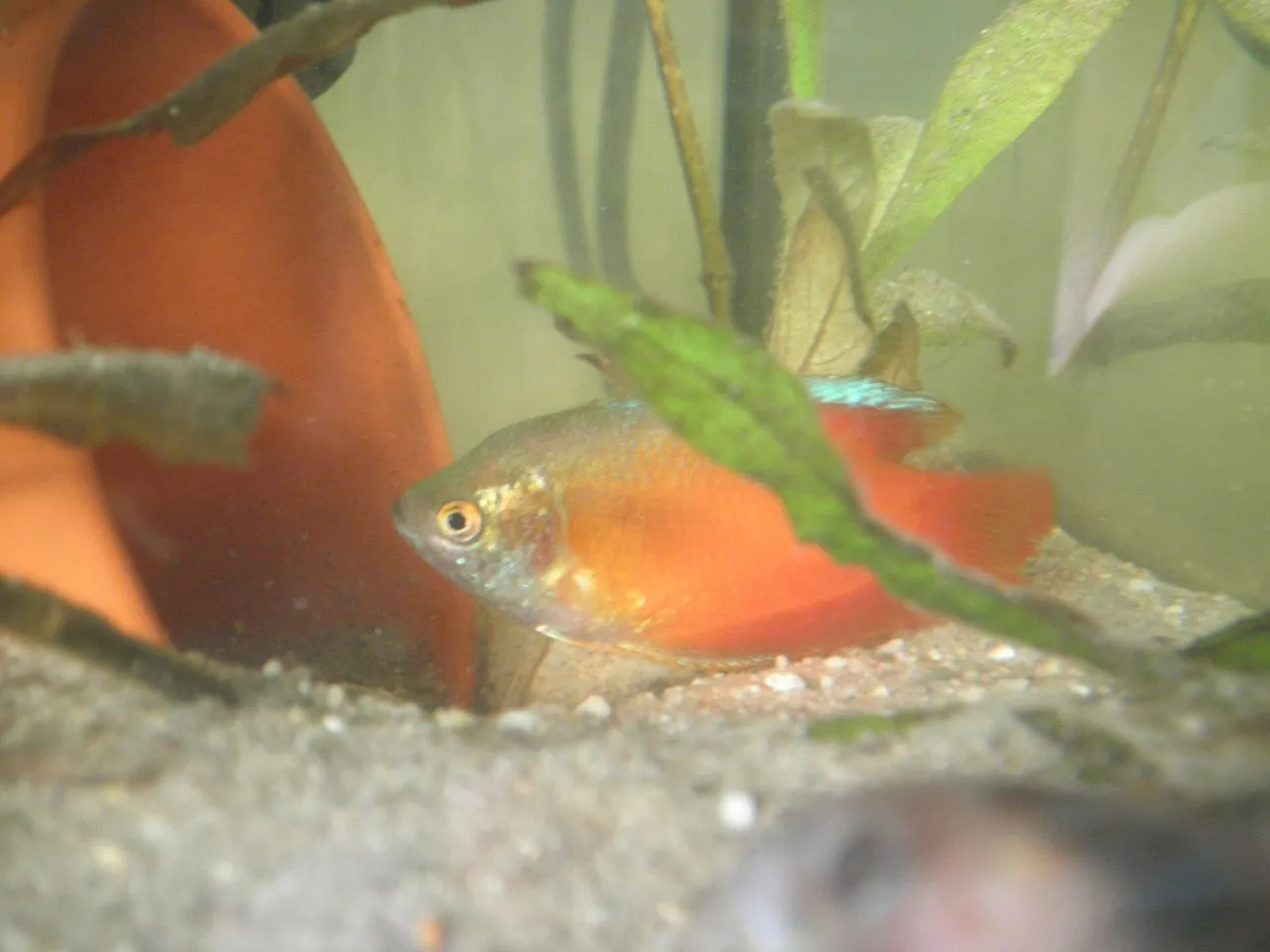
Answer: Honey gouramis (*Trichogaster chuna*) and dwarf gouramis (*T. lalius*) are commonly confused at point of sale but differ in three important ways: honey gouramis are smaller (5–6 cm vs 6–8 cm), gentler in temperament, and crucially do not carry the dwarf gourami iridovirus that has plagued commercial *T. lalius* lines for two decades. For most community keepers, the honey is the safer, calmer, and more rewarding choice.
In a shop tank, a male honey gourami and a male dwarf gourami can look superficially similar — both small, both orange-toned, both labyrinth fish. The differences become obvious within a week of bringing them home. This article is for the keeper standing in front of the tank trying to decide.
Part of the Complete Gouramis & Bettas Guide.
At a Glance
| Attribute | Honey gourami (Trichogaster chuna) | Dwarf gourami (Trichogaster lalius) |
|---|---|---|
| Adult size | 5–6 cm | 6–8 cm |
| Origin | Northern India, Bangladesh | India, Pakistan, Bangladesh, Nepal |
| Temperature | 24–28 °C | 24–28 °C |
| pH range | 6.0–7.4 | 6.0–7.5 |
| Hardness (GH) | 2–8 °dH | 3–10 °dH |
| Temperament | Gentle, mildly social, often shy at first | More territorial; males defend zones |
| Colour pattern | Honey-orange male, plain silvery-gold female | Intense red/blue striped male, plain greyish female |
| Disease risk | Generally robust, no major species-specific disease | Dwarf gourami iridovirus (DGIV) endemic in commercial lines |
| Breeding | Bubble-nest under floating plants | Bubble-nest under floating plants |
| Minimum tank | 40 L for a trio | 60 L for a pair |
| Beginner-friendly | Yes | Mixed — depends on source |
Identification
The males are usually distinguishable on sight:
- Honey gourami male: warm honey-orange body, often with a darker chest stripe in breeding condition. The colour is uniform rather than banded. Pelvic filaments are long and pale orange.
- Dwarf gourami male: intense blue-grey base with vertical red-orange stripes running from gill to caudal. Several colour morphs exist commercially — "flame", "powder blue", "neon" — but all show banded patterning, not the honey's uniform tone.
Females are harder. Both species' females are plain, silvery to greyish-tan, with shorter unpaired fins. Honey females are slightly smaller and slimmer. If in doubt, look at the dorsal fin: honey gouramis have a continuous straight-edged dorsal, while dwarf gouramis show a slightly more rounded dorsal profile.
The two share the same genus and have very similar pelvic-filament anatomy — both extend long sensory pelvics typical of Trichogaster. Older books place both in Colisa (now considered a synonym).
Temperament Differences
This is where the species diverge most clearly in a home aquarium.
Honey gouramis are remarkably peaceful for an anabantoid. A trio of one male and two females coexists in a 40–60 litre planted tank with minimal disputes. They explore the middle and upper water column, sip air at the surface, and rarely chase tankmates. They tolerate small peaceful fish like chili rasboras, ember tetras, and pygmy corydoras without issue.
Dwarf gouramis are more variable. Many individual males are calm. Others claim a corner of the tank and chase the female persistently or harass any fish that approaches the territory. In a tank smaller than 60 litres, dwarf gourami pairs frequently break down. Two males in the same tank almost always fight, and the loser usually dies or stops feeding.
The behavioural difference reflects size, density, and breeding strategy. Both build bubble nests, but the dwarf gourami's larger size translates to a larger claimed territory.
The Iridovirus Problem
Dwarf gourami iridovirus (DGIV) is the single most important reason many keepers, myself included, recommend honey gouramis as a default. The virus emerged in commercial T. lalius farms in Southeast Asia in the 1990s and has remained endemic across the trade ever since. Sudthongkong, Miyata & Miyazaki documented the disease in detail in 2002.
Symptoms appear weeks to months after purchase: faded colour, pale skin patches, lethargy, weight loss, and death. There is no treatment. Affected fish must be euthanised and the tank's other dwarf gouramis are usually already infected. Studies have estimated prevalence in trade-supplied dwarf gouramis at 20–40% in some surveys, though some sources are notably cleaner than others.
Honey gouramis are not vulnerable to DGIV in the same way. Locally-bred dwarf gouramis from a known small breeder may also be clean, but identifying such a source is difficult.
If you want a T. lalius and accept the risk, source from a hobbyist breeder rather than a chain store, quarantine for at least 6 weeks, and accept the possibility of loss.
Water, Tank, and Tankmates
Both species share an almost identical husbandry envelope. The honey tolerates slightly softer water; the dwarf tolerates slightly harder. Both prefer 24–28 °C with stable temperature, mature filtration, and floating cover for bubble-nest construction.
Tankmate priorities:
- Avoid for both: large or aggressive species (angelfish, tiger barbs, green terror); fin-nippers; other gouramis of similar size.
- Safer for both: small peaceful schoolers, bottom-dwelling otocinclus, and corydoras, shrimp colonies only in soft mature tanks.
- Specifically risky for dwarf gourami: anything that crowds the territory.
Both build bubble nests in calm surface water. Floating plants — water wisteria, hornwort — provide the cover both species use for spawning and refuge.
Breeding Differences
The breeding behaviour is broadly similar — male builds a bubble nest, courts the female, the female releases eggs during a clasp, the male collects and tends the eggs in the nest. Differences:
- Honey gourami spawning is gentler. The female is rarely injured. The male tends eggs without aggressively driving the female away unless the tank is small.
- Dwarf gourami spawning can be rougher. Males drive females hard after spawning and a separate compartment or a planted refuge is often necessary.
Honey gourami fry are slightly smaller and require infusoria or commercial fry food for the first week. Dwarf gourami fry are similar but slightly larger and more forgiving on first foods.
Which to Choose
For most community aquarium keepers, the answer is honey gourami. The size is more flexible, the temperament is gentler, and the disease risk is dramatically lower. A trio of honey gouramis in a 60-litre planted tank with chili rasboras and a few corydoras is one of the most reliable peaceful community arrangements available.
Dwarf gouramis remain attractive for one reason: the male's colour pattern is genuinely striking and the honey cannot match it. If that is the priority, buy from a reputable hobbyist breeder, quarantine carefully, and accept that you are choosing aesthetics over safety.
Common Mistakes
- Treating them as interchangeable. A 30-litre tank that suits a honey trio will not stably house a dwarf pair.
- Adding a second dwarf gourami male. Almost always ends in chronic aggression.
- Skipping quarantine on commercial dwarf gouramis. DGIV often presents weeks after purchase.
- Keeping either in hard alkaline tap water without adjustment. Both species are softwater-tolerant but neither thrives at KH > 10 °dH.
- Buying "sunset honey" or "robin red" colour lines without species verification. Some trade names cover hybrid or marker-injected fish.
Frequently Asked Questions
Are honey gourami and dwarf gourami the same species?
No. They are separate species in the same genus. Trichogaster chuna (honey) and Trichogaster lalius (dwarf) are distinct, with different size, behaviour, colour patterns, and disease profiles. The trade often shelves them side by side and the confusion is compounded by ambiguous colour-line names like 'sunset honey' and 'flame dwarf'.
What is dwarf gourami iridovirus?
Dwarf gourami iridovirus (DGIV) is a viral disease that has spread through commercial T. lalius lines since the 1990s. Affected fish develop pale patches, weight loss, and death within weeks; there is no treatment. Honey gouramis are not similarly affected, which is the practical reason many keepers now prefer them.
Which is better for a community tank?
Honey gourami, in almost all cases. They are smaller, less territorial, less prone to disease, and tolerate the same parameter range. The only reason to choose a dwarf is for the male's intense red and blue striping, which the honey does not match.
Can I keep them together?
Possible but not ideal. They share parameters and are both Trichogaster, so males may interact aggressively. A trio of honey gouramis or a male+female pair of dwarfs is more stable than mixing the two species.
Sources & References
- Linke, H. (1991). Labyrinth Fish. Tetra Press.
- Goldstein, R.J. (2004). Bettas, Gouramis and Other Anabantoids. Barron's.
- Vierke, J. (1988). Bettas, Gouramis and Other Anabantoids. T.F.H. Publications.
- Sudthongkong, C., Miyata, M. & Miyazaki, T. (2002). Iridovirus disease in two ornamental tropical freshwater fishes: African lampeye and dwarf gourami. Diseases of Aquatic Organisms, 48(3): 163–173.