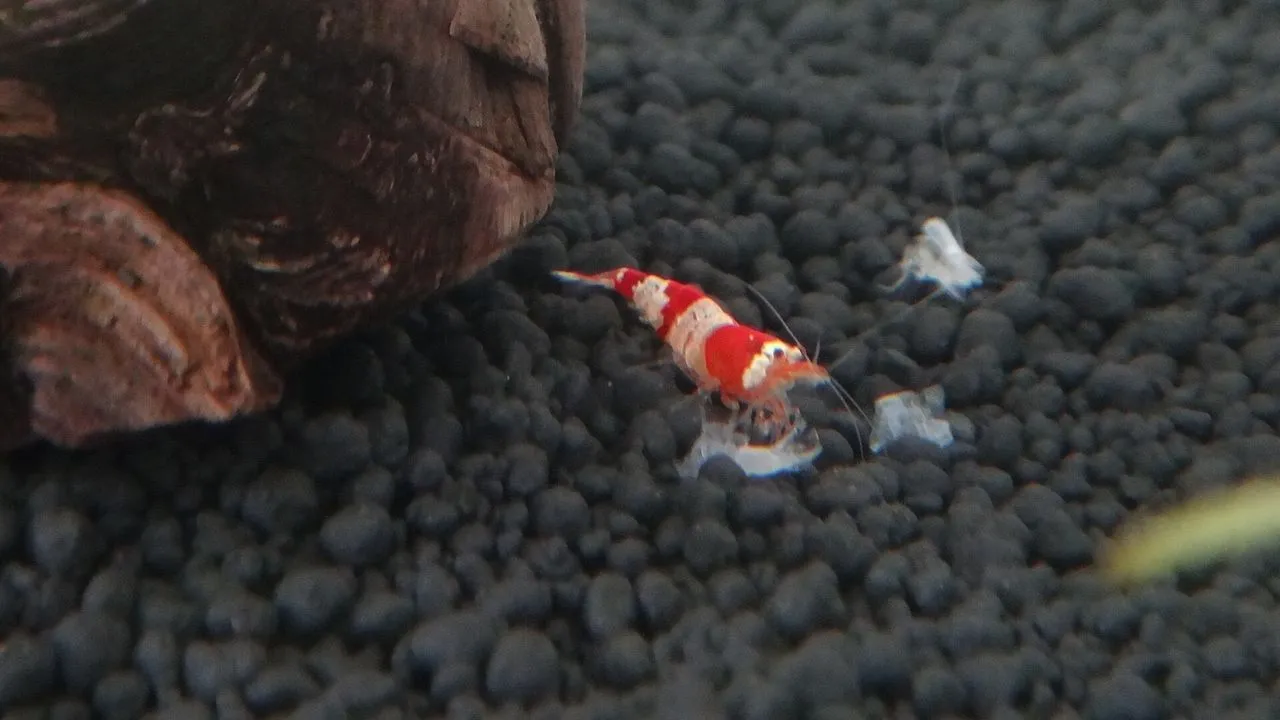
Answer: Prevent shrimp moult failure by holding GH within species-correct targets — Neocaridina 6–8 °dH, Caridina cantonensis 4–6 °dH — keeping TDS swings below 10 ppm between water changes, and eliminating every copper source from the system. The white ring of death is always fatal once visible; prevention happens upstream, in the routine of stable mineralised water and rigorously matched water changes before the next moult cycle begins.
Moult failure — the sequence that produces the white ring of death — is one of the few shrimp-keeping disasters that cannot be fixed once it begins. When the old exoskeleton cracks at the moulting seam and the shrimp cannot emerge, the animal dies. Nothing done at that point changes the outcome. Prevention is therefore the only viable strategy, and it works: colonies that maintain stable, species-correct water chemistry over months rarely see moulting losses.
Part of the Complete Shrimp & Snails Guide.
Why Moult Failure Happens
The full diagnostic picture is covered in Why Is My Shrimp Dying After Moulting?. Briefly: dwarf shrimp of the genera Neocaridina and Caridina build their exoskeletons from chitin and calcium carbonate. Before ecdysis, the animal reabsorbs roughly 20–25% of the calcium from the old shell and forms a new hypodermis beneath it. The moulting trigger is osmotic — the shrimp pumps itself full of water until the old shell bursts at a pre-formed seam. When ambient GH is too low, the new shell forms too soft. When a water change introduces a sudden TDS shift, ecdysis is forced before the new shell is ready. When copper is present, gill function is impaired, disrupting the osmotic water uptake the moult depends on.
All three causes are preventable. None requires expensive equipment. The variable that matters most is consistency.
Parameter Stability Protocol
A GH of 6 °dH that drifts to 4 °dH over three weeks is more dangerous than a GH held steadily at 5 °dH. Shrimp physiology adapts to a stable baseline; abrupt shifts trigger premature ecdysis and incomplete shell mineralisation.
GH should be tested weekly with a liquid drop kit, not a test strip. Record the reading rather than trusting memory. For Neocaridina species, the working target is GH 6–8 °dH — the centre of the 6–14 °dH tolerance range. For Caridina cantonensis bee shrimp, target GH 4–6 °dH using remineralised reverse-osmosis water, since tap water in most regions carries KH far too high for this group. See Water Hardness: GH and KH Explained for the underlying mineral chemistry, and Reverse Osmosis Water for Aquariums for RO setup and remineraliser dosing.
KH should not be ignored. Elevated KH — above 4–5 °dH for Neocaridina, above 1–2 °dH for Caridina cantonensis — competes with calcium uptake at the gill epithelium. In hard tap areas, partial dilution with reverse-osmosis water reduces KH alongside total hardness without stripping GH to zero.
TDS is the fastest stability indicator. Measure tank TDS before every water change and record it. Target drift of less than 10 ppm between sessions. Larger swings indicate either evaporation is concentrating solids (top up with pure water to compensate, not tap) or the replacement water is not being matched accurately.
Temperature controls moult frequency. Neocaridina kept at 24–26 °C moult significantly more often than those at 20–22 °C. More frequent moulting means more opportunities for failure. The physiological optimum for Neocaridina davidi is 20–24 °C; for Caridina cantonensis, 20–23 °C. Temperatures above these ranges accelerate breeding but compress the inter-moult interval and raise the risk of incomplete shell mineralisation.
Species-Correct Mineral Targets
Mineral requirements differ sharply between the common shrimp groups. Applying a single set of parameters to a mixed-species system is a reliable source of moulting failures when the tank contains more sensitive animals than the keeper realises.
| Species group | GH (°dH) | KH (°dH) | TDS (ppm) | Temperature (°C) | Water source |
|---|---|---|---|---|---|
| Neocaridina (cherry, yellow, blue dream) | 6–8 | 2–6 | 150–300 | 20–24 | Tap or lightly remineralised RO |
| Caridina cantonensis (crystal red, Taiwan bee, black crystal) | 4–6 | 0–1 | 80–150 | 20–23 | RO + calcium/magnesium remineraliser |
| Sulawesi Caridina (C. spinata, C. dennerli) | 3–5 | 4–6 | 80–150 | 26–30 | RO + alkaline remineraliser |
Sulawesi shrimp are the exception to the rule that low KH is universally correct for Caridina. Their lake of origin is warm, alkaline, and moderately mineralised — they require both the elevated KH and the higher temperature that would be inappropriate for bee shrimp from southern China.
The calcium-to-magnesium ratio within GH matters as much as the absolute value. A Mg:Ca ratio of approximately 1:3 to 1:4 by weight reflects the ratio found in healthy shrimp haemolymph and supports optimal chitin-matrix mineralisation. Where GH is raised purely with calcium sulphate (gypsum, CaSO₄), magnesium is deficient. Where GH is raised purely with magnesium sulphate (MgSO₄), calcium is deficient. A blend of both salts — roughly 3:1 or 4:1 calcium-to-magnesium by weight — produces a balanced hardness profile. For Neocaridina in areas with moderate tap hardness, cuttlebone or mineral stones can supplement calcium passively without altering KH, though they do not replace GH testing since dissolution rates vary with pH and CO₂ concentration.
Copper Watch
Copper at approximately 0.05 ppm or above is directly toxic to freshwater shrimp. Fish show no distress at that concentration. The gap between "safe for fish" and "toxic to shrimp" is wide enough that copper poisoning in a shrimp tank is frequently attributed to other causes before the source is identified.
The likely entry points are:
- Medications. Many treatments for fish parasites, fungal infections, and algae contain copper sulphate. Never dose copper-based medications into a shrimp tank. If the display requires copper treatment, remove all shrimp to a cycled, copper-free container before dosing and do not return them until multiple large water changes and activated carbon filtration have cleared all residues.
- Liquid plant fertilisers. Most iron and trace-element formulations carry copper. Read the full ingredient list. If the label does not declare copper content, assume it is present. Use dry macronutrient supplements (potassium sulphate, monopotassium phosphate) where possible; test with a copper-specific reagent kit if liquid dosing is unavoidable.
- Tap water from copper pipework. First-draw cold tap water in buildings with copper pipes can carry dissolved copper at biologically significant concentrations, particularly in soft, slightly acidic supply areas where the water is more corrosive. Run the cold tap for 30 seconds before collecting water for shrimp tanks, and test directly if there is any doubt.
- Brass fittings and decorative metal components. Brass is an alloy of copper and zinc. Any brass fitting — airline connectors, tap splitters, ornamental hardware — in contact with aquarium water leaches copper over time. Replace with plastic or stainless steel equivalents.
Dechlorinators neutralise chlorine and chloramines but do not remove copper. The source must be eliminated, not masked.
Diet & Trace Minerals
Water chemistry is the primary determinant of moult success. Diet plays a supporting role, most relevant when ambient GH sits at the lower edge of the acceptable range and the colony cannot fully supplement shell mineralisation from the water column alone.
Amano shrimp and other active grazers benefit from a varied diet as a general health matter; for dwarf Neocaridina and Caridina, the same principle applies to moult quality. Blanched vegetables — courgette, cucumber, spinach — deliver magnesium, potassium, and trace minerals. Dried leaf litter (Indian almond, oak, mulberry) provides humic acids, tannins, and a constant grazing substrate from which shrimp extract mineral traces alongside biofilm.
A mature tank with established biofilm on every surface — wood, stone, plant stems, substrate particles — is a functional feeding environment that supplements dietary mineral intake continuously. Newly set-up tanks with sterile surfaces starve shrimp of this resource, which is one reason moulting losses are disproportionately common in tanks under six months old.
Vary the diet across algae-based foods, small protein portions (once or twice weekly), and vegetable matter. The mineral contribution of diet will not compensate for GH below threshold, but it reduces the margin at which marginal GH becomes a practical problem.
Water-Change Protocol
The water change is the single event most likely to trigger a failed moult when handled badly. A large-volume change with temperature-mismatched or mineral-mismatched replacement water can force ecdysis in mid-cycle animals, producing clustered losses in the 12–24 hours afterwards — a pattern easily misread as disease.
The correct method:
- Test the tank's TDS before every change and record it.
- Prepare replacement water in a separate container — never add water directly from the tap or from an unmixed vessel.
- Measure the replacement water's TDS. Adjust to within 10 ppm of the tank reading by diluting with reverse-osmosis water or adding GH salts as required.
- Match the temperature within 1–2 °C. A heater in the mixing container, or simply allowing it to equilibrate to room temperature, is sufficient for most setups.
- Add dechlorinator to the replacement water before pouring.
- Change no more than 10–20% of tank volume per session, weekly. Fortnightly changes at 30–40% are substantially more disruptive even if the total monthly volume is similar.
The slow-drip method — running replacement water via an airline tube at roughly one drop per second — reduces even the residual TDS shift of a 15% change to near zero. It is standard practice for Caridina cantonensis keepers and is worth adopting for any tank where moulting losses are a concern. See Water Changes: Frequency and Volume for a full account of water-change mechanics for invertebrate systems.
Common Mistakes
1. Making large, infrequent water changes. A 40% change every three weeks is more disruptive than a 15% change every seven days, even if the total volume exchanged is comparable. Regularity and small volume matter more than the absolute weekly figure.
2. Not testing GH of replacement water. Many keepers test the tank but not the bucket. Tap water GH varies seasonally as supply boards switch between source blends. A winter water change that worked fine may introduce a significantly different GH in August. Test the replacement water every time.
3. Trusting fertiliser labels that do not declare copper. The absence of "copper" from a label does not mean the product is copper-free. "Trace elements" and "micronutrients" frequently include copper without naming it. Use a copper test kit in any shrimp tank where liquid fertilisers are dosed, and switch to copper-free products or dry supplementation.
4. Keeping Caridina cantonensis on tap water. Crystal red shrimp and Taiwan bee shrimp require GH 4–6 °dH, KH 0–1 °dH, pH 5.5–6.8. Tap water in most of the UK, Germany, and North America has KH far above 1 °dH. The resulting moulting failures are environmental mismatches, not failures of husbandry in the conventional sense.
5. Diagnosing losses as old age rather than parameter drift. A Neocaridina colony kept at GH 4 °dH does not die immediately — moulting losses accumulate slowly, one or two animals per month, until the colony has declined significantly. These losses are easy to rationalise as natural attrition. If any dead animal shows the white ring, or if deaths are spread evenly across age classes rather than concentrated in the oldest individuals, the cause is environmental. Cherry shrimp colonies can halve in three months from a mineral deficiency the keeper never consciously identified as a problem.
Frequently Asked Questions
What GH should I target to prevent moult failure?
For Neocaridina species (cherry shrimp, yellow shrimp, blue dream shrimp), target GH 6–8 °dH — the centre of the 6–14 °dH tolerance range gives the most consistent moult success. For Caridina cantonensis bee shrimp (crystal red, Taiwan bee, black crystal), target GH 4–6 °dH using remineralised reverse-osmosis water, since tap water in most regions cannot reach this combination reliably. Below the lower bound for either group, the new exoskeleton forms too soft for the shrimp to exit the old shell cleanly.
How small should water changes be to avoid triggering moult failure?
Keep water changes to 10–20% of tank volume weekly. Changes larger than 25% risk a TDS shift that artificially triggers ecdysis in animals mid-cycle. Always premix the replacement water in a separate container, check its TDS to within 10 ppm of the tank, and match the temperature within 1–2 °C before adding it.
Can plant fertilisers cause shrimp moult failure?
Yes. Most liquid trace-element and iron fertilisers contain copper at concentrations that accumulate to toxic levels in an invertebrate tank. The safe upper limit for freshwater shrimp is approximately 0.05 ppm — well below the concentration at which fish show distress. Read the full ingredient list of any fertiliser before dosing a shrimp tank, and favour dry macronutrient supplementation where liquid dosing is unnecessary.
Do I need a remineraliser for Neocaridina?
Not always. Neocaridina species tolerate a wide range of mineral compositions provided GH stays within 6–14 °dH and KH within 2–8 °dH. In much of the UK and Europe where tap water has moderate hardness, no remineralisation is needed. Where tap water is very soft (GH below 4 °dH), adding calcium sulphate and magnesium sulphate to raise GH to 6–8 °dH is sufficient. Caridina cantonensis bee shrimp require RO water with a purpose-blended remineraliser at every water change without exception.
What is the correct calcium-to-magnesium ratio in shrimp water?
The target Mg:Ca ratio by weight is approximately 1:3 to 1:4. In GH terms, roughly 70–75% of the GH contribution should come from calcium and 25–30% from magnesium. Pure calcium-only or magnesium-only GH sources create an imbalance that impairs exoskeleton mineralisation. If preparing your own blend, use calcium sulphate and magnesium sulphate at roughly a 3:1 or 4:1 Ca:Mg ratio by weight.
Sources & References
- Lukhaup, C. & Pekny, R. (2008). Süßwassergarnelen aus aller Welt. Dähne Verlag.
- Werner, U. (1998). Atlas der Wirbellosen im Aquarium. Mergus Verlag.
- Ruppert, E.E., Fox, R.S. & Barnes, R.D. (2004). Invertebrate Zoology: A Functional Evolutionary Approach (7th ed.). Brooks/Cole.