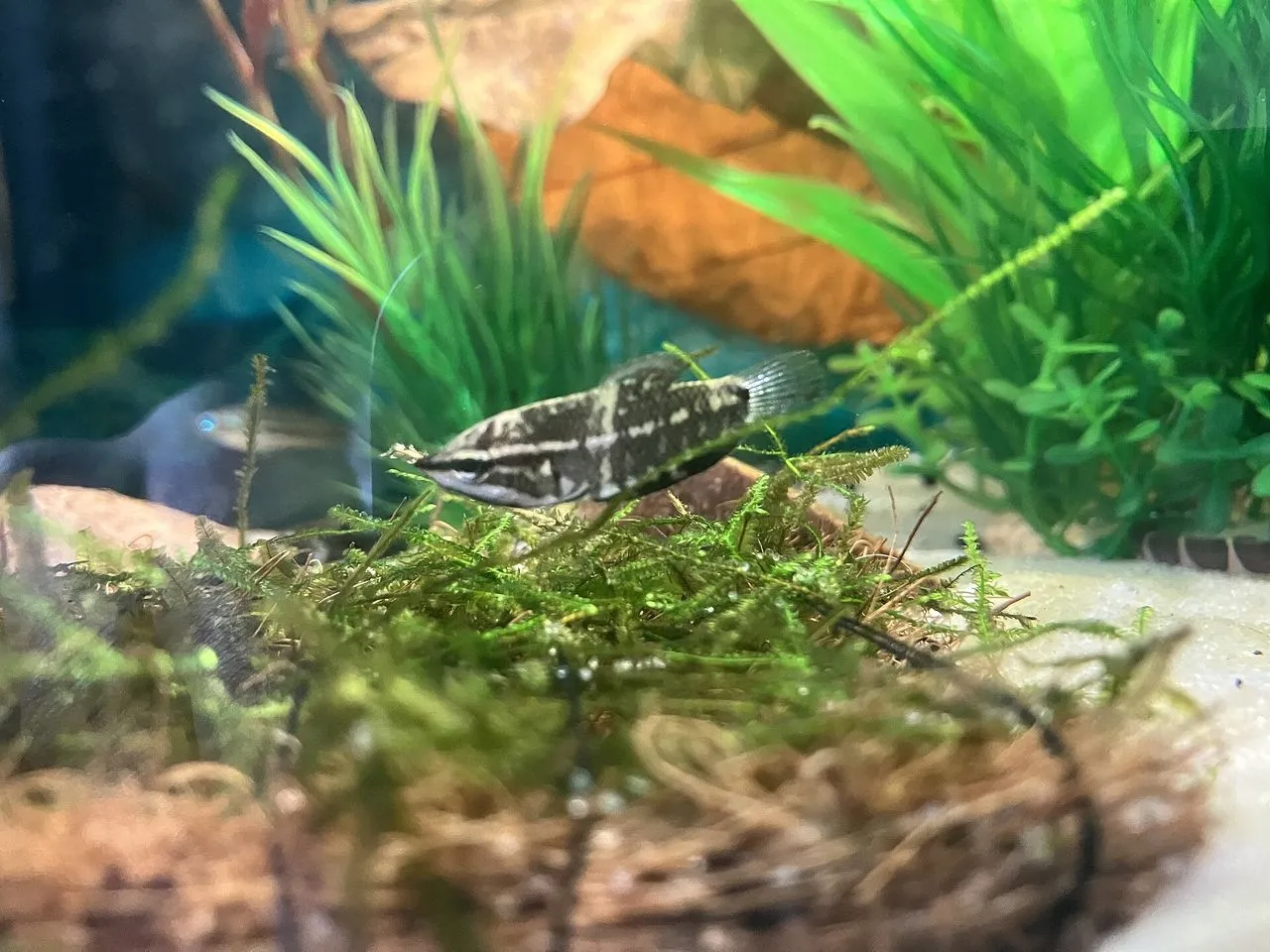
Answer: Taxiphyllum barbieri is a moss for freshwater aquaria, usually grown at 18-28 °C under 15-50 PAR. It is best managed as a low to medium plant: attach with thread or gel cyanoacrylate; trim often. Match carbon, trimming, and fertilisation to its growth form rather than treating it like a generic bunch plant.
Taxiphyllum barbieri is a moss kept for fine branching shoots that shelter fry and shrimp. In aquarium practice it succeeds when the keeper respects its form: attach with thread or gel cyanoacrylate; trim often. It is part of the complete aquarium plants guide, where light class, CO2, substrate, and plant category are treated together rather than as separate shopping decisions.
Identification
Healthy Taxiphyllum barbieri should be recognised by structure before colour. Its normal aquarium size is 2-10 cm mat, with growth speed governed by light, carbon, and nutrient access. Emersed nursery leaves can differ from submerged leaves; this is especially obvious in stem plants and tissue-culture portions. New stock may therefore look unlike established submerged growth for the first month.
| Character | Practical observation |
|---|---|
| Growth form | moss |
| Expected aquarium size | 2-10 cm mat |
| Best light class | low to medium; 15-50 PAR |
| CO2 requirement | 0-10 ppm; CO2 optional |
| Temperature range | 18-28 °C |
| Planting method | attach with thread or gel cyanoacrylate; trim often |
Do not judge the plant during the first week after purchase. Many commercial plants are produced emersed or in vitro because that is cleaner and faster. Submerged leaves must be built with different cuticle thickness, gas-exchange behaviour, and mechanical support. Old leaves may yellow or dissolve while new leaves are perfectly healthy.
Origin and Botany
The name Taxiphyllum barbieri should be used when buying or discussing this plant, because common names hide several species and trade forms. Kew's Plants of the World Online and IPNI are useful for current botanical spelling, while Kasselmann and Rataj & Horeman remain practical aquarium references. Aquarium trade names can lag behind taxonomy for decades.
Its ecological lesson for the aquarium is simple: fine branching shoots that shelter fry and shrimp. A plant adapted to attachment should not be buried like a sword; a root feeder should not be expected to thrive tied to driftwood; a carpet plant cannot be made easy by selling it in a cup. The biology sets the limit before equipment does.
Aquarium Husbandry
Use 15-50 PAR at the plant's growing surface as the starting point. A photoperiod of six to seven hours is appropriate in a new tank; established aquaria can often run seven to eight hours if algae remains controlled. More hours do not compensate for weak carbon. Under high light with unstable CO2, algae gains the advantage because it responds faster than vascular plants can rebuild tissue.
Temperature should remain within 18-28 °C. Most community aquaria sit close to 24-26 °C, which suits this plant unless a specialist high-heat discus tank or cool hillstream tank pushes it outside range. The water chemistry tolerance is usually broader than fish tolerance, but extremes still matter: very soft water can limit calcium and magnesium, while very hard water may slow some soft-water stems and carpets.
For planting, attach with thread or gel cyanoacrylate; trim often. Initial spacing matters. Crowding new stems or plugs blocks circulation and traps detritus; planting a single lonely stem invites it to lean and shade itself. Inert sand or gravel is acceptable for epiphytes and many stems, but rosette root feeders need root-zone nutrition. Active aquasoil can help demanding carpets and stems, provided fish and shrimp are not added during the initial ammonia phase.
| Setup style | Recommendation |
|---|---|
| Low-tech fish-first tank | Keep light in the lower part of the range and avoid aggressive fertiliser dosing |
| Balanced planted community | Dose modest water-column nutrients and prune before old growth decays |
| CO2 aquascape | Aim for about 20 ppm dissolved CO2 before full light intensity begins |
| Shrimp tank | Prefer tissue-culture or trusted pesticide-free stock; rinse thoroughly |
Fertilisation and CO2
The CO2 guidance for this plant is 0-10 ppm; CO2 optional. In a no-CO2 aquarium, avoid sudden increases in PAR and do not expect compact high-speed growth. Fish respiration, substrate microbial activity, and surface exchange provide enough carbon only for plants chosen within that energy budget. Pressurised CO2 should be stable before lights reach full intensity; a green drop checker is a practical target, not a trophy.
Nutrient symptoms are best read from new versus old growth. Pale new leaves point toward trace or iron limitation only after light and carbon are sensible. Pinholes and weak older leaves often implicate potassium or general starvation. Transparent lower leaves in stems often mean shading or insufficient nitrogen, not a mysterious disease. Root feeders should receive substrate fertilisation; epiphytes and mosses depend more on clean water-column supply.
Propagation and Maintenance
Maintenance should follow growth form. Stem plants are clipped above a node, with healthy tops replanted and tired bases discarded when they become woody. Rosettes propagate by runners, daughter plants, or crown division depending on species. Rhizome plants are divided only where each section has leaves and roots. Mosses are trimmed like a hedge: thin layers stay green, thick cushions collect mulm and die inside.
For Taxiphyllum barbieri, the safest routine is inspection during weekly water changes. Remove dying emersed leaves before they decay in the tank, trim only actively growing material, and keep detritus from collecting around the crown or mat. If algae appears, reduce light duration first and check CO2 stability before adding livestock as a cure. Amano shrimp and snails help with films, but they do not fix a lighting error.
Fish and Invertebrate Pairings
This plant pairs well with fish that match its water and structure. Moss is the classic grazing and refuge plant for cherry shrimp; see cherry shrimp. In softer planted communities, many keepers combine plants like this with cardinal tetras, harlequin rasboras, or kuhli loaches depending on substrate and flow. Shrimp benefit from biofilm on leaves and hardscape, especially in moss and rhizome layouts.
Avoid assuming plants solve stocking problems. Digging cichlids uproot foregrounds, large herbivorous fish test soft leaves, and strong-current fish may not suit delicate moss pads. Pair plant and animal by water chemistry, flow, temperature, and behaviour.
Common Problems
| Symptom | Likely cause | Correction |
|---|---|---|
| Yellowing after purchase | Emersed-to-submerged transition | Remove failed leaves and wait for new submerged growth |
| Algae on older leaves | Too much light for growth rate | Shorten photoperiod, improve CO2 stability, prune shaded tissue |
| Plant lifts or detaches | Poor anchoring or disturbed substrate | Replant smaller portions; protect from digging fish |
| Slow growth | Normal for low-energy setups or insufficient nutrients | Match expectations to PAR and fertilise according to growth form |
See Also
- The Complete Aquarium Plants Guide — category reference for light, CO2, substrate, and shop-plant frauds.
- christmas moss, anubias nana, hornwort — related plant profiles with overlapping husbandry choices.
- LED Lighting for Planted Tanks — PAR classes and photoperiod control.
- CO2 Injection Setup — carbon targets for medium and high-energy planted tanks.
- Substrate Selection — matching roots, carpets, sand, gravel, and aquasoil.
Frequently Asked Questions
Does Java Moss (Taxiphyllum barbieri) need CO2?
No pressurised CO2 is mandatory for Java Moss (Taxiphyllum barbieri) in modest light, except where the article notes a carpet or red-stem demand. Growth improves as dissolved CO2 approaches 20 ppm, but stability matters more than chasing a number.
What light level suits Java Moss (Taxiphyllum barbieri)?
Java Moss (Taxiphyllum barbieri) is best treated as a low to medium plant, about 15-50 PAR at the substrate or attachment point. Stronger light without matching carbon and nutrients usually produces algae rather than better growth.
How should Java Moss (Taxiphyllum barbieri) be planted?
Attach with thread or gel cyanoacrylate; trim often. Do not force a growth form into the wrong position; rhizomes rot when buried and root feeders starve when left floating.
Is Java Moss (Taxiphyllum barbieri) safe with shrimp?
Yes, if it is pesticide-free and rinsed carefully. Tissue-culture stock is the safest route for shrimp, but it still needs a submerged transition period before full growth resumes.
Sources & References
- Kasselmann, C. (2010). Aquarium Plants. Krieger Publishing.
- Rataj, K. & Horeman, T.J. (1977). Aquarium Plants: Their Identification, Cultivation and Ecology. T.F.H. Publications.
- Tropica Aquarium Plants. Aquarium Plant Encyclopedia. tropica.com
- Plants of the World Online, Royal Botanic Gardens, Kew. powo.science.kew.org