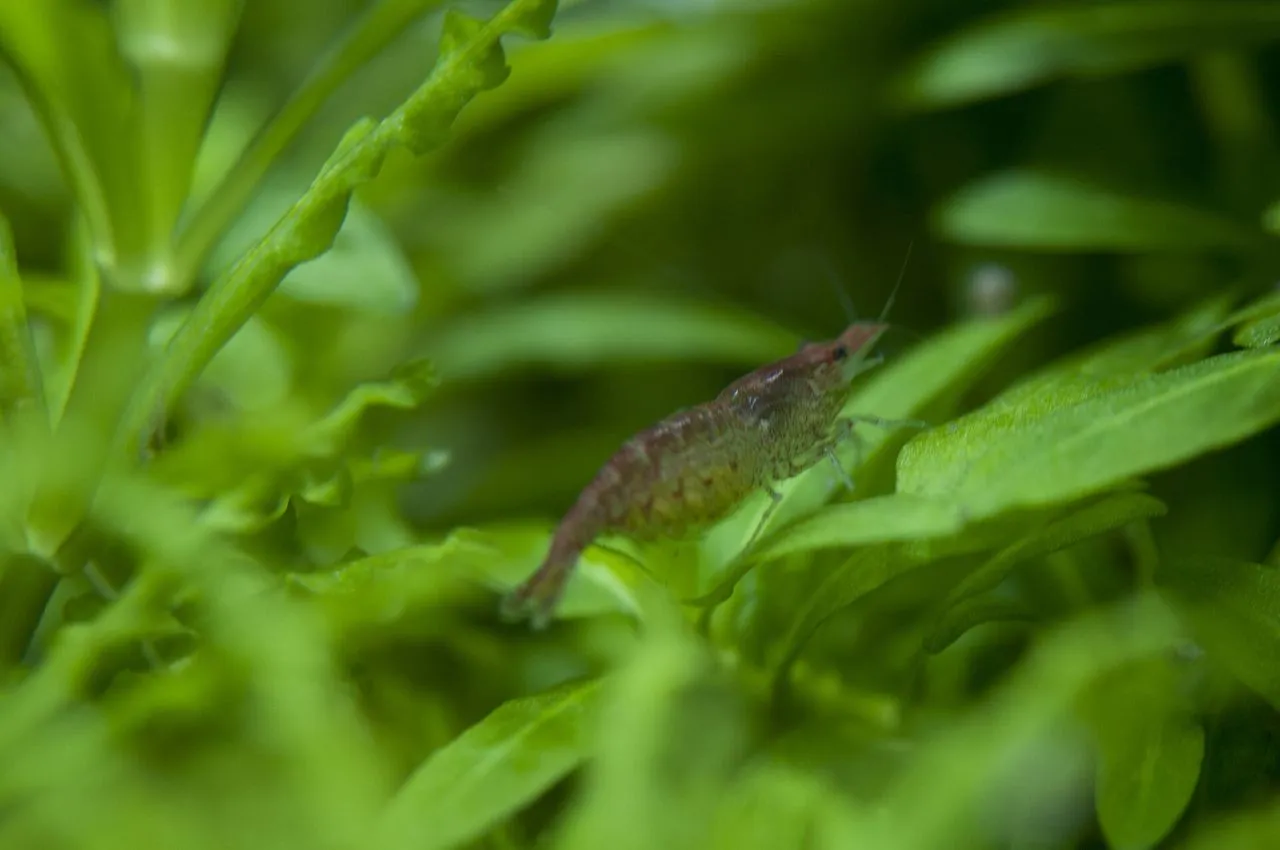
Answer: Cherry shrimp (*Neocaridina davidi*) breeding failure takes three distinct forms: no berried females at all, berried females but no shrimplets surviving, or shrimplets appearing but the colony staying static. The first points to water chemistry, sex ratio, or an immature tank; the second to predation or insufficient cover; the third to slow attrition from all three factors combined. Each requires different diagnosis before any adjustment.
Neocaridina davidi is described as the easiest freshwater shrimp to breed, and that reputation is accurate — in the right conditions. When breeding stops or never starts, the keeper's first instinct is to adjust water chemistry, which is the correct instinct for one failure mode and entirely the wrong move for the other two. "No berried females," "berried females but no shrimplets," and "shrimplets present but the colony staying static" are three separate problems with different root causes, and confusing them prolongs the diagnosis considerably.
Part of the Complete Shrimp & Snails Guide.
The Three Failure Modes
Identifying which failure mode you are in narrows the suspect list by half before you touch a test kit.
| Failure mode | What you observe | Primary suspects |
|---|---|---|
| No berried females | Shrimp are active but no female ever carries eggs | Sex ratio skewed, tank too young, GH below 4 °dH, temperature above 26 °C, nitrate above 20 ppm |
| Berried females, no shrimplets | Females carry eggs; no young ever appear, or they vanish within days | Fish predation, insufficient plant cover, sub-lethal copper, females dropping eggs under stress |
| Shrimplets appear, colony static | Young occasionally visible; adult numbers do not grow | Chronic low-level predation, male-heavy ratio exhausting females, gradual parameter drift |
A single tank can run more than one mode simultaneously. A tank with a skewed sex ratio and small tetras present is combining failure modes one and two.
How to Identify the Problem
Work through this sequence before adjusting anything.
Step 1: Confirm you have both sexes. Female Neocaridina davidi are larger (2–3 cm versus 1.5–2 cm for males), more intensely coloured, and show a visible saddle — an olive-yellow patch of eggs visible through the carapace just behind the head. If every shrimp in the tank looks the same size and pale, you may have purchased only males. A batch of ten shrimp from a single supplier can, by chance, be predominantly one sex.
Step 2: Count your males. A colony needs more females than males. When males outnumber females, they pursue individual females relentlessly after each moult, physically exhausting them. Stressed females carry fewer eggs, drop clutches prematurely, or stop cycling altogether. A rough working ratio is one male per two to three females.
Step 3: Note the tank age. A tank running for less than eight weeks rarely produces berried females. Neocaridina breed readily in mature water with established biofilm. In a new, sterile tank — even one with stable ammonia and nitrite — founders typically spend the first two to three months conditioning and acclimatising. Resist adjusting water during this period; the instability that comes with repeated corrections usually delays the first clutch rather than accelerating it.
Step 4: Check for fish. Even fish marketed as shrimp-safe will eat shrimplets. Any fish above approximately 3 cm in body length should be treated as a shrimplet predator. In a tank with dense moss, some shrimplets survive; in an open, sparsely planted tank, almost none do. If you have berried females but zero juvenile survival, fish predation is the most probable cause — ahead of water chemistry.
Step 5: Test TDS, GH, and nitrate. Low GH — below 4 °dH — is the most common chemical reason for absent breeding. Calcium and magnesium are required for egg development and for exoskeleton formation in rapidly growing shrimplets. A GH of 6–10 °dH with KH of 2–6 °dH and TDS of 180–280 ppm covers the mineral requirement for most Neocaridina lines. Nitrate above 20–30 ppm suppresses breeding and increases egg-drop in berried females. See Water Hardness: GH and KH Explained for testing and correction methods.
Risk and Severity
A breeding failure is rarely an emergency. Existing adults are not in immediate danger unless an underlying parameter problem is causing moult failures simultaneously — see Why Is My Shrimp Dying After Moulting? for that scenario.
The real risk is colony collapse over months rather than weeks. Adult Neocaridina live one to two years under aquarium conditions. A founder group of twenty animals with zero reproduction will be down to a handful within eighteen months. Slow failure modes — static colony, nitrate suppression — allow calm diagnosis. Fast modes — sub-lethal copper exposure, temperature above 28 °C — can halt breeding and begin killing shrimplets within days of the problem beginning.
Solutions and Actions
Address causes in order of probability, not in order of effort.
1. Remove fish, or accept the tradeoff. If any fish are present and shrimplets are absent, move either the fish or the shrimp. A 20-litre shrimp-only tank with a mature sponge filter is the reliable baseline. Community tanks with shrimp colonies are possible, but they require dense moss and the acceptance that colony growth will be slow. See Cherry Shrimp vs Amano Shrimp for how this changes the stocking calculus when your goal is a colony display rather than an algae crew.
2. Add more plant cover than you think you need. Java moss and Christmas moss are the standard choices — both provide fine-leaved structure that shrimplets can vanish into within seconds of emerging. A colony barely holding its numbers through moderate predation can tip into net growth by doubling the moss volume. Floating plants and leaf litter (Indian almond, dried oak) add meaningful refuge at low cost. Anubias nana grows slowly, accumulates biofilm, and provides broad sheltering surfaces without the substrate disturbance that replanting stem plants causes.
3. Test and correct GH. Use a liquid-reagent GH/KH kit — strip tests are not precise enough for shrimp mineral management. If GH is below 6 °dH, remineralise water at the next change using a mineral-balanced GH+ remineraliser formulated for Neocaridina, supplying calcium, magnesium, and electrolytes without raising KH disproportionately. Shift TDS by no more than 20–30 ppm per water change to avoid the parameter shock that triggers premature moulting.
4. Check temperature. The breeding optimum for Neocaridina davidi is 21–24 °C. Temperatures above 26 °C accelerate the moult cycle — females moult more frequently but carry fewer eggs per clutch. Above 28 °C, breeding can stall entirely and oxygen stress compounds the problem. Unheated tanks in temperate rooms often outperform heated ones for Neocaridina breeding fecundity.
5. Audit for copper. Sub-lethal copper — from tap water running through copper plumbing, from certain liquid plant fertilisers, from medications used in a shared water supply — kills shrimplets and embryos while adults appear healthy. Adult Neocaridina tolerate concentrations that are lethal to larvae. If breeding has stopped suddenly in a previously productive colony with no apparent parameter change, check medication history and whether the water source has changed. Activated carbon and copper-specific resins reduce residual levels; the Complete Shrimp & Snails Guide covers copper avoidance in broader context.
6. Rebalance sex ratio. If males markedly outnumber females, add purchased females of the same colour line or remove excess males. See the Cherry Shrimp profile for visual sexing guidance — saddle presence and body curvature are the most reliable field marks in hand.
7. Reduce nitrate. If nitrate tests above 20 ppm, increase water change frequency while matching new water precisely for TDS and temperature. A planted tank with fast-growing stem plants reduces nitrate between changes; water wisteria and rotala consume it efficiently without demanding intensive maintenance.
Prevention
A shrimp-only nano tank — 20 to 40 litres — with a sponge filter, dense moss, and a few pieces of wood is the simplest context in which Neocaridina breed reliably. The sponge filter provides biological filtration without the shrimplet mortality of a hang-on or canister with an unguarded intake. Cycle the tank fully before adding shrimp — the principles in Cycling a New Aquarium apply equally here, with the addition that shrimp are considerably more sensitive to residual ammonia than most fish.
Source water matters. If tap water is very hard (GH above 14 °dH) or very soft (GH below 2 °dH), blending with reverse osmosis water remineralised to target parameters gives the most consistent results. A TDS meter alongside regular GH tests allows precise tracking without daily test-kit sessions.
Keep a single colour line per tank. Mixing cherry shrimp with yellow shrimp or blue dream shrimp produces wild-type Neocaridina davidi descendants within a generation — the colony breeds, but the resulting animals are olive-brown rather than the selected line colour you started with.
Common Mistakes
- Adding a heater to encourage breeding. Warmth does not reliably improve Neocaridina fecundity. Temperatures of 22–24 °C support productive breeding; pushing to 27–28 °C in the belief that warmth promotes reproduction typically reduces clutch size and increases adult stress without improving offspring numbers.
- Performing large water changes to reset a stalling colony. A 40–50% water change in a shrimp tank stresses adults, risks moult failure from TDS shock, and may cause berried females to drop eggs prematurely. Fifteen to twenty percent weekly, matched precisely for temperature and TDS, is more effective than occasional dramatic corrections.
- Blaming the shrimp rather than the tank age. New colonies regularly show no breeding for six to ten weeks. This is normal conditioning behaviour, not a parameter problem. Adjusting water during this period often introduces the very instability that delays breeding further.
- Treating a "shrimp-safe" fish label as a guarantee for shrimplets. Any fish above 3 cm body length will eat shrimplets given the opportunity, regardless of documented temperament. "Shrimp-safe" describes fish that typically leave adult shrimp alone — the shrimplet question is entirely separate.
- Assuming a static colony just needs more shrimp added. Adding more founders to a tank that is already failing to retain juveniles adds bioload without addressing the cause. Diagnose before you stock.
See Also
- Complete Shrimp & Snails Guide
- Cherry Shrimp
- Why Is My Shrimp Dying After Moulting?
- Cherry Shrimp vs Amano Shrimp
- Water Hardness: GH and KH Explained
- Cycling a New Aquarium
Quick answer
Cherry shrimp usually fail to breed when the tank is unstable, too cold, too new, or too exposed. Before changing food or adding more shrimp, check temperature, GH/KH, nitrates, hiding cover, and the male-to-female mix. Small swings can stop breeding even when adult shrimp look healthy.
As an Amazon Associate, we earn from qualifying purchases, at no extra cost to you. A simple freshwater aquarium thermometer is useful here because cherry shrimp often breed more reliably when the tank stays steady instead of drifting several degrees day to night.
Start with stability, not more food
Overfeeding is a common reaction when shrimp are not breeding, but it can make the tank worse. Extra food raises waste, fuels biofilm swings, and can push nitrate up. A stable, mature tank with light feeding usually beats a tank packed with specialty foods.
- Check that temperature is steady before chasing a perfect number.
- Keep nitrates low and avoid large emergency water changes unless something is clearly wrong.
- Make sure molts are clean. Failed molts point more toward mineral balance than diet.
Do you actually have breeding-age females?
A small group can look healthy but still have the wrong mix. Females are usually larger and rounder under the belly. If every shrimp is slim, young, or recently bought, you may simply need time. Most groups settle in for several weeks before the first berried female appears.
Cover matters for babies
Shrimp may breed less when the tank has open space, active fish, or no mossy cover. Fine-leaved plants, leaf litter, and sponge-filter surfaces give shrimplets places to graze and hide. If fish patrol the bottom, assume some babies are being eaten even if you never see it happen.
FAQ
How long does it take cherry shrimp to start breeding?
A settled group may breed within a few weeks, but new tanks often take longer. If the aquarium is under three months old, give the biofilm and plants more time before making big changes.
Will a water change trigger breeding?
Sometimes a small, well-matched water change can help, but big swings can stress shrimp. Match temperature and parameters closely, especially in small tanks.
Frequently Asked Questions
How long does it take for cherry shrimp to start breeding?
In a mature, well-planted tank with both sexes present, most colonies produce the first berried female within four to eight weeks of the founders settling in. In a brand-new tank, allow eight to twelve weeks before concluding there is a problem — the founders need time to condition, recover from transport, and establish in the new water.
Can I breed cherry shrimp in a community tank?
Adults will breed in a community tank, but shrimplet survival depends almost entirely on fish species and cover density. Any fish larger than roughly 3 cm will eat shrimplets. Ember tetras, chili rasboras, and pygmy corydoras cause less attrition than most alternatives, but dense moss is still essential. Expect slower colony growth than in a shrimp-only tank.
What does a berried cherry shrimp look like?
A berried female carries a clutch of 20–40 eggs under her abdomen, between her swimmerets, which she fans continuously to oxygenate them. The eggs are oval, yellow-green to dark olive, and visible from the side. Before fertilisation, females show a saddle — an olive-yellow patch visible through the carapace just behind the head — which is the egg mass before it moves forward to the swimmerets.
Why does my berried female seem to lose eggs over several days?
Progressive egg loss during carrying usually indicates stress. The most common causes are a water change with mismatched TDS or temperature, an ammonia spike, copper exposure, or aggressive pursuit by males during the carrying period. Some egg loss in the final two days before hatching is normal; sustained loss from the first week of carrying is a water-quality or disturbance signal.
Sources & References
- Werner, U. (1998). Atlas der Wirbellosen im Aquarium. Mergus Verlag.
- Lukhaup, C. & Pekny, R. (2008). Süßwassergarnelen aus aller Welt. Dähne Verlag.
- Baensch, H.A. & Riehl, R. (1991). Aquarium Atlas, Vol. 1. Mergus Verlag.