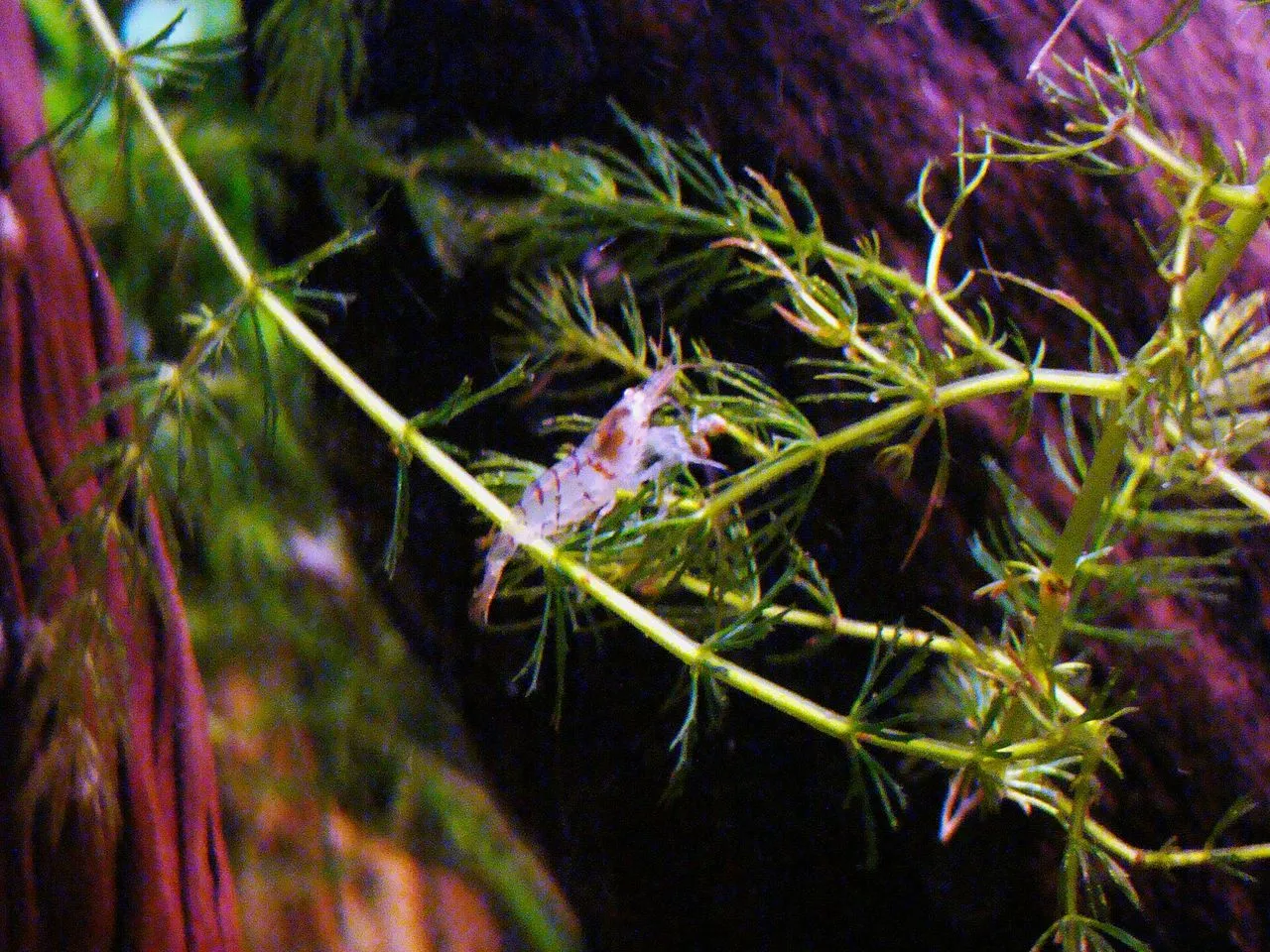
Answer: Choose nerite snails for steady glass, rock, and hardscape grazing. Choose Amano shrimp for soft algae, biofilm, leftover food, and planted tanks. Neither fixes excess light, overfeeding, or unstable water. Test ammonia, nitrite, nitrate, and pH before adding either animal to an algae problem tank.
Caridina multidentata (amano shrimp) and Neritina spp. (nerite snails) are sold at the same shop counter and recommended in the same breath — but they do not eat the same algae. Amanos are free-roaming grazers that work plant leaves, wood, and substrate in pursuit of filamentous and soft green growth. Nerites are methodical hard-surface raspers that clean glass and solid décor slowly and thoroughly. The question is not which animal is better; it is which algae you actually have.
Part of the Complete Shrimp & Snails Guide. Individual profiles: Amano Shrimp and Nerite Snail.
At a Glance
| Attribute | Amano shrimp (C. multidentata) | Nerite snail (Neritina spp.) |
|---|---|---|
| Primary algae target | Hair algae, fuzz algae, soft green spot, biofilm | Hard green spot algae (GSA), diatom film |
| Secondary targets | Leftover food, decomposing plant matter | Biofilm on glass and hard décor |
| Surface coverage | Free-roaming — plants, substrate, wood | Methodical on glass, stone, ceramic |
| Escape risk | Low — stays submerged | High — climbs out of rimless tanks |
| Bioload | Moderate | Low |
| Freshwater breeding | No — amphidromous larvae | No — larvae require salt water; females leave sterile white capsules |
| Lifespan in freshwater | 2–4 years | 1–2 years |
| GH / KH | 4–12 / 1–8 °dH | 6–14 / 4–10 °dH |
| pH | 6.5–7.8 | 7.0–8.0 (prefers alkaline) |
| Temperature | 20–26 °C | 22–27 °C |
| Typical cost (UK, 2026) | £4–£8 each | £2–£5 each |
Algae Performance by Type
Before buying either animal, identify what you have. The full diagnostic framework is at Algae Diagnosis and Control; the short version is in the table below.
| Algae type | Amano shrimp | Nerite snail |
|---|---|---|
| Hair algae (filamentous) | Excellent | Ineffective |
| Fuzz algae | Good | Poor |
| Soft green spot (early stage, plant surfaces) | Good | Moderate |
| Hard green spot algae — glass and rock | Poor | Excellent |
| Diatom film (brown, on glass) | Moderate | Excellent |
| Black beard algae (BBA) | Poor | Poor |
| Green water (suspended algae) | None | None |
Black beard algae and green water require parameter correction — neither grazer makes a meaningful dent in established infestations. BBA accumulates particularly on slow-growing plants like Anubias nana because that plant tolerates the low or fluctuating CO2 that allows BBA to thrive in the first place. Correct the mechanism, then let the grazers maintain the result.
Amano in Practice
A group of five amano shrimp is the minimum useful crew for a 100-litre planted tank. Singles hide constantly and graze far below their potential; a group forages across every surface — plant leaves, wood, substrate, filter intake pipes, the silicone edges of the glass. That broad roaming coverage is their core advantage: they reach soft algae that a nerite snail will never approach.
Five adults in a mature planted tank make visible progress on a moderate hair-algae outbreak within a week. If the underlying cause — excess light duration, unstable CO2, accumulated organics — has been addressed, a crew of amanos will push the algae back to near zero and maintain that through continuous grazing.
The tradeoff is bioload. At 4–5 cm, amanos eat substantially more than a 2 cm nerite and produce proportionally more waste. In a heavily stocked community tank, eight or more amanos load the filter measurably. Five to eight amanos in 100 litres is a sensible balance between cleaning power and biological load in most planted setups.
Target parameters: GH 4–12 °dH, KH 1–8 °dH, pH 6.5–7.8, TDS 120–300 ppm, 20–26 °C. Cooler temperatures extend lifespan — amanos kept at 20–22 °C routinely exceed three years. Full husbandry detail at Amano Shrimp.
Nerite in Practice
Neritina snails are specialist hard-surface grazers. A green-spotted rear panel, diatom-filmed filter pipes, or algae-covered smooth stones are all handled efficiently; soft plant tissue and filamentous threads are largely ignored. Three forms appear regularly in UK freshwater shops: zebra nerite (N. natalensis), horned nerite (N. brevispina), and tracked nerite (N. turrita). All eat the same algae — shell pattern is the only practical difference between them.
Two behaviours define nerite keeping, and both demand active management.
The first is escape. Nerites are coastal snails adapted to surviving tidal exposure above the waterline — climbing out of the water is instinctive behaviour, not a response to poor conditions. An open-top or rimless tank will lose snails to the floor within days. A tight lid, a water level kept three to five centimetres below the rim, or a strip of mesh at the tank edge prevents losses reliably. See Why Are My Snails Climbing Out of the Tank? for a fuller treatment of this behaviour.
The second is egg deposition. Females lay hard white sesame-seed-sized capsules on any smooth hard surface — glass panels, plastic ornaments, filter lids, even glass clips. The capsules are sterile in freshwater; the population does not increase from them. They accumulate and resist casual wiping; a credit card or scraper blade removes them cleanly.
Nerites prefer harder, more alkaline water than amanos: GH 6–14 °dH, KH 4–10 °dH, pH 7.0–8.0. KH below 4 °dH causes gradual shell erosion over months. Full profile at Nerite Snail.
Cohabitation: Combining Both
Most planted tanks develop mixed algae pressure — some filamentous growth on slow leaves, diatom film on the glass, occasional green spot building up on the back panel. A crew of amanos plus three to five nerites addresses that combination more completely than either animal alone, and the two species share space without any friction.
Amanos do not interfere with grazing nerites. Nerites ignore shrimp entirely. Both share an absolute copper-zero tolerance — any copper-containing medication or fertiliser contamination that harms one will kill both. Plan water treatment and fertilisation accordingly before adding either.
The overlapping parameter range sits at GH 6–12 °dH, KH 4–8 °dH, pH 7.0–7.6, TDS 150–280 ppm. That range suits the majority of planted community tanks and is achievable with standard tap or remineralised RO water. The KH floor of 4 °dH is important — it is set by nerite shell requirements, which are stricter than amano needs.
For a comparison of amanos against a colony-breeding option, see Cherry Shrimp vs Amano Shrimp.
Common Mistakes
- Expecting amanos to clean the glass. They won't. Amanos walk across glass but do not rasp it effectively. Hard green spot algae on the front panel is nerite work — not a sign that the amanos are failing.
- Expecting nerites to clear plant algae. They won't. Nerites cannot access fine filamentous growth on plant leaves and are not built to eat it. A nerite resting on a java fern leaf is not grazing — it is resting.
- Running an open tank with nerites. Nerite escapes are predictable, not occasional. Five nerites in an uncovered 60-litre tank can be on the floor by morning. Cover the tank or accept the losses; there is no middle option.
- Treating egg capsules as a population problem. The white dots on the glass are not larvae and cannot hatch in freshwater. Attempting to reduce the "population" by introducing a predator or adjusting water chemistry misunderstands the biology entirely. Scrape the capsules off with a blade every few weeks if the appearance is a concern.
- Stocking a single amano for algae control. A solitary amano hides, eats far less than a group, and produces no visible change in tank algae. The minimum effective number for meaningful algae control is five; for aquariums over 150 litres, eight to ten.
Quick verdict: choose by algae type and tank setup
Nerite snails are usually better for steady film algae on glass, rocks, and hardscape. Amano shrimp are more active pickers for soft algae, biofilm, leftover food, and tight plant surfaces, but they need stable water and peaceful tankmates.
When using both makes sense
A mixed cleanup crew often works best in planted tanks: nerites graze broad hard surfaces while Amanos work through plants and crevices. Do not rely on either animal to fix excess light, overfeeding, or high nutrients; algae control still starts with tank balance.
FAQ: will either one eat all algae?
No. Nerites and Amanos help manage algae, but they will not remove every type or solve an outbreak alone. Hair algae, black beard algae, and cyanobacteria usually need lighting, nutrient, flow, and maintenance changes too.
Quick answer
Pick Amano shrimp for soft algae, leftover food, and planted tanks. Pick nerite snails for steady glass and hardscape grazing. In many peaceful freshwater tanks, using both works better than expecting one animal to clean everything.
Which algae eater fits your tank?
Amano shrimp are more active and better at reaching plant leaves, moss, and tight spots. Nerite snails are slower, but they work steadily on glass, stones, driftwood, and equipment.
Before adding either one, check ammonia, nitrite, nitrate, and pH. A reliable liquid kit such as the API Freshwater Master Test Kit is more useful than guessing from algae growth alone. As an Amazon Associate, we earn from qualifying purchases, at no extra cost to you.
Use both when the problem is mixed
If you have film algae on glass and soft growth on plants, a nerite plus a small Amano group is usually the cleaner setup. Keep feeding light for the first week so they actually graze.
Which one cleans which algae?
Amano shrimp pick at soft film algae, biofilm, and bits of food trapped in moss or carpeting plants. Nerite snails rasp harder surfaces, so they are often better on glass, stones, and older green spot algae. Heavy root feeders in the same planted tank may still need substrate feeding; Seachem Flourish Tabs are a practical option for rooted plants when water-column dosing is not enough. As an Amazon Associate, we earn from qualifying purchases, at no extra cost to you.
- Choose Amano shrimp if the tank is planted, peaceful, and has lots of fine surfaces to graze.
- Choose nerite snails if glass and hardscape are the main problem areas.
- Skip both as a quick fix if ammonia or nitrite is detectable. Stabilize the tank first.
FAQ: Amano shrimp vs nerite snail for algae
Can Amano shrimp and nerite snails live together? Yes, in most peaceful freshwater community tanks. Keep copper medication out, acclimate slowly, and make sure the tank has enough mature biofilm before adding a large cleanup crew.
Test the tank before adding a cleanup crew
Amano shrimp and nerites are small animals, not cleanup equipment. If ammonia or nitrite is detectable, do not add either one yet. Fix the cycle first. If nitrate is high, reduce feeding and improve water changes before expecting grazers to make the tank look clean.
- Amano shrimp: best when the tank is mature, peaceful, and planted.
- Nerite snails: best when you have film algae on glass, rocks, or smooth hardscape.
- Both together: useful in stable tanks, but still not a cure for too much light or food.
As an Amazon Associate, we earn from qualifying purchases, at no extra cost to you. If you need to check the basics first, compare aquarium water test kits here: helpful product options on Amazon
Sources & References
- Werner, U. (1998). Atlas der Wirbellosen im Aquarium. Mergus Verlag.
- Lukhaup, C. & Pekny, R. (2008). Süßwassergarnelen aus aller Welt. Dähne Verlag.
- Coleman, N. (2003). Aquarium Snails. Aquatic Photographics.