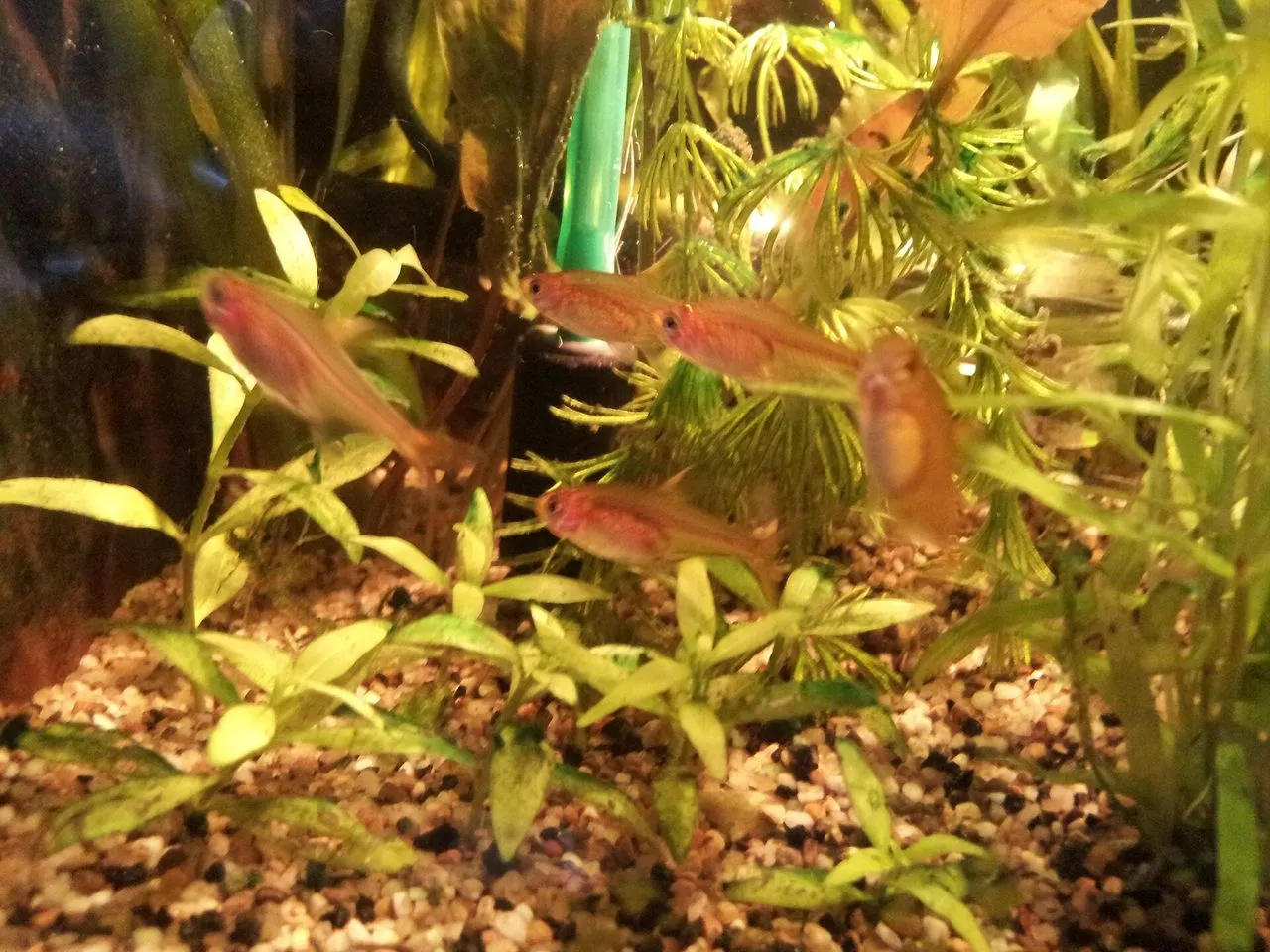
Answer: *Hyphessobrycon amandae* (ember tetra) is a 2 cm tight shoaler best kept in groups of ten or more. Provide GH 1–6 °dH, KH 0–3 °dH, pH 5.5–7.0, 24–28 °C, 50–180 µS/cm. Mature filtration, dimmer planted cover and stable conductivity matter more than chasing a perfect pH number. Embers fail in bright bare tanks because their size makes them cautious;
Hyphessobrycon amandae (ember tetra) is a 2 cm characin associated with Araguaia basin marginal vegetation and quiet warm shallows. It is part of the complete tetras guide, and its care is best understood through social behaviour, water chemistry and origin rather than through colour alone.
Identification
Adult ember tetras are identified by body proportion, stripe or fin pattern, and behaviour in the group. Shop juveniles are often pale after transport, so judge structure before colour. Healthy fish hold level in mid-water, respond quickly to food, and show clear fins without white margins, red streaking or clamped rays.
| Character | Expected in healthy fish | Warning sign |
|---|---|---|
| Adult size | 2 cm | Stunting in old fish kept in small groups or poor water |
| Social pattern | tight shoaler | Isolation, corner hovering or frantic glass surfing |
| Colour | Strongest over dark substrate and under broken light | Sudden fading after water changes or bullying |
| Fins | Clear edges, erect dorsal during display | Ragged edges, cottony growth or persistent clamping |
Sexing is easiest in mature, well-fed fish. Females are usually deeper-bodied when carrying roe; males are slimmer and often brighter in the fins or lateral markings. Do not rely on sexing in newly imported juveniles.
Origin & Habitat
The wild habitat is Araguaia basin marginal vegetation and quiet warm shallows. In practical aquarium terms this means clean water with low suspended waste, shelter at the margins, and enough open space for mid-water movement. Leaf litter, submerged roots and overhanging vegetation reduce light intensity in many habitats, while seasonal floods spread fish into shallow food-rich areas.
A reliable target range is GH 1–6 °dH, KH 0–3 °dH, pH 5.5–7.0, 24–28 °C, 50–180 µS/cm. Conductivity is useful because it captures total dissolved mineral load in a way pH alone does not. A tank at pH 6.6 and 70 µS/cm is very different from pH 6.6 and 450 µS/cm. For the chemistry behind GH and KH, see water hardness explained; for very hard tap water, reverse-osmosis water is the correct tool.
Aquarium Husbandry
Keep this species in a mature aquarium with zero ammonia, zero nitrite and nitrate preferably below 20 mg/L. A group of ten is the minimum; fifteen or more is better when space allows. Use a dark rear background, fine-leaved plants, driftwood and floating shade, but leave a visible front swimming lane. Amazon sword and Cryptocoryne wendtii both suit planted tetra tanks when the substrate and light level match their needs.
| Setup point | Recommendation |
|---|---|
| Minimum group | 10; 15+ preferred |
| Tank length | 60 cm for small calm groups, 90 cm or more for active adults |
| Filtration | Mature biological filtration with gentle-to-moderate current |
| Water changes | 20–35% weekly, temperature-matched and dechlorinated |
| Lighting | Moderate to low; use plants or floating cover to break glare |
Do not add this fish to an immature aquarium. The procedure in cycling a new aquarium prevents the ammonia and nitrite exposure that weakens newly purchased characins before symptoms are visible.
Tankmates & Behaviour
As a tight shoaler, the ember tetra should be stocked around its own group first. Suitable companions include peaceful corydoras, small loricariids, hatchetfish where covered tanks are available, and calm soft-water cichlids that cannot swallow it. In warm blackwater communities, cardinal tetra, rummynose tetra and neon tetra are useful comparison species, while sterbai corydoras works well where temperature is high.
Avoid mixing with fish that demand incompatible chemistry. Hard-water livebearers pull maintenance toward mineral-rich alkaline conditions; large cichlids treat small tetras as food. German blue ram can be a good companion only when the tetra also tolerates 27–28 °C.
Diet
Wild tetras pick at small insects, crustaceans, worms, algae films and drifting organic particles. In aquaria they do best on variety: fine high-quality dry food, frozen cyclops, daphnia, mosquito larvae, baby brine shrimp and occasional crushed spirulina-based foods. Feed small amounts once or twice daily. A tetra with a slightly rounded belly after feeding and a flat belly by the next morning is being fed correctly.
Overfeeding is more damaging than underfeeding. Uneaten food in leaf litter drives bacterial growth and raises dissolved organics, especially in warm low-KH tanks where biofiltration margins are narrower.
Breeding
Most spawning follows the characin pattern: conditioned adults scatter adhesive eggs among fine plants at first light. Use a separate 20–40 litre tank with mature sponge filtration, dim light, spawning mops or moss, and water near the soft end of the species range. Remove adults after spawning. Eggs usually hatch in one to two days depending on temperature; fry become free-swimming several days later and need infusoria before newly hatched brine shrimp.
Breeding success depends on clean, low-bacteria water more than on elaborate equipment. Hard, alkaline water often reduces egg viability in soft-water species even when adults appear healthy.
Common Problems
Embers fail in bright bare tanks because their size makes them cautious; dim light, fine plants and a group of fifteen or more produce the orange colour people buy them for. Quarantine all new fish for at least four weeks. Watch for wasting, white patches in muscle, bent posture, rapid breathing, fin erosion and failure to school. Some symptoms are environmental rather than infectious: high nitrate, low oxygen, temperature shock and sudden conductivity changes all produce dull colour and clamped fins.
Never medicate the display tank on guesswork. Move affected fish to quarantine, test ammonia, nitrite, nitrate, temperature, pH and conductivity, and correct husbandry faults before escalating treatment.
See Also
Frequently Asked Questions
How many ember tetras should be kept together?
Keep at least ten, with twelve to twenty giving better social behaviour. Small groups become nervous or redirect chasing onto tankmates; larger groups spread display pressure and produce more natural movement.
What water parameters suit the ember tetra?
A practical range is GH 1–6 °dH, KH 0–3 °dH, pH 5.5–7.0, 24–28 °C, 50–180 µS/cm. Stability is more important than daily adjustment; use reverse-osmosis water only when the tap supply is too hard for the species.
Is the ember tetra a good community fish?
Yes with peaceful tankmates that share temperature and mineral requirements. Avoid predatory cichlids, boisterous barbs, and long-finned fish when the species is known to nip.
Can ember tetras breed in the aquarium?
They can, but adults eat eggs. Use a separate dim spawning tank with fine plants or mesh, soft clean water, and remove adults after spawning. Fry need infusoria or other tiny first foods.
Sources & References
- Géry, J. (1977). Characoids of the World. T.F.H. Publications.
- Baensch, H.A. & Riehl, R. (1991). Aquarium Atlas, Vol. 1. Mergus Verlag.
- FishBase — Characiform species treatments. https://www.fishbase.se/
- Fricke, R., Eschmeyer, W.N. & Van der Laan, R. Catalog of Fishes. California Academy of Sciences.