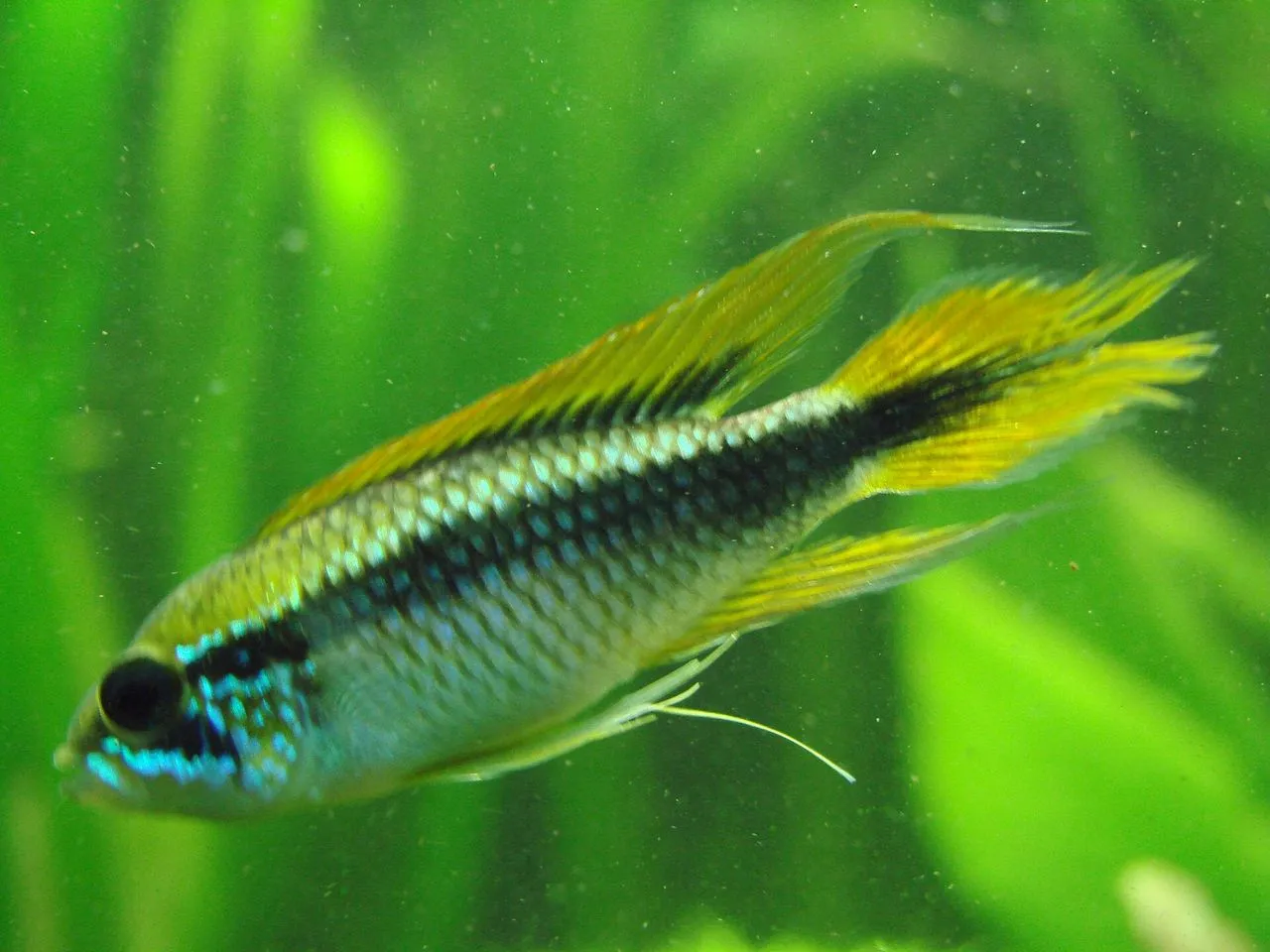
Answer: Apistogramma (especially cacatuoides) and Mikrogeophagus ramirezi occupy the same planted-tank niche but demand very different things. Cacatuoides tolerates GH up to 10 °dH, pH 6.0–7.4, and 24–28 °C — manageable for a first soft-water cichlid. Rams need 27–29 °C, GH under 6 °dH, KH near zero, and non-hormone-treated stock. Parameter precision, breeding behaviour, and sourcing honesty separate the two.
Apistogramma spp. and Mikrogeophagus ramirezi (German blue ram) are both South American dwarf cichlids suited to planted communities with soft water, fine substrate, and subdued lighting. They are sold on the same shelf to the same buyer, and the comparison is legitimate — they occupy a genuinely overlapping niche. Beyond that, the resemblance is surface-level. These two groups differ materially in parameter tolerance, social organisation, breeding biology, sourcing risk, and the experience level each actually requires.
Part of the Complete Cichlids Guide.
At a Glance
| Attribute | Apistogramma cacatuoides | Apistogramma agassizii | German blue ram |
|---|---|---|---|
| Adult size | 5–8 cm | 5–8 cm | 5–7 cm |
| Minimum tank (pair) | 60 L | 60 L | 60 L |
| Minimum tank (group) | 100 L+ (harem) | 100 L+ (harem) | 75 L+ (community) |
| Temperature | 24–28 °C | 25–28 °C | 27–29 °C |
| GH | 2–10 °dH | 0–6 °dH | 0–6 °dH |
| KH | 1–6 °dH | 0–3 °dH | 0–2 °dH |
| pH | 6.0–7.4 | 5.0–7.0 | 5.5–7.0 |
| Social structure | Polygynous harem (1M:2–3F) | Polygynous harem (1M:2–3F) | Monogamous pair |
| Spawning site | Cave interior | Cave interior | Flat rock or open substrate |
| Hardiness | Robust | Moderate | Fragile |
| Farm-stock risk | Low–moderate | Moderate | High |
| Experience level | Beginner–intermediate | Intermediate | Experienced |
Apistogramma in Practice
The genus Apistogramma contains around 90 described species, but two account for most of what reaches the trade: cacatuoides and agassizii. Both are cave-spawning, harem-forming dwarf cichlids — a social architecture with no equivalent in the ram group, and one that directly shapes tank size and layout decisions.
Cacatuoides as the entry species. Apistogramma cacatuoides is the natural starting point for keepers who don't yet run reverse osmosis. Its parameter window — GH 2–10 °dH, KH 1–6 °dH, pH 6.0–7.4, 24–28 °C — overlaps with moderately soft tap water in much of the UK and northern Europe, and it tolerates brief fluctuations that would damage agassizii or kill a ram outright. Multiple colour forms are available (double red, super red, orange flash), and quality tank-bred stock from reputable European breeders is increasingly easy to find.
The harem dynamic is practically significant. A male with two or three females distributes his spawning attention across separate territories; no single female bears the full weight of his interest through the breeding cycle. Each female claims a cave and surrounding floor zone; the male patrols a larger perimeter encompassing all of them. In 100 litres furnished with coconut-shell halves, Indian almond leaf litter, and broken sightlines, a trio will breed without much prompting once settled. The female alone incubates and guards fry, turning a distinctive yellow as a warning signal to tankmates during the brood phase.
Agassizii — softer and less forgiving. Apistogramma agassizii demands blackwater conditions: GH 0–6 °dH, KH 0–3 °dH, pH 4.8–6.8, conductivity 20–150 µS/cm. Tap water with moderate mineralisation will prevent breeding and cause slow decline without RO support. Multiple colour forms exist (fire red, tefe, double red), and hybridised or mislabelled stock is a genuine risk — source from specialists who can confirm locality data.
German Blue Ram in Practice
Mikrogeophagus ramirezi (German blue ram) is among the most intensely coloured small cichlids in the freshwater hobby. It is also among the most reliably killed through mismatched husbandry, and no honest comparison can obscure that.
Temperature is not negotiable. Rams originate from the Orinoco llanos — shallow, sun-warmed savanna pools where water temperatures routinely exceed 28 °C. In an aquarium, 27–29 °C is the functional minimum for long-term immune competence. At the 24–25 °C that suits many general community fish, rams suffer chronically suppressed immunity, become prone to gill flukes and fish tuberculosis, and rarely survive a full year. Temperature sets the parameters for every other species in the tank — the ram defines the temperature, not the other way around.
Farm stock versus locally bred. Most German blue rams in the trade are mass-produced on Southeast Asian farms, frequently under hormone treatment to accelerate colour development in juveniles. These fish arrive visually spectacular and often deteriorate within weeks. The original "German blue ram" was a strain developed by European hobbyists in the 1980s: heavy-bodied, reliably coloured without hormones, and substantially hardier than the Asian-farm successor the name is now applied to indiscriminately. Locally bred or "German strain" fish from specialist UK or European breeders cost considerably more and repay the difference in longevity. If the supplier cannot confirm breeding origin, assume farm stock.
Pair dynamics. Unlike apistos, rams are strictly monogamous — a compatible pair stays close, spawns on flat-rock or open-substrate sites, and both partners guard fry. Compatibility is not automatic; not every male-female combination bonds. The standard approach is to buy four to six juveniles, let pairs form naturally, and rehome the extras once bonds are clear. A mismatched pair in a small tank produces sustained aggression with nowhere to escape. For a cooler-tolerant and substantially more forgiving alternative in the same genus, see the Bolivian ram — larger (7–9 cm), harder-water-tolerant, and comfortable at 24–27 °C.
Tank Setup: Cave vs Substrate Spawner
The spawning site drives much of the physical layout.
Apistogrammas are cave spawners. The female selects an enclosed site — a coconut-shell half, a clay pot on its side, a folded Anubias leaf over driftwood — and spawns on the interior ceiling or wall. Provide at least one cave per female, spaced so each controls a defined zone without continuous sightlines to rivals. Fine sand and leaf litter replicate the blackwater forest-floor habitat and release tannins that nudge pH gently downward.
German blue rams spawn on open flat surfaces: a smooth slate tile, a broad Amazon sword leaf, occasionally bare substrate. Both partners fan and guard the clutch, then move wriggling larvae to shallow pits dug nearby. The tank needs clear areas of fine sand floor with flat stones positioned at moderate distances from planting — not buried inside a cave system. Background plants and leaf cover still benefit the fish, but the critical feature is open benthic space rather than enclosed structure.
Both groups need gentle flow, subdued or dappled lighting, and stable soft chemistry. For the underlying chemistry — what GH and KH measure separately, and why both numbers matter — water hardness, GH, and KH explained covers the detail.
Tankmate Compatibility
Both species suit similar companions: small, non-nippy, chemistry-compatible schooling fish that hold mid-water rather than competing for benthic territory.
Cardinal tetras are the benchmark pairing for soft warm-water cichlids of this type — they share the chemistry requirements, add active mid-column movement, and don't provoke territorial responses from either group. Sterbai corydoras are the preferred bottom companion for ram-temperature tanks specifically; most other corydoras species struggle above 26 °C.
Avoid fin-nippers (tiger barbs, serpae tetras), hard-water community fish (farmed livebearers, African cichlids), and other territory-holding cichlids unless the tank is large enough to create fully separate zones. Shrimp are at genuine risk during any active spawning — both species will predate small shrimp while guarding eggs or fry.
Apistos are more tolerant of mixed-community layouts than rams. Their wider parameter window and lower temperature ceiling allow a broader range of community fish without compromise.
Where Each One Fits
Choose A. cacatuoides if you are new to South American dwarf cichlids, have access to moderately soft water (or can blend tap with a proportion of RO water to reach GH 3–8 °dH), want visible harem territorial behaviour, and prefer robust, predictably sourced tank-bred fish.
Choose A. agassizii if you already run a working RO system producing conductivity consistently under 150 µS/cm and want to pursue locality-specific colour forms or dedicated blackwater breeding.
Choose the German blue ram if you can hold 27–29 °C without compromise, run a dedicated soft-water community rather than a general mixed tank, source locally bred or German-strain fish rather than farm stock, and want a strict pair-bonding dynamic rather than a harem. If any of those three conditions — temperature, chemistry, sourcing — cannot be met, apistos are the honest recommendation.
Common Mistakes
- Running a mixed apisto-ram tank. The temperature ranges create a real conflict. Rams at 24 °C have shortened lifespans; cacatuoides pushed to 29 °C are held uncomfortably warm. The overlap zone satisfies neither species. Choose one group and build the tank around it.
- Buying farm rams on appearance alone. Hormone-treated farm stock is visually indistinguishable from healthy locally bred fish at point of sale. Ask directly: where were these fish bred, are they hormone-free, how long has the seller held them? A seller who cannot or will not answer is itself a signal.
- Keeping one male apisto with one female. A 1:1 pairing concentrates all spawning-cycle harassment on a single female — she can be killed within weeks. A 1:2 or 1:3 male-to-female ratio distributes the pressure. The cacatuoides profile gives tank sizing for each ratio.
- Ignoring nitrate for rams. Even at correct temperature and pH, nitrate above 20 mg/L suppresses ram immune function and breeding condition. Weekly water changes of 30–40% are the minimum rhythm — a ram tank is not a low-intervention system.
- Confusing M. ramirezi with M. altispinosus. The Bolivian ram is larger, cooler, and far more forgiving than the German blue ram. Both share the common name "ram" and are sold interchangeably in some shops. Check the temperature requirement: 23–26 °C means you have a Bolivian; 27–29 °C means you have a German blue. They should not be set up identically.
Frequently Asked Questions
Can Apistogramma and German blue rams be kept in the same tank?
Not recommended. Temperature is the core conflict: cacatuoides thrives at 24–28 °C, while rams need 27–29 °C for long-term immune health. An overlap temperature holds both species at the outer edge of their tolerance simultaneously. They also compete directly for benthic territory and cave sites.
Which is better for a first dwarf cichlid?
Apistogramma cacatuoides. Its parameter window overlaps with moderately soft tap water, it is available as genuine tank-bred stock from European breeders, and the harem social structure distributes aggression so a single female is not harassed to exhaustion. German blue rams are not beginner fish.
Why do German blue rams die so quickly after purchase?
The three leading causes are temperature too low (below 26 °C suppresses immunity in this species), elevated nitrate, and hormone-treated Asian farm stock with compromised lifespans. Locally bred or 'German strain' rams kept at 28 °C with nitrate below 15 mg/L are substantially more resilient.
What is the practical difference between Apistogramma cacatuoides and agassizii?
Both are cave-spawning harem cichlids, but agassizii requires genuinely blackwater conditions — GH 0–6 °dH, KH 0–3 °dH, pH 4.8–6.8, conductivity 20–150 µS/cm. Cacatuoides tolerates harder, more mineralised water. Without a reverse-osmosis unit producing consistent soft water, agassizii is the harder choice.
Which breeds more reliably in captivity?
Apistogramma. Cave-spawning females manage brood defence independently and will breed readily once parameters, caves, and a 1:2 male-to-female ratio are in place. Farm-line rams commonly abandon eggs or consume them — consistent breeding usually requires locally bred fish and impeccable water.
Sources & References
- Loiselle, P.V. (1995). The Cichlid Aquarium. Tetra Press.
- Stawikowski, R. & Werner, U. (1998). Die Buntbarsche Amerikas, Band 1. Eugen Ulmer.
- Römer, U. (2006). Cichlid Atlas, Vol. 1: South American Dwarf Cichlids. Mergus Verlag.
- FishBase — Apistogramma cacatuoides & Mikrogeophagus ramirezi. https://www.fishbase.se/