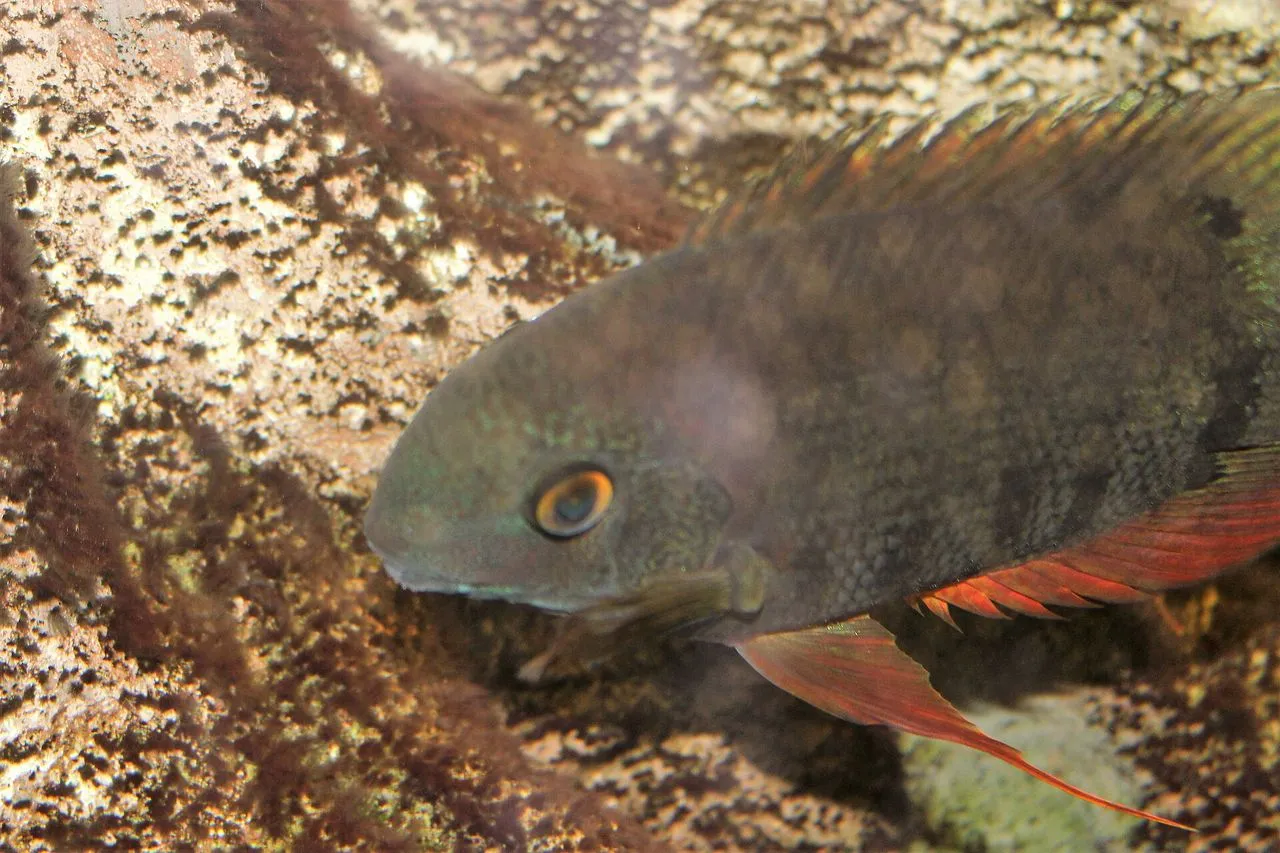
Answer: *Symphysodon* spp. (discus) and *Pterophyllum scalare* (angelfish) are both soft-water South American cichlids, but they suit different keeper profiles and should not share a tank. Discus require narrow blackwater conditions (GH 0–4 °dH, pH 5.0–6.8, 28–30 °C), larger tanks, and a higher budget. Angelfish tolerate a wider chemistry window, cost considerably less, and forgive occasional parameter variance. Choose discus if you can match the water and commit to it; choose angelfish if you cannot.
Symphysodon aequifasciatus and S. discus (discus) and Pterophyllum scalare (angelfish) originate from overlapping Amazonian and Guiana Shield river systems — both occurring in slow, tannin-stained blackwater channels where mineral content drops close to zero. The resemblance ends there. Discus are parameter-sensitive specialists with a narrow chemistry window, high temperature demands, and a purchase cost that reflects the difficulty of keeping them well. Angelfish tolerate a broader range, cost a fraction of the price, and survive the occasional variance that kills discus within weeks. This is not a question of which is better. It is a question of which suits your water, your tank, and your level of commitment.
Part of the Complete Cichlids Guide.
At a Glance
| Attribute | Discus (Symphysodon spp.) | Angelfish (Pterophyllum scalare) |
|---|---|---|
| Adult size | 15–20 cm (disc-shaped body) | Up to 15 cm body; 20–25 cm including fin span |
| Swimming style | Slow, methodical; hovers and inspects | Taller profile, reactive; faster directional movement |
| Temperature | 28–30 °C | 25–28 °C |
| GH | 0–4 °dH | 2–8 °dH |
| KH | 0–1 °dH | 1–4 °dH |
| pH | 5.0–6.8 | 6.0–7.2 |
| Conductivity | 30–120 µS/cm | 80–250 µS/cm |
| Minimum tank (group) | 300 L for six adults | 200 L for four to six; min. 50 cm water height |
| Pair formation | 12–18 months | 10–14 months |
| Breeding mode | Vertical substrate; fry feed on parental skin mucus | Vertical substrate; biparental fanning |
| Cost (UK, 2026) | £30–£100 tank-bred; £100–£300 wild | £10–£40 |
| Experience required | Intermediate to advanced | Beginner to intermediate |
| Key fragility | Temperature drops, dirty warm water, mixed farm/wild lines | Fin damage in short tanks; columnaris risk under stress |
Discus in Practice
The discus is not a community fish in any general sense. It is a group animal with a social hierarchy, slow pair-bond formation, and water chemistry requirements that exclude most community-tank staples. The discus profile covers husbandry in full; the comparison-relevant points are water, temperature, and what those constraints demand.
Water is the first filter. GH 0–4 °dH, KH 0–1 °dH, pH 5.0–6.8, 28–30 °C, conductivity 30–120 µS/cm are not rough guides — they are the functional range within which this species maintains immune stability and breeding condition. Most UK tap water exceeds this hardness, making reverse osmosis water not an upgrade but a starting point. Understanding the difference between general hardness and carbonate hardness matters here more than almost anywhere else; water hardness and KH explains why a stable pH reading can coexist with biologically wrong mineral content.
Temperature at 28–30 °C is non-negotiable and has downstream consequences. Warm water holds less dissolved oxygen, so filtration must provide strong surface agitation and thorough biological processing without generating currents that stress the fish. Water changes must be temperature-matched precisely — a 2 °C drop during a routine change is sufficient to trigger immune suppression in susceptible individuals.
Discus breeding behaviour is unlike any other cichlid. They are vertical substrate spawners whose newly hatched fry, once they have absorbed the yolk sac, feed directly on a mucus layer secreted from the parents' skin. This parental mucus feeding is unique among cichlids. It requires both parents to remain physically close to the fry for the first week and makes the pair acutely sensitive to disturbance near the spawning site.
Before pairs form — a process that takes 12–18 months — the group maintains a loose dominance hierarchy. Dominant fish displace subordinates at feeding sites. Spreading food along the front glass rather than depositing it at one point reduces this pressure and keeps subordinate fish in condition.
Angelfish in Practice
Angelfish are more widely available, more adaptable, and more forgiving — which explains their status as one of the most commonly kept cichlids in home aquaria. The angelfish profile has the full species account. The comparison-relevant details centre on parameter tolerance and what the body plan demands of the aquarium.
The parameter window is genuinely broader: GH 2–8 °dH, KH 1–4 °dH, pH 6.0–7.2, 25–28 °C. Moderately soft tap water in many UK regions falls within or close to this range without RO treatment. Where it does not, partial RO blending or peat-filtered water changes are usually sufficient.
The body plan creates one constraint the numbers alone do not convey: height. P. scalare reaches 20–25 cm from dorsal fin tip to ventral fin tip at adult size. A tank with less than 50 cm water height compresses the fins chronically and stunts the dorsal profile over time. Standard 200-litre aquaria in the UK are often shallower than this; check the water column depth, not just the stated volume.
Social behaviour before pair formation is loose and relatively peaceful. Juvenile groups coexist without strong hierarchy. At 10–14 months, pairs begin separating from the group, claiming a vertical surface or broad leaf as a spawning site and defending it with increasing force. In a 200+ litre tank with adequate visual breaks in the aquascape, a group of six typically settles into one or two dominant pairs while the remaining fish maintain a quieter social arrangement — provided sightlines are interrupted.
Feeding appetite is broad and includes anything small enough to swallow. Neon tetras (Paracheirodon innesi) are a well-documented casualty at adult angelfish size. Cardinal tetras (Paracheirodon axelrodi) grow large enough to be safe with established adults in most tanks.
Tankmate Compatibility
| Tankmate | With discus | With angelfish | Notes |
|---|---|---|---|
| Cardinal tetras | Excellent | Good | Share blackwater parameters; size is safe with adult angelfish |
| Rummynose tetras | Excellent | Good | Prefer soft acidic water; school actively in groups of 10+ |
| Neon tetras | Not recommended | Risky | Small profile — predation risk with adult angelfish |
| Sterbai corydoras | Excellent | Caution | C. sterbai tolerates 28–30 °C; most other corydoras prefer cooler water |
| Bronze corydoras | Not suitable | Good | Preferred range 22–26 °C — incompatible with discus temperatures |
| German blue ram | Possible | Not recommended | Temperature overlap with discus; rams are routinely bullied by angelfish |
| Severum | Not recommended | Possible | Parameter mismatch with discus; size and territory manageable with angels in large tanks |
Cardinal tetra and rummynose tetra are the default soft-water schooling partners for both species, with the temperature caveat for discus tanks. Sterbai corydoras is the correct corydoras choice for a discus setup because, unlike most of the genus, it tolerates sustained temperatures into the low 30s without chronic physiological stress.
Where Each One Fits
Choose discus if you have or can build a reliable RO system, your tank is at least 300 litres with stable heating, you have prior experience with soft-water South American fish, and your budget covers £30–£100 per fish for quality tank-bred lines. The payoff is significant: a group of six discus with cardinal tetras and sterbai corydoras in a well-planted blackwater display is among the most complete freshwater arrangements available to the home aquarist.
Choose angelfish if your tap water is already moderately soft (GH under 8 °dH, pH below 7.2) or you can blend toward that range, your tank is 200 litres with at least 50 cm height, and you want a cichlid that tolerates a mixed community, occasional parameter variance, and the kind of husbandry that does not require RO infrastructure. The pair-formation behaviour and vertical substrate spawning are also genuinely accessible and rewarding without specialist equipment.
The problem is never choosing one or the other. The problem is choosing discus and providing angelfish-level husbandry.
Why Not Both?
Keeping discus and angelfish together is not a workable compromise, and the reasons compound each other.
Temperature is the central conflict. Discus are healthy at 28–30 °C; angelfish are healthy at 25–28 °C. At 28 °C — the only point of meaningful overlap — discus are at the bottom of their comfort range and angelfish are at the top of theirs. Long-term exposure at either species' thermal extreme reduces immune function, shortens lifespan, and suppresses breeding condition.
Feeding dynamics favour angelfish consistently. They are faster, more assertive feeders and displace discus from food in any competitive situation. Chronically underfed discus lose condition quickly and become vulnerable to the bacterial and parasitic infections that warm, organically loaded water makes available.
There is also the disease vector argument. Farm-bred angelfish regularly carry subclinical bacterial loads — Flavobacterium columnare (columnaris) being the most prevalent — that remain dormant in the more robust angelfish but activate in discus kept near the edge of their parameter range. This is not a theoretical risk. It is the mechanism behind a substantial proportion of discus failures in tanks where the water chemistry was technically correct.
For keepers drawn to the shaped South American cichlid look without the specialist demands of discus, severum (Heros efasciatus) offers a practical middle ground: broader chemistry tolerance, lower running cost, and compatible with the soft-water community format.
Common Mistakes
- Keeping discus and angelfish in the same tank. The temperature conflict, feeding competition, and disease transfer risk are all stacked against the discus from day one. Separate tanks are the only workable arrangement.
- Selecting a tank by volume without checking height for angelfish. A 200-litre aquarium at 38 cm height is within the volume specification but compresses adult fins over time. Measure the water column depth before purchasing fish.
- Relying on conductivity alone to assess discus water quality. Conductivity confirms dissolved solids but does not separate GH from KH. A remineraliser used at the wrong concentration can produce low conductivity alongside elevated magnesium — plausible on a conductivity meter, wrong for a discus. Measure GH and KH separately.
- Assuming tank-bred discus tolerate community conditions. Selective breeding has widened the parameter margin slightly, but the immune response to temperature shock and dirty warm water remains intact. Tank-bred is not the same as community-hardy.
- Skipping quarantine before adding any new fish to a discus tank. Every new arrival — tetra, corydoras, or another discus — should complete four to six weeks of quarantine before entering an established discus system. The discus immune system is the most fragile variable in the aquarium.
Frequently Asked Questions
Can discus and angelfish be kept together?
No. The temperature windows overlap only at the extremes — discus need 28–30 °C, angelfish are healthiest at 25–28 °C — and any compromise harms one species. Angelfish are also faster, more assertive feeders that consistently displace discus from food. Farm-bred angelfish can carry subclinical bacterial loads that stress discus immune systems. Keep them in separate tanks.
What are the minimum tank sizes for each?
Discus: 300 litres for a group of six adults. Smaller volumes make water stability difficult, which is the primary failure mode for this species. Angelfish: 200 litres for a group of four to six, with at least 50 cm water height to accommodate the tall fin profile without damage.
Which is more suitable for a less experienced keeper?
Angelfish. They tolerate a wider parameter range (GH 2–8 °dH, pH 6.0–7.2, 25–28 °C), cost considerably less, and survive the occasional water chemistry lapse that kills discus. Discus are an intermediate-to-advanced species that reward prior experience with soft-water South American husbandry.
What tetras are safe with discus?
Cardinal tetras (Paracheirodon axelrodi) are the standard choice — they share the blackwater parameter range and grow large enough to avoid predation. Rummynose tetras (Hemigrammus bleheri) are equally reliable. Neon tetras are risky at adult discus size; their smaller profile makes them viable prey.
Why are discus so expensive compared to angelfish?
Wild specimens require importation from Amazonian river systems and attract export regulation costs, placing them at £100–£300 each. Tank-bred lines are more accessible at £30–£100, but quality varies widely between sources. The price also reflects the investment in selective line breeding for colour, symmetry, and disease resilience.
Sources & References
- Loiselle, P.V. (1994). The Cichlid Aquarium. Tetra Press.
- Stawikowski, R. & Werner, U. Die Buntbarsche Amerikas. Eugen Ulmer.
- FishBase — Symphysodon and Pterophyllum scalare. https://www.fishbase.se/