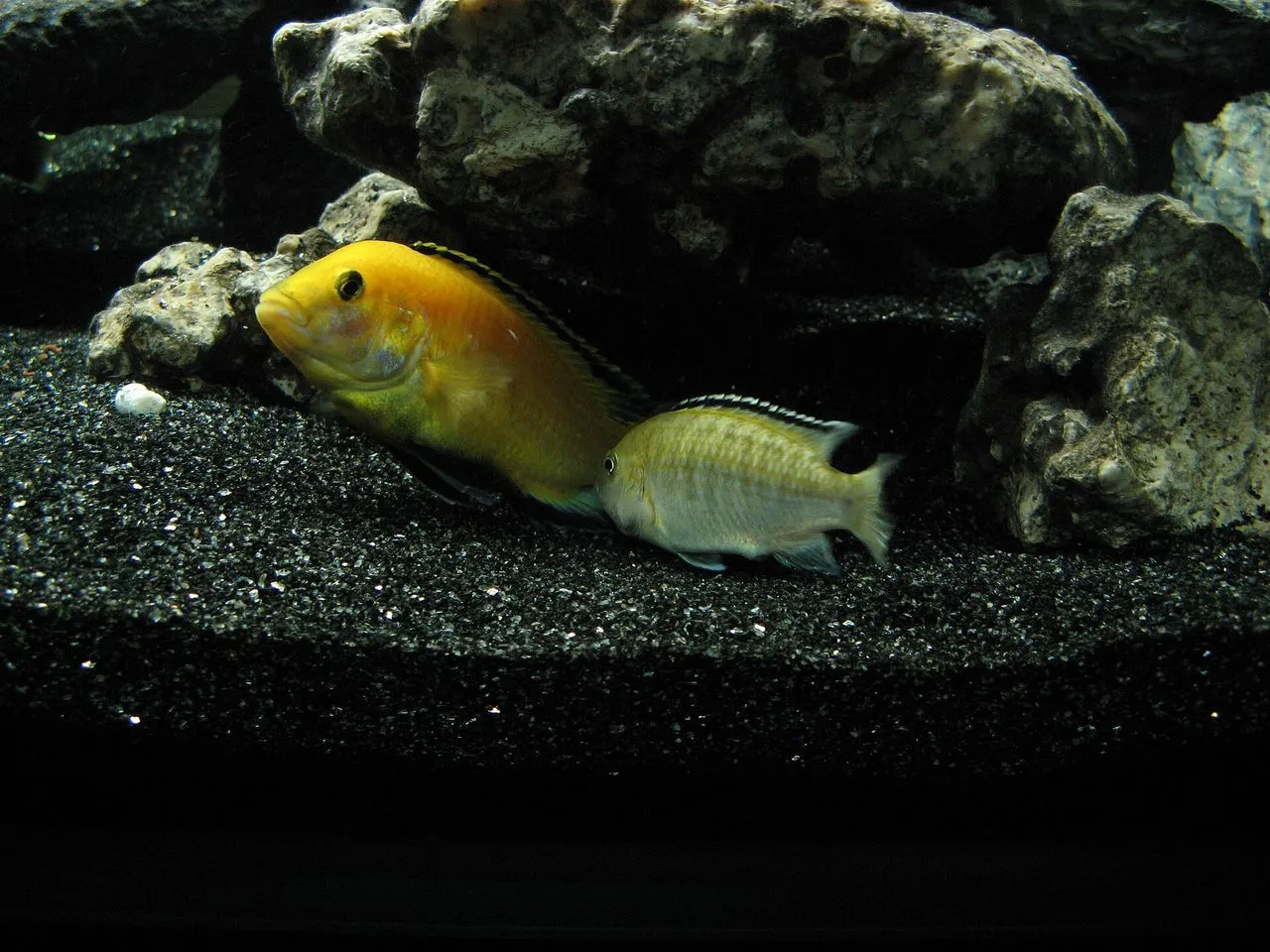
Answer: Angelfish chasing is almost always pair-formation or breeding aggression — both normal in maturing Pterophyllum scalare. Pair-forming fish compete for mates and vertical territory from around six months old; a bonded pair then defends the spawn site against everyone. If the chasing is cyclical and resolves after spawning, it needs monitoring rather than intervention. Sustained, non-cyclical aggression usually means the tank is too small, the group number is wrong, or a fin-nipping tankmate is the real instigator.
Pterophyllum scalare is social and largely peaceful as a juvenile, then changes — sometimes within a few weeks — as it matures and begins competing for mates and vertical territory. That shift, not some character defect, is behind almost every case of an angelfish chasing its tankmates. Understanding which phase you are watching — pair formation, breeding aggression, or a tankmate mismatch — determines whether you need to rearrange the tank, move fish, or simply wait.
Part of the Complete Cichlids Guide.
Main Causes
| Cause | When it occurs | Typical targets |
|---|---|---|
| Pair formation | Sexual maturity, roughly 6–14 months | Other angelfish, especially rival males |
| Breeding aggression | Bonded pair defending spawn site | All tankmates within patrol range of the spawning surface |
| Hierarchy consolidation | New fish added; group too small to spread aggression | Weakest group member |
| Tank volume too low | Insufficient territory relative to fish count | Whichever fish cannot escape |
| Fin-nipping tankmates | Any age — serpae tetras and tiger barbs are the common culprits | The nipping fish and bystanders within range |
| Isolated male with no female | No pair bond achievable; aggression redirected | Everything in reach |
Pair formation and breeding aggression account for the great majority of reports. They are related but distinct: pair formation is about claiming a mate; breeding aggression is about defending what the pair has already won.
How to Identify the Problem
Pair forming in a group
One fish — or two that have begun shadowing each other — chases the others away from a preferred vertical surface or plant corner. The chasee retreats without fighting back; the aggressor does not pursue far. Intensity builds in the days before spawning and eases once the pair has established a clear site. Yamamoto et al. (1999) showed that aggression toward intruders is highest when both partners are present and consolidating the bond, and drops sharply when the pair is separated — a useful diagnostic if you suspect this phase.
Watch for: lip-locking or lateral fin displays between two candidate fish; one individual repeatedly pushing others toward the surface or a back corner.
Breeding pair defending a spawn site
Both fish — male and female — patrol a cone around a chosen surface: a broad leaf, a piece of slate, a smooth section of driftwood, or the flat intake pipe of a filter. Chasing is faster and more determined than pair-formation chasing, and both fish return immediately to the site rather than lingering. This coordinated double-guarding is normal across South American substrate spawners — severums and discus show the same behaviour, though angelfish are generally milder between spawning cycles. Intensity peaks in the 48 hours before spawning and stays elevated for two to three weeks while the pair tends fry.
Watch for: one specific surface being cleaned meticulously by both fish; reduced appetite in the pair; both fish charging outward simultaneously toward intruders.
Chronic hierarchy aggression
A single dominant fish harasses every other angelfish without forming a pair, cleaning a surface, or showing any cyclical pattern tied to spawning. Loiselle (1994) notes that in insufficient aquarium volume, the cichlid dominance hierarchy compresses so completely that the lowest-ranked individual receives concentrated attacks with nowhere to go. This is the most damaging scenario and requires the fastest response.
Watch for: one fish feeding freely while others queue or avoid; subordinates holding the upper water column to stay above the dominant's chosen territory; progressive fin shredding on the weakest individual.
Risk and Severity
| Scenario | Injury risk | Urgency |
|---|---|---|
| Brief pair-formation chasing, resolves in days | Low | Monitor only |
| Breeding pair in 200 L+ tank with visual barriers | Medium — watch the most delicate companions | Move sensitive species if needed |
| Breeding pair in a small or bare tank | High — cornering causes fatal stress | Separate breeding pair or rehouse companions immediately |
| Chronic hierarchy aggression, no pair forming | High — cumulative fin loss and starvation in subordinates | Rehouse the weakest fish or rehome the dominant |
| Fin-nipping tankmate provoking retaliation | Medium — the angelfish is often the secondary victim | Remove the fin-nipper first |
Serpae tetras and tiger barbs are the two most commonly reported fin-nipping culprits in angelfish tanks. Both target the long dorsal and ventral fins. The resulting counter-attack from the angelfish often appears to be unprovoked aggression when the fin-nipper is the real cause.
Solutions and Actions
Pair-formation chasing not causing injury
Wait. Ensure the tank holds at least 200 litres and that tall plants or driftwood give subordinate fish somewhere to break line-of-sight. The chasing typically resolves within one to two weeks once the pair has claimed a corner.
Breeding pair injuring companions
Three options, in order of preference:
- Move the most vulnerable tankmates temporarily. A spare tank or a cycled quarantine container is sufficient for the two to three weeks the fry-guarding phase typically lasts.
- Add a visual barrier. A dense stand of Amazon sword or a piece of driftwood placed between the spawn site and the rest of the tank reduces the pair's patrol radius substantially.
- If the tank is below 200 litres, move the pair to a dedicated breeding setup and return the companions to the main display.
Do not remove the eggs to calm the pair. This restarts the courtship cycle and prolongs the aggressive phase rather than ending it.
Chronic hierarchy aggression
This almost always means three to five fish in a tank that cannot support independent territories. The practical fix is either to increase the group to six or more — distributing aggression — or reduce to one confirmed pair. Three to five angelfish in a 200-litre tank is the most reliably bad configuration in common use: too few fish to diffuse attacks, too little space for subordinates to establish any distance.
Fin-nipping tankmates
Remove serpae tetras or tiger barbs promptly; they cannot be managed out of fin-nipping in a confined system. Good bottom-dwelling alternatives that do not compete for angelfish mid-water territory include bronze corydoras, which occupy the substrate layer and ignore mid-water social dynamics entirely. Cardinal tetras are a reliable mid-water companion in soft, warm setups — they share the angelfish's Amazonian water chemistry, and adult cardinals are too large to be eaten.
Prevention
Start with the right group size. Buy six juveniles and raise them in a 250-litre or larger tank. This gives enough fish for natural pairs to form while spreading competitive aggression across the group. Fewer than four almost always produces chronic bullying once pair formation begins around six to eight months.
Provide dedicated vertical spawning surfaces. When slate tiles, broad-leaved plants, or smooth driftwood are absent, a pair will claim whatever is available — often the filter intake or the front glass — and defend a disproportionately large radius because there is no defined focus point. Leaning two pieces of slate against the rear glass gives pairs a clear site and gives the keeper some control over where aggression concentrates.
Introduce tankmates before the angelfish mature. Fish present since the angelfish were juveniles receive less aggression than fish introduced to an established territory. This is consistent with documented cichlid tendency — familiar individuals are treated differently from strangers. All planned companions should be in place while the angelfish are still small.
Use smaller, more frequent water changes. Dos Santos et al. (2018) demonstrated that large water changes dilute the chemical dominance signals angelfish release in urine, triggering hierarchy re-establishment through chasing. Smaller changes of 15–20% every few days produce equivalent water quality improvement with fewer dominance resets. For the chemistry background on what stable parameters mean for this species, see GH and KH explained.
Common Mistakes
- Keeping three to five angelfish in a mid-size tank. Not enough fish to diffuse aggression; not enough space for independent territories. Go to six in a larger tank or go to a single confirmed pair.
- Adding new tankmates after the pair has established a territory. Any full rearrangement of the hardscape — repositioning the slate, moving plants — resets territorial perception and is the safest moment to introduce new fish. Adding arrivals to an undisturbed, established territory almost guarantees attack.
- Removing the weakest angelfish expecting the aggression to stop. When the bottom-ranked fish is removed, attacks transfer to the next weakest individual. The social structure reconfigures; it does not simplify.
- Misidentifying all chasing as disease or water-quality failure. Pair formation and breeding aggression are normal, recurring behaviours in healthy fish. Treating them with emergency water interventions or medication wastes time and may stress a pair that is simply spawning on schedule.
- Choosing tankmates by size alone. A large gourami looks safe and is roughly the same body size. In practice, both species use the upper water column and their body shape similarity triggers more lateral-display aggression than smaller, faster species do. Review the full tankmate notes in the angelfish profile before finalising the community.
Frequently Asked Questions
Why is my angelfish suddenly aggressive after a water change?
Large water changes dilute the chemical dominance signals angelfish release in urine. When those signals disappear, fish re-establish hierarchy through chasing. Dos Santos et al. (2018) found aggression peaks within 12 hours of a large change and subsides as signals rebuild. Switching to more frequent, smaller changes — 15–20% every few days rather than a single 50% weekly change — reduces this effect without compromising water quality.
Should I remove the eggs to calm a breeding pair?
No. Removing the eggs restarts the courtship cycle, which means the aggressive phase begins again without resolving anything. If other fish are being injured, move the companions to a spare tank rather than disturbing the spawn site.
Is the male or female more aggressive?
Both defend the spawn site actively. Yamamoto et al. (1999) found males attack same-sex intruders more intensely than females do and are the more aggressive sex overall. However, females defend eggs and fry with real force and can inflict serious damage on tankmates that approach too closely.
How many angelfish should I keep to minimise aggression?
Either one, two (a confirmed pair), or six or more. Groups of three to five are the most problematic: large enough for the dominant fish to monopolise territory, too small to diffuse aggression across multiple individuals. In a 250-litre or larger tank, a group of six allows natural pairs to form and settle into semi-distinct zones.
Can I keep angelfish with fin-nippers?
No. Serpae tetras and tiger barbs nip the long dorsal and ventral fins, triggering retaliatory chasing that disrupts the entire tank. The angelfish often appears to be the aggressor when the fin-nipper started the problem. Remove the nipper rather than managing the angelfish's response.
Sources & References
- Yamamoto, M.E. et al. (1999). Mate guarding in an Amazonian cichlid, Pterophyllum scalare. Journal of Fish Biology, 55(4): 888–891. doi:10.1111/j.1095-8649.1999.tb00727.x
- Dos Santos Gauy, A.C., Boscolo, C.N.P., & Gonçalves-de-Freitas, E. (2018). Less water renewal reduces effects on social aggression of the cichlid Pterophyllum scalare. Applied Animal Behaviour Science, 198: 121–126.
- Loiselle, P.V. (1994). The Cichlid Aquarium. Tetra Press.
- FishBase — Pterophyllum scalare. https://www.fishbase.se/