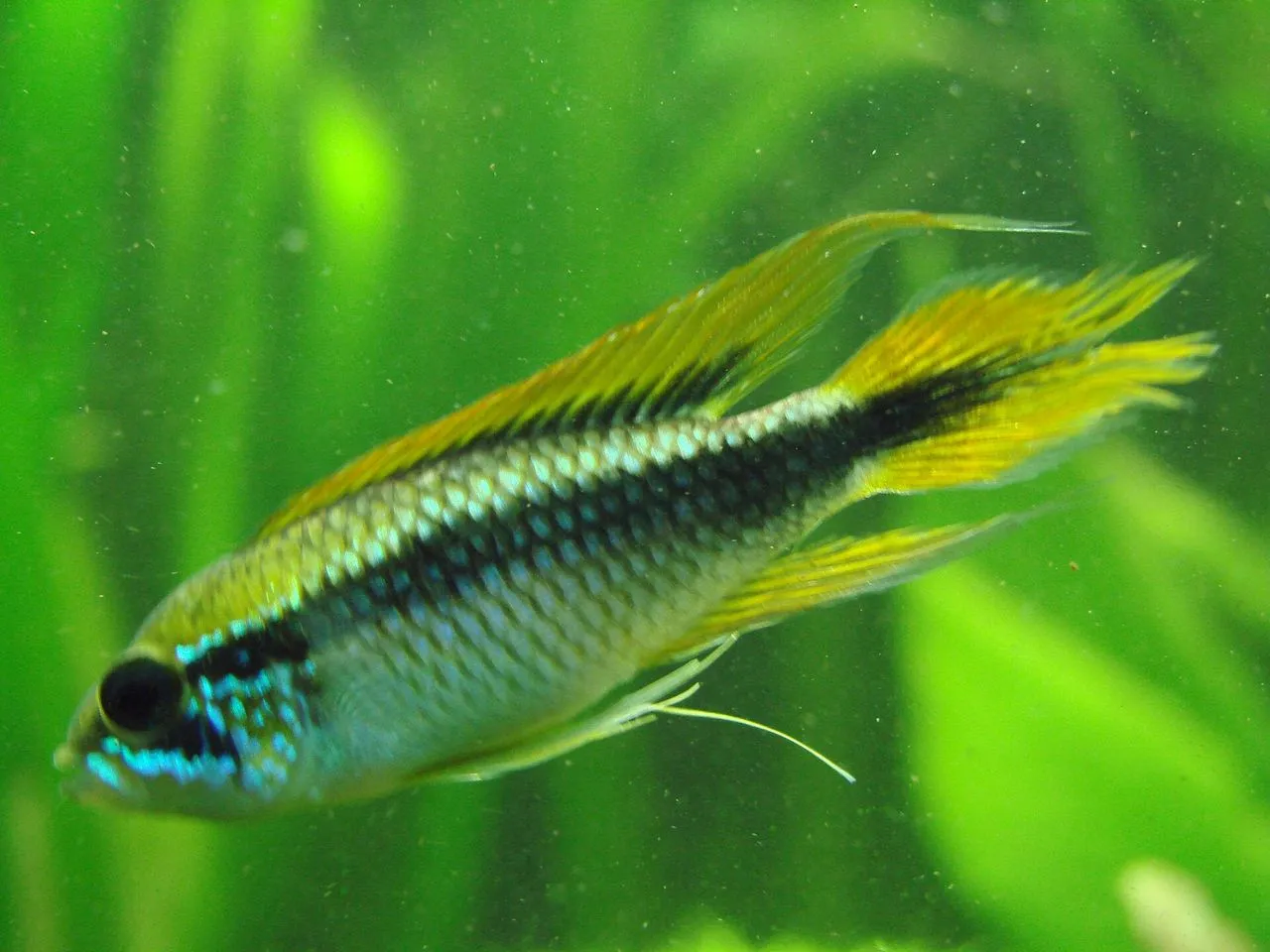
Answer: The Agassiz dwarf cichlid (Apistogramma agassizii) is a 5–8 cm cichlid from Amazon tributaries and blackwater margins requiring GH 0–6 °dH, KH 0–2 °dH, pH 4.8–6.8, 24–27 °C, conductivity 20–150 µS/cm. It is best kept in 75 litres for a pair, 120 litres for a structured harem attempt. Success depends on matching water chemistry, respecting its slender harem-forming dwarf cichlid with strong female brood territories, and preventing the common failure: line mixing, colour-form confusion, and insufficient cave separation.
Apistogramma agassizii (Agassiz dwarf cichlid) is a 5–8 cm cichlid associated with Amazon tributaries and blackwater margins. Its aquarium reputation is accurate only when read through water chemistry and breeding behaviour: this is not a generic community fish, but a species with a recognisable habitat, social system, and failure pattern.
Part of the Complete Cichlids Guide.
Identification
The Agassiz dwarf cichlid is identified first by body plan and then by behaviour. Adult size is 5–8 cm; juveniles sold in shops are often small enough to mislead new keepers about final volume. Colour alone is not a safe diagnostic character because farmed strains, mood, social rank, and breeding condition alter intensity. Use body shape, mouth position, fin outline, and locality information when available.
Sexing is most reliable in mature, conditioned fish. Males usually show larger body size, stronger fin extensions, or more intense display colour, depending on the species. Females often become rounder when gravid and may show brood colour during nesting. Vent sexing is possible but stressful and unnecessary for most home keepers unless forming a confirmed breeding group.
| Feature | Practical reading |
|---|---|
| Adult size | 5–8 cm |
| Minimum aquarium | 75 litres for a pair, 120 litres for a structured harem attempt |
| Social pattern | slender harem-forming dwarf cichlid with strong female brood territories |
| Best temperature | 24–27 °C |
| Main risk | line mixing, colour-form confusion, and insufficient cave separation |
Origin & Habitat
The natural context is Amazon tributaries and blackwater margins. That phrase should guide every aquarium decision. A fish from mineral-rich rift-lake rockwork should not be placed in the same water as a blackwater dwarf cichlid. A fish from leaf litter and soft floodplain margins should not be judged hardy because a shop held it briefly in tap water.
Recommended aquarium chemistry is GH 0–6 °dH, KH 0–2 °dH, pH 4.8–6.8, 24–27 °C, conductivity 20–150 µS/cm. Conductivity is useful because it reveals accumulated dissolved solids that pH alone hides. For aquarists still separating carbonate hardness from general hardness, water hardness and KH explains why a stable pH may still accompany biologically wrong mineral content. Soft-water species often benefit from reverse osmosis water; hard-water species require deliberate remineralisation rather than random buffer additions.
Aquarium Husbandry
Use 75 litres for a pair, 120 litres for a structured harem attempt. This is the functional minimum, not an invitation to crowd. Cichlids claim territories around surfaces, caves, stones, plants, or open sand; the usable space is the space broken by sightlines, not the glass length on the label. Arrange hardscape directly on the tank base before adding sand if the fish digs. Leave swimming lanes where the species is active, and keep refuge zones where subordinate fish can disappear from view.
Filtration should be sized for waste, oxygen, and feeding style. Warm tanks hold less dissolved oxygen, while large cichlids and densely stocked mbuna colonies produce heavy nitrogen loads. A mature biological filter, weekly water changes of 30–50%, and nitrate preferably below 20 mg/L are practical targets for most species. Sensitive dwarf and discus tanks should run lower. New aquaria should be fishless-cycled before purchase; the care article on cycling a new aquarium gives the correct sequence.
Lighting can be moderate. Most cichlids care more about cover, territory boundaries, and water stability than intense plant lighting. South American species can be combined with wood, leaf litter, floating shade, and plants such as Amazon sword where digging is mild. Rift-lake rock fish generally need open rock structures rather than dense planting.
Tankmates & Behaviour
The Agassiz dwarf cichlid shows slender harem-forming dwarf cichlid with strong female brood territories. That social system determines companions. Compare it with apistogramma cacatuoides, german blue ram, discus; those profiles show why cichlids of similar size may still be incompatible when diet, chemistry, or breeding style differs. Cross-category choices should be made for the same reason. Warm soft-water cichlids can suit cardinal tetras, while Tanganyikan and Malawi layouts more often suit robust catfish such as Synodontis petricola.
Avoid fish small enough to be swallowed, fish that nip fins, and fish that require the opposite chemistry. Also avoid mixing two cichlids that want the same territory unless the aquarium is large enough to create independent zones. Breeding pairs compress a whole tank around the nest; peaceful behaviour outside breeding condition is not a guarantee.
Diet
In nature the diet centres on tiny benthic invertebrates, live foods, frozen cyclops, and fine sinking foods. In captivity, variety is safer than novelty. Use a staple appropriate to the species, then add frozen or live foods in small controlled portions. Herbivorous rock-grazers should not be fed rich mammalian or high-fat foods. Predatory and omnivorous American species need protein, but not feeder fish from uncertain sources.
Feed adults once or twice daily in amounts consumed quickly. Fry and juveniles can be fed more often if water changes keep pace. Uneaten food in a warm cichlid tank becomes bacterial load; overfeeding is one of the easiest ways to convert good parameters into chronic disease pressure.
Breeding
Breeding is described as cave spawning with yellow brood-coloured females guarding fry. Condition adults with stable water and measured feeding rather than sudden chemical tricks. Provide the appropriate site: flat stones, broad leaves, caves, vertical surfaces, or rock territories. Do not move eggs unless the parents are known egg-eaters and a separate rearing tank is already cycled.
Parental care changes temperament. A pair may herd fry into pits, fan eggs, mouth-brood, or defend a cave entrance with surprising force. Remove incompatible tankmates before breeding rather than after injuries appear. Fry foods should match mouth size: infusoria and microworm for very small fry, newly hatched brine shrimp for larger dwarf-cichlid fry, and crushed prepared foods only once active feeding is obvious.
Common Problems
The main problem is line mixing, colour-form confusion, and insufficient cave separation. Most losses have a chain: wrong water, social stress, then opportunistic disease. White spot should be treated with an understanding of temperature and medication tolerance; see ich treatment before raising heat in species already near their upper limit. Quarantine is not optional for expensive dwarf cichlids, wild discus, or imported Rift fish.
Do not buy because the juvenile looks healthy in a shop cube. Ask for adult size, breeder origin, diet, and water. A cichlid chosen for its correct habitat is usually easier than a supposedly hardy species forced into the wrong aquarium.
See Also
Frequently Asked Questions
What water parameters does the Agassiz dwarf cichlid need?
Aim for GH 0–6 °dH, KH 0–2 °dH, pH 4.8–6.8, 24–27 °C, conductivity 20–150 µS/cm. Stability is more important than chasing a single pH number, but this species should not be forced into water outside its regional chemistry.
What tank size suits the Agassiz dwarf cichlid?
Use 75 litres for a pair, 120 litres for a structured harem attempt. Larger volumes are easier to keep stable and give subordinate fish room to avoid dominant individuals.
Can the Agassiz dwarf cichlid live with other fish?
Yes, if companions match its chemistry, temperature, and aggression level. Suitable siblings for comparison include apistogramma cacatuoides and german blue ram; mismatched community fish create chronic stress.
How does the Agassiz dwarf cichlid breed?
It is best described as cave spawning with yellow brood-coloured females guarding fry. Breeding changes behaviour sharply, so a peaceful specimen can become territorial once eggs or fry are present.
Sources & References
- Römer, U. (2006). Cichlid Atlas. Mergus Verlag.
- Loiselle, P.V. (1994). The Cichlid Aquarium. Tetra Press.
- FishBase — Apistogramma agassizii. https://www.fishbase.se/