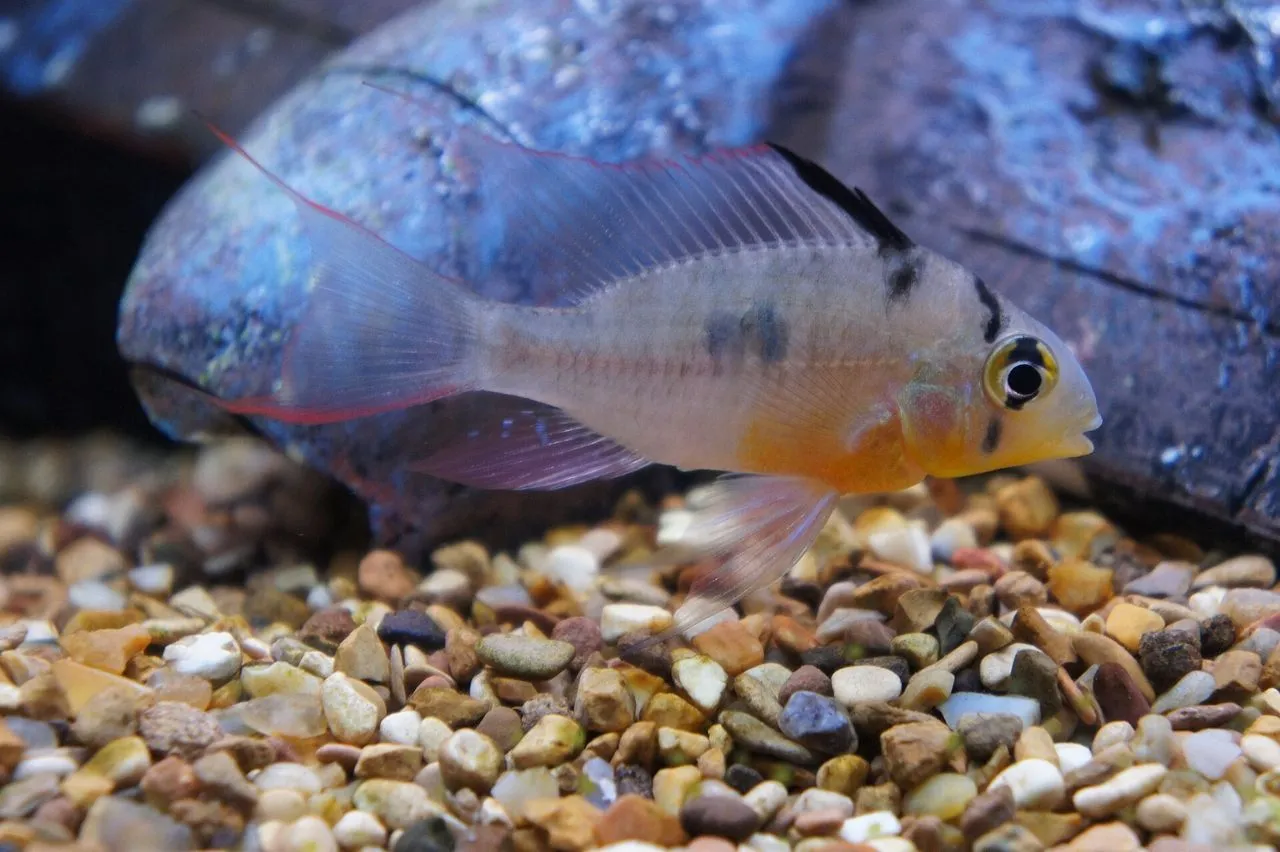
Answer: Ram cichlids hide most often because of farm-stock stress or temperature below threshold. Southeast Asian mass-produced blue rams arrive hormone-compromised and may hide for one to three weeks — many never fully recover. Temperature below 27 °C suppresses Mikrogeophagus ramirezi chronically. Check conductivity (target below 200 µS/cm), verify temperature with a separate thermometer, and examine tankmates before concluding the fish is simply shy.
Mikrogeophagus ramirezi (German blue ram) and its congener M. altispinosus (Bolivian ram) are among the most parameter-sensitive cichlids kept in home aquaria. When either species disappears into cover, stops responding to food, or remains pressed against the back glass for days on end, it is not being timid — it is registering a mismatch with its environment. Hiding is the first behavioural symptom this genus shows when something is wrong, and it typically precedes visible disease signs by a week or more.
Part of the Complete Cichlids Guide.
Main Causes
| Cause | Most affected | Signal | Onset |
|---|---|---|---|
| Farm-stock stress (hormone treatment) | M. ramirezi | Hiding without water fault or external lesions | Day 1 to 3 weeks post-purchase |
| Temperature below threshold | M. ramirezi | Sluggish, pale, stops feeding; all specimens affected | Gradual; worsens in winter |
| High conductivity or wrong pH | M. ramirezi | No visible disease; other species unaffected | Within days of introduction |
| Tank too small | Both | No refuges; submissive fish exposed in open water | Within hours of stocking |
| Tankmate aggression | Both | Fin damage, flinching at feeding time | Hours to days |
| Inter-ram aggression (unpaired males) | Both | Persistent chasing; one fish cornered | Hours to days |
| Breeding behaviour | Both | Paired fish; eggs on flat surface or guarded cave | After pair bond forms — normal |
| Internal pathogen (Tetrahymena, Hexamita, mycobacteria) | M. ramirezi | Pinched belly, clamped fins, laboured breathing | Weeks post-import |
| Uncycled or disrupted biological filter | Both | Ammonia or nitrite detectable; multiple species distressed | First 1–6 weeks |
Nine causes is a long list, but in practice the first two — farm origin and temperature — account for the majority of cases involving M. ramirezi. Both are routinely missed because keepers focus on pH and overlook conductivity, and assume any temperature above 25 °C is adequate for this species.
How to Identify the Problem
Work through this sequence. Each step takes under five minutes and eliminates the most common causes first.
- When did you buy the fish? If within the last three weeks, farm-stock adjustment is the leading explanation. The majority of M. ramirezi in the retail trade originate from Southeast Asian commercial facilities where hormone treatment is used to accelerate colour development and, in some operations, antibiotic dosing is applied to keep fish presentable for export. These fish arrive immune-compromised and respond poorly to transport, repeated water changes, and unfamiliar surroundings. Read Acclimating New Fish before introducing any new dwarf cichlid to an established display tank.
- Verify temperature with a separate thermometer. Heater dials are frequently inaccurate by 1–3 °C. Blue rams require 27–30 °C; below 27 °C they become withdrawn and lose interest in food, and below 25 °C the suppression is chronic and cumulative. The German blue ram profile gives the full parameter range for M. ramirezi specifically. Bolivian rams (M. altispinosus) tolerate 24–27 °C and are noticeably more robust at the lower end — if your fish is a Bolivian and is hiding at 24 °C, temperature is probably not the problem.
- Measure conductivity, not just pH. A conductivity meter reveals total dissolved solids that a standard pH test cannot detect. Mikrogeophagus ramirezi struggles in water above 200 µS/cm; fish held in hard tap water at 350–500 µS/cm will hide and deteriorate even when pH reads an apparently acceptable 7.0. Water hardness and conductivity explained covers why these two measurements differ and what each tells you biologically. If your tap water is hard, Reverse osmosis water for soft-water species explains the blending approach before you purchase the fish.
- Watch tankmates for 15 minutes without approaching the glass. Fast schooling species — tiger barbs, serpae tetras, many cichlids of similar size — can pin rams into permanent cover without inflicting obvious wounds. Human presence at the glass suppresses both aggressor and victim simultaneously; observe from a distance. Good companions for blue rams at compatible temperatures include cardinal tetras, sterbai corydoras (one of the few corydoras species that tolerates the 27–30 °C blue rams require), and otocinclus.
- Check for a bonded pair tending eggs. A cleaned flat stone, a leaf with the underside brushed pale, or a cave entrance guarded by two fish signals breeding behaviour. Hiding in this context is purposeful and not a welfare concern. Both parents remain close to the clutch and may ignore food temporarily — this is normal substrate-spawning cichlid behaviour.
- Test ammonia and nitrite. In a tank under six weeks old, or one that has experienced a large water change or thorough filter cleaning, detectable ammonia or nitrite will suppress all cichlids. If other species are also hiding or showing stress signs alongside the rams, start here.
- Look for disease signs when hiding extends beyond two weeks. Pinched belly, hollow flanks, rapid gill movement at rest, or white stringy faeces in a fish that is not improving points to an internal pathogen. Tetrahymena (rapid surface visits, white skin patches), Hexamita (associated with hole-in-the-head-type lesions at chronic exposure), and Mycobacterium infections are disproportionately common in farm-stock blue rams and difficult to treat once established. See Bacterial vs Fungal Disease for a diagnostic overview before selecting a treatment.
Risk and Severity
The honest assessment of farm-stock M. ramirezi is this: a proportion of fish from Southeast Asian mass-production facilities carry subclinical infections or have immune systems permanently compromised by hormones, and will hide, decline, and die within three to six months regardless of the keeper's actions. Loiselle (1994) noted that German hobbyist-bred strains — raised without hormones in soft, warm water from the outset — have substantially better survival rates. Stawikowski & Werner (1998) make the same distinction. Bright, intensely coloured rams purchased from chain retailers carry higher risk than fish sourced from specialist breeders or documented German-line importers.
Bolivian rams carry significantly lower risk. Mikrogeophagus altispinosus is bred in smaller commercial volumes, is less likely to have been hormone-treated, and tolerates a wider water-chemistry window than its congener. A hiding Bolivian ram is almost always responding to a specific correctable cause rather than latent pathology. The Bolivian ram profile outlines the precise parameter differences between the two species.
Severity scales with duration and appetite. A ram hiding on its first day in a new tank is a different situation from a ram that has hidden for three weeks, is not emerging for food, and has lost visible body mass.
Solutions and Actions
Address causes in order of ease and certainty.
- Raise temperature first. If below 27 °C for M. ramirezi, adjust the heater and confirm with a reliable thermometer. Blue rams often return to open water within 24–48 hours once temperature is stable at the correct level.
- Reduce conductivity gradually. If conductivity is above 200 µS/cm, introduce reverse osmosis water into subsequent water changes, blending to GH 2–4 °dH, KH 0–2 °dH. Do not drop conductivity suddenly; a gradual reduction across two to three weeks is safer than a sharp correction.
- Remove incompatible tankmates. Adding more cover does not resolve aggression — it changes where the subordinate fish is cornered. Rehoming incompatible species or moving the rams to a species-appropriate setup is the only permanent fix.
- Quarantine for suspected pathogens. Move the affected fish to a separate hospital tank before treating. For suspected Hexamita or flagellate infection, metronidazole is the standard drug. For gill parasites, praziquantel. Never treat the display tank blindly; the biological filter may not survive it. Follow Quarantine Tank Protocol for the correct isolation procedure.
Prevention
Source matters more than any other single variable. Purchasing M. ramirezi from a hobbyist breeder, a specialist importer with documented German-line stock, or a fish room running soft water at correct temperature cuts the probability of the hiding-then-declining pattern dramatically. Before buying, ask the seller for the conductivity and temperature they maintain the fish at. If they cannot answer, assume mass-produced Southeast Asian stock.
Provide refuges before the fish arrive: caves, broad-leaved plants such as Echinodorus species, driftwood overhangs, floating plants that cast surface shade. Healthy rams in good water are active and visible — they do not need to hide permanently — but the option of retreat lowers baseline stress. A tank with broken sightlines and multiple territory boundaries is far less likely to produce persistent social hiding than an open, unstructured aquascape.
Match tankmates to water chemistry and temperature before considering aggression ratings. A blue ram cannot thrive in the same water as livebearers, most barbs, or hard-water community fish. A Bolivian ram will not cope alongside species that demand 29–30 °C.
Common Mistakes
- Testing only pH. pH measures hydrogen ion concentration, not total dissolved solids. Water at pH 7.0 and conductivity 450 µS/cm is chemically hostile to M. ramirezi even when the pH reading looks fine. A conductivity meter is not optional for keeping this species successfully.
- Assuming 25 °C is warm enough for blue rams. It is not. The minimum for sustained health is 27 °C; at 25 °C, blue rams enter a slow-stress state that suppresses immune function and invites pathogen outbreaks over weeks and months.
- Adding more fish to fill out the aquascape while a ram is settling. A hiding ram needs stability above all else. More fish means more competition, more potential pathogens, and more disturbance to a fish that needs time to establish itself.
- Reaching immediately for aquarium salt or broad-spectrum medications. Salt raises conductivity — precisely the wrong intervention for a blue ram in hard water. Treating without a diagnosis can destroy the biological filter, add osmotic stress, and mask symptoms that would have guided a more targeted response.
- Accepting persistent hiding as shyness. Rams in appropriate water conditions are not shy fish. A healthy pair will display, court, and feed in open water within one to two weeks of introduction. Hiding that continues past that point is a symptom, not a personality trait.
Frequently Asked Questions
How long should a newly purchased ram cichlid hide before I worry?
A ram from a hobbyist breeder should settle within 3–7 days. Farm-stock blue rams can hide for two to three weeks; some never fully adjust and begin to decline after that point. If the fish is still hiding after three weeks, is not responding to food, or is visibly losing body mass, acclimatisation is no longer the explanation — look for an incompatible parameter or a pathogen.
Can hiding in a ram cichlid ever be normal?
Yes. A bonded pair tending eggs or newly hatched fry will withdraw to the spawning site and guard it closely. Both parents may ignore food temporarily. Look for a cleaned flat stone, pale leaf underside, or cave entrance being defended jointly. Breeding-driven hiding is purposeful and not a welfare concern provided the fish are otherwise healthy and feeding normally between spawning cycles.
My pH is fine but the ram is still hiding — what else should I check?
Conductivity. Mikrogeophagus ramirezi is sensitive to total dissolved solids, not just hydrogen ion concentration. Tap water at pH 7.0 with conductivity 350–500 µS/cm is biologically hostile to this species even though the pH reading looks acceptable. Measure conductivity separately and target below 200 µS/cm. If your water is hard, reverse osmosis blending is the reliable solution.
Is the Bolivian ram as sensitive as the German blue ram?
Substantially not. Mikrogeophagus altispinosus tolerates GH up to 10 °dH, pH up to 7.5, conductivity up to 300 µS/cm, and temperatures as low as 24 °C. It is bred in smaller commercial volumes and less likely to have been hormone-treated. A hiding Bolivian ram is almost always reacting to a specific correctable cause; a hiding blue ram may be reacting to latent pathology that cannot be reversed.
Sources & References
- Loiselle, P.V. (1994). The Cichlid Aquarium. Tetra Press.
- Stawikowski, R. & Werner, U. (1998). Die Buntbarsche Amerikas, Band 1. Eugen Ulmer.
- Römer, U. (2006). Cichlid Atlas. Mergus Verlag.
- <a href='https://www.fishbase.se/summary/Mikrogeophagus-ramirezi.html'>FishBase — Mikrogeophagus ramirezi</a>
- <a href='https://www.fishbase.se/summary/Mikrogeophagus-altispinosus.html'>FishBase — Mikrogeophagus altispinosus</a>