Answer: Discus (Symphysodon spp.) lose colour for reasons ranging from temporary social stress to serious internal parasitism. The most common cause is cortisol-driven melanin redistribution triggered by dominance hierarchy, temperature instability, or water-chemistry mismatch. Persistent fading — especially with weight loss, pale stringy faeces, or slime coat — points to Hexamita, gill flukes, or bacterial disease. Correct the environment first, then rule out pathogens systematically.
Symphysodon aequifasciatus and S. discus (discus) can lose colour for reasons that range from a transient social response to serious internal parasitism. The pigment cells responsible — melanophores carrying melanin, xanthophores and erythrophores carrying carotenoid-based pigments — are under active hormonal and neural control, meaning stress hormones can redistribute pigment within hours. That speed is diagnostically useful: a darkening that resolves within 48 hours after a known stressor is almost certainly reversible; one that persists or worsens over days demands systematic investigation.
Part of the Complete Cichlids Guide.
Main Causes
| Cause | Typical presentation | Urgency |
|---|---|---|
| Acute stress (transport, new tank, sudden parameter change) | Overall darkening or desaturation within hours; reverses in 24–72 h once settled | Low if resolved quickly |
| Social suppression (dominance hierarchy) | One fish chronically duller than the rest; brightens if hierarchy is disrupted | Medium |
| Temperature instability or low temperature | Generalised paling or darkening; reduced activity | Medium |
| Water-chemistry mismatch (high TDS, wrong pH, mineral imbalance) | Gradual fade, often with reduced appetite | Medium |
| Carotenoid deficiency (diet) | Slow, symmetrical colour loss across the body; no other symptoms | Low to medium |
| Hexamita / Spironucleus (internal flagellate parasites) | Colour loss with weight loss, pale stringy faeces, possible head and flank pitting | High |
| Gill flukes (Dactylogyrus, Gyrodactylus) | Darkening, clamped fins, scratching against décor, rapid gill movement | High |
| Bacterial infection ("discus plague" / black death) | Near-black colouration; slime coat sloughing; fish becomes reclusive | Very high |
| Hormone-enhanced farm stock | Colour fades weeks after purchase; does not recover; often concurrent health decline | Low to medium (not correctable) |
A single fish can present more than one of these simultaneously. Stress suppresses immune function, making a fish already losing colour from dominance pressure more susceptible to secondary parasitic infection.
How to Identify the Problem
Work through these steps in order. The aim is to separate environmental and social causes from pathological ones before reaching for medication.
- How long has the fading lasted? Darkening that appears within hours of introduction and clears within two days is almost certainly stress or transit shock. Fading that persists beyond five days demands investigation.
- Which fish are affected? If one fish in a group is consistently dull while others are bright, dominance is the likely cause — read the discus profile for notes on hierarchical colouration in the species. If two or more fish fade simultaneously, look to the water first.
- Test all parameters immediately. Targets: GH 0–4 °dH, KH 0–1 °dH, pH 5.0–6.8, temperature 28–30 °C (82–86 °F), conductivity 30–120 µS/cm, nitrate below 20 mg/L, ammonia and nitrite at zero. Conductivity is a particularly useful early warning — it reveals accumulating dissolved solids before pH shifts become obvious. If you are unsure how GH, KH, and TDS interact, Water Hardness, GH and KH Explained covers the relationships clearly.
- Examine each fish closely. Look for: pale, stringy, or white faeces (Hexamita); grey-white pitting or shallow craters on the head and flanks (hole-in-the-head, associated with chronic Hexamita); scratching or flashing against wood or substrate (gill flukes); excess mucus or slime patches on the skin surface (bacterial or protozoan infection); pinpoint white spots or a salt-grain texture on fins and body (ich — see Ich / White Spot Treatment before raising temperature in fish already near their upper limit).
- Review the diet history. A single staple food fed exclusively over months can produce carotenoid deficiency — slow, symmetrical fading with no other symptoms and no water-quality issue.
- Consider the source. Mass-produced Southeast Asian farm discus are frequently hormone-injected to enhance colour for export. This fades permanently after purchase. Locally bred or German-strain fish do not carry this problem and show markedly better immune resilience throughout their lives.
Risk and Severity
| Cause | Risk to affected fish | Risk to tank |
|---|---|---|
| Acute stress | Low if stressor removed promptly | Negligible |
| Social suppression | Medium if chronic; feeding and immunity both decline steadily | Negligible |
| Temperature instability | Medium; prolonged exposure causes immune compromise | Low |
| Water-chemistry mismatch | Medium; secondary infection probable if uncorrected | Low |
| Carotenoid deficiency | Low | None |
| Hexamita | High without treatment; fish waste away over weeks | High — spreads within the tank |
| Gill flukes | High in juveniles; medium in adults; accelerates if untreated | High — spreads rapidly |
| Bacterial disease | Very high; often fatal without prompt intervention | High |
| Hormonal farm stock | Low to medium | None |
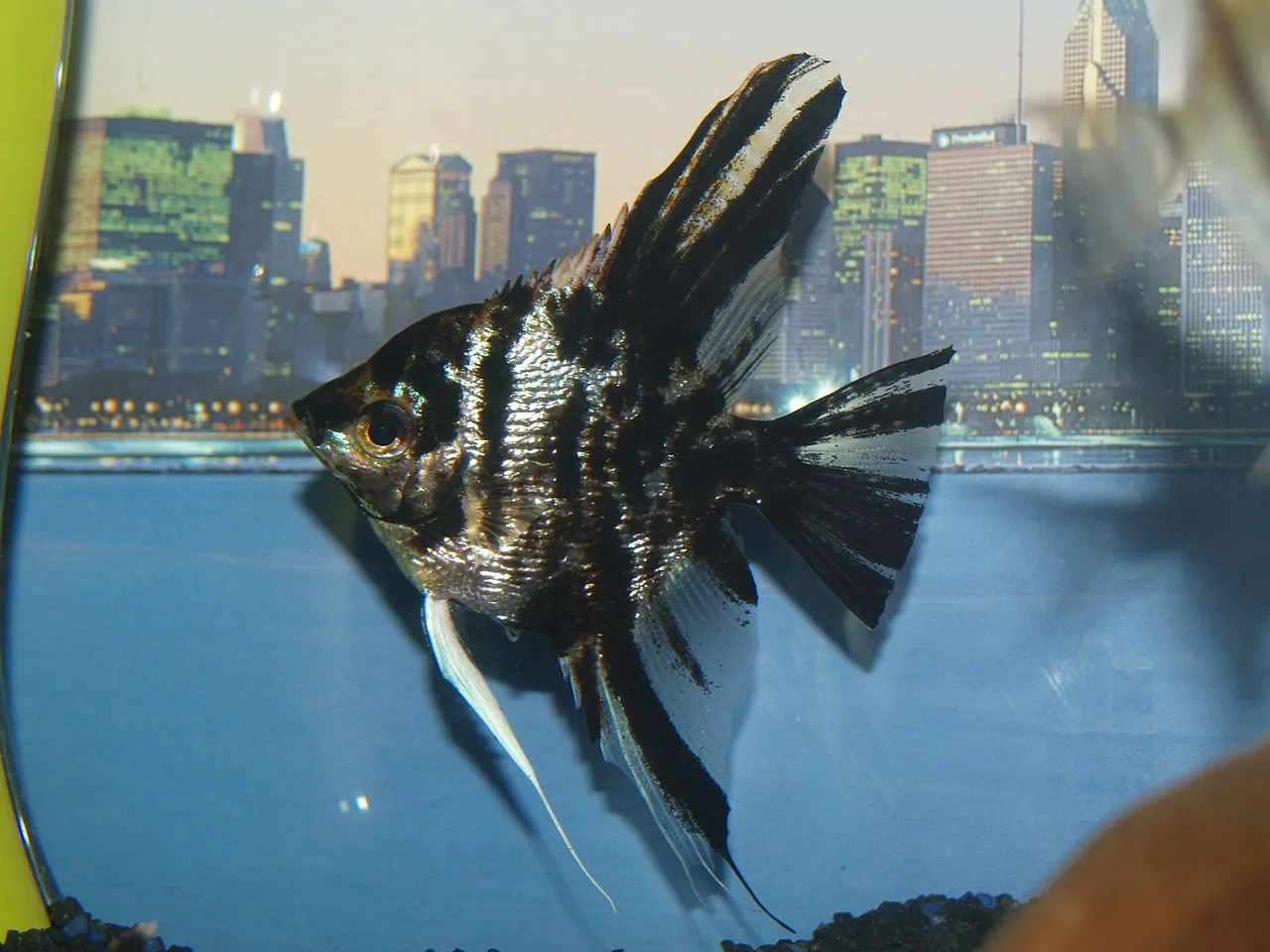
Sensitive cichlid companions kept in the same soft-water biotope — german blue ram (Mikrogeophagus ramirezi) and angelfish (Pterophyllum scalare) — share exposure to any waterborne pathogen present in the tank, so treatment must cover the full system rather than the visibly affected fish alone.
Solutions and Actions
Address causes in this order: water first, then social, then dietary, then pathogenic.
Environmental correction:
- Test all parameters. If conductivity reads above 150 µS/cm in an established discus tank, increase water-change volume and frequency. If your source water is hard, consider partial dilution with reverse osmosis water to bring GH, KH, and TDS into the correct range.
- Verify temperature with a calibrated thermometer, not the heater's dial. Discus kept below 27 °C (81 °F) show chronic immune suppression and become markedly more susceptible to every pathogen listed above. Stability matters as much as the set-point.
- Perform a 25–30% water change with temperature-matched, dechlorinated water. If ammonia is also detectable, Seachem Prime dosed at the emergency rate will bind it while the biological filter catches up. Avoid large single changes that shock the fish with sudden parameter jumps.
Social restructuring:
- If one fish is persistently dark while others are bright, either increase group size to distribute aggression, or remove the dominant individual for 48 hours to break the established hierarchy. Adding visual barriers — driftwood, dense planting of amazon sword (Echinodorus bleheri) along the rear glass — reduces direct line of sight between individuals and lets subdominant fish feed without constant challenge.
Dietary correction:
- If fading is symmetrical and no other symptoms are present, diversify the diet. Natural carotenoid sources — spirulina-based pellets, fresh or frozen krill, and quality beefheart — support pigment synthesis directly. Cardinal tetras (Paracheirodon axelrodi) kept as biotope companions in a planted Amazon setup serve as an informal environmental indicator: they are highly sensitive to water quality, and a healthy, colourful school is a reasonable proxy for stable conditions.
Pathogen treatment:
- For suspected Hexamita: treat the whole tank with metronidazole (5 mg/L as a bath treatment, repeated after 48 hours, or incorporated into food). Remove activated carbon before treatment. Maintain temperature at 30–32 °C (86–90 °F) during treatment if other tank inhabitants allow. Noga (2010) reviews metronidazole dosing in clinical fish medicine in detail.
- For suspected gill flukes: praziquantel is the standard treatment for monogenean trematodes. Treat the whole tank at the label-recommended dose, and plan a quarantine protocol for any future additions — most fluke outbreaks in established tanks trace to a single unquarantined arrival. See Quarantine Tank Protocol.
- For suspected bacterial infection: water quality is the urgent first priority. Significant bacterial infections in discus carry a high mortality rate without prompt intervention. See Bacterial vs Fungal Disease for differential diagnosis before choosing an antibiotic course.
Prevention
- Match water chemistry at purchase. Ask the seller for their tank parameters. Discus bought at GH 10 °dH and placed directly into GH 1 °dH water will show colour stress for days regardless of destination water quality. Gradual acclimation over 60–90 minutes reduces but does not eliminate this shock.
- Quarantine all new arrivals for a minimum of four weeks. A 60-litre quarantine tank with a cycled sponge filter and a reliable heater is inexpensive relative to treating a full display tank. Include praziquantel as standard prophylaxis for flukes.
- Keep temperature stable, especially overnight. Unheated rooms in winter can drop a tank's temperature by 2–3 °C between midnight and morning. A reliable heater with a separate thermometer takes priority over most decorative purchases.
- Feed varied, carotenoid-rich foods from the outset. Rotating spirulina, krill, and quality dry cichlid food on a weekly schedule prevents the slow deficiency fade that a single-food diet produces over months.
- Keep groups of six or more. Smaller groups intensify hierarchy pressure. In a group of six or more individuals, dominance interactions are distributed across more pairings and no single fish is chronically suppressed. Loiselle (1994) discusses group dynamics in Symphysodon in practical terms.
- Source fish carefully. Hobbyist-bred or German-strain discus show more stable colour and substantially better immune resilience than typical farm export stock.
Common Mistakes
- Treating for parasites without correcting water first. Most colour loss in discus traces to environmental causes. Dosing metronidazole into a tank with elevated TDS and an unreliable heater will not resolve the problem and may stress already-compromised fish further.
- Adding new discus to diagnose social causes without quarantining them first. The reasoning — that more fish will dilute aggression — can be sound, but introducing unquarantined individuals risks importing the very pathogens that cause serious colour loss. Quarantine first, always.
- Confusing tannin-darkened water with fish darkening. Peat filtration and driftwood tannins stain the water amber, which is desirable for Amazon biotopes. This colouration can mask subtle changes in the fish. Judge colouration against each fish's own baseline in consistent lighting, not against a bright shop tank.
- Accepting a chronically dark individual as simply the lowest-ranking fish. Prolonged dominance suppression impairs feeding and immunity steadily. A fish that is permanently dark and losing body mass will eventually succumb to opportunistic infection. Either restructure the group or rehome the affected individual before it deteriorates further.
- Raising temperature as a first response to all darkening. Temperature increase is appropriate for certain protozoan infections and is standard for Hexamita, but it also drops dissolved oxygen and intensifies physiological stress on fish already compromised by poor water quality. Diagnose the cause first; adjust temperature only when there is a clear clinical reason to do so.
Frequently Asked Questions
How quickly should discus regain colour after being moved to a new tank?
Most stress-related darkening resolves within 24–72 hours provided water parameters are within range (GH 0–4 °dH, pH 5.5–6.8, 28–30 °C). If colour has not returned after five days, investigate water chemistry and examine each fish closely for symptoms of parasitic or bacterial infection.
Can farm-bred discus ever regain the colour they showed in the shop?
Not if the original colouration was hormone-enhanced. Mass-produced export discus are frequently injected with hormones to boost colour for sale; this fades permanently within weeks or months of purchase. Fish from hobbyist breeders or German-strain lines start duller but retain stable, reliable colouration long-term and carry markedly fewer pathogens.
Is hole-in-the-head disease the same as Hexamita infection?
They are related but not identical. Hexamita (Spironucleus vortens) is an internal flagellate that causes colour loss, weight loss, and pale stringy faeces. In advanced cases, the inflammatory response produces the pitting lesions on the head and lateral line known as hole-in-the-head or HITH. Poor water quality and inadequate nutrition accelerate the syndrome; Hexamita alone does not inevitably produce visible pitting in the early stages.
Should I quarantine a discus that arrives looking healthy and colourful?
Yes, without exception. Vivid, even colouration on arrival may reflect hormone injection rather than genuine health. Gill flukes and Hexamita produce few visible symptoms in early infestation. A four-week quarantine with praziquantel prophylaxis for flukes and close observation of faeces for Hexamita signs is standard practice before any new discus enters a main display tank.
Sources & References
- Loiselle, P.V. (1994). The Cichlid Aquarium. Tetra Press.
- Noga, E.J. (2010). Fish Disease: Diagnosis and Treatment (2nd edn). Wiley-Blackwell.
- FishBase — Symphysodon. https://www.fishbase.se/
- <a href='https://www.ncbi.nlm.nih.gov/pmc/articles/PMC5378087/'>Dijkstra, P.D. et al. (2017). The melanocortin system regulates body pigmentation and social behaviour in a colour polymorphic cichlid fish. Proceedings of the Royal Society B, 284.</a>