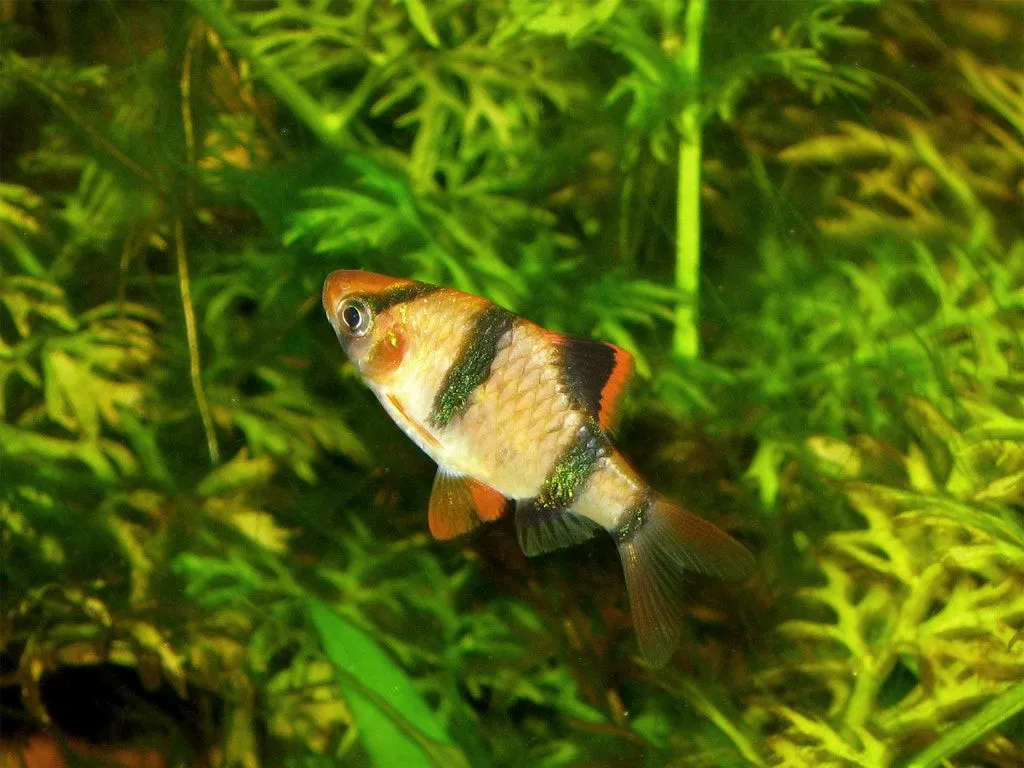
Answer: The tiger barb is an active Indonesian cyprinid best kept in groups of at least eight, with ten to twelve far better. It is not a gentle community fish for slow fins: GH 3–10 °dH, pH 6.0–7.5 and 24–27 °C suit it, but social management matters more than small pH differences.
Puntigrus tetrazona is the tiger barb, a cyprinid associated with Indonesia, especially Sumatra and Borneo-associated trade forms. It is best understood as a barb relative with specific demands, not as a generic community fish chosen by colour. Adults reach 5–7 cm, and successful care depends on group structure, swimming space and stable water: GH 3–10 °dH, KH 1–5 °dH, pH 6.0–7.5, 24–27 °C. The trade may still use an older Puntius label; current names follow FishBase and the Catalog of Fishes.
Part of the Complete Barbs Guide.
Identification
The useful field marks are bold vertical bands, orange fins and a deep active body. Juveniles in shop tanks are often pale because barbs lose colour under crowding, bright light and recent transport. Sex differences vary by condition, but males are usually slimmer and more strongly coloured once settled, while females are fuller-bodied, especially before spawning.
| Character | What to check | Why it matters |
|---|---|---|
| Adult size | 5–7 cm | Tank length and bioload must be planned for the adult, not the juvenile |
| Social form | 90 cm aquarium; 8+ fish, preferably 10–12 | Small groups produce stress, chasing or abnormal hiding |
| Water target | GH 3–10 °dH, KH 1–5 °dH, pH 6.0–7.5, 24–27 °C | Stable mineral content prevents osmotic stress |
| Main warning | fin-nipping from undersized groups | This is the usual cause of failed community attempts |
Do not identify the species from colour alone. Barbs shipped young, chilled or crowded may look like different fish. Body depth, barbel position, banding or lateral stripe pattern, and adult fin shape remain more reliable than temporary colour.
Origin & Habitat
Wild habitat for the tiger barb is best summarised as Indonesia, especially Sumatra and Borneo-associated trade forms. In nature, barbs forage constantly over sand, leaf litter, stones, plant margins and submerged roots. The maxillary barbels are sensory and chemoreceptive organs used to locate edible particles, not ornamental whiskers. Faster-water species rely more on current position and open swimming; forest and blackwater forms use cover heavily.
Aquarium water should match the habitat broadly rather than theatrically. For this species, aim for GH 3–10 °dH, KH 1–5 °dH, pH 6.0–7.5, 24–27 °C, ammonia 0 mg/L, nitrite 0 mg/L and nitrate preferably below 20–30 mg/L. The chemistry behind GH and KH is covered in water hardness explained, and the tank should be fully mature before purchase; see cycling a new aquarium.
Aquarium Husbandry
Provide 90 cm aquarium; 8+ fish, preferably 10–12. The aquarium should include open swimming space, a dark substrate or shaded zones, and enough structure to break sight lines. For smaller planted species, clumps of java fern, Anubias nana and stems provide security. For larger riverine barbs and sharklike cyprinids, hardscape, oxygen and length matter more than dense planting.
Filtration should be sized for active feeding. Barbs are not delicate in the ornamental sense, but they respond poorly to immature filters, low oxygen and dirty substrate. Weekly water changes of 30–50 percent are sensible when nitrate rises; match temperature and hardness to avoid osmotic jolts. Quarantine is advisable for all imports, and the transfer method in acclimating new fish is safer than pouring shop water into a display.
Tankmates & Behaviour
The central behavioural issue is fin-nipping from undersized groups — tiger barb aggression management covers what normal intra-shoal rank-settling looks like versus genuine injury that needs intervention. Suitable tankmates are fishes that occupy different space, tolerate the same current and temperature, and are not carrying long fins that invite attention. Compare closely with five banded barb and black ruby barb before choosing a mixed barb community.
Avoid slow, trailing-finned fish where this species is active or territorial. Many gouramis, especially dwarf gourami, are poor matches with nippy or boisterous barbs. Peaceful bottom fish such as bristlenose pleco or appropriate corydoras can work if temperature and activity levels match; bronze corydoras suits cooler moderate tanks better than very warm ones.
Diet
In captivity, feed as an omnivorous forager: small quality pellets or flakes, frozen bloodworm or daphnia, chopped insect larvae where appropriate, and vegetable matter for larger grazing species. Offer small meals once or twice daily, with one lean day each week in heavily fed community tanks. Overfeeding active barbs is common because they beg vigorously and outcompete quieter fish.
Colour improves with varied food, but diet cannot compensate for wrong social conditions. A stressed fish kept too warm, too hard, too few or in a bare tank will not show stable colour even with rich foods.
Breeding
Most barbs are egg scatterers. Condition adults with varied food, then move the best-coloured pair or small group to a separate breeding tank with soft to moderate water matched to the species, dim light, fine-leaved plants, spawning mops or a mesh floor. Spawning usually occurs in the morning after a cool water change or increased flow. Remove adults immediately; eggs hatch in roughly one to two days depending on temperature, and fry become free-swimming several days later.
First foods should be infusoria, paramecium or commercial microfoods, followed by newly hatched Artemia once the fry can take them. Clean water is more important than heavy feeding in the first week.
Common Problems
The common failure is fin-nipping from undersized groups. The second is buying juveniles without planning for adult behaviour and size. The third is mixing barbs by colour rather than ecology: a quiet blackwater species, a cool-water Pethia and a territorial sharklike cyprinid may all be sold as "barbs", but they are not a coherent stocking plan.
| Symptom | Likely cause | Correction |
|---|---|---|
| Washed-out colour | Stress, bright bare tank, small group | Increase group, add cover, dim light |
| Chasing tankmates | Wrong companions or group size | Remove slow fins; enlarge same-species group |
| Gasping after feeding | Low oxygen or dirty filter | Increase aeration, clean mechanically, protect biofilter |
| Thin fish despite feeding | Internal parasites, bullying or poor quarantine | Isolate, observe faeces, treat only after diagnosis |
See Also
- The Complete Barbs Guide — taxonomy, barbel anatomy and stocking principles.
- Five Banded Barb — sibling barb comparison.
- Black Ruby Barb — another related barb profile.
- Water Hardness: GH and KH Explained — matching mineral content to species.
- Black Skirt Tetra — relevant cross-category husbandry context.
- Dwarf Gourami — compatible setup or contrast.
Frequently Asked Questions
How many tiger barbs should be kept together?
Keep at least eight where the species is a shoaling barb; large sharklike cyprinids need either a proper group in a very large system or, for territorial Epalzeorhynchos, a single adult. The practical recommendation for this species is 90 cm aquarium; 8+ fish, preferably 10–12.
What water parameters suit tiger barbs?
Use GH 3–10 °dH, KH 1–5 °dH, pH 6.0–7.5, 24–27 °C. Stability, oxygen and mature biofiltration are more important than forcing a precise pH with chemicals.
Are tiger barbs fin nippers?
The main risk is fin-nipping from undersized groups. Match tankmates by speed, fin length and confidence rather than assuming all barbs behave alike.
Can tiger barbs breed in aquaria?
Yes, as egg-scattering cyprinids when well conditioned, but adults eat eggs. Use fine plants or mesh, remove adults after spawning, and feed fry with infusoria before newly hatched Artemia.
Sources & References
- Pethiyagoda, R., Meegaskumbura, M. & Maduwage, K. (2012). A synopsis of the South Asian fishes referred to Puntius. Zootaxa.
- Fricke, R., Eschmeyer, W.N. & Van der Laan, R. Catalog of Fishes. California Academy of Sciences.
- FishBase — Cyprinidae species treatments. https://www.fishbase.se/
- Baensch, H.A. & Riehl, R. (1991). Aquarium Atlas, Vol. 1. Mergus Verlag.