Answer:
Rasboras and danios are small Asian danionids whose trade names hide major taxonomic and husbandry differences. Harlequin rasboras suit soft planted communities; tiny Boraras need peat-swamp chemistry around GH 0–3 °dH, pH 4.8–6.4, and 50–120 µS/cm; zebra danios and white clouds prefer cooler, more mineralised water.
Trigonostigma heteromorpha (harlequin rasbora) is the fish that made the word "rasbora" familiar to aquarists, yet it is no longer placed in Rasbora. That single fact captures the category: a cluster of small Asian danionids whose trade names are stable, whose scientific names have moved repeatedly, and whose aquarium success depends on respecting size, water chemistry, and social behaviour rather than treating every small silver fish as interchangeable.
I have kept Southeast Asian blackwater aquaria for more than thirty years, including peat-swamp tanks for Boraras, quiet planted tanks for Trigonostigma, and cooler hill-country setups for danios. The group rewards precision. A harlequin rasbora can be a forgiving community fish; a chili rasbora in hard alkaline water is a stressed animal surviving outside the chemistry that shaped its physiology.
Taxonomy
The modern rasbora-and-danio problem begins with the old family Cyprinidae. For much of aquarium history, almost every small minnow-like Asian fish was placed there, and many were informally called cyprinids. Molecular work and revised morphology have split that broad arrangement. Danionidae is now widely used for danios, rasborins, and related small-bodied Asian lineages. Older aquarium books remain useful, but their genus names must be read historically.
The historical genus Rasbora was paraphyletic: it gathered fishes that looked broadly similar but did not form a single natural lineage. Kottelat and later authors separated several aquarium staples. The harlequin and Espe’s rasboras moved to Trigonostigma, recognised by their deep bodies and triangular lateral wedge. The tiny ember-class species moved to Boraras, a genus name formed by reversing Rasbora and used for very small peat-swamp fishes. Some slender forms moved to Trigonopoma. The celestial pearl danio was described by Roberts in 2007 as Celestichthys margaritatus after its 2006 discovery in Myanmar, then placed by some authors in Danio; both names remain visible in the trade.
The aquarium label therefore needs translation. Harlequin rasbora means Trigonostigma heteromorpha. Phoenix rasbora means Boraras merah. Galaxy rasbora is not a rasbora in the strict sense but the celestial pearl danio, Celestichthys margaritatus or Danio margaritatus. White cloud mountain minnow, Tanichthys albonubes, is included here for aquarium-practical reasons although it is a cool-water danionid ally rather than a peat-swamp rasbora.
| Trade name | Current name commonly used | Husbandry signal |
|---|---|---|
| Harlequin rasbora | Trigonostigma heteromorpha | Soft planted community fish |
| Chili rasbora | Boraras brigittae | Very small blackwater specialist |
| Galaxy rasbora | Celestichthys/Danio margaritatus | Cooler, planted, shy danio |
| Zebra danio | Danio rerio | Active, cool-tolerant model organism |
| Scissor-tail rasbora | Rasbora trilineata | Larger, active, needs length |
Identification
Danionids are generally small, laterally compressed to torpedo-shaped fishes with a single dorsal fin, no adipose fin, cycloid scales, and toothless jaws with pharyngeal teeth. In aquarium practice the useful characters are body depth, lateral markings, mouth size, and swimming level.
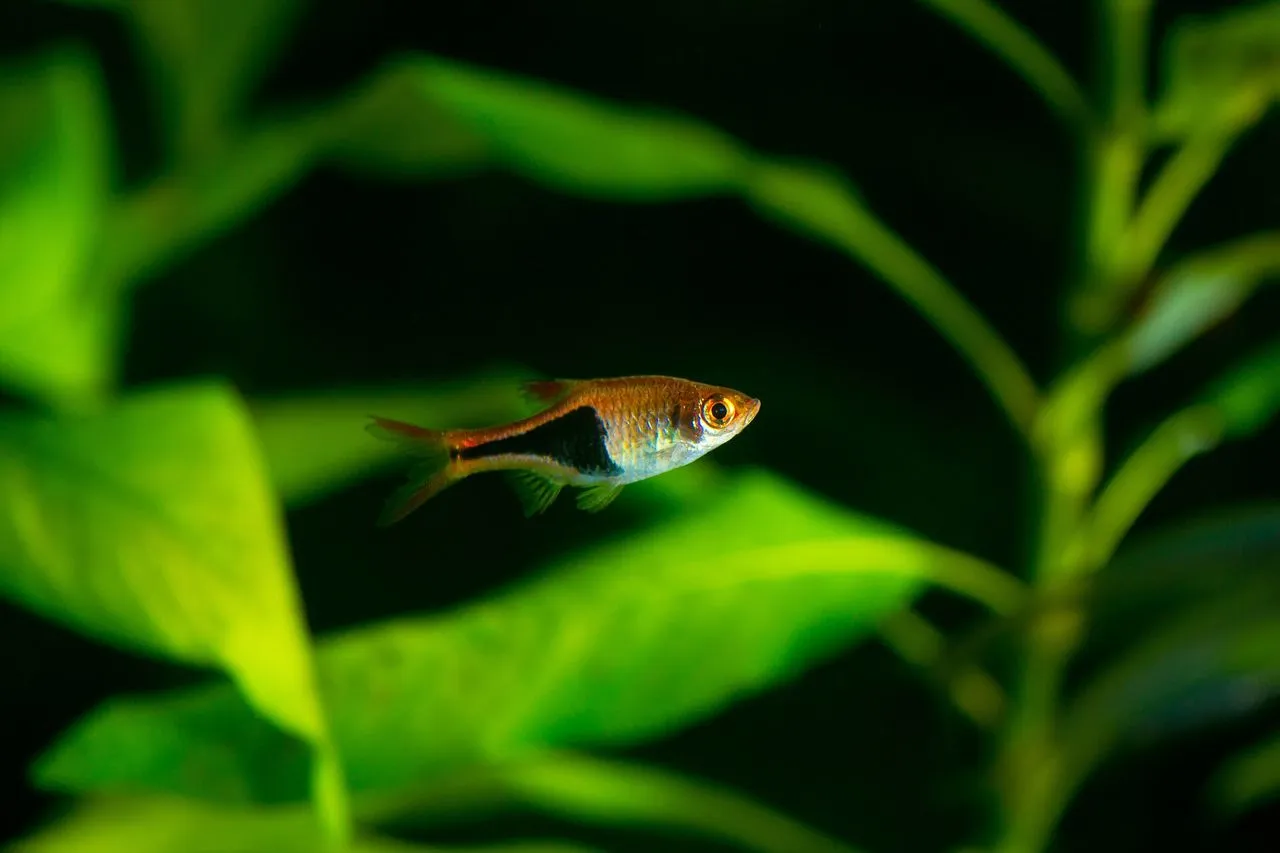
Trigonostigma species are deep-bodied, laterally compressed, and carry a dark wedge or lambchop mark on the rear flank. The wedge shape separates the harlequin rasbora from Espe’s rasbora: harlequins have a broader black triangle and rosier body; Espe’s are slimmer and more copper-orange with a narrower mark. These fish cruise the middle water and look best over dark substrate with plant margins.
Boraras are much smaller: adult chili, phoenix, strawberry, and mosquito rasboras are typically 1.5–2.2 cm. They have tiny mouths, transparent fin membranes, and red, black, or spot markings that intensify in soft acidic water. They are often mis-sorted at importers because stress removes colour and several species occur in similar shipments.
Danios are more active and more surface-oriented. Zebra danio and pearl danio have longer bodies, constant movement, and a stronger appetite. Glowlight danio is smaller but still livelier than most Boraras. The leopard danio is not a separate wild species in the usual aquarium sense; it is a spotted morph of Danio rerio.
Behaviour & Ecology
The most common behavioural error is calling all of these fishes "schooling". True synchronised schooling, where individuals align and turn as a single unit, is rare in the family under normal aquarium conditions. Most are shoaling fishes. They remain socially attentive, spread through a patch of plants, break into small subgroups, and tighten only during alarm. Understanding loose vs tight rasbora schooling helps avoid misreading a relaxed shoal as a problem. That looser behaviour is not a reason to buy three. A group of ten to twenty is the base unit for small rasboras; twenty to forty is better for Boraras because each fish is so small that bioload is rarely the limiting factor.
Social confidence controls colour. A solitary Boraras brigittae hides and becomes a grey sliver. A group of thirty over leaf litter, fed tiny live foods, can show crimson males defending thumb-sized display territories. Harlequins and Espe’s rasboras show a similar, less extreme pattern: large groups reduce skittishness and allow male display without one dominant fish harassing every subordinate.
Breeding is usually egg scattering or plant/debris-associated spawning. Trigonostigma are unusual among common rasboras because they place adhesive eggs on the underside of broad leaves, often under Cryptocoryne leaves in aquarium conditions. Boraras scatter tiny eggs among moss, root tangles, and leaf litter. Danios are prolific egg scatterers and will eat eggs unless adults are separated or a spawning grid is used.
Water Chemistry & Habitat
Southeast Asian peat-swamp blackwater is not merely "low pH". It is low in dissolved minerals, stained by humic and fulvic substances, and often has little carbonate buffering. For the smallest Boraras, a practical target is pH 4.8–6.4, GH 0–3 °dH, KH 0–1 °dH, TDS 30–80 ppm, and conductivity 50–120 µS/cm at 25–27 °C. These values are stable only when the keeper understands GH, KH, and water hardness and uses reverse-osmosis water where tap water is hard.
Not every member of the category needs peat chemistry. Harlequins, Espe’s rasboras, brilliant rasboras, and many danios adapt to planted-tank water around GH 2–10 °dH, KH 1–5 °dH, pH 6.0–7.5, and conductivity 80–350 µS/cm. Zebra danios and white clouds prefer cooler water than peat fish: 18–24 °C suits them better than the 27–28 °C used for chocolate gouramis.
| Group | Temperature | GH | KH | pH | Conductivity |
|---|---|---|---|---|---|
| Boraras peat specialists | 24–27 °C | 0–3 °dH | 0–1 °dH | 4.8–6.4 | 50–120 µS/cm |
| Trigonostigma community rasboras | 24–27 °C | 2–8 °dH | 1–3 °dH | 5.8–7.2 | 80–250 µS/cm |
| Active Rasbora species | 23–26 °C | 3–10 °dH | 1–5 °dH | 6.0–7.5 | 120–350 µS/cm |
| Danios and white clouds | 18–25 °C | 3–12 °dH | 2–6 °dH | 6.5–7.8 | 150–450 µS/cm |
Aquarium Husbandry
Tank shape should match swimming style. Boraras can live in 35–60 litre aquaria if the tank is mature, densely planted, and chemically correct, but they are not good fish for unstable desk cubes. A 60 cm tank gives a group room to spread and creates better thermal and chemical stability. Harlequins and Espe’s rasboras deserve 60–90 cm tanks. Scissor-tail rasboras and pearl danios need length: 90–120 cm is more appropriate because they cruise constantly.
Filtration should be mature and oxygenated without turning a blackwater tank into a torrent. Sponge filters and baffled outlets suit small species. Danios accept more current and often benefit from it. Cycling matters for all of them; a shoal of tiny fish still produces ammonia, and blackwater pH can make test interpretation lazy. A new keeper should read cycling a new aquarium before adding a full shoal.
Planting should create edges, not a bare display arena. Java moss catches eggs and shelters fry. Cryptocoryne wendtii provides broad leaves for harlequin spawning and shaded cover for Southeast Asian layouts. Floating plants soften light, leaf litter supplies tannin and microfauna, and dark substrate reduces startle responses.
Tankmates must share both temperament and chemistry. Small Boraras suit sparkling gourami, chocolate gourami, licorice gouramis, pygmy corydoras, and otocinclus only when the water and feeding plan fit every species. Harlequins work with honey gourami, pearl gourami, peaceful tetras, dwarf cichlids such as the German blue ram, and small catfish. Avoid mixing tiny rasboras with fast danios, barbs, large gouramis, or any fish with a mouth large enough to test them.
Feeding, Conditioning & Colour
The family’s small mouth size is often underestimated. A scissor-tail rasbora can take ordinary flake and small pellets, but a chili rasbora or strawberry rasbora cannot use the same ration efficiently. Food size should match the eye, not the keeper’s convenience. For Boraras, the most reliable daily foods are finely crushed dry diets, cyclops, rotifers, microworms, baby brine shrimp, small daphnia, and the microfauna that develops in moss and leaf litter. For danios, add more open-water foods: daphnia, small bloodworm, mosquito larvae where legal, and fast-sinking crumbs that reach the whole group before dominant fish monopolise the surface.
Colour is a husbandry reading. It is not only pigment genetics. Male Boraras become red when the water is low in minerals, the light is broken by plants, the group is large, and the diet includes small crustaceans. Pale fish in a dealer tank may still be good fish; pale fish six weeks later in a bright hard-water aquarium are reporting a management error. Colour fading in chili rasboras walks through the most common causes in order. Harlequins and Espe’s rasboras show the same principle less dramatically: the copper body and black wedge sharpen over dark substrate with floating cover and steady feeding.
Conditioning for breeding should not mean overfeeding. Small danionids foul soft water quickly when given more frozen food than the filter and plants can process. Feed small portions two or three times daily for a short conditioning period, remove leftovers, and keep nitrate below 20 mg/L for general communities and below 10 mg/L for serious blackwater breeding attempts. Conductivity stability matters more than frequent large water changes.
Breeding in Practice
Egg scattering is the default pattern, but the details determine whether fry ever appear. Danios spawn readily after a cool water change and morning light; adults then turn around and eat eggs. A mesh floor, marbles, or dense spawning mops are used to drop eggs out of reach. Eggs hatch quickly in warm water, and fry need infusoria before baby brine shrimp in the smallest species.
Trigonostigma are the exception most aquarists can observe. Pairs inspect the underside of broad leaves, often turning upside down before placing adhesive eggs. Cryptocoryne wendtii, Anubias leaves, and artificial broad-leaf mops can all be used. The pair should be conditioned in soft slightly acidic water, then moved to a quiet breeding tank with subdued light. After spawning, remove adults. Eggs are sensitive to fungus in dirty water and to osmotic stress in hard water.
Boraras are best bred by patience rather than by dramatic intervention. A mature, species-only tank with moss, leaf litter, low conductivity, and heavy microfauna may yield a few fry regularly if adults are well fed. For higher yield, move a conditioned group to a small blackwater spawning tank for one or two days, then remove adults and feed the invisible fry infusoria. Sudden water changes, bright light, and hungry snails reduce survival. Tiny fry are the reason Java moss is more than decoration in these aquaria.
Buying, Quarantine & Ethics
Choose fish that have been at the shop long enough to recover from import. The best specimens hold position without rocking, breathe evenly, and take small food. Avoid sunken bellies, clamped fins, grey skin sheen, bent spines, and groups in which several fish hover apart from the shoal. Small rasboras are often starved during transport; a fish that cannot compete for food in the dealer tank may not recover in a busy community.
Quarantine is not optional for mixed nano imports. Use a cycled tank with plants, dim light, and water close to the planned display. A bare white-bottom quarantine box is useful for large medicated fish; for tiny danionids it can be a stress amplifier. Observe for wasting, external parasites, mouth damage, and buoyancy problems. Many losses blamed on mysterious disease are actually hard-water stress, starvation, or heat mismatch.
The celestial pearl danio deserves a specific ethical note. Roberts described the species after its discovery near Hopong, Myanmar, and export demand nearly collapsed local populations within roughly eighteen months. The aquarium trade now relies heavily on tank-bred stock, which is what keepers should seek. Wild collection is not automatically unethical when regulated and local people benefit, but sudden demand for a tiny-range fish can damage habitat populations before science and regulation catch up. Buy captive-bred galaxy rasboras whenever possible.
Stocking Patterns That Work
The strongest rasbora and danio aquaria are planned around one dominant shoal rather than many token groups. A 60 cm blackwater tank with thirty chili rasboras, leaf litter, moss, and a pair or small group of sparkling gourami is more coherent than the same tank split among six chili rasboras, six phoenix rasboras, six ember tetras, and a betta. A 90 cm planted tank with twenty harlequins and a pair of honey gourami is calmer than a catalogue of small groups.
Do not combine temperature-incompatible fish for visual convenience. White clouds and zebra danios are at their best in cooler water; chocolate gouramis and many Boraras prefer warm blackwater. A compromise at 25 °C may keep everything alive but gives nothing its best conditions. The same applies to flow. Danios appreciate oxygen and movement; peat-swamp micro-rasboras prefer still margins and fine cover. Matching activity level is as important as matching pH. For a smaller tank where both harlequin and chili rasboras look viable, harlequin vs chili for nano tanks covers the chemistry and space requirements directly.
Notable Species
- Harlequin rasbora (Trigonostigma heteromorpha) — the classic black-wedge rasbora for soft planted communities.
- Chili rasbora (Boraras brigittae) — crimson Borneo peat-swamp nano fish requiring very soft acidic water.
- Phoenix rasbora (Boraras merah) — minute red-spotted species often confused with chili rasboras.
- Strawberry rasbora (Boraras naevus) — pink-red Boraras with a bold flank blotch.
- Galaxy rasbora (Celestichthys margaritatus) — celestial pearl danio, a Myanmar discovery with a cautionary collection history.
- Mosquito rasbora (Boraras maculatus) — spotted peat-swamp species, delicate but beautiful in groups.
- Scissor-tail rasbora (Rasbora trilineata) — larger, active, fork-tailed rasbora needing a long tank.
- Pearl danio (Danio albolineatus) — iridescent, hardy, active danio for cooler planted water.
- Zebra danio (Danio rerio) — the laboratory model organism of the aquarium trade.
- Glowlight danio (Danio choprai) — small Myanmar danio with orange fin flashes.
- White cloud mountain minnow (Tanichthys albonubes) — cool-water classic from southern China.
- Brilliant rasbora and black-line rasbora — understated larger shoalers for spacious planted tanks.
Common Confusions
| Confusion | Reliable separator | Husbandry consequence |
|---|---|---|
| Harlequin vs Espe’s rasbora | Harlequin has deeper body and broader black wedge; Espe’s is slimmer and copper-orange | Same tank style, but Espe’s is better for smaller quiet groups |
| Chili vs phoenix rasbora | Chili has a longer dark lateral stripe; phoenix has a red body with a smaller dark blotch | Both require soft acidic water and tiny food |
| Galaxy rasbora vs true rasboras | Galaxy has spotted body and danio structure, not a rasbora wedge or stripe | Cooler water and dense cover suit it better than hot blackwater |
| Zebra vs leopard danio | Leopard is spotted, but both are Danio rerio forms | Same husbandry; do not treat as separate water needs |
| Cherry barb vs rasbora | Barb has deeper body, different dorsal position, and no Trigonostigma wedge | See cherry barb and rasbora confusion before buying mixed lots |
See Also
- The Complete Anabantoids Guide — Southeast Asian labyrinth fishes that share many blackwater habitats.
- The Complete Tetras Guide — small shoaling fish from a different continent and chemistry range.
- Water Hardness: GH & KH Explained — essential before keeping Boraras in RO-based water.
- Reverse-Osmosis Water — practical route to stable peat-swamp conductivity.
- Pygmy corydoras and otocinclus — small companions for quiet, mature planted tanks.
- Java moss — useful spawning cover for egg-scattering danionids.
Frequently Asked Questions
Are rasboras and danios the same family?
Most aquarium rasboras and danios are treated within Danionidae in modern classifications, although older books placed them broadly in Cyprinidae. The hobby names lag behind taxonomy, so a fish sold as a rasbora may be Trigonostigma, Boraras, Celestichthys, Tanichthys, or Rasbora sensu stricto.
Do rasboras school tightly?
Usually no. Most rasboras and danios are shoaling fishes that hold near one another without the synchronised, single-body movement seen in rummynose tetras. Group size still matters: isolated Boraras hide, lose colour, and feed poorly.
What water do chili and phoenix rasboras need?
The smallest Boraras are soft-water specialists. Aim for GH 0–3 °dH, KH 0–1 °dH, pH 4.8–6.4, TDS 30–80 ppm, and conductivity 50–120 µS/cm. Hard alkaline tap water may keep them alive for a time but often stops breeding and shortens health.
Which rasbora is best for a first planted community tank?
Harlequin rasboras and Espe’s rasboras are the safest choices: peaceful, visible, commercially available, and tolerant of moderate planted-tank water around GH 2–8 °dH, pH 6.0–7.2, and 24–27 °C. Avoid starting with tiny peat specialists unless RO water is already available.
Sources & References
- Kottelat, M. (2013). The Fishes of the Inland Waters of Southeast Asia. Raffles Bulletin of Zoology Supplement 27.
- Liao, T.Y., Kullander, S.O. & Fang, F. (2011). Phylogenetic analysis of the genus Danio and related genera. Zoologica Scripta.
- Roberts, T.R. (2007). The celestial pearl danio, a new genus and species from Myanmar. The Raffles Bulletin of Zoology.
- FishBase — Danionidae and species treatments. https://www.fishbase.se/
- Catalog of Fishes — California Academy of Sciences. https://researcharchive.calacademy.org/research/ichthyology/catalog/fishcatmain.asp