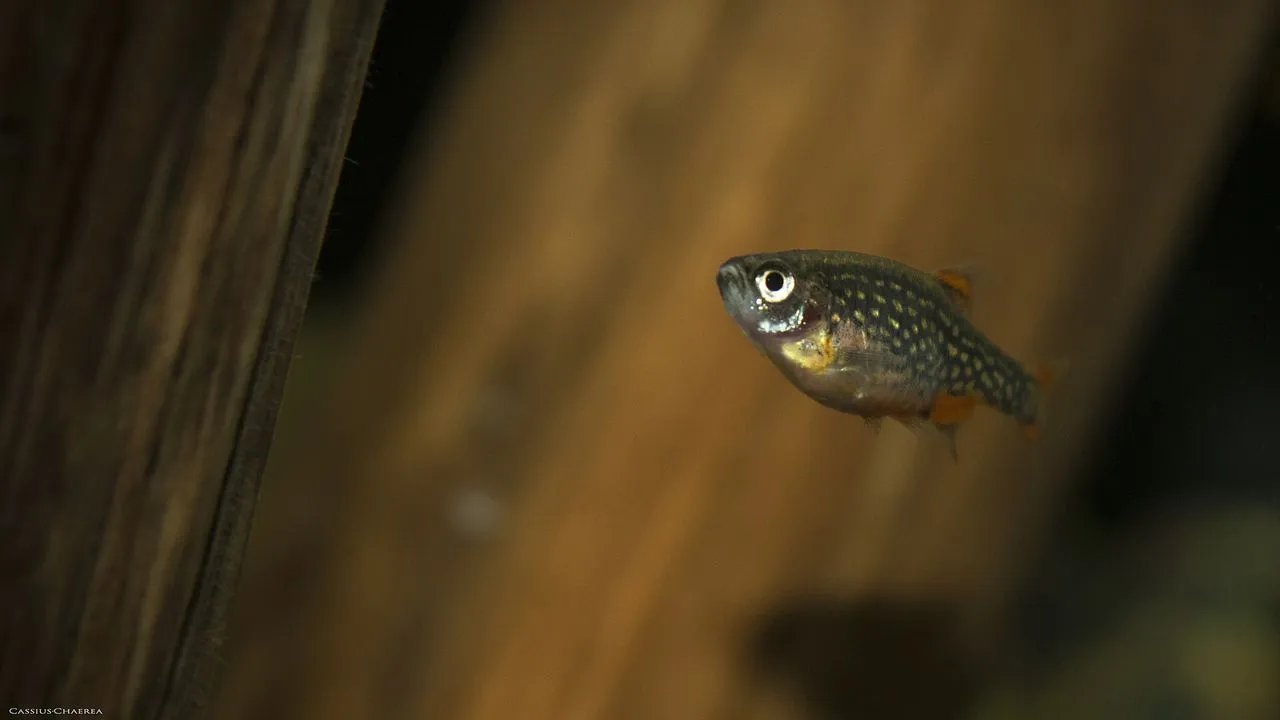
Answer: Galaxy rasbora or celestial pearl danio (Celestichthys margaritatus / Danio margaritatus) is a 2.0–2.5 cm danionid best kept in groups of at least ten, with larger groups strongly preferred. Keep it at 20–24 °C, GH 3–10 °dH, KH 1–5 °dH, pH 6.5–7.6, and conductivity 120–350 µS/cm. Its key requirement is a cool-planted danio with a dramatic discovery and over-collection history.
Celestichthys margaritatus / Danio margaritatus, the galaxy rasbora or celestial pearl danio, is a small Asian danionid whose trade reputation is often simpler than its real husbandry. Adult size is about 2.0–2.5 cm, but the important measurement is not length alone; it is mouth size, social confidence, and the water chemistry in which the fish can feed, colour, and reproduce normally.
Part of the Complete Rasboras & Danios Guide.
Identification
The galaxy rasbora or celestial pearl danio is recognised by spotted body, orange-red fins, and sexually dimorphic colour. Healthy adults hold the body level, move with short deliberate bursts or steady cruising according to species, and respond quickly to food without clamping the fins. Females are usually deeper-bodied when mature. Males are slimmer and show stronger colour during display, particularly in soft water and under subdued lighting.
Juveniles are less helpful for identification. Import batches often arrive pale, thin, and mixed with related species. Do not identify stressed fish by colour alone. Body depth, flank mark, caudal pattern, and adult size are more reliable than the name written on a wholesaler’s bag. This matters because a fish sold beside similar species may need different temperature or conductivity. Compare uncertain specimens with sibling profiles such as glowlight danio, zebra danio, and java moss before buying a mixed group.
| Character | Galaxy rasbora or celestial pearl danio | Common mistake |
|---|---|---|
| Adult size | 2.0–2.5 cm | Judged as a generic nano fish |
| Main mark | spotted body, orange-red fins, and sexually dimorphic colour | Colour fades during shipping |
| Social unit | 10 minimum, 15–30 better | Kept as a token group of six |
| Feeding clue | Small frequent meals | Large flakes left uneaten |
Origin & Habitat
The natural range centres on shallow vegetated ponds near Hopong, Myanmar. Habitat is not identical across the category, but most aquarium failures come from flattening habitat into the phrase "community fish". Water in these systems is often shaded, plant-filled, seasonally variable, and low in aggressive mineral buffering. Leaf litter, submerged grasses, root tangles, and marginal vegetation provide both cover and a continuous source of tiny invertebrates.
For aquarium purposes, use 20–24 °C, GH 3–10 °dH, KH 1–5 °dH, pH 6.5–7.6, and conductivity 120–350 µS/cm. If local tap water is far outside that range, read water hardness, GH, and KH explained before adjusting anything. For the soft-water species, reverse-osmosis water mixed or remineralised to target conductivity is safer than acid products added to hard water. A low pH with high KH is unstable husbandry, not blackwater.
Aquarium Husbandry
A mature planted tank is the correct starting point. For the smallest species, 45–60 cm tanks can work when stocking is deliberate and water chemistry is stable. Active mid-sized species need 75–120 cm of swimming length. The filter should be cycled, oxygenating, and not violent. Sponge filters, pre-filtered intakes, and baffled outlets protect small fish and fry while still moving enough water to prevent dead zones.
Substrate should be dark enough to reduce glare. Use fine sand or small smooth gravel, leaf litter where appropriate, and dense plant margins. Java moss is useful because it traps microorganisms and gives fry cover. Cryptocoryne wendtii suits many Southeast Asian layouts and provides broad, shaded leaves. Floating plants are valuable if they do not exclude all gas exchange.
| Parameter | Target |
|---|---|
| Temperature | 20–24 °C |
| GH | 3–10 °dH |
| KH | 1–5 °dH |
| pH | 6.5–7.6 |
| Conductivity | 120–350 µS/cm |
| Group size | 10 minimum; 15–30 preferred |
Add the full group only after the tank is cycled and feeding microfauna has begun to appear. New aquaria with sterile décor and fluctuating nitrogen waste are poor environments for small danionids. If the aquarium is new, follow cycling a new aquarium and verify ammonia and nitrite at 0 mg/L before purchase.
Tankmates & Behaviour
This is a shoaling fish, not a decorative pair fish. It may not school tightly unless startled, but it still reads safety through the presence of conspecifics. In undersized groups, colour fades, feeding becomes hesitant, and the fish spend more time pressed into plants. In large groups, males display, females feed openly, and the shoal uses the full tank.
Good companions are quiet, similarly sized, and parameter-compatible. Depending on temperature and mineral level, choices can include honey gourami, sparkling gourami, pygmy corydoras, otocinclus, and other rasboras from this category. Avoid fast barbs, large danios with tiny Boraras, predatory cichlids, and any gourami large enough to view them as food. A German blue ram belongs only with warmer soft-water rasboras, not cool danios or white clouds.
Diet
Wild food is small: insect larvae, microcrustaceans, tiny worms, rotifers, and surface-trapped invertebrates. In captivity the diet should be equally fine. Crushed high-quality dry food works as a base, but colour and breeding condition improve with live or frozen cyclops, baby brine shrimp, daphnia, microworms, and finely sieved mosquito larvae where legal and safe.
Feed small portions once or twice daily. A fish with a tiny mouth cannot use a large flake drifting past the shoal. Food should be small enough to swallow immediately and varied enough that weaker individuals get access. Remove uneaten food, especially in low-conductivity blackwater tanks where bacterial blooms can follow overfeeding.
Breeding
The galaxy rasbora or celestial pearl danio is an egg layer. Spawning occurs among fine plants and spawning mops, usually after conditioning with live foods and a small drop in conductivity or a cool-water change within the normal range. Adults provide no parental care and commonly eat eggs. A separate breeding tank with moss, a mesh floor, or marbles gives better survival than hoping fry will appear in a community tank.
Fry are small and need infusoria, rotifers, or other microscopic first foods before newly hatched brine shrimp. Keep water changes small, frequent, and matched for temperature and conductivity. Sudden jumps in TDS are a common reason tiny fry vanish after appearing to hatch successfully.
Common Problems
The common failures are predictable: groups too small, tanks too bright, food too large, water too hard for soft-water species, and tankmates too boisterous. Clamped fins and hiding usually indicate stress before disease. Check ammonia, nitrite, temperature, conductivity, and aggression before reaching for medication.
Do not mix this fish into a generic shop assortment without quarantine. Small danionids travel poorly when starved, chilled, or bagged with more aggressive species. A quiet quarantine tank with plants and identical water is better than a bare bright box.
See Also
- Complete Rasboras & Danios Guide — taxonomy, water chemistry, and group-level husbandry.
- glowlight danio, zebra danio, and java moss.
- Water Hardness: GH & KH Explained — the chemistry behind GH, KH, TDS, and pH.
- Reverse-Osmosis Water — useful for blackwater and low-conductivity setups.
- Java moss — spawning cover and fry refuge for small egg scatterers.
How big do galaxy rasboras get?
Galaxy rasboras (celestial pearl danios) stay tiny: adults reach about 2 to 2.5 cm (under one inch), with females slightly rounder and males more intensely coloured. They reach adult size within their first year, so the small fish you buy will not outgrow a nano setup.
Minimum tank size and group size
Despite their size, they do best in groups of at least ten, which means a footprint of roughly 45 cm / 10 gallons or more so males can display without constant conflict. Dense planting and gentle flow matter more than raw volume; a simple nano aquarium sponge filter provides safe, low-current filtration that will not pull these small fish in.
FAQ: what should I feed galaxy rasboras?
Their mouths are small, so standard flakes are often too large. Crushed flake, micro pellet fish food, and small live or frozen foods like baby brine shrimp and daphnia keep them in top colour. Feed small amounts once or twice daily and make sure food reaches the mid and lower water column where they prefer to stay.
As an Amazon Associate, we earn from qualifying purchases, at no extra cost to you.
Frequently Asked Questions
How many galaxy rasbora or celestial pearl danios should be kept together?
Keep at least ten, and use fifteen to thirty when space allows. This is a shoaling fish: colour, feeding confidence, and normal display all improve when the group is large enough to dilute stress.
What water parameters suit the galaxy rasbora or celestial pearl danio?
Aim for 20–24 °C, GH 3–10 °dH, KH 1–5 °dH, pH 6.5–7.6, and conductivity 120–350 µS/cm. Stability is more important than chasing a single pH number, but hard alkaline water is inappropriate for the soft-water species.
Can galaxy rasbora or celestial pearl danios live with bettas or gouramis?
Yes, when chemistry and temperament match. Quiet species can share planted tanks with honey, sparkling, chocolate, or pearl gouramis; avoid large or predatory anabantoids and any fish that outcompetes them at feeding time.
Are galaxy rasbora or celestial pearl danios easy to breed?
They are egg layers and adults usually eat eggs. Use mature plants, moss, or a separate spawning setup, then remove adults or protect eggs with mesh. Fry require very small live foods during the first days.
Sources & References
- Kottelat, M. (2013). The Fishes of the Inland Waters of Southeast Asia. Raffles Bulletin of Zoology Supplement 27.
- FishBase species treatment. https://www.fishbase.se/
- Catalog of Fishes — California Academy of Sciences. https://researcharchive.calacademy.org/research/ichthyology/catalog/fishcatmain.asp
- Roberts, T.R. (2007). The celestial pearl danio, a new genus and species from Myanmar. The Raffles Bulletin of Zoology.