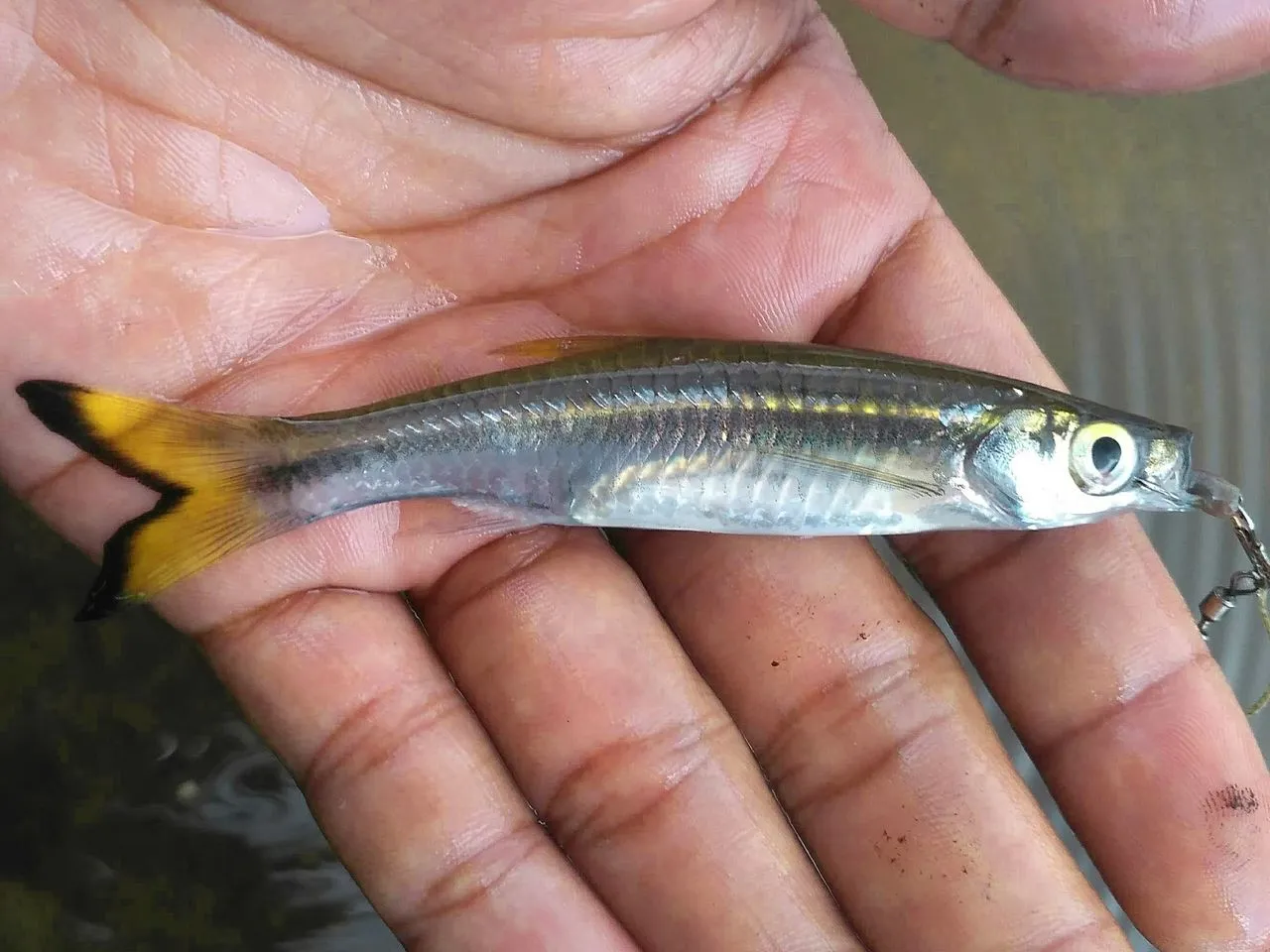
Answer: Cherry barbs and rasboras are confused because stressed importer fish lose colour and arrive under vague trade labels. Separate them by structure: Trigonostigma rasboras have a black wedge or lambchop mark, cherry barbs lack it, and Boraras are far smaller. Correct identification matters because Boraras need much softer acidic water than ordinary community barbs.
Trigonostigma heteromorpha and Puntius titteya should not be difficult to separate, yet mixed importer tanks make the problem common. Stressed cherry barbs, Espe’s rasboras, harlequin rasboras, and small red rasborins can all appear as washed-out orange fish with a dark line when they first arrive. Buying by trade colour alone is a reliable way to build the wrong community.
Part of the Complete Rasboras & Danios Guide.
Why the Confusion Happens
The confusion is commercial rather than scientific. Small Asian cypriniform fishes travel through the same exporters, arrive under compressed trade names, and are often unpacked before colour returns. A wholesaler may list "red rasbora", "assorted rasbora", or "nano red fish" while the shipment contains Espe’s rasbora, harlequin rasbora, cherry barb, and occasionally chili rasbora or phoenix rasbora. Size differences are also blurred because juveniles of larger species overlap adults of tiny species.
Taxonomy adds another layer. Rasboras and danios in this category are danionids or close aquarium allies, while cherry barbs belong with the barbs. Hobby language still treats many small red Asian fishes as if they were a single community-fish pool. They are not. A cherry barb is a Sri Lankan barb with different adult behaviour from a peat-swamp Boraras and different body structure from Trigonostigma.
Identification Checklist
Use structure before colour. Shipping stress removes red and copper pigment, but body shape and markings remain readable under calm light.
| Feature | Trigonostigma rasboras | Cherry barb | Boraras species |
|---|---|---|---|
| Body depth | Deep, laterally compressed | Deeper than Boraras, barb-shaped | Very tiny, slender to short-bodied |
| Main flank mark | Black wedge or lambchop | Dark lateral stripe, no wedge | Stripe, blotch, or spots depending species |
| Adult size | 3–5 cm | 4–5 cm | 1.5–2.5 cm |
| Swimming style | Midwater shoal | Lower-midwater, more individual | Shy micro-shoal among cover |
| Water signal | Soft planted water | Soft to moderate community water | Very soft acidic blackwater |
The harlequin rasbora has the broadest black triangular wedge, with a deeper rosy body. Espe’s rasbora is slimmer, more copper-orange, and has a narrower lambchop mark. Cherry barbs lack that wedge entirely. Males become rich red when settled; females are tan to amber with a dark side line. Boraras are much smaller, with mouths so tiny that ordinary flakes are often too large.
Husbandry Consequences
A mixed lot is not merely a naming problem. It changes the aquarium. Harlequins and Espe’s rasboras fit warm soft planted communities at 24–27 °C, GH 2–8 °dH, KH 0–3 °dH, pH 5.8–7.2, and conductivity around 80–250 µS/cm. Cherry barbs tolerate a broader range and are less dependent on peat-style water. Tiny Boraras often need GH 0–3 °dH, KH 0–1 °dH, pH 4.8–6.4, and 50–120 µS/cm. Those are not interchangeable conditions.
Tankmates also change. A group of cherry barbs can live with robust peaceful community fish, but a group of chili rasboras can be outcompeted by the same tankmates. A harlequin group works beautifully with honey gourami or pearl gourami. Tiny Boraras are safer with sparkling gourami, pygmy corydoras, and very small quiet fish. If the water is not already understood, read water hardness, GH, and KH explained before mixing groups.
What to Do at the Shop
Ask to see the fish after they have been in the dealer’s tank for several days. Newly unpacked fish are pale, hungry, and breathing hard, making identification and health assessment unreliable. Look for intact mouths, level swimming, normal gill rhythm, and a group that responds to food. Avoid tanks where dead fish remain, where several species are mixed at random, or where tiny fish are housed with larger barbs.
Buy enough of one identified species to form a proper group. Six mixed red fish are worse than twelve correctly identified Espe’s rasboras. If the shop cannot separate the species, either wait or buy the whole group only if quarantine space allows later sorting.
Quarantine and Sorting
Quarantine mixed lots in a planted, cycled tank with subdued light. Use neutral-to-soft water that will not shock either likely group: for example GH 3–6 °dH, KH 1–2 °dH, pH 6.4–7.0, and 24–25 °C. This is not final blackwater for Boraras, but it is safer than dropping unidentified fish straight into extreme chemistry. After colour returns, sort by body shape and size.
Feed tiny foods during quarantine: crushed dry food, cyclops, daphnia, and baby brine shrimp. Watch which fish feed confidently and which are being excluded. The smallest Boraras may need a separate low-flow tank before the larger fish finish every meal.
Breeding Clues
Breeding behaviour can confirm identity. Trigonostigma place eggs on the underside of broad leaves, often after the pair turns upside down beneath the leaf. Cherry barbs scatter adhesive eggs among plants and show no leaf-turning rasbora behaviour. Boraras scatter extremely small eggs into moss and leaf litter, with fry appearing only in mature, predator-light tanks.
These clues are useful only after the fish are healthy. Do not force breeding conditions on recent imports. Stabilise water, feed well, and identify the group first.
See Also
- Complete Rasboras & Danios Guide — group taxonomy and water chemistry.
- Harlequin rasbora — the broad-wedge Trigonostigma.
- Espe’s rasbora — the slimmer copper lambchop rasbora.
- Chili rasbora — tiny blackwater Boraras often mixed in nano shipments.
- Water Hardness: GH & KH Explained — essential for sorting soft-water and moderate-water fish.
- Sparkling gourami — a small Southeast Asian companion for quiet blackwater tanks.
Frequently Asked Questions
Why are cherry barbs confused with rasboras?
They are similar in size, colour, and export route, and stressed fish in dealer tanks often lose the markings that make identification easy. Importers may also use broad labels such as assorted red rasbora or mixed nano fish.
What is the fastest way to separate a cherry barb from a harlequin rasbora?
Look for the Trigonostigma wedge. Harlequin and Espe’s rasboras carry a black triangular or lambchop mark on the rear flank; cherry barbs have a more barb-like body and lack that clean wedge.
Can cherry barbs and rasboras live together?
Often yes in soft to moderately hard planted water, but they are not the same fish. Cherry barbs are cyprinid barbs from Sri Lanka and tolerate different behaviour and chemistry than peat-swamp Boraras.
What should I do with a mixed importer lot?
Quarantine the whole group, identify fish after colour returns, then split species by size, temperature, and water chemistry. Do not put tiny Boraras with larger active barbs or danios.
Sources & References
- Kottelat, M. (2013). The Fishes of the Inland Waters of Southeast Asia. Raffles Bulletin of Zoology Supplement 27.
- FishBase species treatment. https://www.fishbase.se/
- Catalog of Fishes — California Academy of Sciences. https://researcharchive.calacademy.org/research/ichthyology/catalog/fishcatmain.asp
- Pethiyagoda, R. (1991). Freshwater Fishes of Sri Lanka. Wildlife Heritage Trust of Sri Lanka.