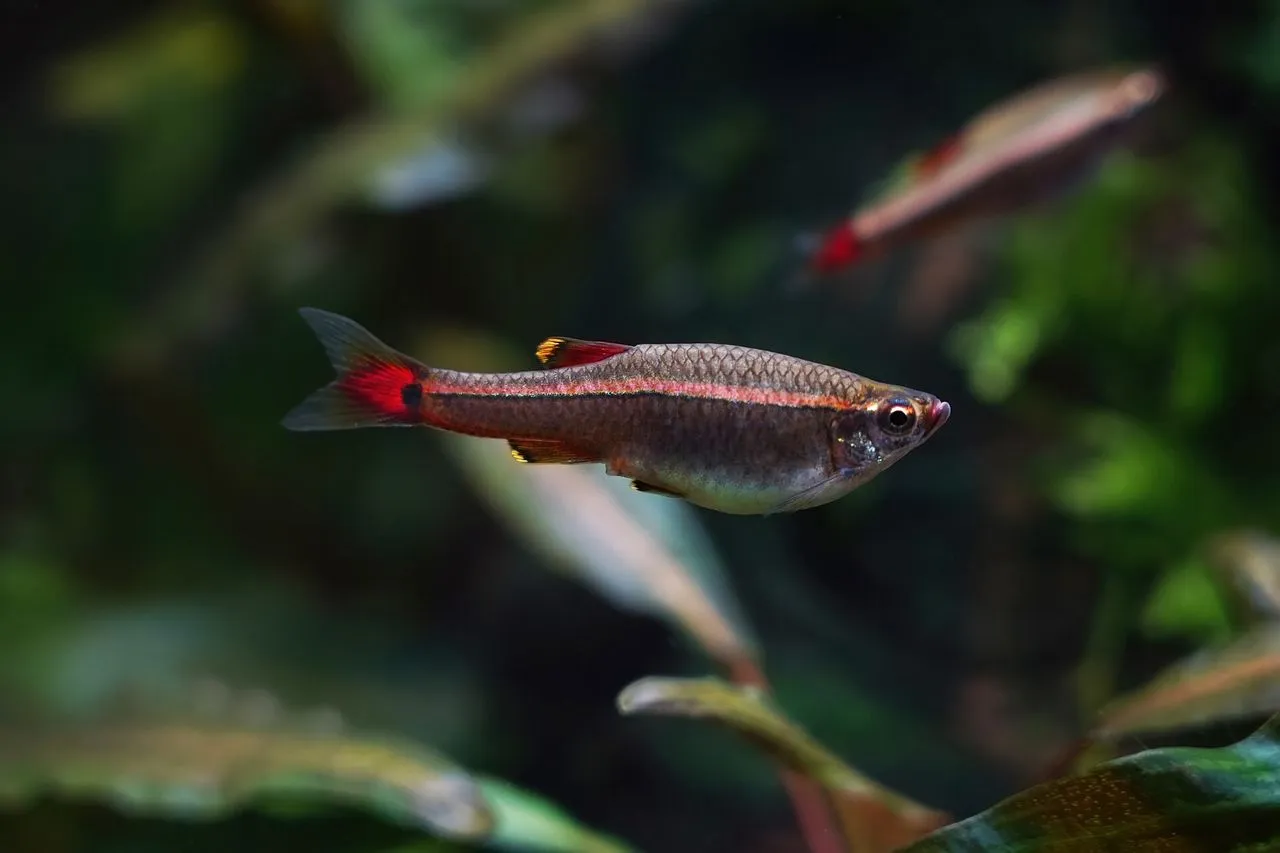
Answer: Harlequin rasboras are shoaling fish, not schooling fish. A loose distribution across the tank is normal and healthy behaviour for a settled group of eight or more in a stable aquarium. Tight, synchronised schooling is a threat response — if you see it constantly, something in the tank is alarming them. If you see no grouping at all, group size or water quality is the more likely problem.
Trigonostigma heteromorpha (harlequin rasbora) does not school the way rummynose tetras do, and there are two quite different situations that both get described as "won't school". The first is normal, healthy shoaling — a loose distribution of fish spread through mid-water, aware of each other but not moving in lock-step. The second is genuine stress: fish clustering in one corner, hiding in plants, or one individual isolated behind a filter inlet for hours. Before anything is changed, it is worth knowing which of those is actually happening.
Part of the Complete Rasboras & Danios Guide.
Main Causes
Shoaling and schooling are not synonyms. Schooling is tight, synchronised group movement where individuals align and turn as a single unit — the behaviour seen in sardines or rummynose tetras under predator pressure. Shoaling is the looser social arrangement most cyprinids use in everyday life: fish remain aware of conspecifics, prefer their company, and distribute through a shared patch of habitat without moving in perfect coordination. Pitcher & Parrish (1993) established this distinction clearly, and it runs through most of the subsequent literature on group behaviour in teleosts.
T. heteromorpha is a shoaling species. In a stable aquarium with no predators and correct water chemistry, loose distribution is the expected outcome — not a failure state.
| What you see | What it means | Problem? |
|---|---|---|
| Fish spread loosely through mid-water, maintaining loose awareness of each other | Normal shoal in a settled, low-threat tank | No |
| Fish tighten briefly after a water change, then disperse within 30 minutes | Alarm response to disturbance; resolves naturally | No |
| 2–3 fish visible; rest pressed into plants or near the substrate | Group too small; individuals withdrawing under social stress | Yes |
| One fish isolated near a corner or filter inlet for hours | Social exclusion, injury, or illness | Yes — investigate the individual |
| Full group clusters at one end or near the surface continuously | Water quality issue, aggressive tankmates, or poor lighting setup | Yes — test water and observe tankmates |
| Fish rarely within a body-length of any conspecific | Group too small or tank dimensions too restrictive | Likely — review group size and tank shape |
How to Identify the Problem
Four variables account for the majority of cases where harlequin rasboras fail to shoal openly.
Group size. The fish reads safety through the density of conspecifics nearby. Below six to eight individuals the dilution effect that makes open-water cruising feel safe disappears, and fish retire into cover rather than using the whole tank. Twelve is a comfortable minimum for consistent open behaviour; fifteen to twenty is where colour, male display, and relaxed feeding all emerge together. This is the first variable to check and the most commonly underestimated one at the point of purchase.
Tank shape. T. heteromorpha is a mid-water cruiser that ranges laterally. A tall, narrow aquarium constrains horizontal swimming lanes and produces fish that hover in vertical layers rather than shoaling across the length. A 90 cm or 120 cm tank of moderate depth suits the species far better than a 50 × 50 × 60 cm display cube, even when water volume is identical. Swimming length is what matters.
Lighting and cover. A bare, brightly lit aquarium over pale substrate makes every fish feel exposed. Rasboras in this environment do not distribute freely — they cluster near any available plant cover. The tight grouping near the back plants that reads as nice schooling is a stress posture. Subdued lighting, a dark substrate, floating plants, and enough planting to break sight lines into zones rather than a single open arena all reduce that clustering within days. Java moss on driftwood and floating water wisteria are useful starting points.
Tankmates. A larger, faster fish at the far end of the tank is enough to push a nervous shoal into the nearest corner without any visible chasing. The rasboras are not being harmed — they are reading constant activity as a persistent threat signal. Espe's rasbora, honey gourami, and pygmy corydoras are genuinely compatible. Tiger barbs, large danios, or fast rainbow fish are not, even when physical injury is never observed.
Risk and Severity
A harlequin rasbora distributed loosely around a well-planted, stable tank is under no stress. That is the correct outcome. Chronic tight schooling and chronic hiding are both problems, but they differ in weight.
Chronic isolation — one fish spending its day behind a filter inlet, refusing to join the group — is a welfare concern. It may indicate injury, a parasitic burden, or a social rank too low to compete at feeding time. It may also mean the group is simply too small and that individual has been outcompeted for position. Fish held in persistent social isolation show elevated cortisol and suppressed immune function over time; this is not a cosmetic issue.
Constant tight schooling in a group of fifteen, by contrast, signals that the tank environment is triggering the alarm response repeatedly — a fast tankmate, glass-tapping, or a vibrating pump — and is worth addressing. It is physiologically costly to sustain a tight school, and fish doing so are not feeding or displaying normally.
Solutions and Actions
Fix the most likely cause before changing multiple variables at once.
Increase the group if it is below eight. Add fish in one step rather than one or two at a time. Drip-acclimate new arrivals carefully — Acclimating New Fish covers the full protocol. Quarantine new additions before introducing them to a stable shoal; a stressed shop fish can carry disease into a healthy tank within days.
Improve cover and soften the lighting. Plant the back and sides densely. Add java moss on driftwood to provide a broken lower level. Floating plants soften the surface light without blocking gas exchange entirely. A darker substrate reduces startle responses significantly and is the cheapest single improvement in a bare-bottom tank.
Assess tankmates honestly. Watch the tank for 20 minutes after lights-on, before feeding, from a distance. Which fish controls the swimming space? Which areas do the rasboras avoid? A single barb commanding the mid-water is enough to pin a group of twelve into one corner.
Check water parameters. If the group is large enough but still clustering near the surface, test ammonia, nitrite, and conductivity. T. heteromorpha in water that is too hard or that has elevated ammonia will crowd near any area of higher oxygenation. That is physiological distress, not social behaviour, and the Complete Aquarium Care Guide is the correct starting point.
Prevention
Buy a group of twelve or more at the outset rather than six with the intention of adding more later. A shoal establishes its social dynamics in the first few weeks; adding new individuals months later can disrupt that balance and trigger low-grade aggression between established and new fish.
Choose a tank with more length than height. A 90 × 35 × 40 cm tank is far better suited to harlequin rasboras than a 50 × 50 × 60 cm cube. The horizontal dimension is the critical one.
Select tankmates from the peaceful end of the spectrum. The Complete Rasboras & Danios Guide covers compatible options in detail. Chili rasboras share the category but fare better in a species-focused setup — they are far smaller and combining them with harlequins tends to leave both groups undersized for confident shoaling.
Common Mistakes
Expecting tight schooling from a shoaling species. Harlequin rasboras are not rummynose tetras. Loose distribution in a settled tank is the correct outcome. If sustained tight schooling is the aesthetic goal, this is the wrong species for that goal.
Buying too few to keep costs down. Six harlequins in a 60 litre tank will distribute poorly and show faded colouration. The same tank with twelve will show coherent group behaviour and stronger colour within a few weeks. The fish are inexpensive; the cost of an undersized group is sustained poor display.
Mixing harlequin and Espe's rasboras to reach a target number. T. heteromorpha and T. espei look similar in the shop and occupy the same mid-water niche, but each recognises its own conspecifics more reliably than the other. A tank with eight harlequins and eight Espe's typically functions as two sub-shoals of eight rather than a coherent group of sixteen. See Espe's rasbora for that species' individual requirements.
Calling corner-clustering "schooling". Rasboras pressed against the back plants under full-spectrum lighting are stressed, not shoaling. Providing cover and lowering light intensity usually resolves this within days.
Changing only the fish count without addressing the environment. More fish in a tall, bare, bright tank will still cluster badly. Group size, tank shape, cover, and tankmate selection all feed the same behaviour. The environment should be right before the group is built to full size.
See Also
- Harlequin rasbora (Trigonostigma heteromorpha) — full species profile with water parameters, diet, and breeding.
- Espe's rasbora — closely related species; keep separately rather than mixing groups to reach a target number.
- Complete Rasboras & Danios Guide — the shoaling vs schooling distinction covered across the whole family.
- Acclimating New Fish — protocol for adding new shoal members without introducing disease or osmotic stress.
- Java moss — useful cover and sight-line breaker for planted rasbora tanks.
Frequently Asked Questions
Is it normal for harlequin rasboras to spread out around the tank?
Yes. A settled shoal of eight or more will typically distribute across the middle water, occasionally break into loose sub-groups, and come together only at feeding or when disturbed. That spread is healthy shoaling behaviour, not a sign of incompatibility or poor husbandry.
How many harlequin rasboras are needed for coherent shoal behaviour?
Eight is a workable minimum; twelve to fifteen is better. Below six or seven individuals, fish become isolated rather than loosely grouped, and stress signs follow — faded colour, hiding, hesitant feeding. Group size is the single most impactful variable in rasbora behaviour.
Why do my rasboras suddenly school tightly after a water change?
A water change, net disturbance, or sudden vibration is a classic alarm trigger. The fish tighten briefly, then disperse once the perceived threat passes. Tight cohesion persisting for hours after a routine change suggests the change was too large, too cold, or chemically different from the tank water.
Can I mix harlequin rasboras with Espe's rasboras to make a larger group?
Generally no — not for the purpose of building a coherent shoal. The two species are closely related but recognise conspecifics more reliably than they recognise each other. Eight harlequins plus eight Espe's rasboras tend to function as two separate sub-shoals rather than one group of sixteen, leaving each species below its effective threshold.
Sources & References
- Kottelat, M. (2013). The Fishes of the Inland Waters of Southeast Asia. Raffles Bulletin of Zoology Supplement 27.
- Pitcher, T.J. & Parrish, J.K. (1993). Functions of shoaling behaviour in teleosts. In: Pitcher, T.J. (ed.) Behaviour of Teleost Fishes, 2nd edn. Chapman & Hall, London. pp. 363–439.
- FishBase — Trigonostigma heteromorpha species treatment. https://www.fishbase.se/