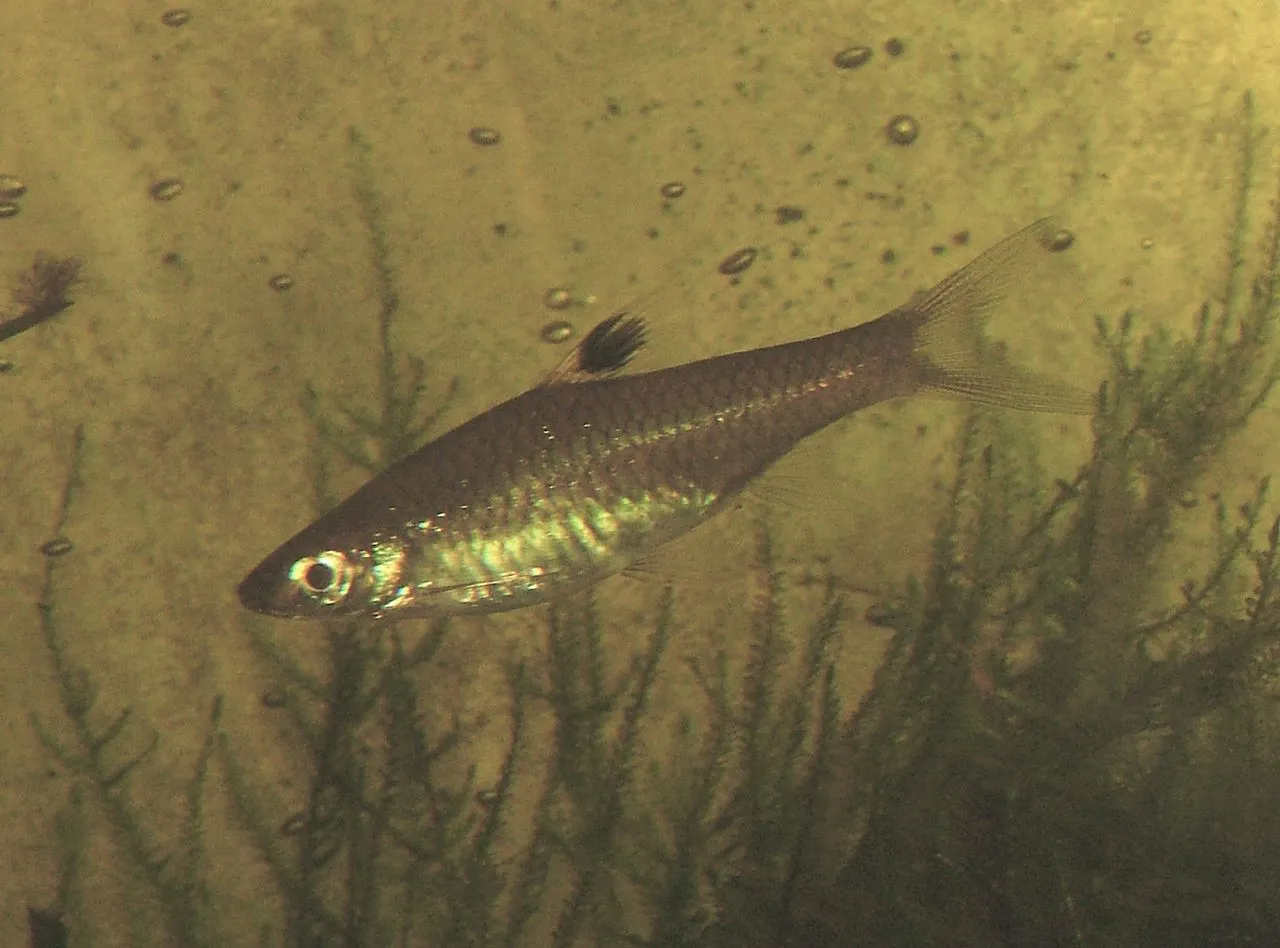
Answer: Pale colour in chili rasboras is almost always environmental or social: water above GH 4 °dH or conductivity above 120 µS/cm suppresses pigment expression, a bright bare tank removes the contrast they need to display, and a shoal below ten leaves subdominant males permanently washed out. Fix TDS first — target 50–80 µS/cm using RO water — then add dark substrate, floating plants, and increase the shoal to fifteen or more.
Boraras brigittae (chili rasbora) is not a species that hides its health. When conditions suit it, a male holds a vivid crimson body against leaf litter and dark substrate and defends a thumb-sized display territory with fins spread. When conditions are wrong, that red fades to a dull orange-pink, the fish retreats to the plant margins, and the shoal goes largely unnoticed. The change is not random and not a sign of clinical disease — it is a predictable physiological and behavioural response to water chemistry, lighting, social structure, and, less commonly, age or origin.
Part of the Complete Rasboras & Danios Guide.
Main Causes
| Cause | Mechanism | Typical onset |
|---|---|---|
| Hard water (GH >4 °dH) | Dissolved minerals suppress chromatophore expression | Gradual over days to weeks |
| High conductivity (>120 µS/cm) | Chronic low-level osmotic stress in water outside the natural range | Days after switch to harder tap water |
| Bright tank, no cover or dark substrate | Chilis display against dark contrast; bright bare tanks suppress display | Immediate on introduction |
| Shoal too small (<10 individuals) | Subdominant males stay pale without competing conspecifics | Persistent if group never reaches critical mass |
| Boisterous or oversized tankmates | Predation cues and feeding competition suppress social display | Days after introduction of offending species |
| Post-transport recovery | Cortisol from shipping contracts pigment cells | 1–3 days after arrival; resolves in 2–4 weeks |
| Juvenile fish (<6 months) | Full colouration does not develop until sexual maturity | Persistent until around 6–8 months old |
| Old age (>3 yr) | Chromatophore output declines as fish age | Gradual over months |
More than one cause is usually active at the same time. A shoal of six in hard tap water under bright LEDs presents three or four drivers simultaneously.
How to Identify the Problem
Three patterns point to different fixes.
Developmental paleness affects juveniles under roughly six months old. All fish look pale consistently, but they feed actively, swim in open water, and show no clamped fins or hiding behaviour. The fish are not yet mature; nothing is wrong beyond needing time.
Environmental paleness appears regardless of social dynamics. Colour does not improve even when dominant males attempt display. Test conductivity first — if it reads above 120 µS/cm or GH exceeds 4 °dH, water chemistry is the primary driver. A tank with light-coloured substrate, no floating plants, and bright overhead lighting compounds the problem independently of hardness. These fish evolved under forest canopy over dark peat; contrast and shadow are not optional extras.
Social paleness produces a mixed picture: one or two fish, usually the largest males, show noticeably more colour than the rest while subdominants are consistently washed out and avoid displaying. This is hierarchy-driven suppression. Without enough conspecifics to diffuse dominance, only the top male expresses full colour. This pattern can appear even in perfectly soft water.
Risk and Severity
Paleness from water hardness or conductivity is not cosmetic in the long term. B. brigittae evolved in Bornean peat swamps where conductivity is routinely 30–80 µS/cm and GH is near zero. Chronic osmotic stress in hard alkaline water suppresses immune function over months, shortens lifespan, and stops breeding. Fish kept at GH 6 °dH or above often develop a persistent dull appearance alongside a slightly tight look around the fins — not a named disease, but a measurable metabolic cost. The species is small enough that early signs are easily missed until decline is well advanced.
Paleness from social suppression or transport stress is less physiologically damaging but still signals that the fish is not in normal behavioural condition. Chronic suppression in an undersized shoal reliably leads to reduced feeding confidence and more time hidden in plants.
Solutions and Actions
- Measure conductivity and GH before changing anything. A TDS meter and a GH test kit are both necessary. pH 6.5 is consistent with GH 10 °dH; hardness and conductivity are the values that matter for this species, and a pH probe alone tells you nothing useful about mineral load. See water hardness, GH, and KH explained for the relationship between these parameters.
- Lower TDS with RO water. If GH exceeds 4 °dH or conductivity exceeds 120 µS/cm, switch to reverse-osmosis water remineralised to a target of 50–80 µS/cm. Transition gradually — no more than 20% of tank volume per day — to avoid osmotic shock from a sudden drop in minerals.
- Add dark substrate if not already present. Fine black sand or dark inert gravel increases the visual contrast against which males display. Light-coloured substrate is one of the most consistently overlooked suppressors of Boraras colour and is easy to correct at setup.
- Introduce floating plants and dense midground cover. Water wisteria, salvinia, or frogbit reduces light penetration and creates dappled zones. Java moss and christmas moss across the midground give subdominant males somewhere to retreat between displays. If lighting cannot be dimmed easily, dense planting is the most immediate practical intervention available.
- Increase the shoal to fifteen or more. At this group size, dominant hierarchy becomes fluid — multiple males display simultaneously, subdominants stop suppressing entirely, and colour competition lifts the whole group. Chili rasboras at fifteen-plus over leaf litter and dark substrate in properly soft water will show crimson males during most of the day. A 60-litre tank can hold twenty individuals without difficulty; bioload is almost never the limiting factor, group size is.
- Evaluate tankmates honestly. Phoenix rasboras, mosquito rasboras, sparkling gouramis, and small corydoras rarely trigger suppression. Active barbs, larger danios, and even moderately active dwarf gouramis can be sufficient to push a small Boraras shoal into permanent hiding and pale colouration.
- Allow post-transport fish four weeks before judging colour. Cortisol from shipping suppresses pigment expression; it resolves once the fish settles, but only in correct conditions. An early verdict is almost always too pessimistic.
Prevention
The three requirements — soft water, visual security, and a large shoal — reinforce each other. Removing any one reliably produces pale fish even if the other two are correct.
- Set up correct water before buying fish. Confirm GH 0–2 °dH, KH 0–1 °dH, conductivity 50–80 µS/cm, and pH 5.0–6.5 before introducing any Boraras. If local tap water exceeds GH 6 °dH, an RO setup is not optional for this species.
- Aquascape before introducing fish. Dark substrate, almond or catappa leaf litter, dense plant margins, and floating cover should all be in place at the point of purchase, not added afterwards.
- Buy the full shoal at once. A group of twenty that establishes together forms a more stable hierarchy than one assembled piecemeal over months, where each new arrival disrupts the existing social structure.
- Avoid tankmates above 4–5 cm or species with boisterous feeding behaviour. Chili rasboras do best alongside other miniature Boraras, small corydoras, dwarf shrimp, and calm anabantoids. Anything that creates a constant threat cue belongs in a different tank.
Common Mistakes
- Testing only pH and concluding the water is "soft". pH 6.5 is compatible with GH 10 °dH. Always test hardness and conductivity directly; pH is not a proxy for mineral content.
- Relying on colour-enhancing foods as the primary intervention. Live and varied foods support chromatophore health, but no diet compensates for conductivity above 200 µS/cm or a shoal of six under bright lighting.
- Keeping six to eight fish because the tank is small. Bioload from twenty chili rasboras in a 60-litre tank is negligible. The limiting factor for colour and normal behaviour is group size, not volume.
- Adding tannins without measuring hardness. Oak leaves and peat extract adjust colour and lower pH at low KH, but they do not reduce GH or conductivity. Hard water stays hard after adding tannins; a water source change is the only effective route.
- Judging colour in the first week after purchase. Transport stress causes temporary paleness that has nothing to do with home-tank conditions. Allow a full month before concluding that something in the setup is wrong.
Frequently Asked Questions
Why are my chili rasboras pale straight after I bought them?
Transport stress floods fish with cortisol, which causes temporary pigment cell contraction. Newly arrived chili rasboras typically need two to four weeks in correct conditions — GH 0–3 °dH, conductivity 50–80 µS/cm, subdued lighting, and a full shoal — before colour approaches its maximum. Evaluating colour within the first week after purchase is unreliable.
Will colour-enhancing foods fix pale chili rasboras?
Diet supports chromatophore health, and live or frozen foods such as cyclops and baby brine shrimp do contribute to colour intensity. However, no food compensates for GH above 6 °dH, conductivity above 200 µS/cm, or a shoal of six under bright lighting. Correct water chemistry and social conditions first; varied diet is a secondary factor, not a primary fix.
Does water hardness really affect fish colour?
Yes, directly. Boraras brigittae evolved in Bornean peat swamps where GH is near zero and conductivity is 30–80 µS/cm. At GH 6 °dH or above, pigment cells remain partially contracted and the fish rarely approach full display colouration regardless of other conditions. Testing only pH misses this — use a GH kit and a TDS meter, not a pH probe alone.
How many chili rasboras do I need to see full colour?
At ten fish, one or two dominant males will display. At fifteen to twenty, multiple males compete simultaneously and the whole shoal spends more time in open water showing colour. Below ten, social hierarchy suppresses subdominant males into near-permanent paleness. Group size is one of the highest-leverage changes a keeper can make, and bioload from twenty chili rasboras is negligible.
Sources & References
- Kottelat, M. (2013). The Fishes of the Inland Waters of Southeast Asia. Raffles Bulletin of Zoology Supplement 27.
- Baensch, H.A. & Riehl, R. (1993). Aquarium Atlas, Vol. 1. Mergus Verlag.
- FishBase — Boraras brigittae species treatment. https://www.fishbase.se/
- Catalog of Fishes — California Academy of Sciences. https://researcharchive.calacademy.org/research/ichthyology/catalog/fishcatmain.asp