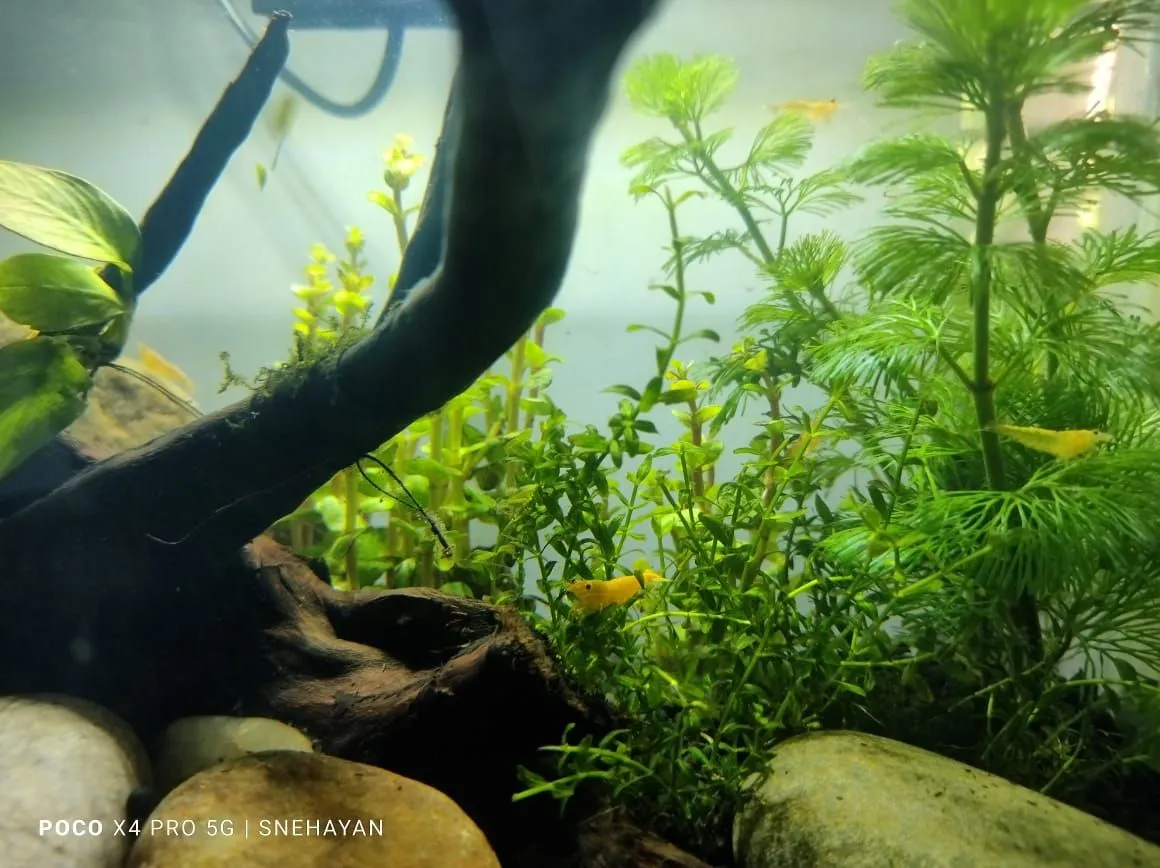
Answer: Leggy stem plants — long internodes, sparse leaves, stems stretching toward the surface — are etiolation: a photoreceptor-driven response to insufficient light. The cause is nearly always inadequate PAR at substrate level, wrong spectrum, or a photoperiod too short to support compact growth. Fix the light before adjusting CO2 or nutrients. Stretched internodes don't shorten once formed; trim the tops and replant them under the corrected conditions.
Stem plants stretch for the same reason a seedling leans toward a windowpane. When photoreceptors in the stem register insufficient light, the plant diverts energy away from leaf production and into internode elongation — growing longer between each leaf pair in an attempt to reach a brighter zone. This response is called etiolation, it is fully documented in vascular plant physiology, and it explains the overwhelming majority of leggy aquarium stems. The plant is not failing; it is responding rationally to a problem the keeper introduced.
Part of the Complete Aquatic Plants Guide.
Main Causes
| Cause | Mechanism | Typical signal |
|---|---|---|
| Insufficient PAR | Phytochrome response triggers internode elongation | All stems stretch; new leaves smaller than normal |
| Wrong spectrum | Cool-white or old fluorescent output lacks red; plant misreads energy budget | Pale stretched growth even under apparently bright fixtures |
| Photoperiod too short | Under 6 hours daily, the plant can't accumulate enough photosynthate | Slow growth with increasingly long internodes over weeks |
| Photoperiod too long at low intensity | Extended dim light encourages shade-response elongation | Stretched stems despite lights running 10–12 hours |
| CO2 limitation under high light | Plant has photons but can't fix carbon; growth priority shifts to elongation | Leggy growth despite adequate PAR; drop checker consistently blue |
| Mutual shading | Dense planting blocks light to lower stems; lower leaves drop, tops reach upward | Lower half of stems bare; upper tips still healthy |
| Nitrogen excess relative to other nutrients | Elevated nitrogen pushes vegetative elongation at the expense of compact form | Rapid pale elongation; phosphorus or iron deficiency concurrent |
The first cause — insufficient PAR — accounts for the great majority of cases. Before adjusting CO2, nutrients, or photoperiod, establish what PAR your fixture delivers at substrate level.
How to Identify the Problem
The diagnostic measurement is internode length: the distance between adjacent leaf pairs on the stem. A stem plant in correct conditions produces internodes of roughly 5–15 mm depending on species. A leggy plant stretches those gaps to 30–60 mm or more, and the leaves at each node are often smaller than they should be.
Confirm this before assuming a nutrient problem. Leggy stems are still green and still growing — the plant is not starving. That distinguishes etiolation from the chlorosis and leaf damage covered in the aquarium plants turning yellow article. Stretched green stems indicate a light problem; yellowing leaves indicate a different set of causes entirely.
Species baseline matters. Bacopa caroliniana has a naturally more open growth habit than compact stems like Rotala rotundifolia; it will show wider internodes even under adequate light. Ludwigia repens sits between the two — tolerant of moderate light but visibly leggier below 35 PAR. If the same fixture drives compact Rotala but open Bacopa, the light may be adequate for one species and marginal for the other.
| Species | Internodes under adequate PAR | Minimum PAR for compact form |
|---|---|---|
| Bacopa caroliniana | 10–20 mm | ~25–30 PAR |
| Ludwigia repens | 8–15 mm | ~35 PAR |
| Rotala rotundifolia | 5–12 mm | ~40 PAR |
| Hygrophila polysperma | 10–18 mm | ~20–25 PAR |
If you don't have a PAR meter, a reliable proxy is the shadow test: hold your hand 30 cm above the substrate. A fixture delivering 40 PAR or more casts a sharp, distinct shadow. Diffuse or absent shadows suggest you are likely below 30 PAR.
Risk and Severity
Legginess is cosmetic at first — unattractive but not lethal. Over weeks the problem compounds. Lower leaves, shaded by the lengthening stems above them, begin to drop. The bare lower stem sections collect detritus, create stable attachment points for green hair algae and thread algae, and reduce the plant's total photosynthetic output. A tank of leggy stems is a tank in which algae already has a structural advantage.
Left unaddressed — no trimming, no light correction — stem plants eventually become unstable. The woody lower stems can no longer support top growth, the stems topple or float free, and the substrate is left bare. The biological competition between the declining plant and opportunistic algae usually resolves in the algae's favour at this stage.
Solutions and Actions
Address the root cause before replanting. Replanting tops under the same inadequate light produces the same leggy growth within two or three weeks.
Increase PAR (most common fix):
Raise the fixture, clean the lens, increase the output setting, or replace the unit with one suited to planted tanks. For easy stem species — water wisteria, Bacopa caroliniana, hornwort — 30–40 PAR at substrate level is the minimum for compact growth. For colour stems like Rotala rotundifolia and Ludwigia repens, 50–80 PAR is appropriate. See LED Lighting for Planted Tanks for fixture assessment and PAR class guidance.
Adjust photoperiod:
If the tank is running under 6 hours, increase to 7–8 hours in 30-minute increments over two weeks. If it is already running 10–12 hours under low-intensity light, shorten to 7–8 hours — dim light over a long period is not equivalent to adequate light over a shorter one, and algae exploits the extended photoperiod faster than understimulated stems can respond.
Address CO2 if applicable:
In a high-light tank above 50 PAR, inadequate dissolved CO2 can force elongation even when light is correct. Target 15–20 ppm dissolved CO2 and confirm stability with a drop checker. See CO2 Injection Setup for system calibration. Low-tech tanks without pressurised CO2 should not be pushed above 40–50 PAR without accounting for the carbon limitation.
Trim and replant the tops:
Once the light is corrected, trim each stem 2–3 cm above a healthy node and replant the top cutting in the substrate. Discard the bare lower section. New growth from the replanted tops will be compact under the improved conditions. This reset is faster than waiting for existing leggy stems to grow out — stretched internodes don't change once the cells are formed.
Thin dense plantings:
If mutual shading is the cause, remove every second or third stem to restore light penetration. Adequate spacing for most stem plants is 3–5 cm between stem centres. Better spacing allows light to reach the lower third of the plant and reduces lower leaf drop.
Prevention
Plan lighting before buying plants. A fixture that delivers adequate PAR across the tank footprint is the single most important preventive step. Many compact fluorescent and T8 fixtures sold with budget starter tanks deliver 15–25 PAR at substrate — enough for Java fern, hornwort, and anubias, but not enough for compact stem growth. Assess the fixture before purchasing stem plants. The LED Lighting for Planted Tanks guide covers PAR classes and what to look for in a replacement fixture.
Choose species matched to the light you have. Hornwort (Ceratophyllum demersum) and water wisteria tolerate 25–35 PAR and grow acceptably in modest-light tanks, though even they will stretch under very dim conditions. Compact colour stems — Rotala, Ludwigia, Alternanthera reineckii — belong in a tank that delivers 50+ PAR consistently.
Establish a trimming routine. Even under ideal light, stem plants grow toward the surface and eventually shade their own lower sections. Trimming the top 30–40% of each stem every 2–3 weeks and replanting the tops prevents the bare-lower-stem cycle before it starts.
Common Mistakes
- Blaming CO2 or nutrients before checking light. Etiolation is a light response. Green but stretched stems point to PAR first. Adjusting fertiliser or CO2 without correcting the light rarely produces lasting improvement.
- Compensating with a longer photoperiod. Running lights for 12 hours cannot substitute for adequate intensity. Dim extended photoperiods favour algae, not compact stem growth.
- Replanting tops without fixing the cause. The new cuttings will grow compact for a week or two, then stretch again under the same inadequate conditions.
- Leaving bare lower stems in the tank. Spent, leafless stem sections attached to the substrate contribute no photosynthesis and provide stable surface area for algae to colonise.
- Applying the same PAR standard to every species. Bacopa caroliniana at 30 PAR shows wider internodes than tight Rotala at the same PAR — but it may be near its natural compact form. Read the individual species profile before concluding the light is categorically wrong.
Frequently Asked Questions
How do I know if leggy growth is a light problem rather than a nutrient deficiency?
Colour is the diagnostic. Etiolated stems are green — sometimes pale green, but still green — with long gaps between leaf pairs and smaller-than-normal leaves at each node. Nutrient deficiency shows first as yellowing, chlorosis, or pinholes in leaves. If stems are stretching but still fully coloured, check PAR before testing nutrients.
Will fixing the light make my leggy stems compact again?
No. Internode cells are already elongated and will not shorten. The fix is to trim each stem a few centimetres above a healthy node, replant the top cutting in the substrate, and discard the bare lower section. New growth from those replanted tops will be compact under the corrected conditions.
How much light do stem plants actually need to stay compact?
It depends on species. Tolerant stems — Bacopa caroliniana, water wisteria, hornwort — remain acceptable at 25–35 PAR. Mid-range stems like Ludwigia repens need 35–55 PAR. Compact colour stems like Rotala rotundifolia require 50–80 PAR for tight nodes and good red colouration. Measure or estimate at substrate level, not at the water surface.
Can CO2 cause leggy growth even in a well-lit tank?
Yes. Under high light with insufficient dissolved CO2, a plant receives photons but cannot fix carbon efficiently. Growth priority shifts to elongation rather than dense leaf production. If stems are leggy despite adequate PAR, check that dissolved CO2 is reaching 15–20 ppm and that the drop checker is consistently green rather than blue.
Sources & References
- Walstad, D. (2013). Ecology of the Planted Aquarium. Echinodorus Publishing.
- Kasselmann, C. (2003). Aquarium Plants. Krieger Publishing Company.
- Rataj, K. & Horeman, T.J. (1977). Aquarium Plants: Their Identification, Cultivation and Ecology. T.F.H. Publications.
- Tropica Aquarium Plants — cultivation notes for individual species. https://tropica.com/