Answer:
Aquarium plants succeed when growth form, light, carbon, and substrate match. Low-tech tanks below 30 PAR suit Anubias, Java fern, mosses, crypts, and Vallisneria. Carpets and red stems usually need 60+ PAR and about 20 ppm dissolved CO2. Never bury rhizomes, feed root-heavy rosettes, and avoid terrestrial shop plants sold as aquatics.
Freshwater aquarium plants are not decoration pasted onto fishkeeping. They are living primary producers, microbial surfaces, oxygen sources by day, oxygen consumers by night, and the difference between a nervous bare tank and a stable habitat. Microsorum pteropus, the Java fern, and Anubias barteri var. nana both survive in dim fish-room corners, but they do so by growing slowly on hardscape rather than by behaving like rooted stem plants. Misreading that biology is the usual beginning of plant failure.
I am Dr. Helena Marlow, an ichthyologist by training and a low-tech planted-aquarium keeper by habit. My fish work began in rocky Tanganyika, but my home aquaria have always contained plants: Cryptocoryne beds for dwarf cichlids, Java moss for shrimp, Vallisneria in mineral-rich livebearer water, and slow Anubias tied to stone in tanks where digging fish make substrate planting futile.
Taxonomy and Plant Categories
Aquarium plants are not one taxonomic unit. They are a trade grouping drawn from monocots, dicots, ferns, mosses, liverwort-like aquatics, and floating vascular plants. The practical keeper should think first by growth form.
Rhizome epiphytes include Anubias nana, Anubias barteri, and Java fern. Their growing point is a horizontal rhizome. Roots anchor the plant to wood, rock, or a coarse surface; the rhizome itself must remain in oxygenated water. Bury it and rot often begins at the crown, even when the leaves still look green for weeks.
Stem plants include water wisteria, Bacopa caroliniana, Rotala rotundifolia, and Ludwigia repens. They grow from nodes, accept trimming, and are propagated by cutting the healthy top and replanting it. In high light they need frequent pruning; in low light they stretch upward, shed lower leaves, and invite algae on the exposed stems.
Rosette root feeders include Amazon sword, Cryptocoryne wendtii, Cryptocoryne balansae, and Vallisneria spiralis. Their crown sits at substrate level and their roots do much of the nutrient work. They respond to mineralised substrate or root fertilisation more strongly than to water-column fertiliser alone.
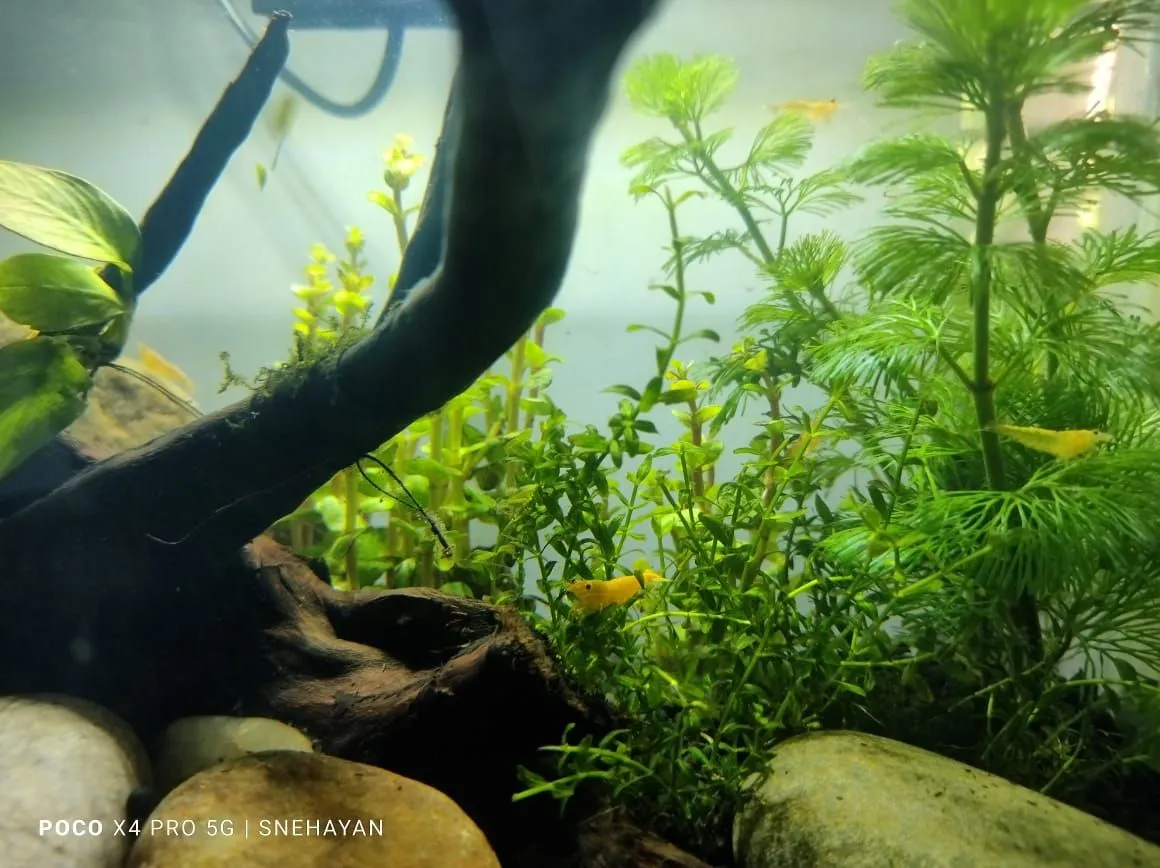
Mosses such as Java moss and Christmas moss attach to wood, stone, filter guards, and spawning mops. They do not need deep substrate, but they collect detritus and require trimming. Carpet plants such as dwarf hairgrass and Monte Carlo are small foreground species that demand stable light, carbon, and substrate. They are sold as beginner carpets far more often than they behave as beginner plants.
Hornwort stands apart as a rootless, fast-growing submerged plant that can float or be loosely weighted. True floating plants such as Salvinia, Amazon frogbit, red root floater, and duckweed absorb nutrients rapidly and shade the water column. Useful though they are, floaters must be controlled: a surface sealed with duckweed can reduce gas exchange and starve lower plants of light.
| Growth form | Examples | Nutrient emphasis | Beginner risk |
|---|---|---|---|
| Rhizome epiphyte | Anubias, Java fern | Water column, biofilm on hardscape | Rhizome buried and rotted |
| Stem plant | Bacopa, Rotala, Ludwigia, Hygrophila | Water column plus substrate contact | Insufficient CO2 under strong light |
| Rosette root feeder | Swords, Cryptocoryne, Vallisneria | Substrate and root zone | Crown buried; starvation in inert gravel |
| Carpet | Dwarf hairgrass, Monte Carlo | Substrate, CO2, high PAR | Lifted mats, algae, poor rooting |
| Moss | Java moss, Christmas moss | Water column | Detritus buildup and smothering |
| Floating | Frogbit, Salvinia, duckweed | Water column nitrate and phosphate | Surface overgrowth and shading |
Light, CO2, and the Algae Triangle
Light is measured usefully as PAR at the substrate, not as marketing wattage or visual brightness. Low light is roughly 30 PAR or less at the substrate, medium light 30-60 PAR, and high light above 60 PAR. These are not moral grades. Low light is excellent for slow epiphytes, crypts, mosses, and many fish-first aquaria. High light is a specialised tool for compact stems, red pigmentation, and carpets, and it punishes unstable carbon.
CO2 is the second axis. A no-CO2 aquarium commonly runs below 5 ppm dissolved CO2 after the morning peak from fish respiration. At that level, choose low-light species and accept slower growth. Pressurised injection becomes practically meaningful near 20 ppm, often indicated by a green drop checker when the reference solution is correct. Carpet plants and fine red stems usually need that stability more than they need any single bottled fertiliser.
The error pattern is predictable: a bright LED, no CO2, generous fertiliser, and a tank full of plants that cannot use the light. Algae do not appear because nitrate exists; algae appear because plants are not growing fast enough to occupy the light and nutrients supplied. The care articles on planted-tank LED lighting, CO2 injection, and algae diagnosis are best read together for that reason.
| Setup | PAR at substrate | CO2 target | Suitable plants |
|---|---|---|---|
| Fish-first low-tech | 10-30 | Below 5 ppm | Anubias, Java fern, Java moss, crypts |
| Balanced low-tech | 25-45 | Below 5 ppm, stable surface exchange | Cryptocoryne, Bacopa, Vallisneria, hornwort |
| Medium planted | 35-60 | 10-20 ppm helpful | Ludwigia, Rotala, swords, wisteria |
| High-energy aquascape | 60+ | 20-30 ppm | Dwarf hairgrass, Monte Carlo, dense red stems |
Photoperiod matters. Six to seven hours is enough for new tanks. Mature low-tech tanks often settle at seven to eight hours. Ten-hour days are rarely necessary indoors and often convert minor imbalance into green dust, hair algae, or black beard algae. Algae prevention in low-tech tanks works through photoperiod, plant density, and surface agitation — the three controls available before CO2 enters the picture.
Substrate and Fertilisation
Substrate choice follows plant choice. Epiphytes can be grown in a bare-bottom quarantine tank if tied to wood. Swords and crypts cannot be treated that way long term. In inert sand or gravel, root feeders need root tabs or a mineralised layer. In active aquasoil, they can grow strongly but may receive an initial ammonia pulse that is unsafe for fish and shrimp until the tank is cycled.
The distinction between root and water-column feeding is not absolute. Aquatic plants exchange nutrients through both roots and leaves, but emphasis differs. Amazon swords build enormous root systems and exhaust inert gravel. Stem plants take nitrate, potassium, phosphate, and trace elements readily from the water column. Mosses and rhizome plants have little use for deep fertiliser. A fertiliser plan should match biology, not the shop shelf.
The estimative index method deliberately doses non-limiting macronutrients and micronutrients, then resets with a large weekly water change. It works best with strong plant mass, good circulation, and CO2 injection. Without CO2 it becomes less elegant, because carbon rather than nitrate or phosphate is the limiting factor. Walstad-style low-tech systems take the opposite route: soil or mineralised substrate, modest light, abundant plant mass, and slower equilibrium. The high-tech vs low-tech planted tank comparison maps those trade-offs — equipment cost, maintenance time, and plant palette — side by side.
For most aquarists the practical target is moderate nitrate, enough potassium to prevent pinholes in older leaves, iron and traces for new growth, and water changes that keep dissolved organics from accumulating. Deficiency diagnosis is useful only after light and CO2 are sensible. A yellowing Anubias under 10 PAR is not an iron case; it is a plant receiving too little usable energy.
Emersed Growth, Tissue Culture, and Shop Fraud
Many aquarium plants are grown emersed because air growth is faster, cheaper, and less algae-prone. Anubias, swords, crypts, Bacopa, Ludwigia, and Rotala often arrive with leaves formed in humid air. Once submerged, those leaves may persist, melt, or be replaced gradually by thinner submerged foliage. Tissue-culture cups are pesticide-free and therefore attractive for shrimp tanks, but they are still physiologically emersed at sale. Rinse the gel, divide the plant into small portions, and expect a transition period of two to six weeks.
Cryptocoryne melt deserves special mention. Cryptocoryne species can shed every visible leaf after transplant, temperature shock, pH change, or root disturbance. That is not automatically disease or failure. If the crown and rhizome remain firm, new submerged leaves commonly emerge over two to six weeks. Throwing the plant away after the first melt is one of the commonest avoidable losses.
A darker problem is the sale of terrestrial plants as aquarium plants. Ophiopogon, often labelled mondo grass, is a houseplant. Spathiphyllum, the peace lily, is a houseplant. Dracaena cuttings are houseplants. Aluminium plant and many variegated terrarium plants may look handsome underwater for a month, then decay from the inside. They belong with their roots in wet substrate and leaves in air, not fully submerged in a fish tank. Kasselmann and Rataj & Horeman remain valuable partly because they separate true submerged aquatics from plants that merely tolerate wet feet.
Aquarium Husbandry and Fish Pairings
Plants should be chosen for the fish as much as for the aquascape. Mbuna cichlids graze, dig, and test soft tissue; Anubias tied to rock is more realistic than a field of delicate stems. The complete cichlids guide and electric yellow cichlid profile are useful reminders that hard alkaline water and active rock fish limit the plant palette.
Warm Amazon community tanks can use swords, crypts, floating cover, and soft-water stems. Discus, cardinal tetras, and rummynose tetras look natural among broad leaves, but the water still must be warm, clean, and oxygenated. A plant that survives 28 °C is not automatically a plant that enjoys low oxygen under a sealed mat of floating leaves.
Bettas and gouramis benefit from low-flow planted structure. Siamese fighting fish use Java fern, Anubias, and floating roots as resting cover. Pearl gouramis show better colour and less nervous pacing when the surface is partly broken by floating plants. Shrimp tanks are the natural home of moss: cherry shrimp graze biofilm in Java moss and Christmas moss, while Amano shrimp help keep high-light plantings free of early algae.
Substrate-disturbing fish impose limits. Kuhli loaches are gentle but can uproot new carpets before runners anchor; see the kuhli loach profile before planting fragile foregrounds in loose sand. Large cichlids and digging catfish can make root-feeder layouts temporary unless plants are potted or protected by hardscape.
Reading Plant Symptoms
Plant diagnosis is most useful when it begins with growth position. New leaves report the plant's current ability to build tissue; old leaves report stored nutrient movement, shading, and senescence. A broad yellow sword leaf at the outside of the rosette may simply be an old emersed leaf being abandoned. Pale new sword growth, by contrast, suggests that the crown is still trying to grow but lacks some combination of light, carbon, trace elements, or root-zone nutrition. Yellowing as a nutrient diagnostic only resolves once light and carbon are ruled out — old-leaf patterns point toward different causes than new-leaf patterns.
Older aquarium books sometimes present deficiency charts as if each symptom maps neatly to one element. In practice, carbon instability and light mismatch create most false diagnoses. A Rotala top that reddens near the light but drops lower leaves is not automatically nitrate-starved; it may be shading itself after being left untrimmed. An Anubias leaf coated with green spot algae is not proof of excess phosphate; it is a slow leaf sitting under more light than the plant can use. A crypt that melts after being moved is not diseased if the crown remains firm.
| Symptom | First check | Common correction |
|---|---|---|
| Transparent old leaves | Shading, potassium, age of emersed leaves | Remove failed leaves, improve spacing, dose balanced fertiliser |
| Pale new growth | Light and trace availability | Confirm PAR, then supply iron/traces if growth is active |
| Pinholes in older leaves | Potassium or general starvation | Dose complete fertiliser; feed root plants at the substrate |
| Black beard algae on leaf edges | CO2 instability or high organic load | Stabilise CO2, clean detritus, reduce photoperiod |
| Stems leggy and leaning | Insufficient PAR or overcrowding | Trim tops, replant with spacing, improve light distribution |
| Carpet lifting in sheets | Mat too thick or roots too shallow | Trim hard, replant small plugs, improve CO2 and substrate anchoring |
Observe over two weeks rather than two days. Plants respond more slowly than fish, and a correction that is sensible on Monday can be invisible until the following water change. The exception is decay: remove rotting terrestrial plants, melted leaves, and anaerobic clumps promptly because they feed bacteria and consume oxygen.
Choosing Plants for a New Aquarium
A new aquarium should not begin with a collector's plant list. It should begin with a stable plant mass that matches the equipment already present. In a no-CO2 tank with a modest LED, start with Anubias, Java fern, Java moss, hornwort, Vallisneria, and one forgiving crypt. That mixture covers hardscape, background, nutrient uptake, and shelter without relying on high-speed growth. Add more demanding stems only after the tank's photoperiod, nitrate trend, and algae pattern are understood.
For medium-light aquaria, Bacopa, water wisteria, Ludwigia, and swords add structure, but the keeper must trim before stems shade themselves — etiolation in stem plants follows directly from insufficient PAR reaching the mid-section. Weekly pruning is not cosmetic. It keeps circulation through the plant mass, prevents older leaves from becoming algae plates, and forces new submerged growth from healthy nodes. Stem tops should be replanted while they are still strong; waiting until the lower half is bare wastes the plant's best tissue.
High-energy tanks should be planted densely from the first day and run with carbon stability before full light intensity is used. Dwarf hairgrass and Monte Carlo planted sparsely into new aquasoil under bright light but without mature CO2 control usually grow algae faster than roots. If pressurised CO2 is not part of the design, use open sand foregrounds, low moss pads, or small crypts instead of pretending every tank needs a lawn.
Acclimation and Quarantine
Plants can introduce algae, snails, hydra, planaria, pesticide residues, and decaying nursery material. Fish keepers are accustomed to quarantine for animals but often put new plants straight into shrimp tanks. That is risky. Tissue-culture plants are the safest for sensitive invertebrates because they are grown sterile and pesticide-free, though they still require rinsing and transition. Potted or bunched plants from shared dealer systems should be inspected, stripped of rock wool where appropriate, and held separately if shrimp value is high.
Chemical dips are sometimes useful but are not universal medicine. Strong oxidisers can damage mosses, liverwort-like plants, and fine stems. Alum, dilute bleach, and peroxide protocols all carry plant-specific risk and must be followed by thorough rinsing and dechlorination where relevant. I prefer prevention: trusted suppliers, tissue culture for shrimp tanks, and a holding container with light, heat, and circulation for uncertain stock.
During acclimation, plant deeply enough for stability but not so deeply that crowns or rhizomes are buried. Trim obviously dying emersed leaves at planting, but keep firm functional leaves even if they are not pretty. They still photosynthesise while submerged leaves form. A plant is established when it produces new growth suited to the aquarium, not when the original shop leaves remain unchanged.
Notable Aquarium Plants
- Anubias nana (Anubias barteri var. nana) — compact low-light rhizome plant for shaded hardscape.
- Anubias barteri (Anubias barteri) — larger Anubias for robust layouts and cichlid-adjacent tanks.
- Java fern (Microsorum pteropus) — fern epiphyte with leaf plantlets and strong low-tech tolerance.
- Java moss (Taxiphyllum barbieri) — adaptable moss for fry, shrimp, and hardscape texture.
- Amazon sword (Echinodorus bleheri) — large root-feeding rosette for warm South American displays.
- Cryptocoryne wendtii (Cryptocoryne wendtii) — forgiving crypt once established, despite transplant melt.
- Cryptocoryne balansae (Cryptocoryne crispatula var. balansae) — tall ribbon crypt tolerant of more mineralised water.
- Vallisneria spiralis (Vallisneria spiralis) — runner-forming background plant for hard-water layouts.
- Hornwort (Ceratophyllum demersum) — rootless nitrogen sink for fry cover and fast stabilisation.
- Water wisteria (Hygrophila difformis) — adaptable stem plant with changing leaf form.
- Bacopa caroliniana, Rotala rotundifolia, and Ludwigia repens — stem plants spanning easy green growth to CO2-responsive colour.
- Dwarf hairgrass, Monte Carlo, and Christmas moss — foreground and hardscape plants that reward stable maintenance.
Common Confusions
| Sold as | Reality | Aquarium consequence |
|---|---|---|
| Mondo grass | Ophiopogon, terrestrial | Survives briefly submerged, then rots |
| Peace lily | Spathiphyllum, terrestrial | Leaves must be in air; not an underwater plant |
| Dracaena | Terrestrial cane cutting | Decays when fully submerged |
| Emersed crypt | True aquatic grown in air | May melt, then regrow submerged leaves |
| Tissue-culture carpet | True plant, emersed physiology | Needs transition, CO2, and stable light |
| Red stem under weak light | Often true species | Turns green or sheds lower leaves without sufficient PAR |
See Also
- LED Lighting for Planted Tanks — PAR classes and photoperiod planning.
- CO2 Injection Setup — practical carbon targets and drop-checker interpretation.
- Substrate Selection — sand, gravel, aquasoil, and rooting depth.
- Algae Diagnosis and Control — matching algae type to cause.
- Cherry Shrimp — moss-based shrimp tanks and pesticide caution.
- The Complete Cichlids Guide — plant limitations in digging and grazing cichlid aquaria.
Frequently Asked Questions
What is the easiest aquarium plant category for low-tech tanks?
Rhizome epiphytes such as Anubias and Java fern are the most reliable. They tolerate 10-35 PAR, do not require enriched substrate, and fail mainly when the rhizome is buried.
Do planted aquariums need CO2 injection?
No, but plant choice changes. Below 5 ppm dissolved CO2, use low-light plants and slower growth expectations. Around 20 ppm CO2, medium and high-light stems and carpets become much more predictable.
Why do new plants melt after purchase?
Many aquarium plants are grown emersed or in tissue culture before sale. Their air-grown leaves are not built for submerged gas exchange, so they may shed old leaves while producing submerged growth over several weeks.
Which shop plants should not be submerged?
Avoid Ophiopogon sold as mondo grass, Spathiphyllum sold as peace lily, Dracaena cuttings, aluminium plant, and most variegated houseplants. They may stay green for months underwater, then rot and foul the tank.
Sources & References
- Kasselmann, C. (2010). Aquarium Plants. Krieger Publishing.
- Rataj, K. & Horeman, T.J. (1977). Aquarium Plants: Their Identification, Cultivation and Ecology. T.F.H. Publications.
- Tropica Aquarium Plants. Aquarium Plant Encyclopedia. tropica.com
- Walstad, D. (2013). Ecology of the Planted Aquarium (3rd ed.). Echinodorus Publishing.
- Plants of the World Online, Royal Botanic Gardens, Kew. powo.science.kew.org