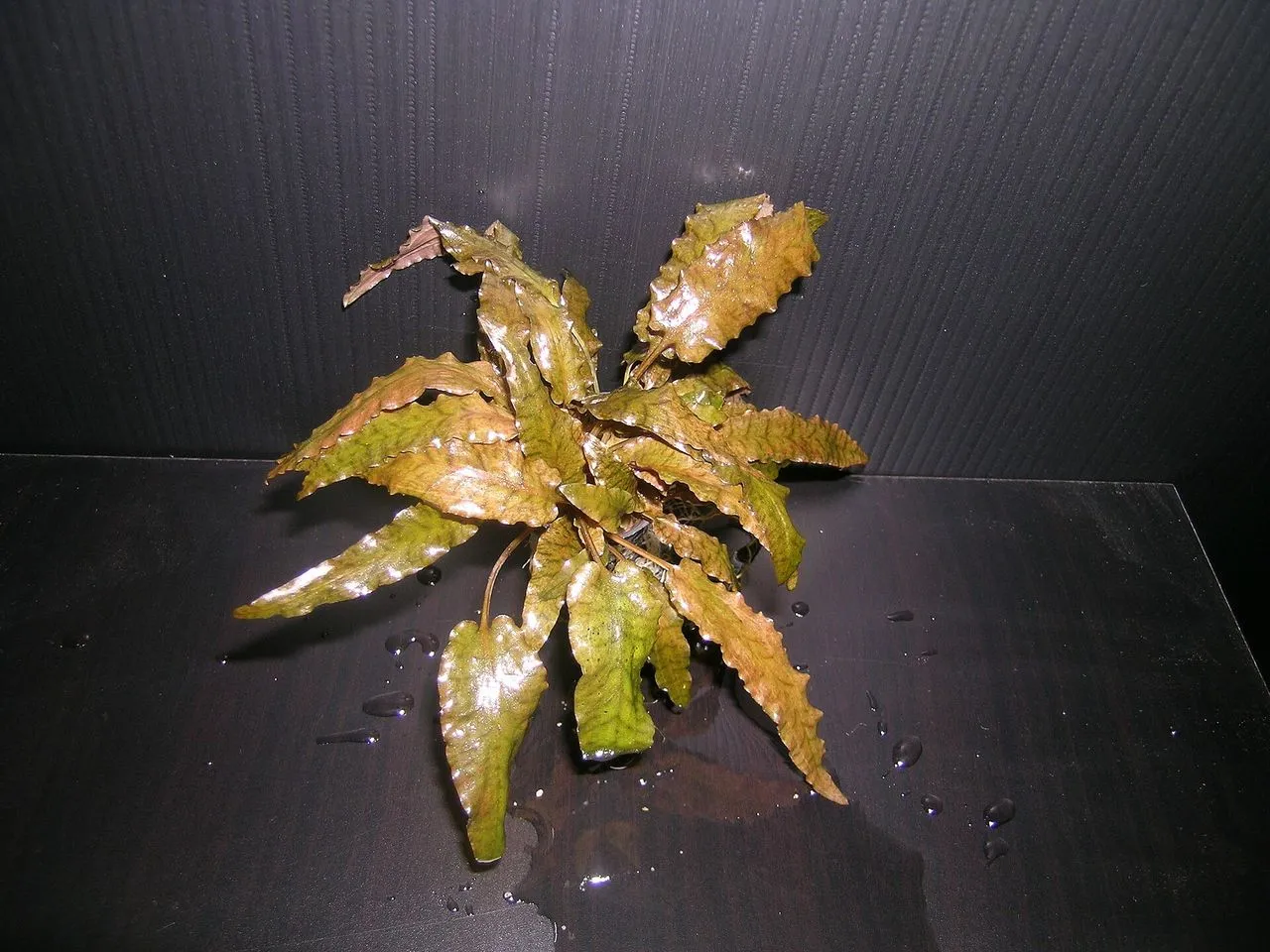
Answer: Cryptocoryne plants shed their leaves in response to any sudden shift in conditions, a behaviour known as crypt melt. It is not a disease. The rhizome and roots remain alive underground. If the rhizome feels firm and the roots are white, recovery is almost certain: trim the dissolving leaves, hold your parameters stable, and wait 4-8 weeks for new submersed growth. Do not uproot the plant.
Crypt melt looks like a catastrophe. A healthy stand of Cryptocoryne plants dissolves into translucent ribbons over 48 hours and the keeper assumes the plants are dead. They almost certainly are not. Crypt melt is a recognised adaptive response: the plant sheds its leaves to conserve the energy stored in its rhizome when surrounding conditions shift. The rhizome and roots survive underground. The leaves return once conditions stabilise.
Part of the Complete Aquatic Plants Guide.
For the general picture of why aquarium plants melt, including stem plants, Echinodorus, and anubias, see Why Are My Aquarium Plants Melting?. This article covers the Cryptocoryne-specific mechanisms and the practical distinction between recoverable melt and true rhizome rot.
Main Causes
| Trigger | What happens | Typical timing |
|---|---|---|
| Emersed-to-submerged transition | Commercially grown emersed leaves are not water-adapted; the plant sheds them to build submersed-form replacements | Within 1-2 weeks of purchase |
| Sudden parameter change (pH, KH, GH, temperature) | Leaf tissue no longer suited to the new chemistry; rhizome withdraws resources | Hours to days after the change |
| Lighting shift up or down | Energy balance disrupted; existing leaves become metabolically costly | Days after the change |
| CO2 addition or loss | Even introducing CO2 to a stable tank shifts pH and carbonate chemistry, which is enough to trigger melt | Within a week of the CO2 change |
| Substrate disturbance or replanting | Root system disruption severs nutrient pathways; rhizome sheds leaves to redirect energy to rebuilding roots | Within days of being moved |
| Immature or recently set-up tank | Unstable parameters during cycling — ammonia spikes, pH swings, nitrate build-up — make melt almost inevitable in newly planted crypts | Continuously until the tank matures |
The first two causes cover the vast majority of cases. Most commercial Cryptocoryne stock arrives grown emersed above water; the transition to submersed life triggers melt in nearly every first purchase. Cryptocoryne wendtii is particularly prone to a dramatic complete melt on transfer, while Cryptocoryne crispatula var. balansae tends to recover more quickly once established.
How to Identify the Problem
The critical question is not why the leaves are melting but whether the rhizome is still alive.
The rhizome is the horizontal, slightly thickened stem just at substrate level, from which leaves grow upward and roots grow downward. Check it by pressing gently from above with a fingertip. Do not excavate the plant.
| What you find | Diagnosis | Prognosis |
|---|---|---|
| Rhizome firm, cream or pale tan; roots white; only leaves dissolving | Crypt melt — adaptive response | Almost certain recovery with stable conditions |
| Rhizome soft but not yet black; roots starting to brown | Early rot or severe melt under poor conditions | Possible recovery if substrate conditions are corrected promptly |
| Rhizome black, soft, collapsing; roots absent or hollow; foul smell | Rhizome rot — true plant death | Remove plant; trim to any firm white tissue; identify and fix the underlying cause |
In recoverable melt, a firm rhizome snaps cleanly under pressure rather than compressing into slime. The contrast with rot is unmistakeable once you have felt both.
Amazon sword plants also drop outer leaves under stress, but they recover through the crown rather than the rhizome. Cryptocoryne recovery is almost entirely rhizome-driven, which is why excavating the plant is so damaging.
Risk and Severity
Melt itself is low risk. The rhizome of a healthy Cryptocoryne stores enough carbohydrate to regenerate a full set of submersed leaves after a complete melt, provided conditions are now stable. Rataj and Horeman documented specimens recovering after total leaf loss from established stands.
The indirect risk is more significant. Dissolving leaf matter releases dissolved organics and can spike ammonia in smaller or recently set-up tanks. Trim aggressively and remove the debris promptly. Monitor ammonia across the first two weeks of recovery.
Rhizome rot is the only truly fatal outcome, and it traces to different causes: the rhizome crown buried in anaerobic substrate, copper contamination from tap water or certain medications, or sustained bacterial attack in a tank that never stabilises. Melt and rot are separate processes, and treating melt as though it were rot produces the worst possible outcome.
Solutions and Actions
If the rhizome is firm (melt, not rot):
- Leave the plant in place. Every uproot is a fresh disturbance that restarts the cycle.
- Trim dissolving leaves at the base with sharp scissors and remove the debris from the water column.
- Hold all parameters stable for the next 4-8 weeks: same temperature, same photoperiod, same fertiliser dose, same CO2 rate if injecting. Stability matters far more than optimising any individual value.
- Continue dosing substrate nutrition normally. Cryptocoryne are root feeders; root tabs or a nutrient-rich aquasoil keep the rhizome supplied even while the plant has no submersed leaves. See Substrate Selection for practical options.
- Wait. New leaves appear as tightly rolled pale shoots at the crown, often narrower and differently coloured than the original emersed growth. That difference in appearance is normal.
If CO2 was recently changed:
Adding CO2 to a previously low-tech tank shifts pH and carbonate chemistry simultaneously. Stabilise the system at a lower bubble rate before making any further adjustments. See CO2 Injection Setup for target dissolved concentrations and dosing practice specific to planted aquaria.
If the rhizome is black and soft (rot):
Remove the plant. Trim all soft, black rhizome tissue until you reach firm white tissue. If any healthy section remains with roots attached, replant it in clean, well-oxygenated substrate. Identify the cause before replanting: a buried crown, an anaerobic substrate layer, or copper in the water column will destroy the regrowth.
Prevention
- Buy submersed-grown or tissue-culture stock where possible. Plants already adapted to submersed life skip the emersed transition melt. Tissue-culture plants in jelly cups are the safest option for new keepers, though they still need a brief settling period.
- Plant once and leave alone. Most melt in established tanks comes from unnecessary replanting. Choose a position and commit to it.
- Use a nutrient-rich substrate. Cryptocoryne are heavy root feeders. Plain inert gravel offers nothing during recovery; aquasoil or gravel supplemented with root tabs gives the rhizome the iron, potassium, and micronutrients needed to rebuild tissue quickly.
- Maintain stable, frequent water changes rather than sporadic large ones. A consistent 20-30% weekly change prevents the nitrate and organic build-up that triggers melt in otherwise stable tanks. See LED Lighting for Planted Tanks for guidance on keeping the photoperiod stable as part of the same routine.
- Acclimate new plants promptly. Float the bag to equalise temperature, then plant immediately. Leaving roots exposed to air for more than a few minutes adds stress before the plant is even in the water.
Common Mistakes
- Pulling the plant up to check the roots. Examine the rhizome from above with a fingertip, not by excavating. Every uproot adds weeks to the recovery.
- Replanting a melting crypt in a "better spot." Moving a melting plant into fresh substrate does not accelerate recovery. It compounds the original stress with a second disturbance.
- Adding extra fertiliser to speed up recovery. During melt, Cryptocoryne have no submersed leaves to photosynthesise or absorb water-column nutrients. Sudden dosing increases change parameters further, which is precisely the opposite of what the plant needs.
- Raising light intensity to help the plant recover. Without submersed leaves, the plant cannot use the extra PAR. Higher light simply advantages algae colonising the substrate around the crown.
- Discarding the plant after a complete melt. A stand of Cryptocoryne wendtii that looks like bare soil is not dead. Give it 6-8 weeks of undisturbed, stable conditions before drawing any conclusion about viability.
Frequently Asked Questions
Is crypt melt a disease?
No. It is an adaptive response, not a pathogen or infection. Cryptocorynes evolved in seasonal rivers where water levels rise and fall dramatically; shedding leaves to conserve rhizome energy when conditions shift is how the plant copes. The term 'Cryptocoryne disease' is sometimes used in older literature, but it describes the response itself, not a disease agent.
How long will my Cryptocoryne take to recover from melt?
Most species send up new submersed leaves within 3-6 weeks once conditions stabilise. Slower-growing species such as Cryptocoryne parva can take 6-10 weeks; larger species like Cryptocoryne crispatula var. balansae tend to bounce back sooner. Every disturbance — moving, replanting, or poking the rhizome — restarts the clock.
Should I remove a melting Cryptocoryne from the tank?
No. Remove only the dissolving leaves by clipping them cleanly at the base with sharp scissors. Leave the rhizome and roots undisturbed in the substrate. The rhizome stores enough energy to regenerate a full set of leaves provided conditions are now stable.
My crypts have melted completely. Are they dead?
Not necessarily. Check the rhizome: if it is firm and cream or pale, the plant is dormant rather than dead. Melt can strip every visible leaf from a stand of Cryptocoryne wendtii within 48 hours and leave the tank looking bare, yet new growth returns within weeks. A soft, blackened rhizome with a foul smell is the sign of true rot, not melt.
Can established crypts melt again after they have settled?
Yes, though far less easily than newly planted specimens. Any significant change — replanting, a large water-parameter swing, a filter failure, or a major substrate disturbance — can trigger melt even in a plant that has been established for a year. The more stable the tank, the more resilient the plant becomes over time.
Sources & References
- Kasselmann, C. (2003). Aquarium Plants. Krieger Publishing Company.
- Rataj, K. & Horeman, T.J. (1977). Aquarium Plants: Their Identification, Cultivation and Ecology. T.F.H. Publications.
- Florida Aquatic Nurseries. Cryptocoryne Melt, with photographic documentation by Neil Frank. floridaaquatic.com
- Tropica Aquarium Plants. Aquarium Plant Encyclopaedia. tropica.com
- Wikipedia contributors. Cryptocoryne (Crypt melt section). en.wikipedia.org