Answer:
Barbs are true cyprinids ranging from peaceful 4 cm cherry barbs to pond-sized tinfoil barbs and bala sharks. Most need groups, oxygenated mature water and tankmates matched to speed. Current names matter: many old Puntius labels are obsolete after the 2012 split into Puntius, Pethia, Puntigrus, Dawkinsia, Sahyadria and related genera.
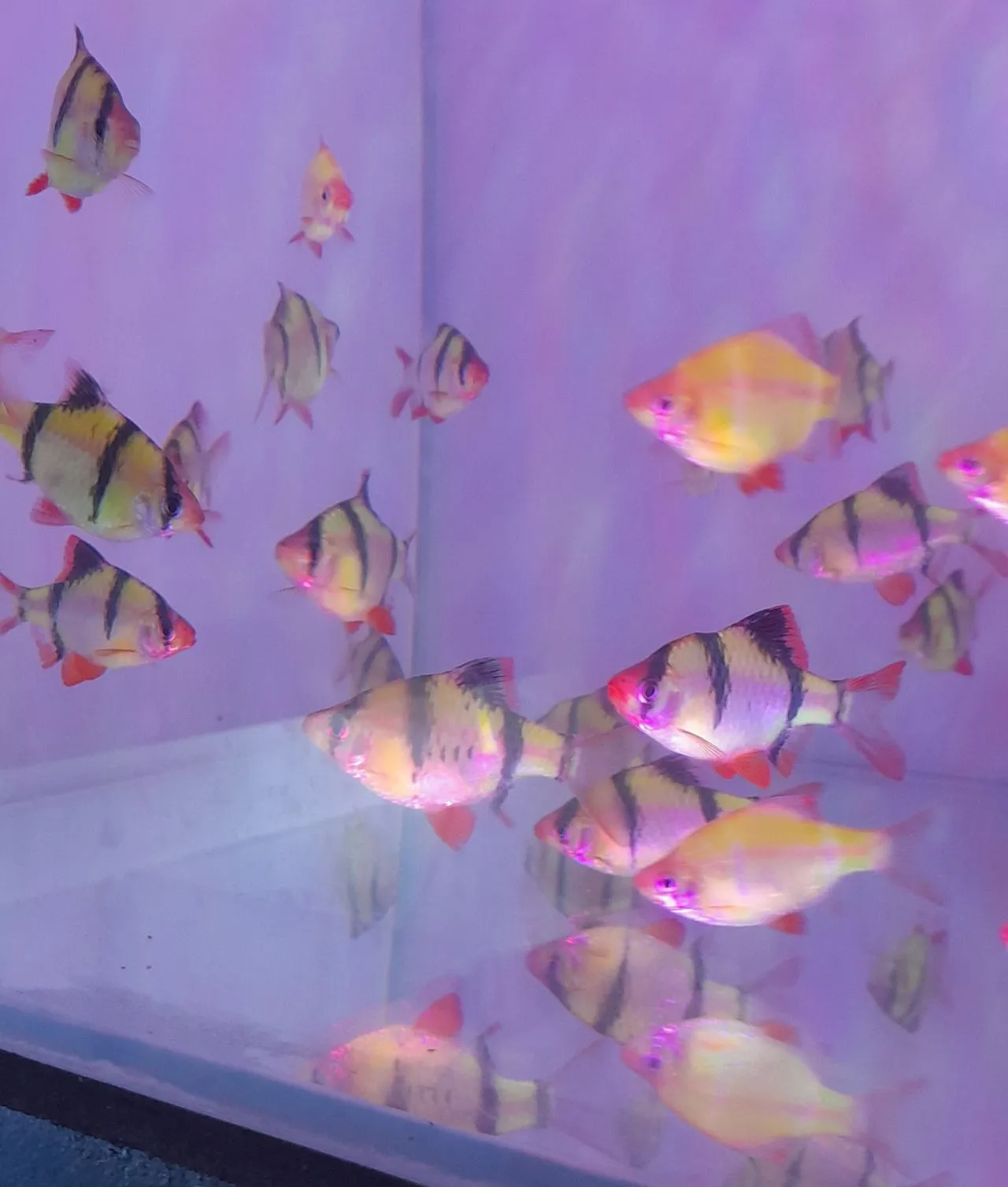
Puntigrus tetrazona (tiger barb) is the aquarium trade's most famous example of a small cyprinid whose behaviour changes completely with group size. Kept in a trio, it is a fin-shredding nuisance; kept in a shoal of ten or more in a long planted tank, the same fish spends most of its energy in displays, lateral chases and rank negotiation with its own kind. That social lesson runs through the entire barb category.
I have kept barbs in planted aquaria for more than thirty years, from quiet Sri Lankan cherry barbs in peat-stained water to fast riverine Sahyadria and pond-sized Barbonymus. The family rewards aquarists who think in terms of current, oxygen, social scale and adult size rather than shop-tank colour.
Taxonomy
Aquarium barbs are cyprinids: members of Cyprinidae sensu stricto after the danionid split removed danios, rasboras and their close relatives from the older broad hobby sense of "cyprinid". That matters because barbs and danios are often sold beside one another and share egg-scattering habits, but their anatomy, adult size and social behaviour are not interchangeable. The Danionidae material belongs in the complete rasboras guide; this guide treats true barbs and the freshwater "sharks" of Cyprinidae.
The single most important taxonomic point for aquarists is the post-2010 collapse of the old catch-all Puntius. For decades, nearly every small South or Southeast Asian barb in the trade was labelled Puntius: tiger barbs, rosy barbs, cherry barbs, black ruby barbs, filament barbs and others. Pethiyagoda, Meegaskumbura and Maduwage (2012) showed that this arrangement was paraphyletic and split South Asian material into more coherent genera including Puntius, Pethia, Dawkinsia, Haludaria, Puntigrus, Desmopuntius, Oliotius, Barbodes and Sahyadria. FishBase and the Catalog of Fishes track the current combinations, but shop labels still trail by years.
The practical result is that a label reading "Puntius" may be historically familiar but taxonomically obsolete. Tiger barb is now Puntigrus tetrazona, not Puntius tetrazona. Rosy barb is Pethia conchonius. Denison barb is Sahyadria denisonii. Filament barb is Dawkinsia filamentosa. Melon barb is Haludaria fasciata. The name change is not academic decoration: it groups fishes with more similar morphology, geography and evolutionary history.
The aquarium "sharks" belong here too. Red-tail black shark (Epalzeorhynchos bicolor), rainbow shark (Epalzeorhynchos frenatum) and bala shark (Balantiocheilos melanopterus) are not sharks; they are cyprinids with a sharklike body plan, high dorsal fins and active benthic or mid-water habits. Their husbandry is closer to robust barbs than to any marine elasmobranch, but their territoriality and adult size make them unsuitable for small mixed communities.
Identification
Most barbs have a laterally compressed to torpedo-shaped body, cycloid scales, a forked caudal fin and one or two pairs of maxillary barbels. The barbels are sensory and chemoreceptive structures used while foraging across sand, leaf litter, stones and plant debris. Their size varies with ecology. Sand-snuffling and riverine species such as denison barbs show obvious barbels; faster open-water forms and tinfoil-class barbs often have shorter ones. They are not decorative whiskers and should not be confused with the numerous barbels of corydoras catfish, which belong to a very different order.
| Group | Typical species | Adult size | Key identification feature | Husbandry meaning |
|---|---|---|---|---|
| Small peaceful barbs | Cherry barb, checker barb | 4–6 cm | Slender body, modest mouth, quiet shoaling | Planted community, low aggression |
| Nippy shoalers | Tiger barb, five-banded barb | 5–7 cm | Bold vertical bands, high activity | Eight or more; avoid slow fins |
| Cool-tolerant Pethia | Rosy barb, Odessa barb | 6–10 cm | Males develop red flank or flush | Long tanks; moderate current |
| Riverine Indian barbs | Denison barb, filament barb | 12–18 cm | Streamlined body, strong swimming | Oxygen, length, ethical sourcing |
| Large barbs | Tinfoil barb, bala shark | 30 cm+ | Deep or long body, heavy scale rows | Public-aquarium or pond-scale space |
| Labeonine "sharks" | Red-tail and rainbow shark | 12–16 cm | Sharklike silhouette, coloured fins | Territorial bottom territories |
Colour is useful only after structural checks. A young black ruby barb in a shop can look dull and brown, while a conditioned male becomes dark charcoal with crimson on the head and flank. Female cherry barbs are brownish with a lateral line and may be overlooked beside red males. Tank-bred gold barbs are golden because of selective breeding, not because wild Barbodes semifasciolatus looks like a coin.
Behaviour & Ecology
Barbs are social fishes, but "social" does not always mean peaceful. Most form shoals rather than strict synchronised schools. Individuals keep visual contact, feed in the same area, spar briefly, and use the group as a risk buffer. In aquaria, that social buffer is often the difference between a functional display and chronic harassment.
Tiger barbs are the model case. Their fin-nipping reputation is deserved when they are kept in undersized groups or with unsuitable slow-finned companions. The behaviour is not random malice. Small groups fail to distribute status pressure, so chasing and biting spill onto angelfish, gouramis and long-finned tetras. In groups of eight, ten or twelve, aggression is redirected within the tiger barb shoal through short displays and pursuit — tiger barb intra-shoal aggression covers what normal rank-settling looks like and when it becomes a problem requiring intervention. The comparison with black-skirt tetra is useful: both are active shoalers whose nipping risk falls when group size and tank structure are correct.
By contrast, cherry barbs and checker barbs are shy to moderate shoalers that use vegetation as cover. They do not need racing current or boisterous tankmates. Black ruby barbs sit between the extremes: peaceful if kept in a group with visual cover, but males become intense during display. Denison barbs and filament barbs are river fishes that need length and oxygen more than dense vegetation. Tinfoil barbs and bala sharks are powerful swimmers whose juvenile shop size conceals adult mass.
Most barbs scatter eggs among plants, roots, leaf litter or gravel and show no parental care. Adults readily eat eggs. Breeding aquaria therefore use fine-leaved plants, spawning mops, marbles or mesh bottoms, with adults removed after spawning. This is the opposite of the pair-guarding and fry care described in the complete cichlids guide.
Water Chemistry & Habitat
No single water recipe fits all barbs. Their habitats range from Sri Lankan shaded forest streams through Indian Western Ghats riffles, Myanmar floodplain streams, Borneo blackwater and large Southeast Asian rivers. The safest working method is to sort species by origin and flow.
| Habitat style | Representative species | Practical target |
|---|---|---|
| Sri Lankan forest stream | Cherry, black ruby | GH 2–8 °dH, KH 0–4 °dH, pH 6.0–7.2, 23–26 °C |
| Borneo/Sumatra blackwater edge | Five-banded, checker | GH 1–6 °dH, KH 0–2 °dH, pH 5.5–6.8, 24–27 °C |
| North Indian and Myanmar seasonal streams | Rosy, Odessa | GH 5–15 °dH, KH 2–8 °dH, pH 6.5–7.8, 20–25 °C |
| Western Ghats flowing water | Denison, filament, melon | GH 3–10 °dH, KH 1–5 °dH, pH 6.5–7.5, 22–26 °C, high oxygen |
| Large lowland rivers | Tinfoil, bala | GH 4–15 °dH, pH 6.5–7.8, 24–28 °C, heavy filtration |
| Thai lowland labeonine territories | Red-tail, rainbow shark | GH 5–15 °dH, pH 6.5–7.8, 23–27 °C, structured bottom |
Understanding GH and KH matters more than chasing a pH number. A blackwater five-banded barb in GH 12 °dH water is not being helped by acid buffer that swings pH downward while conductivity remains high. A rosy barb kept too warm at 28 °C may survive but loses the cooler-water vigour that makes the species valuable.
Aquarium Husbandry
Tank length is the limiting variable for most barbs. A 60 cm aquarium can suit cherry barbs, checker barbs or five-banded barbs if planted well. A 90 cm aquarium is a sensible minimum for tiger barbs, rosy barbs and Odessa barbs. Denison barbs, filament barbs and bala sharks need 120 cm or more, with bala sharks ultimately exceeding what most home tanks provide. Tinfoil barbs belong in very large systems; juveniles sold at 6 cm become deep-bodied 30 cm fish.
Filtration should be mature before barbs are added. Active cyprinids feed hard and punish weak biofiltration. Ammonia and nitrite must remain 0 mg/L, nitrate preferably below 20–30 mg/L for ordinary community setups and lower for soft-water species. The cycling process is covered in cycling a new aquarium, and new imports should be handled with the care described in acclimating new fish.
Planting depends on the group. Small barbs benefit from thickets of java fern, Anubias nana, Cryptocoryne and fine stems, with open feeding space. Tiger barbs need more open lanes and broken sight lines rather than a solid jungle. Rosy and Odessa barbs may nibble tender shoots; tough epiphytes and Vallisneria spiralis stand up better. Riverine species need oxygenated flow and clear swimming length.
Tankmates should be chosen by speed and fin shape. Good companions for moderate barb communities include robust tetras, danios, peaceful bottom fish such as bristlenose pleco, and corydoras only where temperature and activity match. Slow, filament-finned anabantoids are poor choices with tiger barbs: dwarf gourami and pearl gourami are better kept with calmer fish. Robust cichlids such as firemouth cichlid can coexist with larger barbs in spacious tanks, but only when neither species can bully the other continuously.
Stocking Plans That Work
A barb aquarium should start with one behavioural centre, not a shopping list of colours. In a 75 cm quiet planted tank, twelve cherry barbs with six bronze corydoras and a bristlenose pleco is coherent: all tolerate moderate soft water, none require violent current, and the cherry barbs occupy the middle and lower plant margins without overwhelming the bottom fish. The same tank with three cherry barbs, three tiger barbs, two rosy barbs and a young rainbow shark is not diverse; it is socially incoherent.
For a 90 cm active community, choose one nippy or semi-boisterous shoal and design around it. Ten tiger barbs can be excellent in a planted tank with open lanes, rounded stones, tough plants and no slow fins. Tankmates should be robust, short-finned and quick enough to feed under pressure. A black-skirt tetra group can work in a larger version of the same design, but mixing two nippy mid-water shoals in a modest aquarium often produces constant low-grade conflict rather than a balanced display.
A 120 cm river-style aquarium is the minimum scale at which denison barbs, filament barbs or melon barbs begin to make sense. These fish need length for acceleration, dissolved oxygen near saturation, and current that moves across the tank rather than blasting one corner. Rounded river stones, open sand, wood roots and bands of Vallisneria create structure without stealing swimming space. Bottom companions should be chosen carefully; warm-tolerant corydoras such as sterbai corydoras can suit some setups, while cooler or very fast systems may favour loaches instead.
The large cyprinid category is a separate decision. Tinfoil barbs and bala sharks are not upgraded tiger barbs. They are long-lived, heavy-bodied fishes that eat strongly, move forcefully and turn ordinary aquaria into cramped holding tanks. If a home cannot provide a genuinely large system, these species should be admired elsewhere. A juvenile's 6 cm shop length is a temporary stage, not the animal being purchased.
Reading Shop Labels Critically
Barb labels are often a mixture of old taxonomy, trade shorthand and domestic colour names. "Green barb" may mean wild-coloured Barbodes semifasciolatus or an imprecise label for a gold barb shipment. "Sumatra barb" may be used carelessly for tiger barbs, for Puntius vittatus, or for mixed small Southeast Asian barbs. "Red shark" might refer to a rainbow shark, red-tail black shark, albino domestic rainbow shark, or a seller's attempt to avoid a precise name.
The correct response is not to memorise every bad label but to inspect the fish. Count bars or spots. Look for maxillary barbels. Check body depth, mouth position and adult fin shape. Ask whether the fish are tank-bred or wild-caught, particularly for denison barbs. If a seller cannot give the scientific name and the adult size, treat the purchase as risky. Tank & Tendril species profiles use current binomials because they give the aquarist a stable point from which to check FishBase, the Catalog of Fishes and conservation assessments.
Domestic forms deserve the same caution. Long-fin tiger barbs, albino tiger barbs, moss-green tiger barbs, gold barbs and albino rainbow sharks are ornamental variants, not husbandry exceptions. A long-fin tiger barb is still a tiger barb socially, and its elongated fins may even make it more vulnerable within an aggressive group. An albino rainbow shark is still territorial. Colour morphs do not erase oxygen demand, adult size or social pressure.
Ethical Sourcing
Denison barbs deserve special treatment. Sahyadria denisonii is endemic to the Western Ghats and is listed Endangered by the IUCN. Raghavan and colleagues documented severe pressure from the aquarium trade after the species became globally fashionable in the late 1990s. Export quotas in Tamil Nadu and Karnataka and captive-breeding work, including CMFRI programmes, have improved the picture, but the ethical recommendation remains simple: buy captive-bred denison barbs or do not buy them.
Red-tail black sharks also carry a conservation warning. Epalzeorhynchos bicolor has been considered extinct in the wild since 1996, although farmed aquarium stock remains widespread. Keeping the species is not a conservation act, and casual breeding claims should be treated sceptically unless documented. The priority is not to create new demand for wild fish from damaged habitats.
Notable Species
- Tiger barb (Puntigrus tetrazona) — the classic fin-nipping barb; group size and tankmate choice determine success.
- Cherry barb (Puntius titteya) — peaceful Sri Lankan small barb suited to planted community aquaria.
- Rosy barb (Pethia conchonius) — cool-tolerant, active and hardy when not overheated.
- Denison barb (Sahyadria denisonii) — endangered Western Ghats species; captive-bred sourcing is essential.
- Gold barb (Barbodes semifasciolatus) — selectively bred golden line of an adaptable East Asian barb.
- Five-banded barb (Desmopuntius pentazona) — calmer blackwater relative often confused with tiger barb.
- Black ruby barb (Pethia nigrofasciata) — Sri Lankan species with dramatic male breeding colour.
- Odessa barb (Pethia padamya) — Myanmar barb described scientifically in 2008; males carry a red flank stripe.
- Tinfoil barb (Barbonymus schwanenfeldii) — large river barb for very large aquaria or ponds.
- Bala shark (Balantiocheilos melanopterus) — large shoaling cyprinid frequently sold too small for its future tank.
Common Confusions
| Confusion | Reliable separator | Husbandry consequence |
|---|---|---|
| Tiger barb vs five-banded barb | Tiger is deeper, bolder and more aggressive; five-banded has calmer blackwater habits | Five-banded suits quieter tanks; tiger needs larger boisterous shoal |
| Cherry barb vs small rasboras | Cherry barb has cyprinid barbels and different lateral stripe; rasboras lack barbels | Do not assume identical blackwater tolerance or behaviour |
| Denison barb vs similar Indian red-line barbs | Current Sahyadria taxonomy and locality matter | Conservation sourcing is central |
| Bala shark vs red-tail/rainbow shark | Bala is an open-water shoaler; Epalzeorhynchos are territorial bottom-oriented fishes | Tank design and group strategy differ completely |
| Gold barb vs wild green barb | Golden colour is a domestic strain of Barbodes semifasciolatus | Husbandry is the same; colour says nothing about water need |
See Also
- Tiger barb — social aggression and fin-nipping management.
- Denison barb — Western Ghats ecology and ethical sourcing.
- Red-tail black shark — territorial labeonine care and wild-extinct status.
- The Complete Tetras Guide — comparison with characin schooling and nipping behaviour.
- Water Hardness: GH and KH Explained — chemistry behind barb parameter matching.
- The Complete Catfish Guide — bottom-dwelling companions and barbel anatomy comparison.
Frequently Asked Questions
Are barbs good community fish?
Some are excellent community fish, but only when size, speed and social structure match the tank. Cherry, checker and five-banded barbs suit calm planted aquaria; tiger barbs need large same-species groups; tinfoil and bala sharks outgrow ordinary community tanks.
Why did so many barb scientific names change?
The old aquarium genus Puntius contained unrelated South Asian, Southeast Asian and African lineages. Pethiyagoda, Meegaskumbura and Maduwage (2012) split many South Asian barbs into Puntius, Pethia, Dawkinsia, Haludaria, Puntigrus, Desmopuntius, Oliotius, Barbodes and Sahyadria; the trade still lags behind.
How many barbs should be kept together?
Small and medium barbs should usually be kept in groups of eight or more; ten to twelve is better for active species. Tiger barbs are the clearest case: small groups redirect aggression toward tankmates, while larger groups keep most sparring within the shoal.
Do barbs need hard or soft water?
It depends on origin. Sri Lankan and blackwater Southeast Asian species often prefer GH 2–8 °dH and pH 6.0–7.2; rosy and Odessa barbs tolerate cooler, moderately hard water; red-tail and rainbow sharks accept GH 5–15 °dH. Match the species, not the word barb.
Sources & References
- Pethiyagoda, R., Meegaskumbura, M. & Maduwage, K. (2012). A synopsis of the South Asian fishes referred to Puntius. Zootaxa.
- Fricke, R., Eschmeyer, W.N. & Van der Laan, R. Catalog of Fishes. California Academy of Sciences.
- FishBase — Cyprinidae species treatments. https://www.fishbase.se/
- Baensch, H.A. & Riehl, R. (1991). Aquarium Atlas, Vol. 1. Mergus Verlag.
- Raghavan, R. et al. Conservation assessments for Western Ghats freshwater fishes and Sahyadria denisonii.