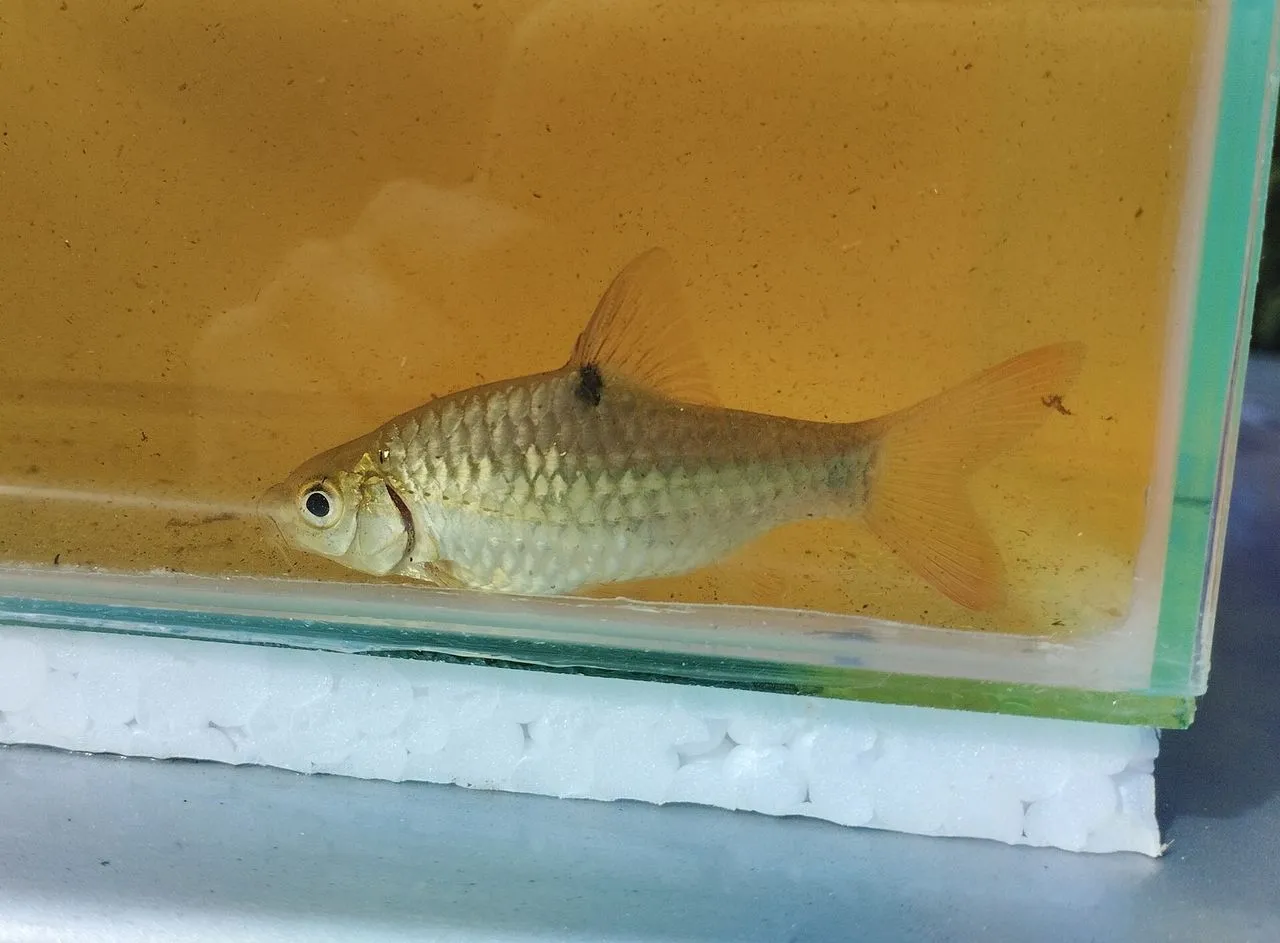
Answer: Tiger barbs usually attack each other because the school is too small, the tank is too bare, or one fish is weak and getting targeted. Keep at least six to eight tiger barbs, give them swimming room, break up sightlines with plants, and separate an injured fish if the chasing turns into damage.
Best first step: Count the shoal. Fewer than eight tiger barbs almost guarantees redirected aggression; raise the group to 10-12 before changing anything else.
Avoid: Removing fish to calm things down. Shrinking the group concentrates the aggression on whoever is left.
Puntigrus tetrazona, the tiger barb, is built for social life. In a large shoal it channels its energy into constant movement, hierarchy display, and competitive feeding. Reduce that shoal below a functional size and the social energy has nowhere productive to go — it concentrates onto subordinates, and fish start deteriorating. The instinct to remove fish or separate the aggressor is understandable, but it is almost always wrong. The fix is more tiger barbs, not fewer.
Part of the Complete Barbs Guide.
Main Causes
Tiger barb aggression falls into three distinct patterns, each with a different root cause and a different solution. Most people misidentify which one they are seeing.
| Cause | What you see | Root problem |
|---|---|---|
| Shoal too small | One or two fish chased relentlessly; persistent hiding by one individual | Below 8–10 fish; dominance concentrates on subordinates |
| Sex imbalance | Relentless male pursuit; females show frayed fins or refuse to leave cover | Too many males relative to females in a conditioned group |
| Breeding display | Intensified orange and black on males; side-by-side chasing near substrate | Seasonal courtship behaviour — not harmful if females can escape |
| Tank too small | Constant skirmishing with no settled zones | Below 100 litres; sub-groups cannot establish distance |
| Wrong tankmates | Long-finned fish nipped repeatedly; a betta or guppy continuously harassed | Species mismatch — not an intra-shoal problem |
| New addition | Established fish mob the newcomer for 24–48 hours | Normal hierarchy reset after rank disruption |
The single most common cause is an undersized shoal. Tiger barbs sold in batches of four or five are almost certain to produce a bullied individual within weeks.
How to Identify the Problem
The distinction that matters most is whether the conflict is inside the shoal or directed at other species.
Within-shoal chasing and sparring is normal. Tiger barbs maintain a linear dominance order through display and short pursuits, and a group of twelve with occasional fin-flaring is healthy. The fish to watch are the ones not chasing — a fish that hides behind the filter return, clamps its fins, or hangs back at feeding time is being chronically singled out.
Useful observations to make over a ten-minute watch:
- Is the same individual chased by multiple fish, or do different fish take turns chasing each other?
- Does the target have frayed or split fins? Persistent nipping causes visible fin damage before any other physical symptom appears.
- Do all fish compete equally at feeding, or does one hang back and pick at scraps?
- Are attacks brief and then abandoned, or does one fish pursue another relentlessly across the whole tank?
If tankmates rather than other tiger barbs are the target, the hierarchy is not the problem. That is a community compatibility failure. The tiger barb species profile covers suitable companions and the logic behind the choices.
Risk and Severity
A tiger barb chronically singled out in a group of four or five can be dead within weeks. Sustained subordinate stress suppresses the immune system, reduces feeding, and leaves fin damage open to secondary infection. If fins are already fraying, read fin rot diagnosis before assuming the cause is bacterial — social bullying and early fin rot present identically at first glance.
Long-finned tankmates face a different kind of risk. Tiger barbs nip continuously rather than in isolated incidents, and fin tissue repeatedly cropped does not regenerate cleanly. Bettas, angelfish, and male fancy guppies placed in a tiger barb community are at serious risk of permanent fin damage.
The breeding-season scenario is the least severe of the three patterns. Most females tolerate male display if there are enough of them and enough cover in the tank. A single female outnumbered by males is a different situation.
Solutions and Actions
Increase shoal size to 10–12 fish. This is the primary fix for intra-shoal aggression. The behaviour itself does not stop, but it spreads across enough individuals that no single fish is persistently targeted. Buy fish of similar size to the existing group — introducing small juveniles into an established adult shoal usually just creates more subordinates at the bottom of the ranking.
Correct the sex ratio. Aim for roughly equal numbers, or a slight female majority. A four-male, two-female group during breeding condition will exhaust the females. A surplus of females is manageable; a surplus of males is not.
Add visual breaks. Rockwork, driftwood, and dense plant clumps divide the tank into zones where a subordinate fish can move out of a dominant fish's line of sight. Bare, bright tanks concentrate aggression because there is nowhere to escape to. The same principle that makes cherry barbs calmer in planted tanks applies here — cover is functional social infrastructure, not decoration.
Remove incompatible tankmates. If the aggression is directed at other species, adding more tiger barbs solves nothing. Rehome the long-finned fish or the tiger barbs. Dwarf gouramis are a particularly poor match — their extended ventral fins attract nipping and they cannot outswim a determined group.
Isolate a chronic aggressor as a last resort. Occasionally one individual pursues others disproportionately even in a large group. Removing it for two to four weeks breaks the established hierarchy; on reintroduction it re-enters as a newcomer rather than a dominant. This rarely solves anything permanently and should only be tried after shoal size has already been increased.
Prevention
Get the shoal size right before you buy. Tiger barbs purchased as four or six juveniles for a 60-litre starter tank will outgrow both the social and spatial limits of that setup within months.
- Buy 10–12 individuals from the same shop tank. Fish from the same batch are already partially ranked and settle faster into a new hierarchy.
- Use a minimum 100-litre tank. Length and open water are essential for normal social behaviour. A 60-litre tank cannot support a stable hierarchy of twelve active fish.
- Match tankmates by speed and fin length. Fast, short-finned fish — danios, corydoras, rosy barbs, gold barbs — coexist far more reliably than slow ornamental species.
- Avoid anabantoids, fancy livebearers, and angelfish. This is not a matter of individual fish temperament. Tiger barbs nip; those species cannot withstand sustained group nipping.
- Feed two small meals per day. Hungry tiger barbs are more aggressive. Consistent feeding reduces the displacement aggression that spikes between meals.
Common Mistakes
- Buying fewer fish to reduce aggression. This is the most damaging misunderstanding. Four tiger barbs concentrate more aggression onto fewer targets than twelve. Smaller groups are more dangerous, not safer.
- Separating the bullied fish permanently. Removing the target treats the symptom. Return it to the same small group and the next weakest individual gets singled out instead.
- Removing the aggressor. In a small group, removing the dominant fish promotes the next in the hierarchy. The aggression continues with a different fish at the top.
- Adding a betta to dominate the barbs. Bettas do not establish territories that a shoaling barb group respects. A male betta placed with tiger barbs will be harassed continuously and cannot fight back effectively against a coordinated group.
- Treating for disease when the problem is social. Frayed fins and a clamped, withdrawn posture from bullying are identical to early bacterial infection. Confirm the social cause before reaching for medication — adding chemical stressors to an already-stressed fish delays recovery.
When a tank divider buys you time
If one fish is being hammered and you cannot upgrade the group right away, a divider is a better stopgap than a breeder box. A clear panel such as this acrylic aquarium divider kit splits the tank while water volume and filtration stay shared, so the bullied fish can recover in sight of the shoal without being touched. Treat it as a bridge, not a solution. The fix is still a bigger group.
As an Amazon Associate, we earn from qualifying purchases, at no extra cost to you.
Quick answer: why are tiger barbs fighting?
Tiger barbs usually chase and nip because the school is too small, the tank is too tight, or one fish is weak and being singled out. Keep a larger group, break up sight lines with plants and hardscape, and test the water before assuming the fish are just mean.
Check the water before rearranging the whole tank
Aggression often looks worse when ammonia, nitrite, nitrate, or pH are drifting. Test before you move fish around, especially if the chasing started suddenly after a water change or new stocking. A freshwater aquarium water test kit is more useful here than guessing from behavior alone. As an Amazon Associate, we earn from qualifying purchases, at no extra cost to you.
Group size changes the mood
A pair or trio of tiger barbs often turns every disagreement into a grudge match. In a larger school, the chasing spreads out and one fish is less likely to get battered. If you cannot keep a proper group in the tank you have, rehoming may be kinder than trying to force peace.
FAQ
Should I separate the bully tiger barb?
Separate a fish if another barb is injured or cannot eat. For ordinary chasing, fix group size, space, cover, and water quality first. Removing one fish can simply make another barb take over the same role.
Do tiger barbs attack other fish too?
Yes, especially slow fish with long fins. Angelfish, bettas, fancy guppies, and similar tankmates are easy targets.
When tiger barb chasing is normal and when it is not
Short bursts of chasing are normal for tiger barbs. A problem starts when one fish cannot rest, hides in a corner, has torn fins, or gets pinned during feeding. That is no longer pecking-order behavior. It is stress that can turn into infection or a dead fish.
Fix the group before you blame one mean fish
- Raise the school size if you only keep three or four. Small groups spread all the nipping onto one or two targets.
- Break up the tank with plants, wood, or a temporary divider while fins heal. A simple Penn-Plax Aqua Life Tank Divider can buy time without tearing down the whole aquarium. As an Amazon Associate, we earn from qualifying purchases, at no extra cost to you.
- Watch feeding. If the same fish misses food every time, feed from two spots so the dominant barbs cannot guard everything.
Should you remove the aggressive tiger barb?
Remove the aggressor only if the tank is already large enough, the school is big enough, and injuries keep happening. In many cases, removing one fish just shifts the bullying to the next weakest barb.
Frequently Asked Questions
Is it normal for tiger barbs to chase each other?
Yes, within limits. Tiger barbs establish a dominance order through chasing and fin displays, and this is normal in a healthy, adequately sized group. Concern starts when one individual is persistently singled out — showing clamped fins, hiding continuously, or refusing food. That signals a group too small to distribute the social load across enough individuals.
How many tiger barbs should I keep to reduce aggression?
Ten to twelve is the practical target for a 100-litre or larger tank. Eight is a minimum, but the hierarchy in a group of eight can still concentrate heavily on one individual. Larger groups spread dominance across more fish, and each individual receives less sustained attention from dominant animals.
Can tiger barbs live with angelfish or bettas?
No. Angelfish have long trailing fins that invite continuous nipping, and betta males are slow, solitary fish that tiger barbs will harass relentlessly. Both combinations typically end in fin damage or death of the more vulnerable species. Tiger barbs work best in a species-biased tank or alongside fast, short-finned companions of similar temperament.
Why are my tiger barbs attacking a new fish I just added?
Adding fish disrupts the established hierarchy. Every new individual shifts the social ranking, and a period of chasing and display is the group re-establishing order. This is usually brief if the newcomer is another tiger barb of similar size. It is more severe if the new fish is a different species, or if the shoal was already undersized.
What does breeding behaviour look like compared to aggression?
During courtship, males intensify in colour — orange fins deepen and the black bands become more saturated. Males chase females persistently, and there is often side-by-side shivering near the substrate or plant cover. This resembles aggression but is directional and paired. If a female cannot escape, add more visual breaks or introduce additional females to distribute the male attention.
Sources & References
- FishBase — Puntigrus tetrazona species account. https://www.fishbase.se/
- Baensch, H.A. & Riehl, R. (1991). Aquarium Atlas, Vol. 1. Mergus Verlag.
- Pethiyagoda, R., Meegaskumbura, M. & Maduwage, K. (2012). A synopsis of the South Asian fishes referred to Puntius. Zootaxa.
- Axelrod, H.R. et al. (1995). Dr. Axelrod's Atlas of Freshwater Aquarium Fishes. T.F.H. Publications.