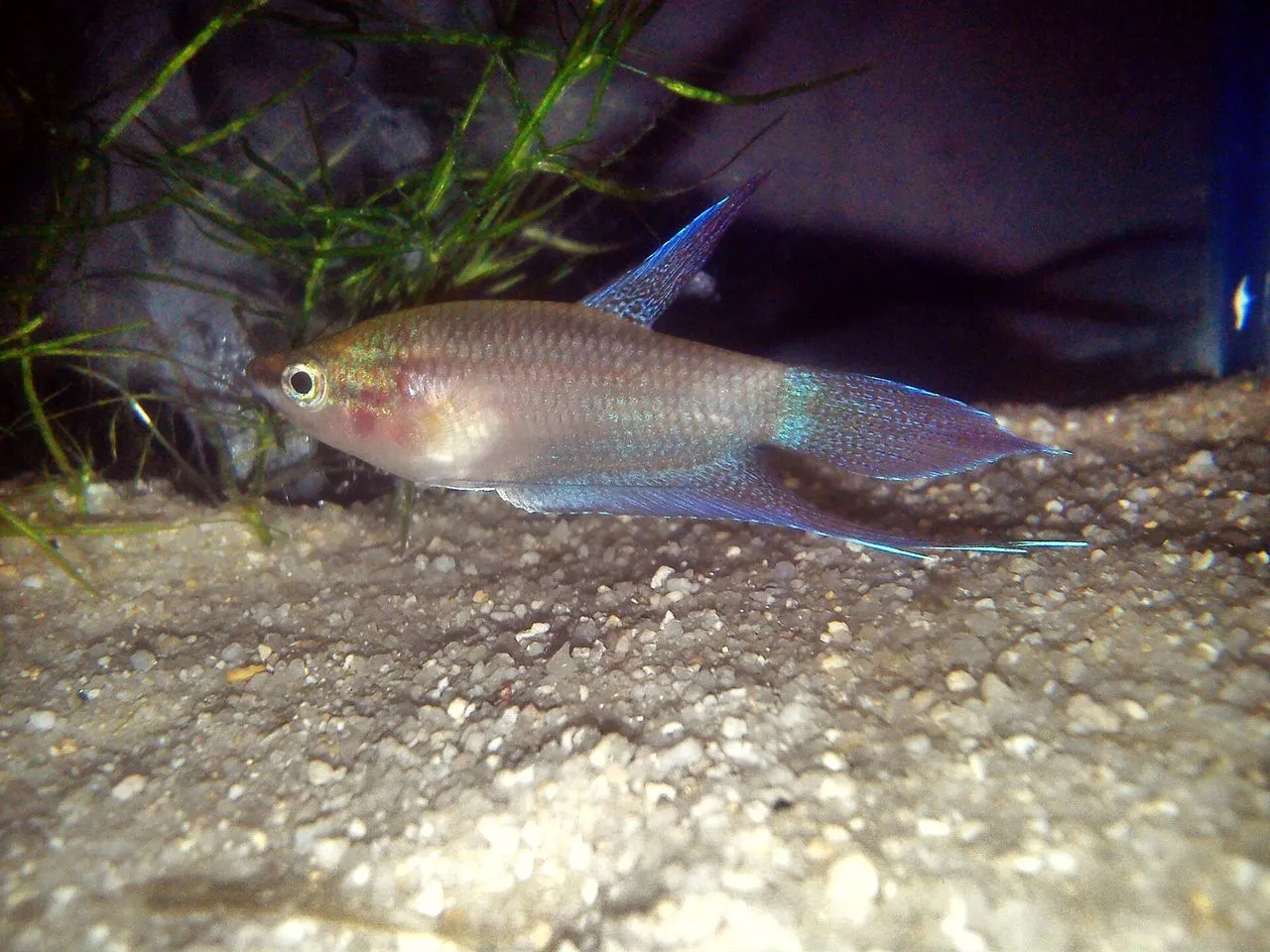
Answer: *Trichopsis vittata* is a 6–7 cm labyrinth fish best kept at 24–28 °C, GH 2–8 °dH, KH 0–3 °dH, pH 5.5–7.2. This larger Trichopsis uses audible croaks in territorial and courtship encounters. Provide a covered, mature aquarium with gentle filtration, open surface access, and tankmates chosen for calm behaviour rather than colour contrast.
Trichopsis vittata, the croaking gourami, is a 6–7 cm anabantoid whose aquarium success depends on understanding both the labyrinth organ and the habitat from which the fish comes. It breathes atmospheric air from the surface as well as using its gills, so the tank must provide clean water below and a warm humid air layer above. This larger Trichopsis uses audible croaks in territorial and courtship encounters.
Part of the Complete Gouramis & Bettas Guide.
Identification
The croaking gourami is identified by body shape, fin proportions, colour pattern, and behaviour rather than by a single marking. Adult size is usually 6–7 cm, though poor rearing and undersized quarters can leave fish smaller without making them healthy. Males are normally more intensely coloured and more territorial. Females are rounder when conditioned, with shorter unpaired fins in most species. Juveniles can be difficult; buy from a source that labels fish by scientific name, not only by trade colour.
| Character | Typical croaking gourami | Useful comparison |
|---|---|---|
| Adult length | 6–7 cm | Compare with sparkling gourami |
| Breathing | Labyrinth organ, regular surface sips | Surface panic plus rapid gills suggests water-quality trouble |
| Breeding | bubble-nest | See honey gourami for contrast |
| Best aquarium style | Covered, planted, low current | Fast open communities cause chronic stress |
Do not judge health only by appetite. Anabantoids often continue feeding while ammonia, nitrite, or bacterial disease is already damaging gill and skin tissue. Clear eyes, intact fin edges, smooth breathing, and normal surface visits are better signals.
Origin & Habitat
Wild habitat varies across the group, but the pattern is usually warm, shallow, vegetated water with low current. Many populations occur among leaf litter, submerged grasses, floating plants, or marginal roots where dissolved oxygen can fall sharply overnight. Atmospheric breathing is an adaptation to that setting, not permission to keep the fish in dirty water.
For this species, plan around 24–28 °C and GH 2–8 °dH, KH 0–3 °dH, pH 5.5–7.2. If using tap water outside that range, read water hardness, GH, and KH explained before altering chemistry. Low KH acidic tanks are safer when made from reverse-osmosis water plus measured remineralisation than when forced downward with random acid additions. Tannins from botanicals are useful, but they do not neutralise ammonia or replace filtration.
Aquarium Husbandry
A mature aquarium is essential. For small species, a 40–60 litre tank can work when it is densely planted, lightly stocked, and stable; medium gouramis need 90–180 litres; large species require far more. The filter should process ammonia and nitrite reliably while keeping surface turbulence modest. Sponge filters and baffled outlets are often better than high-velocity returns.
| Parameter | Recommended range |
|---|---|
| Temperature | 24–28 °C |
| GH / KH / pH | GH 2–8 °dH, KH 0–3 °dH, pH 5.5–7.2 |
| Ammonia and nitrite | 0 mg/L at all times |
| Nitrate | Ideally below 20 mg/L; lower for blackwater specialists |
| Surface access | Always open, with a secure lid and humid headspace |
Set the tank before the fish arrives. Cycling a new aquarium is not optional, especially for bettas and gouramis sold as hardy beginner fish. Use fine-leaved or broad-leaved cover, floating plants, and dark retreats. Java fern, Anubias nana, and Cryptocoryne wendtii suit many low-current setups. Leave clear breathing lanes at the surface.
Tankmates & Behaviour
Choose tankmates that neither nip fins nor outcompete at feeding time. Southeast Asian shoalers are the most natural companions: harlequin rasboras for medium tanks, chili rasboras for tiny peaceful species, and the complete rasboras guide for broader matching. Kuhli loaches work well in warm soft tanks with sand and cover.
Avoid mixing similarly shaped male anabantoids unless the tank is large and heavily structured. A male guarding a nest may claim the upper third of the aquarium. In small tanks, that is the whole tank. Long-finned tankmates, nippy barbs, hyperactive danios, and large cichlids are poor companions. For croaking gourami, the main behavioural risk is stress from bright, open tanks and fin-nipping companions.
Diet
In nature, small anabantoids pick insect larvae, microcrustaceans, worms, tiny surface prey, and aufwuchs; larger species add plant matter, molluscs, or fish according to anatomy. In captivity, feed a varied diet: fine quality prepared food as a base, plus frozen cyclops, daphnia, mosquito larvae, bloodworm in moderation, and live foods when conditioning breeders. Feed small portions once or twice daily. A slightly lean fish with sharp behaviour is healthier than a bloated fish fed rich foods every time it begs.
Surface feeding is normal, but sinking foods help bottom tankmates and reduce frantic competition. Remove uneaten food. In soft acidic water, decay can push bacterial counts upward even when nitrate remains low.
Breeding
The breeding mode is bubble-nest. Conditioning requires privacy, live or frozen food, and stable warm water. For nest-builders, provide floating plants or a calm corner under a leaf. The male courts, embraces the female, and tends the eggs or larvae near the surface. For mouth-brooders, disturbance is the enemy; do not keep checking the brooding fish with a torch or net.
Fry require tiny first foods such as infusoria, rotifers, or newly hatched brine shrimp once large enough. The warm humid air above the water is critical when the labyrinth organ develops. Sudden cold air from an open lid can kill or deform fry even when the water itself tests well.
Common Problems
The recurring failures are predictable: uncycled tanks, hard water used for blackwater fish, cold dry air above the surface, aggressive tankmates, and skipped quarantine. Imported anabantoids can carry bacterial infections, external parasites, or viral disease in the case of some dwarf gourami lines. Use the quarantine tank protocol for new fish and consult fin rot diagnosis before treating ragged fins.
Specific warning for this profile: stress from bright, open tanks and fin-nipping companions. The fix is rarely a single medicine. Correct the environment first, then treat confirmed disease.
See Also
- Complete Gouramis & Bettas Guide
- Sparkling Gourami
- Honey Gourami
- Water Hardness: GH & KH Explained
- Cycling a New Aquarium
- Harlequin Rasbora
Croaking gourami care at a glance
Croaking gouramis do best in a calm, warm, planted aquarium with gentle filtration, floating cover, and stable water. They are small labyrinth fish, so avoid strong current and leave open access to the surface for breathing.
Tank mates and behavior
Choose peaceful fish that will not nip fins or outcompete them at feeding time. Their famous croaking sound is usually part of social or breeding behavior, especially between males, and does not automatically mean the fish is distressed.
FAQ: are croaking gouramis good beginner fish?
They can work for careful beginners who can keep water stable and provide a quiet planted tank. They are less suited to rough community tanks, boisterous tank mates, or setups with fast flow and little cover.
Frequently Asked Questions
What water parameters does the croaking gourami need?
Croaking gourami does best at 24–28 °C, GH 2–8 °dH, KH 0–3 °dH, pH 5.5–7.2. Stability is more important than a perfect number, but hard alkaline water is unsuitable for blackwater species.
Can croaking gourami live with rasboras?
Yes for quiet species and suitable size matches. Harlequin rasboras suit medium gouramis, chili rasboras suit tiny peaceful species, and predatory or large anabantoids should not be trusted with small tankmates.
Does croaking gourami need air access?
Yes. As a labyrinth fish it must reach the surface. Keep a covered tank with a warm humid air gap and do not seal the lid so tightly that heat and stale air accumulate.
How does croaking gourami breed?
The usual breeding mode is bubble-nest. Condition adults on small live or frozen foods, provide floating cover, and remove or separate adults according to the species behaviour.
Sources & References
- Linke, H. (1991). Labyrinth Fish. Tetra Press.
- Goldstein, R.J. (2004). Bettas, Gouramis and Other Anabantoids. Barron's.
- Vierke, J. (1988). Bettas, Gouramis and Other Anabantoids. T.F.H. Publications.
- Schäfer, F. (2005). All About Labyrinthfish. Aqualog.