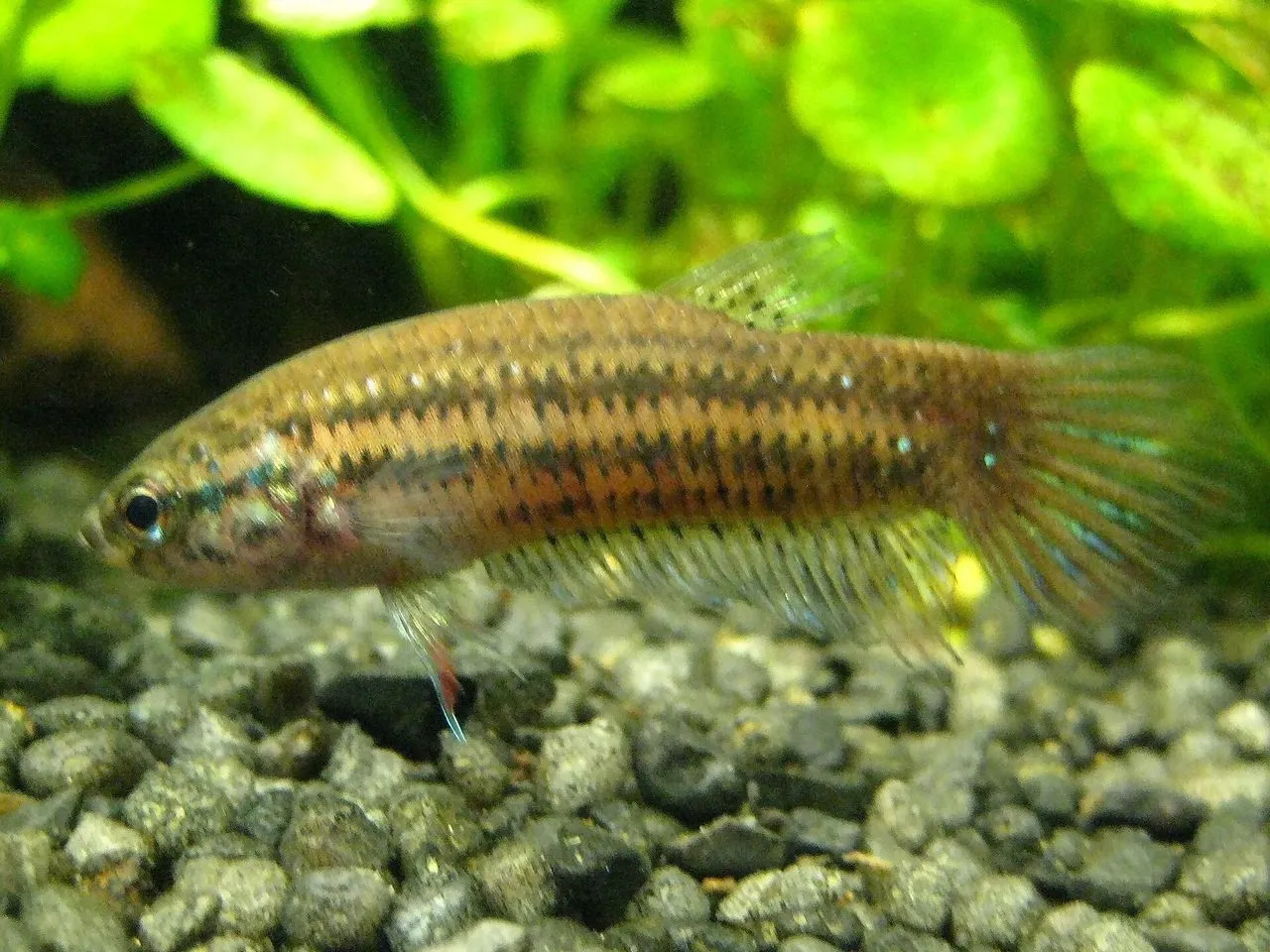
Answer: Gourami flaring is normal labyrinth-fish behaviour in the right context — a brief opercular display between two males, or courtship signalling to a female, causes no lasting harm. The concern arises when flaring is sustained and one-sided: a male repeatedly flaring at a reflection, at a neighbouring tank's fish, or at a subordinate male without escape routes is under chronic territorial stress, which suppresses feeding, causes fin damage, and can kill the subordinate.
Opercular flaring — the sudden fanning-open of the gill covers, the colour surge, the squared-up posture — is one of the most visible displays in a freshwater aquarium. All anabantoids do it. The question is not whether it happens but what it means when it does: a brief display between males resolving itself within minutes is healthy social behaviour; the same fish spending hours fixed against the glass or relentlessly pursuing a tank companion is a problem that needs a practical solution.
Part of the Complete Gouramis & Bettas Guide.
Main Causes
All members of the suborder Anabantoidei — gouramis, bettas, paradise fish, climbing perch — are capable of opercular flaring. The behaviour evolved in the shallow, heavily vegetated, low-oxygen waters of South and Southeast Asia, where territory is a finite resource and inter-male competition is intense. Tate et al. (2017) describe the labyrinth organ as central not only to the physiology of these fish but to the entire suite of territorial and courtship behaviours that define them as a group.
| Trigger | Most likely species | Notes |
|---|---|---|
| Inter-male territorial display | Trichopodus trichopterus (three-spot, opaline, gold, blue — all the same species) and T. microlepis | Most common cause in home aquaria; the three-spot group is among the most aggressive gouramis kept |
| Courtship display to a female | Trichogaster lalius (dwarf), T. chuna (honey), T. leerii (pearl) | Normal; male flares and intensifies colour before driving the female toward the bubble nest |
| Mirror reaction at the tank glass | Any species under bright overhead lighting | Fish reads its reflection as a permanent rival; flaring is indefinite since the reflection always mirrors the threat |
| Adjacent tank visible through glass | Any species near a second tank housing a male of the same or closely related species | Separation by an opaque panel between tanks resolves it |
| New fish introduction | Any species with a pre-established territory | Males flare at every new conspecific for 24–72 hours; resolves as hierarchy stabilises, or escalates if space is insufficient |
| Chronic stress display | Any species in an undersized or structurally bare tank | Sustained low-level flaring combined with clamped fins and darkened colouration — this overlaps with aggression but often signals a fish under persistent pressure rather than one actively hunting a rival |
How to Identify the Problem
Duration, direction, and the response of the other fish are the three diagnostics.
Normal display — no action required: Two males flare briefly across a sightline, hold position for a few seconds, and separate. A male fans open his opercula while circling a female near the bubble nest and the female holds her ground or retreats calmly. Displays last seconds to two or three minutes and both fish resume normal activity immediately.
Territorial pressure — monitor closely: One male claims a corner or the entire upper water column and flares at a second male every time it approaches. The subordinate shows a clamped dorsal fin, retreats to the opposite end of the tank, and feeds less reliably. In a large, heavily planted tank this sometimes stabilises into a workable hierarchy. In a bare or small tank it almost always escalates.
Reflection or neighbour trigger — act promptly: A single fish flares repeatedly at the glass with no rival present. The display is directed at one specific panel, intensifies when the fish approaches directly, and continues for extended periods. Check whether a second aquarium is visible through that pane, then check whether bright lighting is creating a mirror effect on a pale-walled background.
Chasing, fin damage, refuge-hiding — separate now: If the subordinate fish shows torn fins, bite marks along the caudal peduncle, or refuses to leave a corner to feed, separation is the only effective response. Fin damage can be assessed using the fin rot diagnosis guide to determine whether secondary infection has set in.
Risk and Severity
Brief intraspecific flaring in a well-structured tank carries low risk. The physiological cost is real — Tate et al. (2017) document that a sustained opercular flare reduces water flow over the gills, briefly hypoxic the displaying fish — but short bouts are tolerated without cumulative harm.
The risk scales with confinement and social asymmetry. A dominant Trichopodus trichopterus male claiming the top third of a 60-litre tank will systematically suppress a subordinate over days to weeks: interrupted feeding, chronic stress hormone elevation, and eventual physical injury. The process is slow enough to miss if you are checking the tank only at feeding time.
Reflection-driven flaring carries no aggression risk to other fish, but is a welfare concern for the fish doing the flaring. Forsatkar et al. (2016) demonstrated that gill flaring is the opening move in a full territorial escalation sequence in Betta splendens — a closely related anabantoid. A male that cannot resolve the encounter (because the reflection never submits) remains in a state of unresolved arousal for as long as the trigger exists.
Solutions and Actions
- Identify the trigger before acting. Is there a rival male in the tank, a reflection in the glass, or a neighbouring aquarium in the sightline? Each calls for a different fix and none of them requires chemical intervention.
- Break sightlines with hardscape. Rearrange rocks, wood, and tall stem plants to create visual partitions across the mid and upper tank. A male that cannot maintain continuous sight of a rival de-escalates faster than one with an unbroken view across open water.
- Apply an opaque external background. Black card or black aquarium backing fixed to the outside of the rear and side panels eliminates reflection flaring almost immediately. It has the additional benefit of reducing fish stress generally by removing constant stimulation from outside the tank.
- Separate tanks that face each other. If two tanks with male gouramis are positioned side by side or opposite each other, place an opaque divider between them or reposition one tank entirely. Moving the glass a few centimetres to break direct sightlines is rarely sufficient.
- Remove the subordinate if injury is present. Move the less dominant male to a separate tank or partition. Do not rely on the dominant fish "calming down" once a hierarchy has reached the point of physical damage.
- Increase volume and add structure. For species like three-spot gourami, tanks under 120 litres with two males are almost always problematic regardless of planting. More volume is not a universal fix, but it is a prerequisite for any multi-male arrangement.
- Reconsider sex ratio. A single male kept with two or three females distributes his courtship and territorial energy differently than a male competing with another male. For the calmer species — dwarf gourami, pearl gourami — a harem arrangement often produces stable, interesting behaviour without chronic aggression.
Prevention
Species selection is the most effective lever. Trichopodus trichopterus — the three-spot and all its commercial colour forms — is consistently one of the most territorial gouramis in home aquaria. Sparkling gouramis (Trichopsis pumila) and honey gouramis are among the least aggressive. If your priority is a peaceful community rather than breeding behaviour from a dominant male, the choice of species matters more than tank size or hardscape design. See honey gourami vs dwarf gourami for a direct comparison of temperament across the two most commonly sold small species.
Practical prevention checklist:
- Single-male stocking in tanks under 120 litres removes inter-male competition entirely and is the simplest reliable approach.
- Dense planting and floating cover break sightlines naturally; surface vegetation also reduces reflection from the water surface under strong lights.
- Opaque external backgrounds on all panels from the start prevent reflection problems before they develop.
- Quarantine new fish in a separate tank before introduction. A male that has held territory for months reacts aggressively to any new conspecific; a quarantine tank protocol also gives you the chance to assess the new fish's health before it enters the main display.
- Choose non-competing tankmates. Harlequin rasboras and bottom-dwelling loaches occupy different water layers and rarely provoke a gourami's territorial response in a properly sized tank.
Common Mistakes
- Treating all flaring as a problem. Courtship flaring directed at a receptive female, or brief display between two males that resolves in minutes, is normal anabantoid social behaviour. Intervening at the first opercular spread disrupts natural behaviour without addressing any actual welfare issue.
- Removing one fish without identifying the trigger. Taking out a subordinate male while the dominant continues to flare at the glass means the behaviour reappears with every new fish added. Confirm whether the trigger is a rival, a reflection, or an adjacent tank before deciding what to move.
- Placing new fish directly into a tank with an established territorial male. Rearrange hardscape before any new introduction so the established fish must re-establish territory rather than defending familiar zones.
- Assuming two three-spot gouramis will settle down in a standard community tank. This species escalates reliably in confined quarters. The expected outcome in a tank under 120 litres with two males is injury to the subordinate within days to weeks.
- Declaring the situation resolved because flaring has stopped. A subordinate that has withdrawn completely — sitting in a corner, not feeding, barely moving — may simply have ceased displaying. Check for genuine normal behaviour: active swimming, regular surface air visits, and feeding at every meal.
Frequently Asked Questions
Is it normal for my gourami to flare its gills?
Yes, in short bursts. Opercular flaring is the primary agonistic and courtship display across all anabantoid species. A male flaring briefly at another male or during a spawning encounter is behaving normally. Sustained flaring — minutes to hours at a time, particularly at a reflection or at a fish that cannot escape — is a stress signal that requires a husbandry response.
Why does my gourami flare at the tank glass?
It is responding to its own reflection. Under bright overhead lighting against a dark wall, the tank glass acts as a mirror. The fish perceives a permanent intruder male and flares indefinitely, since the reflection always returns the threat. An opaque dark background taped to the outside of the glass eliminates this almost immediately.
Will my gourami hurt itself from flaring?
Brief displays are tolerated without lasting harm. Tate et al. (2017) note that a prolonged opercular flare reduces water flow across the gills, placing the fish in a temporary hypoxic state. Hours of sustained flaring at a reflection is a welfare concern for the flaring individual. The greater risk is to any subordinate fish in the same tank: chronic harassment suppresses feeding and eventually kills.
Do female gouramis flare?
Rarely, but it occurs. Females of honey gourami (Trichogaster chuna) in peak spawning condition sometimes perform a reduced opercular flare directed at the male or at close-proximity females. It is far less frequent and less intense than male inter-male display and does not normally require any intervention.
Sources & References
- Tate, M., McGoran, R.E., White, C.R. & Portugal, S.J. (2017). Life in a bubble: the role of the labyrinth organ in determining territory, mating and aggressive behaviours in anabantoids. Journal of Fish Biology, 91(3): 723–749.
- Forsatkar, M.N., Nematollahi, M.A. & Brown, C. (2016). Male Siamese fighting fish use gill flaring as the first display towards territorial intruders. Journal of Ethology, 35(1): 51–59.
- Linke, H. (1991). Labyrinth Fish. Tetra Press.
- Goldstein, R.J. (2004). Bettas, Gouramis and Other Anabantoids. Barron's.