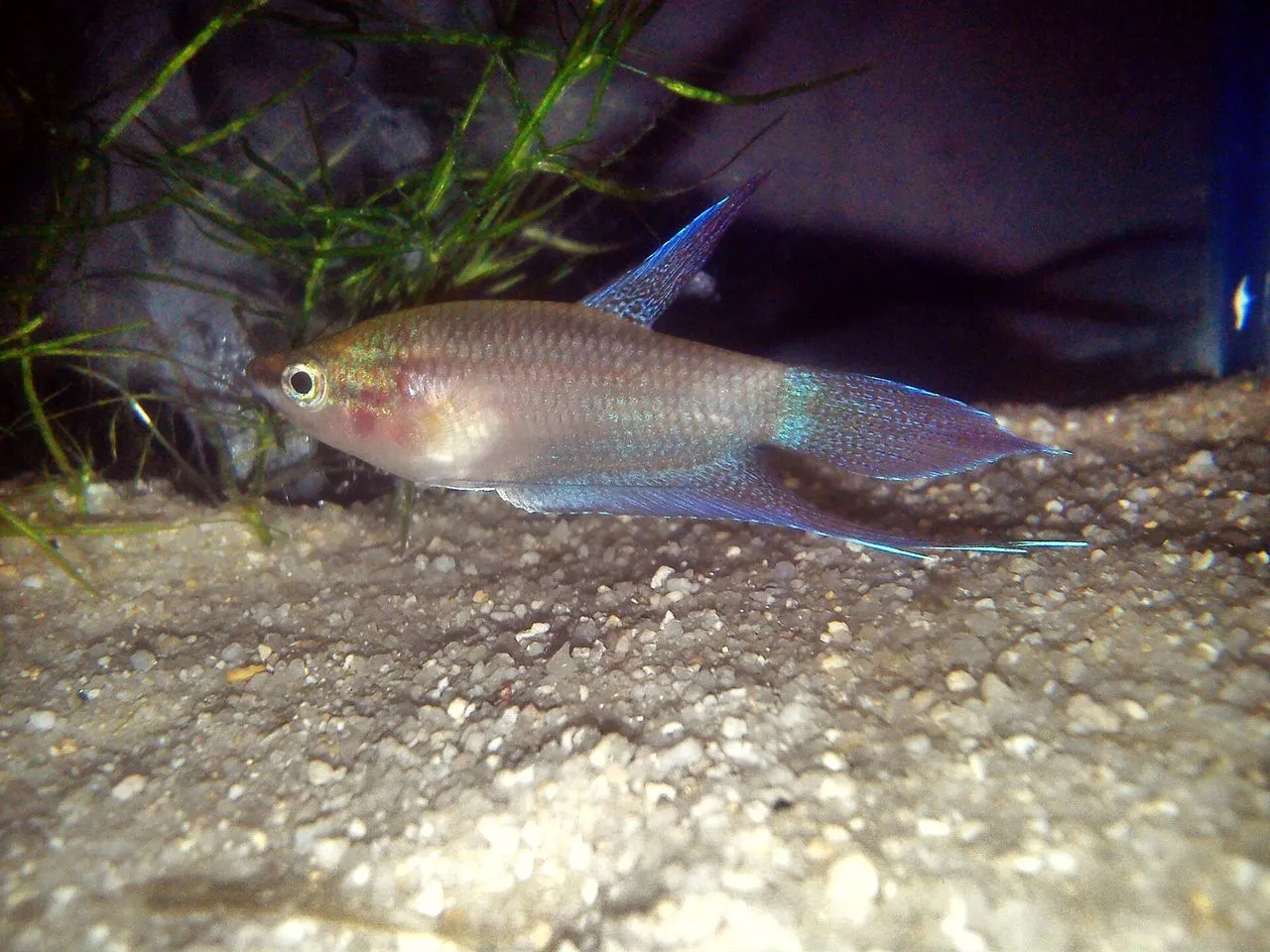
Answer: *Betta splendens* suits a 20–40 litre tank kept as a single fish: interactive, free of significant trade disease, and needing no companion. *Trichogaster lalius*, the dwarf gourami, wants 60 litres or more for a stable pair and carries a well-documented iridovirus risk in commercial lines. For a tank of 40 litres or under, a betta is the practical choice. For a gourami in a larger setup, the honey gourami is a lower-risk alternative.
Betta splendens and Trichogaster lalius, the dwarf gourami, share more than a shelf in the fish shop — both are labyrinth fish, both breathe atmospheric air, and both thrive in warm, planted, low-current tanks. The resemblance ends there. Bettas are solitary animals kept one to a tank; dwarf gouramis work best as a male-female pair in a larger volume. The practical cutoff is roughly 40 litres: below that, a betta is the only sensible choice.
Part of the Complete Gouramis & Bettas Guide.
At a Glance
| Attribute | Betta (Betta splendens) | Dwarf gourami (Trichogaster lalius) |
|---|---|---|
| Adult size | 6–7 cm | 6–8 cm |
| Minimum tank | 20 L (40 L+ recommended) | 60 L for a pair; 40 L for a solo male |
| Social setup | One male, kept alone | Male-female pair, or solo male |
| Temperature | 24–28 °C | 24–28 °C |
| GH / KH / pH | 5–12 °dH / 3–10 °dH / 6.5–7.5 | 3–10 °dH / 2–6 °dH / 6.0–7.5 |
| Temperament | Interactive, recognises keeper | Shyer, more reactive |
| Disease risk | No significant trade disease | DGIV iridovirus endemic in farm lines |
| Lifespan | 3–5 yr (fancy fins: 2–3 yr) | 4–6 yr |
| Beginner-friendly | Yes, with a proper solo setup | Mixed — depends heavily on source |
Betta in Practice
Betta splendens is one of the few aquarium fish that actively engages with the keeper. Most males learn to surface when a familiar face approaches, follow a finger moved across the glass, and eat confidently from tweezers within days of settling in. For a solo-species tank in a small volume, that interactive quality makes the arrangement genuinely rewarding rather than limiting.
The minimum viable tank is 20 litres, but 40 litres is where a betta shows its best behaviour and health. The Siamese fighting fish profile covers the full parameter range; the relevant figures for a comparison are 24–28 °C, GH 5–12 °dH, KH 3–10 °dH, pH 6.5–7.5. Filtration should process the volume without creating surface turbulence — sponge filters or baffled outlets work well. A secure, close-fitting lid is non-negotiable: bettas jump, and the air layer above the water must stay warm and humid for the labyrinth organ.
Male bettas cannot be kept together. Two males will fight until one is dead or too injured to recover. A male with a female may breed in the right conditions but will pursue her relentlessly without dense planting and sufficient retreat space. The single-male setup is not a compromise — it is what the species requires.
Fancy-fin lines carry a higher fin-rot risk and typically live 2–3 years rather than the 3–5 of a plakat or wild-type. Water-quality problems and surface-breathing trouble show in posture before they show in test results — why is my betta laying on the bottom covers the early warning signs.
Dwarf Gourami in Practice
The dwarf gourami is the more visually striking fish. The male carries intense alternating red-orange and blue-grey vertical banding from gill to caudal fin. Several colour morphs exist commercially — "flame", "powder blue", "neon" — but all show this banded pattern. Females are plain silvery-grey with shorter fins, and are frequently not stocked in shops that sell only males.
For a stable pair, 60 litres is the minimum. In less space, the male claims the whole upper water column as territory and the female cannot escape persistent chasing. Two males together in any community tank will fight, with predictable results. A solo male in 40 litres is possible but removes most of the behavioural interest.
Parameters overlap comfortably with the betta's: 24–28 °C, GH 3–10 °dH, KH 2–6 °dH, pH 6.0–7.5. The slightly softer, more acidic end of that range suits wild-type and hobbyist-bred stock better than the hard-water end.
DGIV — the iridovirus problem. Dwarf gourami iridovirus has been endemic in commercial T. lalius farm lines since the 1990s. Sudthongkong, Miyata & Miyazaki (2002) documented the disease formally; subsequent surveys have estimated prevalence at 20–40% in trade-supplied fish. Symptoms emerge weeks to months after purchase: colour fade, pale or ulcerated patches on the skin, wasting, and death. There is no treatment. Affected fish die, and tank-mates of the same species are likely already infected. This is not a minor footnote — it is the central practical risk of keeping this species from commercial stock.
If you want a gourami at this size and the iridovirus problem gives you pause, the honey gourami is the direct alternative: similar parameters, similar size, gentler in temperament, and free of the DGIV problem that has plagued T. lalius lines. The honey gourami vs dwarf gourami comparison covers the distinction in full. For any dwarf gourami purchase, use the quarantine tank protocol for at least six weeks before introducing fish to a display tank.
Where Each One Fits
The decision is mostly volume and risk tolerance.
| Tank volume | Recommended choice | Reasoning |
|---|---|---|
| 20–35 L | Betta only | Dwarf gourami pair is too cramped; solo male possible but limiting |
| 40–55 L | Betta with peaceful community | Suits small rasboras or corydoras alongside; one anabantoid only |
| 60–80 L | Betta or dwarf gourami pair | DG: source from a hobbyist breeder; honey gourami is the lower-risk gourami |
| 80 L+ | Either, with full community | Betta: avoid long-finned or nippy tankmates; dwarf gourami: one pair maximum |
Experience matters here too. A well-planted betta setup at 40 litres tolerates the minor stocking errors any beginner makes, provided water quality is sound. A dwarf gourami pair at 60 litres has less margin — a territorial breakdown or an iridovirus case can unfold in days. For a first anabantoid, the betta or the honey gourami is the more predictable outcome. Once you have a feel for labyrinth fish husbandry, a carefully sourced dwarf gourami is a reasonable next step.
Tankmate Compatibility
Both species prefer calm, planted tanks with warm, soft water. The tankmate criteria differ because bettas are vulnerable to fin-nipping and dwarf gouramis are territorial in the upper water column.
Betta tankmates: avoid species with long decorative fins that the betta may treat as a rival — male guppies and veiltail mollies are common mistakes. Avoid confirmed fin-nippers: tiger barbs, serpae tetras, and similar barb species. Good companions include harlequin rasboras, ember tetras, pygmy corydoras, and kuhli loaches — all of which share the warm, soft-water preference and do not compete at the surface.
Dwarf gourami tankmates: avoid any second anabantoid male in a tank under 120 litres. Otherwise, the dwarf is compatible with small peaceful fish — chili or harlequin rasboras, small tetras, otocinclus, and bottom-dwelling corydoras. A male in breeding condition will patrol the upper water actively, so taller tanks with dense mid-level planting protect the female and reduce territorial disputes.
Common Mistakes
- Putting two male bettas together. Two males will fight to the death regardless of tank volume. One betta per tank, without exception.
- Buying dwarf gouramis from a shop tank with visible losses. DGIV spreads through a shared system. Dead or faded fish alongside live stock is a clear warning sign — do not buy from that batch.
- Housing a dwarf gourami pair in under 60 litres. The male will pursue the female until she stops feeding or is physically injured. The space requirement is not a preference.
- Adding fin-nippers to a betta tank. Fancy fins attract nipping within days. Assess every potential tankmate for this risk before purchase.
- Skipping quarantine on dwarf gouramis. DGIV typically presents two to six weeks after purchase. A minimum six-week quarantine is the only way to catch early-onset cases before they reach the display tank.
Frequently Asked Questions
Can a betta and a dwarf gourami share a tank?
Not reliably. Both are labyrinth fish and both males are territorial at the surface. A betta will flare at and pursue a dwarf gourami male, and the enclosed upper water column becomes contested ground. In most tanks under 120 litres, one anabantoid species is the sensible rule.
What is the minimum tank size for a dwarf gourami pair?
60 litres is the practical minimum for one male and one female Trichogaster lalius. Below that volume, the male claims the whole tank as territory and the female has no space to retreat. A single male can be kept in 40 litres but loses most of the species' natural behaviour.
Is dwarf gourami iridovirus still a problem in 2026?
Yes. DGIV has been endemic in commercial farm lines since the 1990s. Surveys have estimated 20–40% prevalence in trade-supplied fish at various points. There is no treatment — affected fish die, and tank-mates may already be infected. Quarantine for at least six weeks and source from hobbyist breeders where possible.
Which is easier for a careful beginner, a betta or a dwarf gourami?
A betta in a proper single-species setup is more straightforward. The solitary requirement removes most stocking complexity, and there is no significant endemic disease to screen for. Dwarf gouramis are more demanding because of the space requirement for a stable pair and the iridovirus risk in commercial stock.
What is the honest alternative to a dwarf gourami?
The honey gourami (Trichogaster chuna) is smaller, gentler, and does not carry DGIV. For most keepers who want a colourful gourami in a community tank, it is the better choice at this size. The honey gourami vs dwarf gourami comparison covers the distinction in full.
Sources & References
- Linke, H. (1991). Labyrinth Fish. Tetra Press.
- Goldstein, R.J. (2004). Bettas, Gouramis and Other Anabantoids. Barron's.
- Sudthongkong, C., Miyata, M. & Miyazaki, T. (2002). Iridovirus disease in two ornamental tropical freshwater fishes: African lampeye and dwarf gourami. Diseases of Aquatic Organisms, 48(3): 163–173.