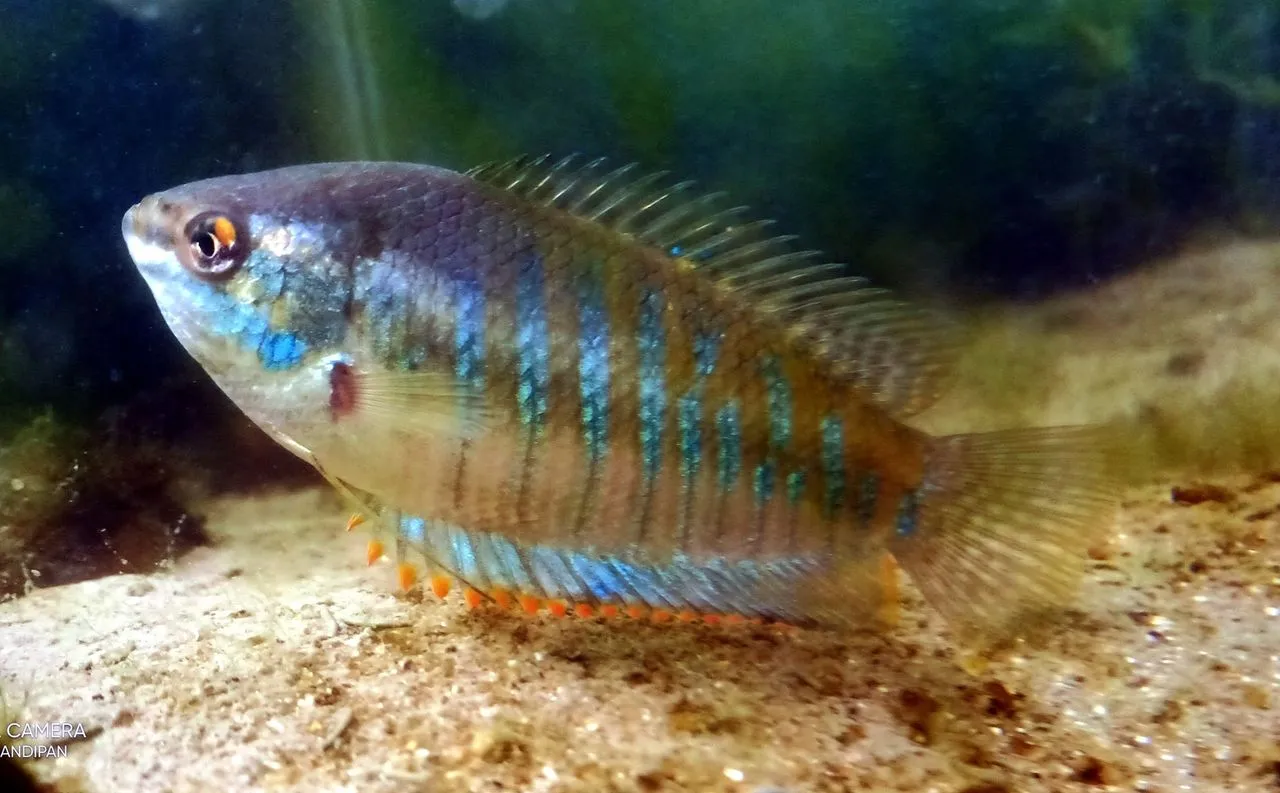
Answer: Clamped fins — fins pinched tight against the body rather than fanned out — are the earliest stress signal in Betta splendens. Test the water first: ammonia or nitrite above 0 mg/L is the most common trigger. Temperature below 24 °C is the second. Once water quality and temperature are confirmed safe, examine the fish closely for velvet, ich, or early fin rot.
In Betta splendens, clamped fins — the dorsal, caudal, and anal fins held tight against the body rather than fanned freely — appear before loss of appetite, colour fading, or visible lesions. A healthy betta fans its fins, flares at its reflection, and holds the dorsal erect at rest. When all of that stops, the fish is signalling stress before anything else is externally visible.
Part of the Complete Gouramis & Bettas Guide.
Main Causes
The causes divide into three categories: acute environmental problems (correctable within hours), disease (requires diagnosis and targeted treatment), and permanent or chronic conditions (limited options). The table below lists the most common, ordered by likelihood in a typical home tank.
| Cause | Accompanying signs | Urgency |
|---|---|---|
| Ammonia / nitrite poisoning | Rapid gill movement, surface hovering, reddened gills | Immediate — test now |
| Low temperature (below 24 °C) | Lethargy, slow movement, reduced appetite | Immediate — check heater |
| Acclimation stress | Onset within 24–72 h of transport or tank transfer | Monitor — usually resolves in days |
| pH shock / chlorine exposure | Sudden onset after a water change | Immediate — check dechlorination |
| Elevated nitrate / high TDS | Chronic lethargy, pale colouration, no acute trigger | Urgent — 30–50% water change |
| Bacterial infection (early) | Fin edges beginning to fray, behaviour changes | Urgent — confirm before treating |
| Velvet (Oodinium) | Gold-dust shimmer under angled torchlight, scratching | Urgent — confirm visually first |
| Ich (Ichthyophthirius multifiliis) | White salt-like dots on fins or body | Urgent |
| Fin rot (early stage) | Progressive erosion along fin margins | Urgent — see fin rot diagnosis |
| Current too strong | Affects long-finned fancy strains most; fish exhausted | Adjust filter output |
| Internal parasites | Wasting, hollow belly, abnormal faeces | Investigate systematically |
| Mycobacteriosis | Chronic wasting, pale colouration, no treatment response | Limited — see FAQ |
| Genetic / structural | Permanent from purchase; no other signs | Not correctable |
Velvet is the disease most frequently missed because it is invisible under standard tank lighting. Turn the room and tank lights off, shine a torch at a 45-degree angle across the fish's flank. An Oodinium-infested betta shows a gold or rust-coloured dust on the skin that disappears under overhead light. Left untreated, velvet progresses from skin to gills within days — faster than ich.
How to Identify the Problem
Work through three questions in order.
Did this start suddenly? Clamped fins appearing after a water change, after adding a fish, or after transport point to an acute environmental trigger. Compare the onset to any tank action in the preceding 24 hours. Chlorine in a water change, temperature shock from poorly matched replacement water, or acclimation stress in a new arrival all produce rapid clamping.
What do the parameters say? Test ammonia, nitrite, nitrate, temperature, and pH before anything else. In a new tank — under six weeks old, or any setup without established biological filtration — ammonia and nitrite poisoning is the most probable cause and the most urgent. The siamese fighting fish species profile gives the full parameter envelope: 24–28 °C (75–82 °F), GH 2–8 °dH, KH 1–4 °dH, pH 6.2–7.4. A betta below 24 °C will clamp within hours; below 22 °C, immune function is substantially suppressed and secondary infections follow.
What does the fish look like under a torch? After parameters are confirmed safe, examine the fish systematically: fin edges for early erosion, body surfaces for velvet shimmer or ich spots, gill covers for swelling or redness, and belly profile for wasting. A betta that remains clamped for more than 48 hours on clean water and correct temperature almost certainly has a disease cause.
The three patterns to distinguish:
- Acute — rapid onset, parameters abnormal or a recent tank event identifiable; resolves when the environment is corrected.
- Chronic — persistent over days or weeks, parameters correct, secondary symptoms developing; disease is likely.
- Permanent — unchanged from purchase or present for months without progression; may be anatomical in heavily inbred fancy strains, or early mycobacteriosis.
A betta clamping fins while also resting on the substrate represents a more advanced state of distress. That combination is covered in why is my betta laying on the bottom, where the differentials overlap but the priority actions differ.
Risk and Severity
Clamped fins are not themselves lethal. The conditions behind them often are.
Ammonia at 0.5 ppm damages gill epithelium within hours. Bettas breathe atmospheric air via the labyrinth organ and can supplement gill function at the surface — which means they tolerate low dissolved oxygen longer than most species, but it also means gill damage can be well advanced before the fish shows the desperate gasping seen in non-labyrinth species. A betta that is still surfacing normally and clamping fins may already have compromised gill tissue.
Velvet progresses faster than keepers expect. A fish that is mildly clamped and scratching on day one may have significant gill involvement by day four. Ich on the body is less immediately dangerous than ich on the gills, which disrupts breathing directly.
Chronic causes — internal parasites, mycobacteriosis — produce slow decline over weeks to months. Early intervention for internal parasites is more effective than late; mycobacteriosis has no treatment. Identifying the pattern quickly (acute vs chronic) determines how much time you have to act.
Solutions and Actions
Work through this sequence. Do not reach for medication before completing steps 1 and 2.
Step 1 — Test the water. Ammonia, nitrite, nitrate, pH, and temperature. If ammonia or nitrite are above 0 mg/L, perform a 30–50% water change with temperature-matched, dechlorinated water, then re-test after 4 hours. In an uncycled or recently set-up tank, read cycling a new aquarium before adding more fish or attempting chemical shortcuts.
Step 2 — Confirm the temperature. Check with a calibrated thermometer, not the heater dial. If the heater has failed or is undersized, replace it before proceeding. Restore temperature gradually — no more than 1 °C per hour if the tank has cooled significantly.
Step 3 — Check the most recent water change. If clamping began within hours of a water change, verify dechlorination (full dose for the change volume, not a splash) and that the replacement water matched tank temperature within 1–2 °C. A large change with very different hardness can also shock soft-water bettas osmoregulatorily.
Step 4 — Examine the fish under a torch. Velvet check first (darkened room, angled beam). Then fin edges for erosion. Then body for ich spots. If fin edges are degrading, cross-reference bacterial vs fungal disease before choosing a treatment.
Step 5 — Check flow rate. Long-finned fancy bettas — halfmoon, crowntail, rosetail — cannot swim efficiently against more than a gentle current. If the fish rests with fins clamped on the downstream side of the filter return, reduce flow with a spray bar, sponge prefilter, or baffle.
Step 6 — Treat disease only after environment is confirmed clean. Medicating in poor water adds chemical stress to an already compromised fish. When treatment is warranted: velvet responds to copper-based medication or formalin at the correct dose; ich responds to a temperature increase to 30 °C held for ten days combined with salt or proprietary treatment; bacterial infections require antibiotic treatment, ideally after confirming bacterial rather than fungal origin.
Prevention
A betta clamping fins in a stable, mature tank is a one-off investigation. A betta clamping repeatedly has an environment that is not yet stable.
Establish full biological filtration before adding fish. Ammonia and nitrite spikes in an uncycled or partially cycled tank are the most frequent cause of clamped fins across all betta setups. Follow cycling a new aquarium to completion, or seed a new filter with established media.
Use a reliable heater and verify it. A thermometer separate from the heater itself is not optional. In winter, rooms that cool overnight can drop a tank 2–4 °C by morning — enough to cause clamping by the time you see the fish.
Dechlorinate every water change, every time. Chlorine and chloramine attack gill tissue acutely. A full-strength dechlorinator at the correct dose for the volume changed is the only safe approach.
Quarantine new arrivals. Velvet and ich enter established tanks on unquarantined fish. A four-week quarantine period, following the procedure in acclimating new fish, is sufficient to detect most disease before it reaches the display tank. Wild betta imbellis and other wild-collected anabantoids carry a higher parasite load than tank-bred stock and warrant the full period regardless of apparent health at purchase.
Match flow rate to fin type. A sponge filter or baffled hang-on-back running at low output is the appropriate choice for long-finned fancy bettas. High-velocity returns cause chronic exhaustion that presents as permanent mild clamping with no other diagnosable cause.
Common Mistakes
- Treating without testing. Adding medication, salt, or botanical extracts before measuring the water delays identification of the actual problem — usually ammonia or temperature — and may compound the stress.
- Trusting water clarity as a health signal. A tank can be visually spotless and contain 1 ppm ammonia. Clear water is not a diagnostic result.
- Interpreting labyrinth breathing as evidence the fish is coping. Because bettas breathe at the surface, keepers often assume a surfacing fish is fine. Surfacing with clamped fins and reduced movement is compensation, not health.
- Using aquarium salt as the first response to any symptom. Salt has a role in specific circumstances and at appropriate concentrations. It does not address an uncycled tank, a failed heater, bacterial infection, or internal parasites, and bettas from soft-water setups tolerate salinity less well than livebearers or goldfish.
- Not fixing the root cause after the fish recovers. A betta that unclamped after a water change will clamp again if the tank remains uncycled, the heater remains unreliable, or the change routine does not improve. The episode is the signal; the environment is the problem.
See Also
- Complete Gouramis & Bettas Guide
- Siamese Fighting Fish — full species profile including parameter envelope
- Why Is My Betta Laying on the Bottom? — overlapping differential
- Fin Rot Diagnosis — when clamped fins progress to tissue loss
- Cycling a New Aquarium — the most preventable cause
- Acclimating New Fish — quarantine protocol for new arrivals
Frequently Asked Questions
How do I tell clamped fins from a betta just resting?
A resting betta may fold its fins partially for a few minutes, then spread them again when it moves or investigates. Clamped fins are persistently held close to the body — dorsal, caudal, and anal fins all tight — and do not relax when the fish swims. A fish resting normally will also fan its fins periodically and respond to movement outside the tank. Persistent clamping for more than 30 minutes, especially combined with reduced appetite or surface hovering, is always worth investigating.
My water tests are all fine. Why are the fins still clamped?
After ammonia, nitrite, temperature, and pH are confirmed normal, work through the physical causes. Check for velvet by shining a torch at a 45-degree angle across the fish in a darkened room — velvet shows as a gold-dust shimmer invisible under overhead light. Check fin edges for early erosion (bacterial fin rot), body surfaces for ich spots, and gill covers for swelling. Heavily inbred fancy strains occasionally hold fins semi-clamped permanently due to anatomical issues rather than disease. Exclude disease first before assuming a genetic trait.
Is aquarium salt useful for clamped fins?
Salt has specific uses: it reduces osmotic stress during ammonia recovery and disrupts the life cycle of velvet and ich at appropriate concentrations. It is not a general-purpose cure for clamped fins. Treating an undiagnosed case with salt while the actual problem — temperature, an uncycled tank, early bacterial infection — remains uncorrected delays proper diagnosis and adds osmotic stress to soft-water bettas that do not need it.
Can a betta recover from clamped fins caused by mycobacteriosis?
Mycobacteriosis (Mycobacterium marinum or M. fortuitum) is chronic and incurable in fish. A betta with long-term wasting, pale colouration, and persistently clamped fins that does not respond to environmental correction or disease treatment may have this condition. It is also a zoonotic risk — wear gloves when working in the tank. Euthanasia is usually the appropriate decision for confirmed or strongly suspected cases. Stoskopf (1993) covers the diagnostic presentation and biosafety considerations in detail.
Sources & References
- Linke, H. (1991). Labyrinth Fish. Tetra Press.
- Goldstein, R.J. (2004). Bettas, Gouramis and Other Anabantoids. Barron's.
- Noga, E.J. (2010). Fish Disease: Diagnosis and Treatment. Wiley-Blackwell.
- Stoskopf, M.K. (1993). Fish Medicine. W.B. Saunders.