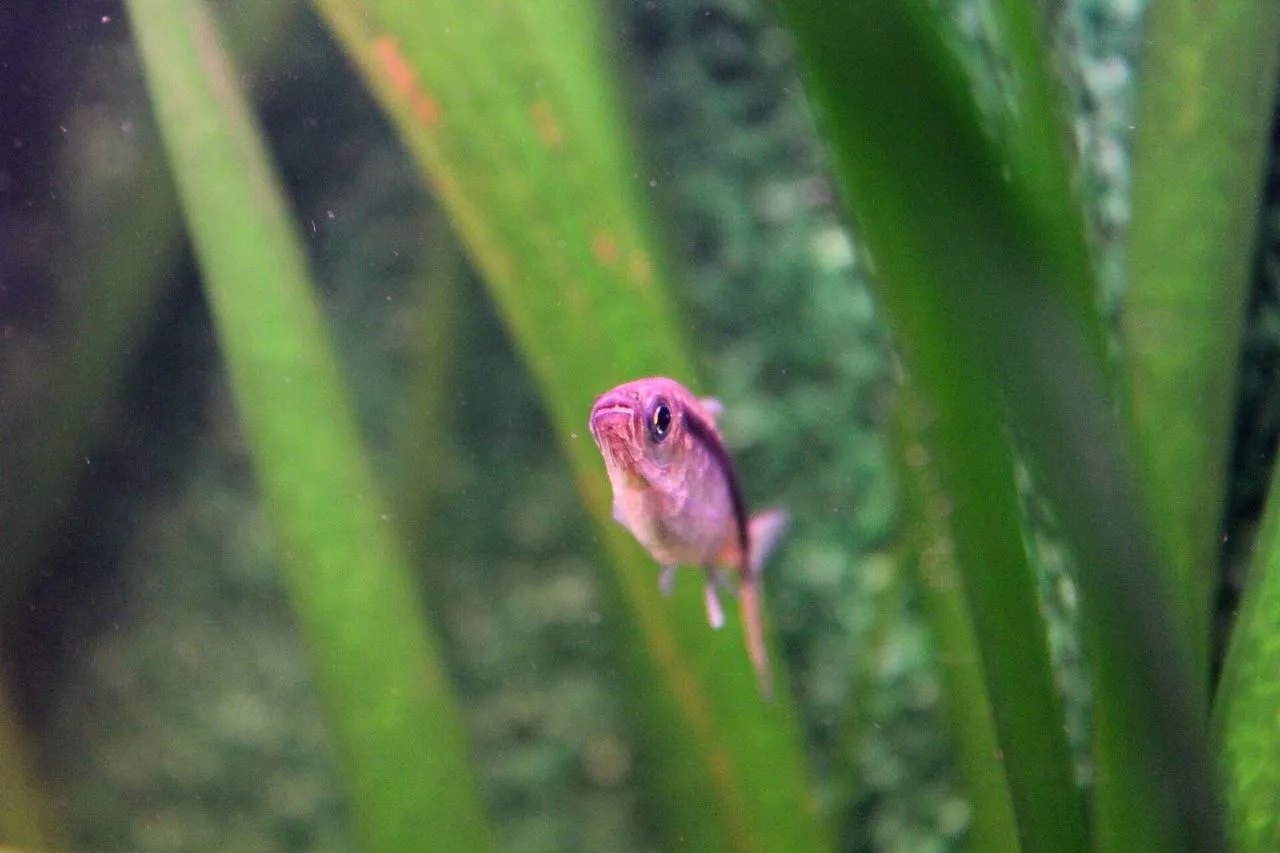
Answer: Cardinal tetras (*Paracheirodon axelrodi*) carry a red stripe running the full body length from eye to tail; in neon tetras (*P. innesi*) the red covers only the posterior half. Cardinals grow slightly larger (4–5 cm vs 3–4 cm), require stricter soft-water chemistry, and are substantially hardier — wild-caught from the Rio Negro under a sustainable fishery rather than mass-produced on Southeast Asian farms. For most keepers able to provide the correct water, the cardinal is the stronger long-term choice.
Cardinal and neon tetras are sold side by side in virtually every aquarium shop, routinely mislabelled, and frequently treated as the same animal. The differences between Paracheirodon axelrodi (cardinal tetra) and P. innesi (neon tetra) are actually sharp — in colour pattern, origin, hardiness, and long-term cost — and the recommendation usually goes to the cardinal once those differences are understood.
Part of the Complete Tetras Guide. For individual care profiles, see Cardinal Tetra and Neon Tetra.
At a Glance
| Attribute | Cardinal tetra (P. axelrodi) | Neon tetra (P. innesi) |
|---|---|---|
| Adult size | 4–5 cm | 3–4 cm |
| Red stripe | Full body — eye to tail | Posterior half only |
| Blue stripe | Mid-flank, eye to tail | Mid-flank, eye to tail |
| Origin | Rio Negro / Orinoco, wild-caught | Southeast Asian farms, tank-bred |
| GH | 0–4 °dH | 1–6 °dH |
| KH | 0–1 °dH | 0–3 °dH |
| pH | 4.5–6.5 | 5.5–7.0 |
| Temperature | 24–28 °C | 22–26 °C |
| Conductivity | 30–80 µS/cm | 80–250 µS/cm |
| Hardiness once settled | High — intact wild immunity | Variable — often poor from inbreeding |
| NTD (Pleistophora) susceptibility | Low — strong natural resistance | High |
| Longevity | 3–5 years | 2–3 years (often less) |
| Typical UK price | £3–£6 | £1.50–£3 |
Identification
The quickest way to tell the two apart is the red stripe. In a cardinal, red runs from the pectoral fin base all the way to the tail — it covers the full ventral half of the body. In a neon, red begins mid-body and the anterior belly is silvery-white. Under adequate light in a settled tank this is immediately clear. Under the fluorescent overheads of most shops, with stressed pale fish, it can be harder to judge. Look at the belly from in front: white forward of the vent means neon.
Size is the second indicator. Adults differ by roughly a centimetre — cardinals at 4–5 cm versus neons at 3–4 cm — but juveniles arrive at similar sizes and the difference collapses in young fish.
Both species pale dramatically under transport stress, high light, or bare tanks. Do not buy based on colour intensity. Buy based on horizontal posture, intact fins, and whether the school holds together and responds to food. A pale fish holding level with clean fins in a settled group is a better purchase than a bright fish hovering at the surface alone.
Cardinal in Practice
Wild-caught P. axelrodi arrive from the Rio Negro and upper Orinoco via an artisanal fishery that has operated sustainably for decades. Project Piaba, a conservation non-profit founded in 1991 by Dr. Ning Labbish Chao at the University of Amazonas, has monitored this harvest and confirmed no measurable population decline despite approximately 20 million cardinals collected annually. Cardinals account for roughly 80% of the Barcelos artisanal fish trade, and that trade gives riverine communities a direct economic reason to protect forest and river habitat rather than clear it. Buying wild-caught Rio Negro cardinals from responsible importers actively supports this.
The chemistry requirement is non-negotiable: GH 0–4 °dH, KH 0–1 °dH, pH 4.8–6.5, 26–28 °C, conductivity 30–100 µS/cm. These are blackwater parameters, and there is no equivalent shortcut. If your tap supply runs above GH 5–6 °dH, reverse osmosis is the correct tool — water hardness explained covers the chemistry behind GH, KH, and conductivity in full. Cardinals placed into moderately hard neutral tap water may look healthy for weeks before quietly declining; the stress accumulates before any visible symptom appears.
Once established in correct conditions, cardinals are reliably hardy. Wild-caught stock carries intact immune function, not compressed by generations of high-density farming. Expect 3–5 years from a settled group of ten or more.
Cardinals show strong natural resistance to Pleistophora hyphessobryconis, the microsporidian parasite that causes neon tetra disease. This is not the same as full immunity, and cardinals can carry other conditions. Quarantine all new arrivals for at least four weeks regardless.
Neon in Practice
Paracheirodon innesi has been commercially tank-bred since the 1950s, initially in Europe and then at massive scale in Southeast Asia. The neons sold today in most chain stores come from high-volume facilities where throughput is the priority, not genetic diversity or immune competence. Generations of intensive inbreeding have produced fish that are smaller, more disease-prone, and less resilient than their wild ancestors. Early attrition — losses in the first two to three months after purchase — is a recognised pattern rather than bad luck.
The broader water parameter tolerance that neons are credited with is partly an artefact of farming history: fish reared in harder, less acidic water than the species' natural range become adapted to those conditions across generations. This is practically useful if you cannot prepare soft acidic water, but it does not compensate for weakened immunity.
Neon tetra disease is the central risk. Pleistophora hyphessobryconis causes pale saddle patches behind the dorsal fin, wasting, bent posture, and loss of school cohesion. There is no treatment. Any fish showing these signs should be removed immediately — survivors in the same tank are often already infected. If you are losing neons without an obvious environmental explanation, why are my neon tetras dying one by one provides a structured diagnosis.
Well-sourced neons — from a hobbyist breeder, a specialist retailer with a demonstrably clean supply chain, or a shop with evidently low turnover and healthy display tanks — are decent community fish. Their smaller size suits 60-litre tanks where a cardinal school would feel constrained, and the lower temperature ceiling fits a different community template.
Tankmate Compatibility
Both species work in the same broad community framework: soft-water planted tanks with peaceful mid-water fish, corydoras or small loaches as bottom-dwellers, and dwarf cichlids that share water chemistry. Neither species bothers tankmates; neither survives with fish large enough to eat them.
For cardinal-focused blackwater setups, German blue ram is a natural companion — it demands the same 26–28 °C and soft-acid water. Discus are sometimes kept in large blackwater displays with cardinal schools, though discus husbandry is substantially more demanding and suits neither fish as a casual pairing.
The rummynose tetra (Hemigrammus rhodostomus) is the strongest third option for a blackwater school — overlapping parameters with the cardinal, similarly tight schooling behaviour, and a visually distinct colour accent. A mixed school of cardinals and rummynoses in correct blackwater conditions is one of the more striking freshwater displays available.
For neon setups, the lower temperature range opens the stock list to species unavailable to cardinal tanks. Fish comfortable at 22–25 °C — certain corydoras, cooler-water rasboras — share a tank more naturally with neons than with cardinals.
If you keep both species together, set the water chemistry for the cardinal. Neons will tolerate cardinal parameters; cardinals will not hold long-term condition in neon-optimised water.
Where Each One Fits
The case for cardinal is strong for anyone who can provide the water chemistry: better colour, stronger hardiness, longer lifespan, and a sourcing story that actively supports wild habitat conservation. The higher per-fish cost — roughly double that of commercial neons — is largely recovered through lower attrition once the group is settled. A school of twelve cardinals kept correctly tends to cost less over two years than successive batches of budget neons that keep dying.
The case for neon comes down to two practical constraints. First, tap water: if your supply runs above GH 8 °dH with no realistic path to reverse osmosis, neons are the workable choice and cardinals are not. Second, tank size: for a 40–60 litre community tank, neons' smaller body gives each fish more room to move and leaves more stocking headroom for other species.
Neither species tolerates an immature aquarium. Cycling a new aquarium fully before adding either is non-negotiable; ammonia and nitrite exposure weakens both species in ways that show up weeks later as disease susceptibility rather than immediate death.
Common Mistakes
- Treating them as interchangeable. They are different species with different chemistry, temperature ranges, and husbandry demands. A tank optimised for one is not automatically correct for the other.
- Assuming neons are the safer choice. Commercial neon attrition rates are high enough that many experienced keepers factor early losses into the budget. The low price reflects supply economics, not robustness.
- Buying in groups smaller than eight. Both are true schoolers. Fewer than eight fish per species produces nervous, reclusive animals that hide and rarely display natural behaviour. Ten is the practical minimum.
- Skipping quarantine on neons because they seem cheap. Pleistophora infection can be present in fish that look healthy for two to four weeks after purchase. A single infected fish in an unquarantined batch can trigger losses across an entire display tank.
- Judging colour intensity at point of sale. Both species show their best colour only over dark substrate under soft light in a settled tank. Bright colour under harsh shop lighting tells you very little; active schooling, horizontal posture, and intact fins tell you considerably more.
Frequently Asked Questions
Can cardinal and neon tetras be kept together?
They can share a tank — both are peaceful mid-water schoolers that ignore each other. The practical problem is chemistry. Cardinals need GH 0–4 °dH, KH 0–1 °dH, and pH 4.5–6.5; neons tolerate up to pH 7.0 and GH 6 °dH. Set the water for the cardinal and neons will cope. Set it for the neon and cardinals will slowly decline over months.
Why do my neon tetras keep dying?
The most common causes are commercial line collapse and neon tetra disease. Mass-farmed P. innesi have been inbred across generations for volume production, leaving many batches with weakened immune function that fails in anything but perfectly stable conditions. Losses in the first three months after purchase are common with poor-quality shop stock. Neon tetra disease (Pleistophora hyphessobryconis) is incurable; any fish showing a pale saddle behind the dorsal fin should be removed immediately.
Are cardinal tetras difficult to keep?
They require genuinely soft, acidic water — GH 0–4 °dH, KH 0–1 °dH, pH 4.8–6.5, 26–28 °C. If your tap water is hard, reverse osmosis is necessary. Once established in correct parameters, however, wild-caught cardinals are notably resilient and long-lived compared with commercial neons. The challenge is water preparation, not ongoing day-to-day care.
Is buying cardinal tetras bad for wild populations?
No — the evidence runs the other way. Project Piaba, a conservation non-profit founded in 1991, has documented the Rio Negro wild fishery as sustainable at current harvest levels. Cardinals make up roughly 80% of the Barcelos artisanal fish trade, and that trade gives local communities a direct economic reason to protect river habitat from logging and agriculture. Buying wild-caught Rio Negro cardinals from responsible importers supports conservation rather than undermining it.
Sources & References
- Géry, J. (1977). Characoids of the World. T.F.H. Publications.
- Noga, E.J. (2010). Fish Disease: Diagnosis and Treatment, 2nd ed. Wiley-Blackwell.
- Project Piaba (2023). About Us. https://projectpiaba.org/about-us/
- FishBase — Paracheirodon axelrodi and Paracheirodon innesi. https://www.fishbase.se/