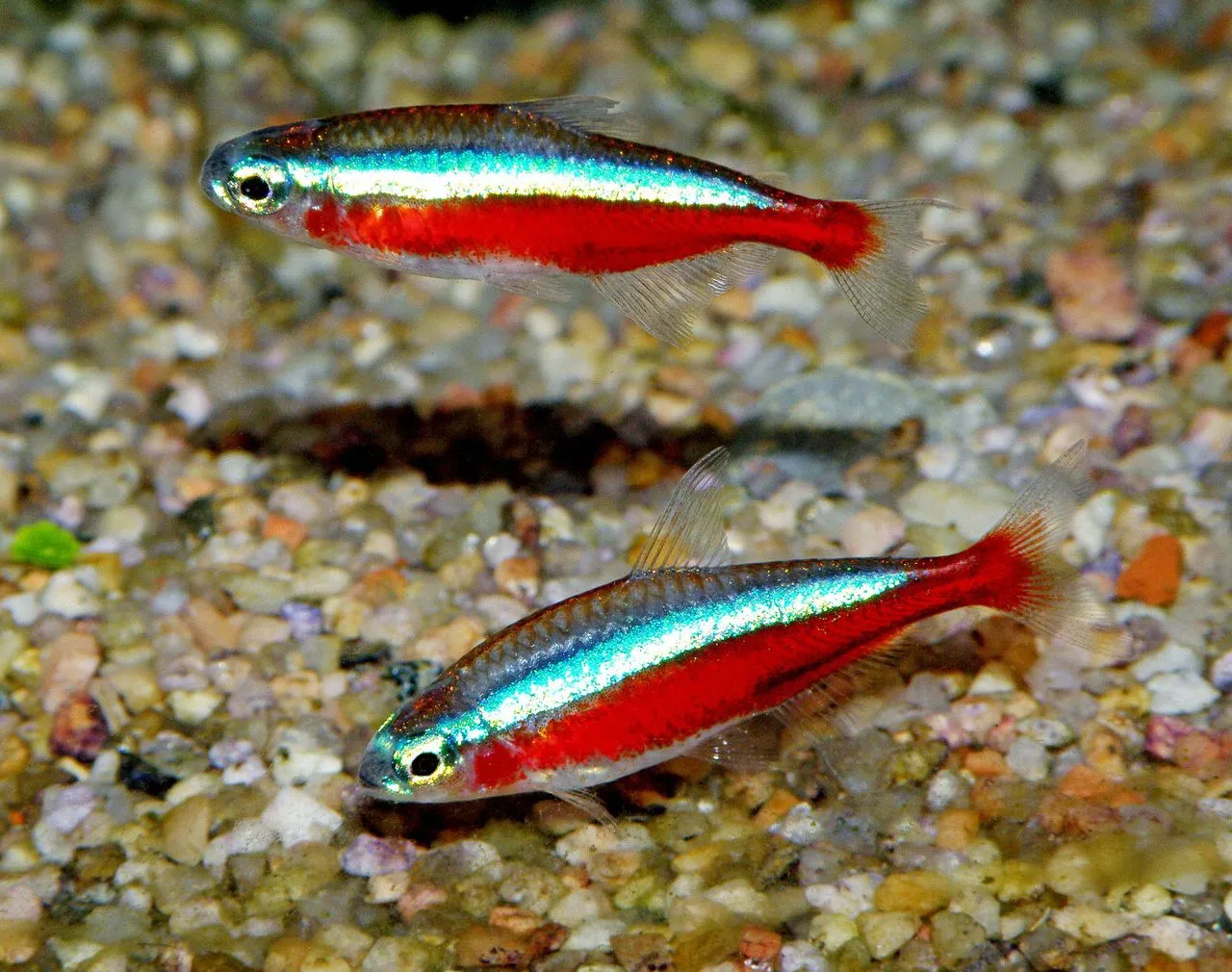
Answer: Fin nipping in tetras comes down to two things: species and shoal size. Serpae, black-skirt, and bleeding-heart tetras are confirmed fin-nippers. Any of these kept in groups below eight will redirect aggression from their own shoal onto slower tankmates. Fix both problems together — increase the shoal to ten or more and remove long-finned species from the tank.
Fin nipping in tetras is not random — it is predictable, and the two root causes operate independently of each other. Some tetra species are documented fin-nippers regardless of conditions; any of them kept in too small a shoal will redirect that aggression onto slower, longer-finned tankmates. Unless both causes are addressed, the behaviour does not stop.
Part of the Complete Tetras Guide.
Main Causes
| Cause | Mechanism | Species most at risk |
|---|---|---|
| Species selection | Hyphessobrycon eques, Gymnocorymbus ternetzi, Hyphessobrycon erythrostigma are confirmed nippers; this is species-level behaviour, not a correctable individual habit | Serpae, black skirt, bleeding heart |
| Shoal below threshold | Fewer than 8–10 individuals; the group cannot absorb its own social pressure, so display energy redirects toward anything slower in the tank | All tetra species |
| Incompatible tankmates | Long, slow fins act as a persistent nipping trigger even in otherwise stable groups | Black skirt and serpae in particular |
| Overcrowding | High fish density with limited swimming lanes increases interception frequency | All species |
| Hunger | Underfed fish compete more aggressively between meals and during feeding | All species |
| Wrong shoal composition | One or two individuals of several tetra species instead of a single proper shoal; each fish is effectively kept singly | All species |
| Breeding behaviour | Males of some species nip females during courtship displays; usually brief and contained within the shoal | Serpae, bleeding heart |
Three species demand the most attention. The serpae tetra (Hyphessobrycon eques) is the most reliably documented nipper — a small group will reach angelfish, bettas, and long-finned plecos within hours of introduction. The black-skirt tetra (Gymnocorymbus ternetzi) is close behind: four fish in a modest tank will damage slow-moving tankmates systematically and persistently. The bleeding-heart tetra (Hyphessobrycon erythrostigma) is less aggressive but still a genuine risk in groups below eight, particularly toward slow fish with flowing fins.
Diamond tetras (Moenkhausia pittieri) and Buenos Aires tetras (Hyphessobrycon anisitsi) appear in the fin-nipper category occasionally but are less consistent. Neon, cardinal, ember, and rummynose tetras are rarely problematic when kept in adequate numbers with compatible tankmates.
Longfin line-bred variants — longfin black skirts and white skirts — introduce a different problem: they swim more slowly than wild-type fish and often become targets of nipping rather than aggressors, including from wild-type members of their own species.
How to Identify the Problem
The first question is whether the nipping is happening within the tetra shoal or directed at other species. The two patterns look different and call for different responses.
Nipping within a tetra shoal is largely normal social maintenance. Fish chase briefly, display with spread fins, and move on. No single individual is singled out persistently, fins recover between episodes, and the group swims together without obvious distress. This does not need intervention unless one fish is being isolated and refused access to food.
Nipping directed at other species follows a different pattern. One target — almost always the slowest, most elaborately finned fish in the tank — loses progressive fin tissue over days. The victim begins hiding, refuses food, and shows fraying along the trailing edges of the caudal, dorsal, or anal fin. Because a stressed, hiding fish is slower, the damage compounds: the nippers find it easier to reach over time, not harder.
Watch the tank for ten minutes immediately after lights-on and again at feeding time. These are the two windows when tetra aggression is highest. Individual culprits are visible at these moments — watch for a fish that repeatedly accelerates toward the same target rather than competing for food in the general activity.
Risk and Severity
Persistent fin nipping carries consequences well beyond cosmetics. A fish spending weeks evading nippers is in chronic stress — immune function declines, appetite falls, and body condition deteriorates even before the fin damage becomes visually striking.
Exposed fin tissue is the direct entry point for bacterial infection. Fin rot — progressive bacterial erosion of fin rays — follows directly from unresolved nipping in a community tank. In a clean, well-maintained aquarium, early fin rot responds to improved water quality and separation from the aggressor. In compromised conditions, it advances from the fin edges toward the body and becomes systemic.
The victim also competes poorly at feeding time. A fish under consistent social pressure eats less, loses condition faster, and becomes more vulnerable to opportunistic disease. Monitor body condition alongside fin integrity — a fish growing noticeably thinner week on week is signalling a management problem even if the fin damage looks mild.
Severity scales with time. A fish nipped for a week in otherwise good water recovers quickly once conditions change. One nipped for two months has compromised fins, depleted immune reserves, and potentially entrenched secondary infections. Act on the first signs, not the obvious ones.
Solutions and Actions
- Separate the target fish immediately. Move any visibly damaged fish to a quarantine tank while you address the root cause in the main display. Continued exposure in the community tank compounds the injury and gives infection more time to establish. See the quarantine tank protocol if you do not already have a suitable setup.
- Increase the shoal to ten or more. Adding fish to the existing nipping species distributes aggression within the group — the social hierarchy reorganises within days and the pressure that was going toward tankmates dissipates into intra-shoal displays. Eight is the lower edge; ten is a more reliable threshold; fifteen is better where space allows.
- Remove long-finned and slow-moving tankmates. Bettas, angelfish, fancy guppies, and goldfish should not share a tank with serpae, black-skirt, or bleeding-heart tetras under any circumstances. No stocking configuration makes this consistently safe: the trigger is the tankmate's fins and movement speed, not the mood of the tetras on a given day.
- Replace nipping species with peaceful alternatives. Neon tetras, ember tetras, and cardinal tetras give the schooling effect in a community tank without the compatibility risk. These species keep their aggression within the shoal at appropriate group sizes and do not target long-finned tankmates.
- Feed in two or three small portions per day. Hunger amplifies tetra aggression during and between meals. Smaller, more frequent feeds reduce competition at the water surface without increasing organic load or water quality problems.
Do not expect removing the "worst" individual to solve the problem. Taking one fish from a group of four leaves three fish still below the viable shoal threshold, and aggression redistributes to the remaining fish almost immediately.
Prevention
The cleanest prevention is choosing the right tetra species at the point of purchase. Before buying any tetra, assess whether the planned community includes long-finned fish. If it does — angelfish, bettas, guppies, goldfish — rule out serpae, black skirt, and bleeding heart immediately and regardless of what a retail shop says about a particular batch of fish.
Shoal size at purchase matters as much as species choice. Buying six with the intention of adding more later rarely produces a stable tank — undersized groups establish nipping habits quickly, and introducing new fish to a tank with an existing aggression dynamic does not reliably reset it. Start with ten. If the tank cannot accommodate ten individuals of a given species with adequate space, that species does not belong in that tank.
Mixed-species tetra tanks fail consistently when no individual species has a proper shoal. A tank with two serpae, three black skirts, and five neons contains no viable social unit of any species. Each group is too small to stabilise internally, and the result is chronic low-level aggression across all three. Run one species in adequate numbers or run two species as separate, properly sized shoals — never a token handful of several.
Verify line-bred variants before purchasing. Longfin black skirts and white skirts are slower than standard fish and should be kept only in species-specific setups or with other slow-swimming fish that cannot pursue them.
Common Mistakes
- Assuming a larger tank solves the problem. More space reduces overcrowding pressure but does not alter species temperament or compensate for a shoal that is below the viable social threshold.
- Keeping three or four as a "trial." The species documented in this guide nip in small groups — that is the problem you are observing. Three fish is not a trial configuration; it is the cause.
- Removing only the most visible aggressor. A group of four minus one is still a group of three. The social pressure driving nipping is still there; it redistributes to other fish within days.
- Treating fin damage before removing the cause. Antibacterials and antifungals slow infection but do not stop the nipping. Returning a treated fish to the same tank without changing the stocking restarts the cycle from the beginning.
- Mixing longfin tetras into a standard community. Longfin black skirts attract nipping from wild-type members of their own species, from other tetras kept in small groups, and from barbs. They need a separate, compatible setup.
See Also
Frequently Asked Questions
Which tetras are the worst fin nippers?
Serpae tetra (Hyphessobrycon eques), black-skirt tetra (Gymnocorymbus ternetzi), and bleeding-heart tetra (Hyphessobrycon erythrostigma) are the three most consistently reported nippers in the hobby. Diamond tetra and Buenos Aires tetra occasionally join that list. Neon, cardinal, ember, and rummynose tetras are rarely problematic when kept in adequate numbers.
Will adding more tetras stop the nipping?
Often yes, if shoal size was the trigger. A group of ten or more serpae or black-skirt tetras distributes aggression within the school rather than directing it at tankmates. Shoal size alone will not solve the problem if long-finned, slow-moving fish still share the tank — remove those regardless of how large the tetra group becomes.
Can tetras nip fins in the dark?
Yes. Nipping happens at any time, including overnight and around feeding. A fish with progressive fin damage despite a large shoal is likely being targeted during feeding competition or by a specific individual. Feed in multiple spots and observe the tank shortly after lights-on and at feeding time to identify the source.
Will damaged fins grow back?
Clean fin tissue regenerates well in clean water, but only once the nipping stops. Fins that are continually attacked do not heal — the fish must be separated from the aggressor first. Chronic nipping creates open wounds that invite bacterial infection; see the fin rot diagnosis guide if the edges show white, red, or cottony growth.
Sources & References
- Géry, J. (1977). Characoids of the World. T.F.H. Publications.
- Axelrod, H.R., Burgess, W.E., Pronek, N. & Walls, J.G. (1995). Atlas of Freshwater Aquarium Fishes. T.F.H. Publications.
- FishBase — Characiform species treatments. https://www.fishbase.se/
- Baensch, H.A. & Riehl, R. (1991). Aquarium Atlas, Vol. 1. Mergus Verlag.