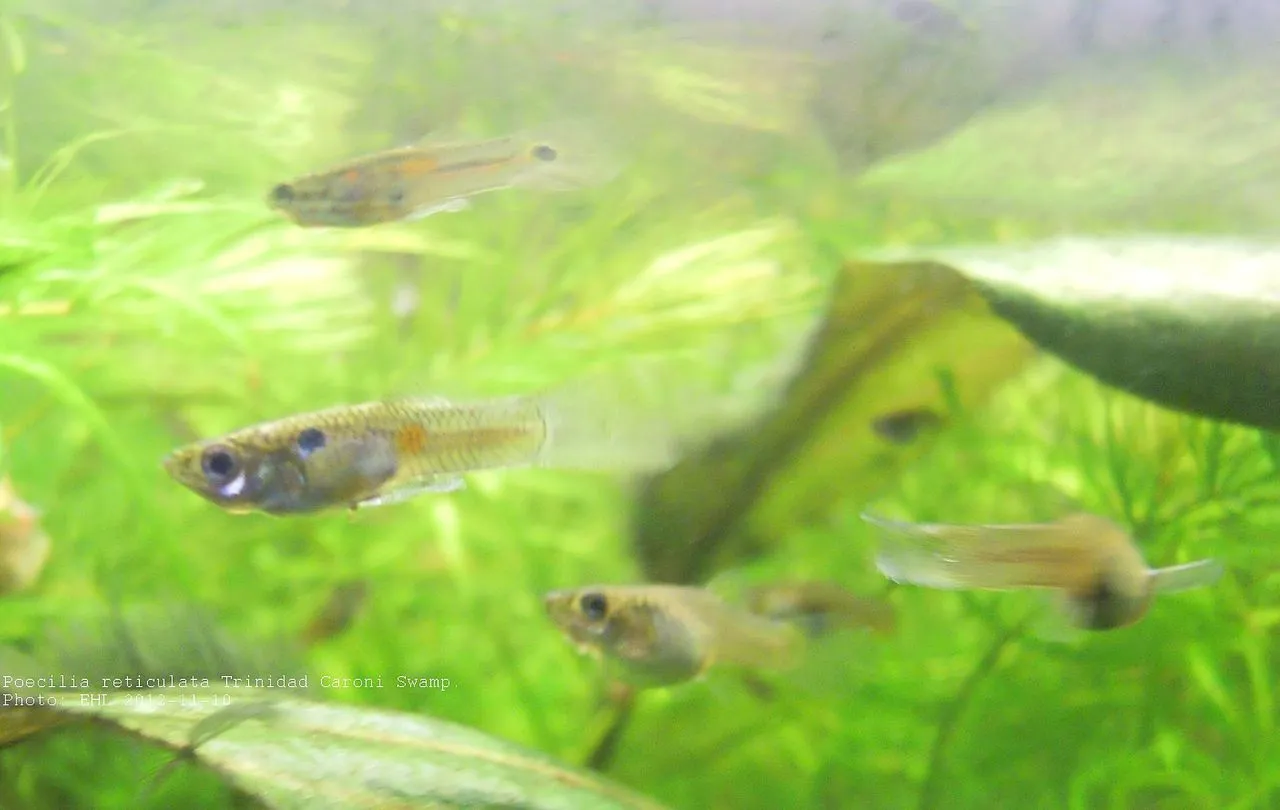
Answer:
Livebearers are internally fertilising fishes including guppies, platies, swordtails, mollies, Limia, mosquitofish, halfbeaks, and four-eyed fish. Most familiar poeciliids need hard alkaline water (GH 12–25 °dH, pH 7.4–8.4), not soft community conditions. Their defining issues are sperm storage, rapid reproduction, male harassment, hybridisation, and commercial-line disease.
Poeciliidae is the livebearer family most aquarists meet first, often through Poecilia reticulata (the guppy) or a tank of orange platies. Familiarity has not made the group simple. The same family contains small matrotrophic species that release one fry at a time, hard-water coastal mollies that tolerate full marine water, and predatory fish that swallow adult tankmates whole.
I am Dr. Helena Marlow, an ichthyologist and long-term planted-tank aquarist. Livebearers were the fish of my childhood tanks, but the adult lesson has been chemical rather than sentimental: the common forms fail most often because they are kept like soft-water community fish. A livebearer aquarium should be planned around minerals, sex ratios, and reproduction before colour is considered.
Taxonomy
The aquarium word "livebearer" is practical rather than taxonomic. It includes poeciliids such as guppies, mollies, platies, swordtails, mosquitofish, pike livebearers, and Limia; halfbeaks in Hemiramphidae; and four-eyed fishes in Anablepidae. The category is united by internal fertilisation and live birth, not by one recent common aquarium ancestor.
Poeciliidae is the centre of the hobby group. The principal genera here are Poecilia, Xiphophorus, Gambusia, Heterandria, Limia, and Belonesox. Poecilia includes guppies, Endlers, and mollies; Xiphophorus includes platies and swordtails. FishBase and the Catalog of Fishes are the safest current references because aquarium names lag behind systematics and because hybrid farm stock routinely enters shops under species names it does not deserve.
The halfbeak wrestling halfbeak, Dermogenys pusilla, is not a poeciliid. Its surface-dwelling body plan, beak-like lower jaw, and brackish-leaning husbandry place it in a different family. The four-eyed fish, Anableps anableps, is also outside Poeciliidae, but its internal fertilisation, live birth, and specialist surface ecology make it relevant to aquarists studying livebearing strategies.
Identification
Male poeciliids have a gonopodium: a modified anal fin formed principally from rays 3, 4, and 5. It is not merely a pointed fin. It is a sperm-transfer structure with hooks, grooves, and species-specific shape. Females retain the fan-shaped anal fin and are generally deeper-bodied, particularly when gravid. In mature guppies, Endlers, platies, mollies, and swordtails, sexing is usually immediate once the anal fin is inspected.
The gonopodium explains several husbandry facts that shops often present as surprises. Females can store sperm in the ovary and produce broods long after separation from males. Males may harass females persistently, so a single pair is rarely kind. A tank with one male and three or more females usually distributes attention better, although the best ratio depends on species, cover, and the male line's behaviour.
| Feature | Poeciliid livebearers | Halfbeaks | Four-eyed fish |
|---|---|---|---|
| Fertilisation | Internal; male gonopodium | Internal; modified anal fin in males | Internal; sided genital structures |
| Swimming level | Midwater to surface, species-dependent | Surface | Surface, eyes at air-water interface |
| Typical aquarium chemistry | GH 12–25 °dH, pH 7.4–8.4 | GH 10–20 °dH, often light brackish | Brackish, marine-tolerant |
| Reproductive pattern | Broods after 3–6 weeks; sperm storage common | Live young, fewer larger fry | Live young; specialised mating alignment |
Reproductive Biology
Most familiar poeciliids are lecithotrophic. The egg is provisioned with yolk before fertilisation, and the embryo develops mainly on that yolk while retained inside the female. Guppies, Endlers, swordtails, platies, and many mollies fit this general pattern. Gestation is commonly 24–35 days at 24–27 °C, with warmer water shortening the interval while also increasing metabolic demand.
Heterandria formosa, the least killifish, is different. It is matrotrophic: the mother supplies nutrients to developing embryos during gestation through a placenta-like follicular system. Instead of one dramatic brood drop, females release one or two well-formed fry over many days. This pattern makes the species unusually suitable for densely planted nano aquaria when predatory tankmates are absent.
Superfetation complicates the tidy calendar. Females in Poecilia, Heterandria, and Limia can carry embryos at different developmental stages from sequential matings. A guppy female that looks only modestly gravid may already contain early embryos for a later brood. This is one reason culling, separation, and line breeding require more time than novice breeders expect.
Water Chemistry & Habitat
The common aquarium mistake is to keep livebearers as generic community fish at GH 3–6 °dH and pH 6.8. Many survive long enough to be sold, breed once, and then decline. The evolutionary centre of the group lies in mineral-rich Central American, Caribbean, and coastal waters where limestone, tidal influence, and seasonal evaporation create hard alkaline conditions.
A practical livebearer baseline is GH 12–20 °dH, KH 6–12 °dH, pH 7.4–8.2, conductivity 350–900 µS/cm, temperature 23–27 °C, ammonia and nitrite 0 mg/L, nitrate preferably below 20 mg/L. Mollies often need the upper end of that range; a sailfin molly kept at GH 4 °dH is being asked to compensate continuously — molly shimmy documents what that osmoregulatory failure looks like in practice. The care article on water hardness and KH is essential if the tap supply is soft.
Plants still belong in these tanks. Vallisneria spiralis suits alkaline water and gives fry vertical refuge. Anubias nana tolerates most hard-water layouts when the rhizome is not buried. Floating plants help fry but must not trap surface-feeding halfbeaks or four-eyed fish.
Aquarium Husbandry
Cycle the aquarium before purchase. Livebearers are often hardy after acclimation, but they are not resistant to ammonia, nitrite, or export-chain disease. The cycling guide and quarantine protocol matter especially for mass-farmed guppies and mollies. Four weeks in a bare observation tank with matched hardness prevents chronic pathogens from entering the display.
Stock by adult size and reproduction. Guppies and Endlers work in 60–90 litres if breeding is controlled. Platies and variatus platies are better in 90 litres or more. Swordtails need length, not just volume; 120 cm frontage is reasonable for adult males. Mollies require oxygen, minerals, vegetable-rich feeding, and more space than their shop size suggests. Pike livebearers and four-eyed fish are specialist projects, not community additions.
Tankmates should share chemistry and temperament. Convict cichlids illustrate the same Central American mineral context but are too territorial for most mixed livebearer tanks. X-ray tetras tolerate more mineral and occasional brackish influence than many tetras. Sterbai corydoras can handle warmer harder water better than many corys, but bronze corydoras and bristlenose plecos still need oxygen, clean substrate, and moderate nitrate. Avoid combining livebearers with Siamese fighting fish; fin shape, activity, and chemistry make that pairing poor.
Disease and Trade Problems
Commercial guppy lines carry a particular warning: chronic fish tuberculosis caused by Mycobacterium marinum, M. fortuitum, and related non-tuberculous mycobacteria is widespread. Signs include wasting despite feeding, spinal curvature, lethargy, fin erosion, and slow loss over weeks — the full pattern of persistent guppy mortality and line collapse is covered in a dedicated article. It is zoonotic. Any aquarist with cuts, eczema, or immune compromise should use gloves and avoid reaching into suspect tanks. Euthanasia, disinfection of equipment, and strict quarantine are more honest than repeated medication attempts.
Fin damage is common in high-male tanks and in long-finned fancy guppies. The fin rot diagnosis article is useful because torn fins from harassment, bacterial fin rot, and columnaris-like lesions require different responses. In livebearers, the first treatment is often social: reduce male pressure, improve water, and remove nippers.
Hybridisation is the other central trade problem. Xiphophorus hellerii and X. maculatus hybrids are fertile and have contributed heavily to commercial swordtail and platy colour lines. Guppy-Endler hybrids dominate many "fancy Endler" imports. A fish can be beautiful and useful while not being pure Poecilia wingei. Breeders should label stock accurately rather than attach conservation language to uncertain ancestry.
Planning a Livebearer System
A livebearer aquarium begins with a water report, not a shopping list. If tap water already leaves the tap at GH 12–18 °dH, KH 6–10 °dH, and pH above 7.4, the keeper has an advantage: stability can be maintained with ordinary water changes rather than constant adjustment. If tap water is GH 2–5 °dH, the choice is either to remineralise deliberately or to keep a different fish group. Adding a little crushed coral to a filter and hoping for the best is not a measurement plan. Test GH, KH, pH, nitrate, and conductivity; record the values after a water change and again one week later.
Substrate and décor should support chemistry without turning maintenance into guesswork. Aragonite sand, limestone, coral rubble, and shell grit raise hardness and alkalinity, but the effect depends on flow, water-change volume, and the starting KH. In tanks for mollies, Limia, and many Xiphophorus, a modest calcareous component is useful. In a guppy display where the tap water is already hard, inert sand and plants may be enough. The practical target is repeatability: if a 40% water change moves GH from 18 to 12 °dH and the tank climbs back to 18 °dH by the next weekend, the fish are experiencing a weekly mineral swing.
Sex ratios deserve the same planning. Male livebearers are not malicious, but their reproductive strategy is persistent pursuit. A tank containing one male guppy and one female is a harassment machine. A tank containing five male guppies and no females may be calmer than a mixed group if there is space and line-of-sight cover. Females are not passive containers for fry; chronic male pressure causes hiding, thinness, damaged fins, and premature death. Plant thickets, floating cover, and visual barriers are welfare tools.
Fry management is an ethical issue. A successful mixed livebearer tank produces more fish than most aquarists can house. Predation by adults removes some fry but should not be the only plan. Before buying mixed-sex platies, mollies, or swordtails, decide whether surplus juveniles will be separated, sold, given to a known keeper, or prevented by single-sex stocking. Shops may not accept mixed, hybrid, or weak juveniles, and releasing aquarium livebearers outdoors is ecologically irresponsible and often illegal.
Food should match the digestive bias of the group. Mollies and many Limia spend much of the day scraping algae and biofilm; constant rich bloodworm feeding produces fat fish with poor gut health. Guppies and platies are more generalist but still benefit from vegetable matter. Pike livebearers are the exception: they are predators and cannot be made into community grazers. A useful weekly pattern for common species is a staple prepared food, two vegetable-heavy feeds, two small live or frozen invertebrate feeds, and a light fasting day for adults.
The best display tanks for livebearers look calmer than dealer tanks. They have fewer males, more plants, stable minerals, no frantic fin-nippers, and enough filtration that nitrate remains below 20 mg/L without heroic water changes. They also contain fewer varieties. A tank with one good platy line, one compatible bottom fish, and healthy Vallisneria is more durable than a crowded mixture of guppies, mollies, swordtails, halfbeaks, and soft-water tetras. Restraint is not aesthetic timidity; with livebearers, it is disease prevention.
Compatibility by Chemistry, Not Reputation
The phrase "community fish" is a poor guide to livebearer compatibility. A guppy, a neon tetra, a bronze corydoras, and a dwarf gourami may all be peaceful, but they do not ask the same thing from water. The livebearer wants mineral content and alkaline buffering; the soft-water fish often wants lower conductivity and reduced carbonate hardness. Long-term compromise usually favours the hardier species in the short term and injures the more specialised one later. A mixed community should be built from overlapping parameter ranges, not from a shop label.
Temperature creates a second filter. Variatus platies and mosquitofish tolerate cooler rooms better than mollies. Sailfin mollies and many common mollies prefer warm, oxygen-rich water. Swordtails tolerate tropical temperatures but need current and length. The least killifish does well in small quiet tanks that would be too cramped for swordtails and too still for mollies. The result is that a livebearer category contains several aquarium styles rather than one standard recipe.
Social speed is the third filter. Male guppies and Endlers investigate constantly; swordtails cruise fast; mollies graze and display; halfbeaks occupy the surface and startle into lids; four-eyed fish require the air-water boundary as habitat. Bottom dwellers must not be chosen merely to "clean up". Sterbai corydoras can work in warmer, moderately hard water, while many corydoras are less suitable. Bristlenose plecos tolerate a broad range but add waste and need wood, vegetable food, and oxygen. There is no substitute for matching the full set of requirements.
For that reason, the most successful livebearer tanks are often geographically plain. A Central American layout with platies, swordtails, limestone, Vallisneria, and a moderate-current filter teaches more than a mixed display assembled from unrelated shop favourites. A molly tank with mineral-rich water, algae, open surface movement, and no delicate tankmates is not less sophisticated than a soft-water aquascape. It is simply designed around the fish actually being kept.
A useful planning test is to write the proposed stocking list with adult size, GH, KH, pH, temperature, diet, and breeding behaviour beside each species. If any row requires an apology, remove that species. Livebearers are generous fish when their basic chemistry and social rules are respected; they are not a licence to ignore biogeography.
Notable Species
- Guppy (Poecilia reticulata) — prolific, colourful, and frequently burdened by mass-farm disease.
- Endler's livebearer (Poecilia wingei) — small Venezuelan livebearer at the centre of the pure-versus-hybrid trade debate.
- Platy (Xiphophorus maculatus) — compact Central American livebearer with many colour lines.
- Variatus platy (Xiphophorus variatus) — cooler-tolerant relative often hybridised with common platies.
- Swordtail (Xiphophorus hellerii) — active, larger livebearer whose males carry the caudal sword.
- Sailfin molly (Poecilia latipinna) — high-dorsal coastal molly requiring space and mineral-rich water.
- Common molly and its black, dalmatian, and balloon forms — hardy only when water and welfare constraints are respected.
- Mosquitofish (Gambusia affinis / G. holbrooki) — aggressive, invasive livebearers better studied than casually kept.
- Limia (Limia spp.) — Caribbean alternatives that reward hard-water specialists.
- Wrestling halfbeak, pike livebearer, and four-eyed fish — specialist livebearers for keepers prepared to design around surface feeding, predation, or brackish water.
Common Confusions
| Confusion | Reliable separator | Husbandry consequence |
|---|---|---|
| Guppy vs Endler | Endlers are smaller, wilder patterned, and provenance-sensitive; many imports are hybrids | Do not sell hybrids as pure P. wingei |
| Platy vs variatus platy | Variatus is usually more elongate and cooler-tolerant; trade fish are often mixed | Temperature and line labels may be unreliable |
| Common molly vs sailfin molly | Sailfin males have a tall flag-like dorsal and larger adult size | Sailfins need more space and stronger mineral support |
| Black molly vs healthy molly | Melanism hides bruising, parasites, and early lesions | Inspect behaviour, fins, and body profile rather than colour alone |
| Halfbeak vs poeciliid | Halfbeaks have beak-like lower jaw and surface-only feeding | They need calm surface space and careful lids |
See Also
- Water Hardness: GH and KH Explained — the chemistry behind hard-water livebearer care.
- Cycling a New Aquarium — preventing ammonia and nitrite damage before stocking.
- Quarantine Tank Protocol — essential for commercial guppy and molly lines.
- X-ray tetra — a tetra with unusual tolerance for mineral-rich and lightly brackish water.
- Convict cichlid — Central American hard-water context, not a peaceful livebearer companion.
- Vallisneria spiralis — a hard-water-tolerant plant that shelters fry.
Frequently Asked Questions
Are livebearers easy community fish?
They are easy only when the water is hard, alkaline, and clean. Most guppies, mollies, platies, swordtails, Limia, and mosquitofish do best at GH 12–25 °dH, KH 6–15 °dH, pH 7.4–8.4, and nitrate below 20 mg/L.
Do female livebearers need a male to keep producing fry?
Not immediately. Female poeciliids store sperm in the ovary and can produce broods for weeks or months after the last mating. This is why a single purchased female guppy, platy, molly, or swordtail may drop fry in quarantine.
What is the difference between lecithotrophic and matrotrophic livebearing?
In lecithotrophy the egg yolk is loaded before fertilisation and the embryo mainly consumes that yolk. In matrotrophy the mother supplies additional nutrients during gestation. Heterandria formosa is the aquarium example: it produces one or two fry per day over an extended period.
Can livebearers live in soft water?
Most common livebearers should not be treated as soft-water fish. Guppies and platies may survive moderate water, but mollies and many Central American species deteriorate in low GH/KH. Use the GH/KH article before trying to adjust tap water.
Sources & References
- Meffe, G.K. & Snelson, F.F. (1989). Ecology and Evolution of Livebearing Fishes (Poeciliidae). Prentice Hall.
- Reznick, D.N. & Travis, J. (2019). The Evolution of Life Histories in Poeciliid Fishes. University of Chicago Press.
- Houde, A.E. (1997). Sex, Color, and Mate Choice in Guppies. Princeton University Press.
- Greven, H. (2010). Atlas of Goodeids. Aqualog Verlag.
- FishBase — Poeciliidae, Anablepidae, Hemiramphidae species accounts. https://www.fishbase.se/
- Catalog of Fishes — Fricke, Eschmeyer & Van der Laan, California Academy of Sciences.