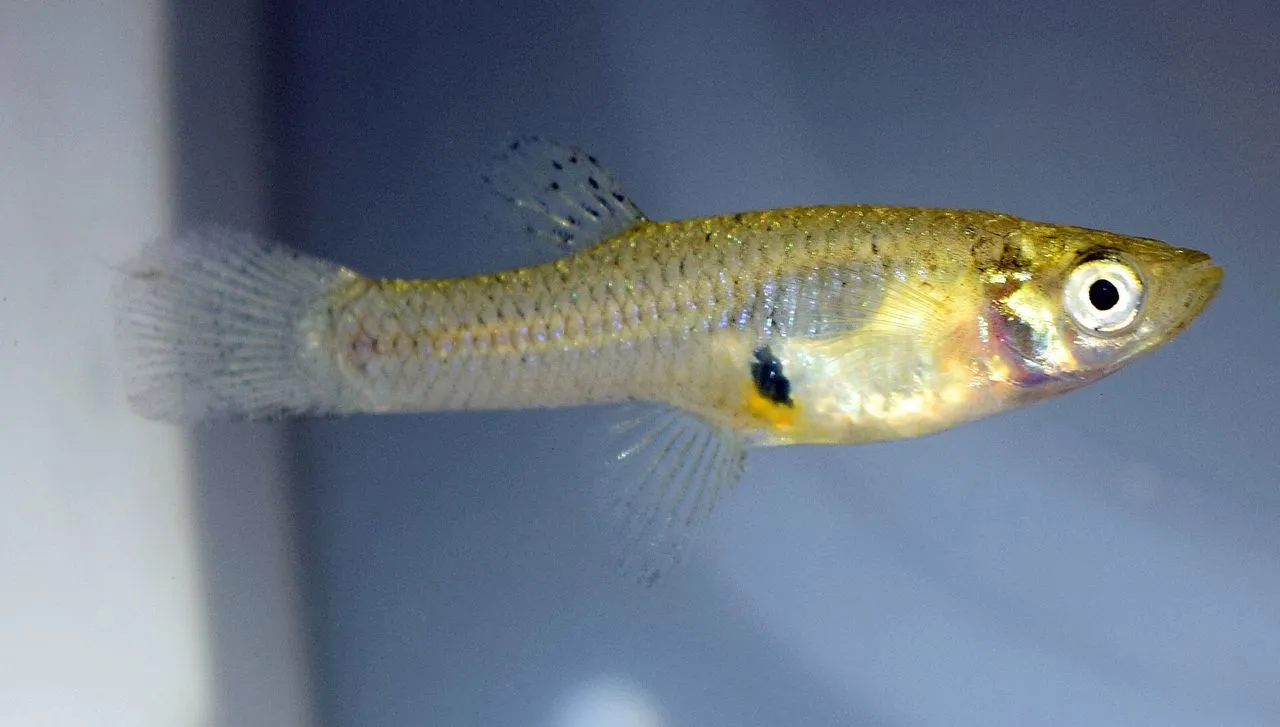
Answer: Mollies shimmy — a lateral rocking motion without forward progress — most often because the water is too soft. Poecilia species need mineral-rich water: GH 12–25 °dH, KH 8–15 °dH, TDS above 400 µS/cm. Correct chemistry first by raising hardness with a marine salt mix to 3–5 ppt; also confirm temperature is above 26 °C and rule out ammonia or nitrite before assuming hardness is the sole cause.
Shimmying in Poecilia spp. is a neuromuscular symptom — a side-to-side rocking without forward motion — distinct from swim bladder disorder, general stress, and infectious disease. The fish holds its position in the water column while the body oscillates; it is upright and responsive but cannot make coordinated forward progress. The symptom occurs across the molly complex (P. sphenops, P. latipinna, P. velifera, and farmed hybrids), occasionally in Gambusia spp. (mosquitofish), and rarely in Poecilia reticulata (guppy). It is overwhelmingly a water chemistry problem, not an infection.
Part of the Complete Livebearers Guide.
Main Causes
| Cause | Mechanism | How to confirm |
|---|---|---|
| Low TDS / soft water | Osmotic imbalance across gill epithelium; fish cannot regulate internal sodium, chloride, and calcium | GH below 10 °dH or TDS below 300 µS/cm; soft regional tap water |
| Low temperature | Neuromuscular slowing; shimmy appears below 24 °C, persistent below 22 °C | Thermometer reads below target range; unheated or under-heated tank |
| Ammonia or nitrite poisoning | Gill epithelium damage impairs osmoregulation | Test kit reads ammonia or nitrite above 0 mg/L |
| Sudden chemistry swing | Large water change with mismatched TDS or KH causes acute osmotic shock | Recent water change using soft, untreated, or RO replacement water |
| Genetic weakness / inbreeding | Fancy strains have reduced physiological reserve; balloon mollies are particularly susceptible | Affects specific individuals in an otherwise well-managed tank |
| Parasitic gill infection | Ichthyobodo, Chilodonella, or similar protozoa irritate gill tissue | Additional signs: scratching on décor, excess mucus, rapid operculum movement |
| Old age | End-of-life deterioration | Fish at or past normal lifespan; no water chemistry cause identified |
Soft water accounts for the great majority of cases in tanks that otherwise appear well-maintained. It is the cause most likely to be missed because many retailers hold mollies in near-freshwater conditions — the fish may look healthy in the shop but arrive already osmotically stressed, then shimmy within days as the deficit becomes apparent.
How to Identify the Problem
Shimmy vs swim bladder disorder
| Sign | Shimmy | Swim bladder disorder |
|---|---|---|
| Body posture | Upright; normal axial alignment | Tilted, rolled, or inverted |
| Position in water | Stationary or slowly drifting; often mid-water or near substrate | Floating at surface or sinking regardless of effort |
| Forward motion | Absent — body rocks in place | Present but erratic and uncontrolled |
| Response to stimulus | Reacts — turns toward food, moves away from threat | Sluggish; does not respond normally |
| Fin posture | Often clamped | Variable |
Shimmy vs general stress
A stressed fish hides, refuses food, and clamps its fins but swims normally when it moves. A shimmying fish cannot make coordinated forward progress — the lateral oscillation replaces directed movement entirely. A stressed fish darts into cover; a shimmying fish rocks in open water. The distinction matters because the interventions are completely different.
Risk and Severity
Acute shimmy triggered by a sudden chemistry swing can resolve within hours once the water is corrected. Chronic shimmy from persistent soft water or low temperature means the osmoregulatory system has been compromised for weeks; recovery then takes several days of correct conditions, and some fish never fully normalise.
Balloon mollies carry extra risk — their compressed body form reduces organ capacity and likely constrains gill surface area, leaving less physiological reserve than normal-bodied fish. A balloon molly shimmying in marginally soft water has a substantially worse prognosis than a common molly under identical conditions.
Shimmy is not infectious and will not spread to other species. It does indicate that water chemistry needs to be corrected before other fish in the same system are also affected — a tank running GH 5 °dH is stressful for all mollies, not only the one currently showing symptoms.
Solutions and Actions
Work through these in order.
Step 1: Test before treating. Measure GH, KH, temperature, ammonia, and nitrite. Adding marine salt to an ammonia-poisoned tank will not resolve the shimmy; adding nothing to a soft-water tank will not either. Confirm the cause first.
Step 2: Rule out ammonia and nitrite. If either reads above 0 mg/L, perform an immediate 25–30% water change with temperature-matched, dechlorinated replacement water. Follow the guidance in water changes: frequency and volume for the correct protocol. Resolve the nitrogen cycle cause before adjusting salinity — otherwise you are layering two stressors simultaneously.
Step 3: Raise hardness and TDS with a marine salt mix. If GH is below 12 °dH or TDS is below 400 µS/cm, the water is too soft for mollies. Use a marine salt mix, not plain sodium chloride. Poecilia spp. are euryhaline fish from coastal and estuarine habitats where water contains calcium, magnesium, sulphate, and carbonate alongside sodium and chloride. Plain NaCl raises conductivity on paper while leaving the calcium, magnesium, and carbonate deficit intact — the minerals that actually drive osmoregulation and skeletal maintenance. A marine salt mix dissolved to 3–5 ppt raises GH, KH, and TDS simultaneously. Read water hardness: GH and KH explained for what these parameters mean in practice. Raise salinity gradually — no more than 1–2 ppt per 24 hours — to avoid the osmotic shock of overcorrecting too quickly.
Step 4: Raise the temperature. Set the heater to 26–28 °C and confirm with a separate thermometer. Temperature-related shimmy often resolves within 12–24 hours once the target range is reached and stable.
Step 5: Isolate if the tank is a community setup. A shimmying molly cannot compete for food and may attract fin-nipping from tankmates. Move it to a warm, hard-water hospital tank while the main tank chemistry is being corrected.
Prevention
Shimmying is almost entirely preventable through correct species selection and chemistry verification before stocking.
Test tap water hardness before buying mollies. Many UK municipal supplies run GH below 8 °dH — well below what Poecilia tolerates long-term. If your tap water is soft, you must either harden all replacement water permanently with a marine salt mix or choose different fish. Endler's livebearer (Poecilia wingei) tolerates a wider hardness range; platies (Xiphophorus maculatus) are somewhat more tolerant of moderate softness; guppies bred over many farm generations in near-freshwater may cope where mollies will not.
Do not add mollies to an existing soft-water community tank. Tetras, discus, and South American biotope fish assembled around GH 2–6 °dH and pH 6.5–7.0 are incompatible with molly chemistry. Raising hardness to molly requirements will stress soft-water species; leaving it soft will steadily compromise the mollies.
Match water change chemistry to the tank. Replacing 30% of a salted, hard molly tank with unsalted soft tap water dilutes TDS and can trigger shimmy within days. Pre-mix replacement water in a separate container, confirm GH and TDS before adding it, and raise marine salt concentration in the bucket to match the display tank before introducing it.
Avoid buying from shop tanks showing any shimmy. Farm mollies are frequently held in near-freshwater conditions, and fish that arrive already osmotically stressed shimmy before your water chemistry is even wrong — they simply cannot recover quickly enough from the prior deficit.
Common Mistakes
- Using plain "aquarium salt" (NaCl) instead of a marine salt mix. Sodium chloride alone does not restore calcium, magnesium, or carbonate. It raises conductivity while leaving the mineral deficit intact — the fish continues to shimmy.
- Performing a large, rapid water change to "fix" shimmy. A sudden shift from salted hard water to unsalted soft water makes the osmotic problem acutely worse. Gradual chemistry correction over 24–48 hours is essential.
- Diagnosing shimmy as swim bladder disorder and fasting or feeding peas. The cause is osmotic, not digestive. Fasting a shimmying molly in wrong-chemistry water does nothing useful and delays the correct intervention.
- Adding mollies to a planted soft-water community tank, then treating shimmy with salt. The salt concentration needed for mollies stresses soft-water plants and sensitive co-inhabitants. The fish was the wrong choice for the tank; adding salt creates a secondary problem rather than solving the first.
- Discarding or euthanising the fish within the first few hours of treatment. Osmoregulatory recovery takes time. A fish still rocking 6 hours after raising marine salt has not failed to respond — it needs 24–72 hours of correct conditions before visible improvement begins.
See Also
Frequently Asked Questions
What is molly shimmy?
Shimmy is a neuromuscular symptom in which the fish rocks laterally from side to side without making forward progress. The fish stays in one place while the body oscillates. It is not a disease itself but a response to osmotic stress, most commonly from water that is too soft or too cool.
Can shimmy kill mollies?
Yes, over time. Acute shimmy from a chemistry swing can resolve within hours if corrected quickly. Chronic shimmy from persistent soft water means the fish's osmoregulatory system is failing; without intervention most fish decline over weeks and die. The sooner chemistry is corrected, the better the prognosis.
Is aquarium salt enough to stop molly shimmy?
No. Plain aquarium salt is sodium chloride only. Mollies need calcium, magnesium, and carbonates alongside sodium and chloride to restore osmotic balance. A marine salt mix dissolved to 3–5 ppt is the correct treatment because it raises GH, KH, and TDS simultaneously.
Can other livebearers get shimmy?
Shimmying is most reliably observed in Poecilia species — mollies and occasionally mosquitofish (Gambusia). Guppies (Poecilia reticulata) show it rarely; platies (Xiphophorus maculatus) almost never under normal aquarium conditions. The symptom reflects how much more mineral-dependent mollies are compared to other livebearers.
How long does recovery from shimmy take?
Acute cases with a clear chemistry trigger often stabilise within 12–24 hours of correction. Fish with chronic exposure to soft water may take 3–5 days of correct conditions to stop rocking noticeably, and some individuals — particularly balloon mollies with reduced physiological reserve — may never fully recover.
Sources & References
- Meffe, G.K. & Snelson, F.F. (1989). Ecology and Evolution of Livebearing Fishes (Poeciliidae). Prentice Hall.
- Stoskopf, M.K. (1993). Fish Medicine. W.B. Saunders.
- Baensch, H.A. & Riehl, R. (1991). Aquarium Atlas, Volume 1. Mergus Verlag.
- FishBase — Poecilia sphenops species account. https://www.fishbase.se/