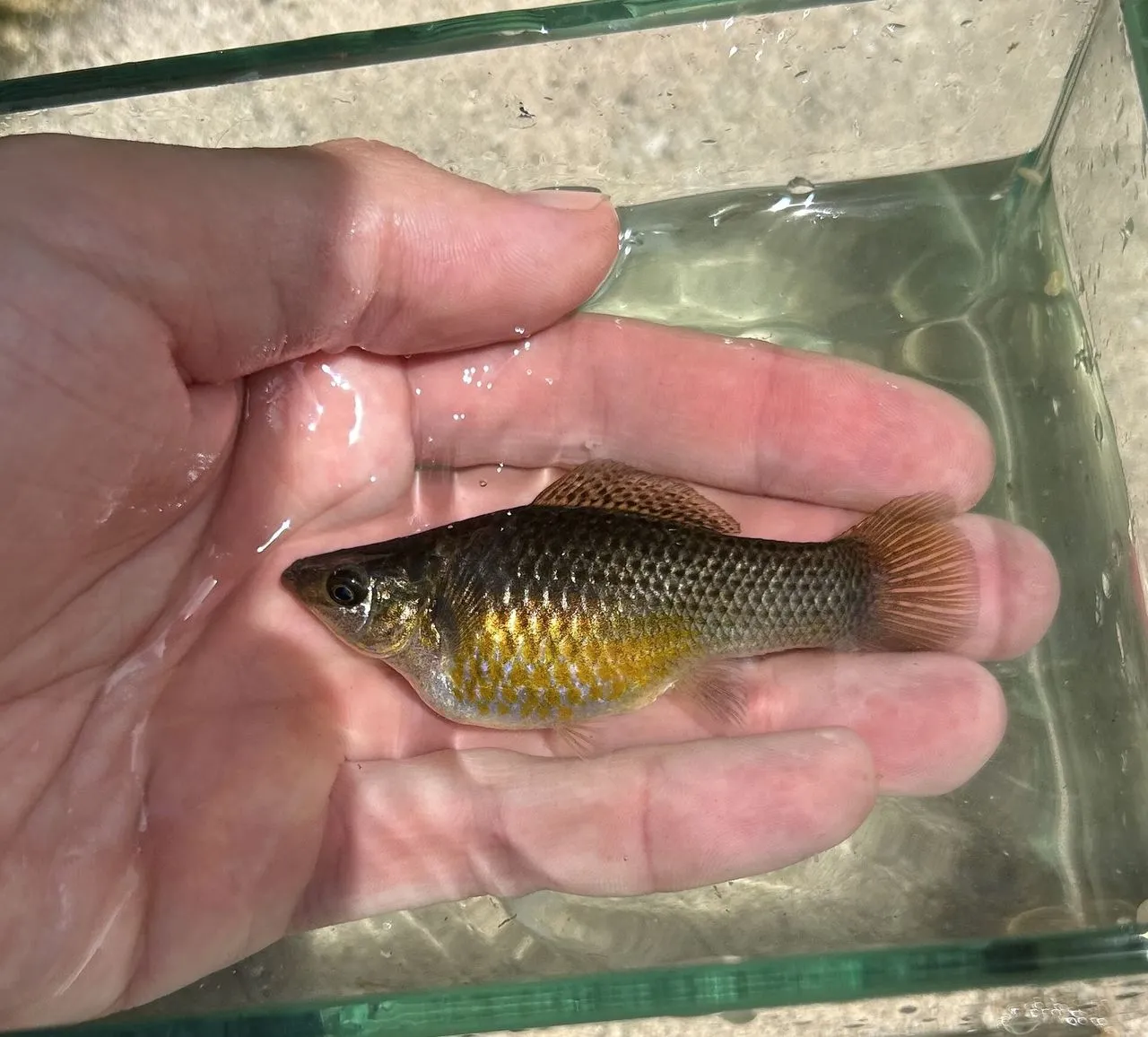
Answer: Most guppy deaths trace to two root causes: heavily inbred farm-line stock carrying chronic disease — primarily mycobacteriosis — and water that is too soft or too cold for the species. Fix the water first: aim for GH 8–12 °dH, KH 4–8 °dH, pH 7.2–8.0, and 23–26 °C. Then source replacement fish from a hobbyist breeder rather than a chain-store retail tank.
The guppy, Poecilia reticulata (Peters, 1859), earned its reputation as a hardy beginner fish from wild-caught and early captive-bred stock — not from the fancy strains that dominate retail aquatics today. Selective pressure for colour, fin length, and pattern novelty across fifty-plus generations of farm breeding has traded genetic resilience for appearance. Chronic mortality in fancy guppy tanks is almost never bad luck. It traces, reliably, to two causes: immunocompromised stock carrying endemic disease, and water that does not meet the species' mineral requirements.
Part of the Complete Livebearers Guide.
Main Causes
These six causes account for the overwhelming majority of persistent guppy losses. They are not mutually exclusive — farm-line fish placed into soft, cold, or uncycled water will fail from several at once.
| Cause | Typical mortality pattern | Key diagnostic |
|---|---|---|
| Farm-line collapse (inbreeding + chronic infection) | Slow drip over weeks to months; new arrivals die within days of purchase | Chain-store source; wasting, curved spine |
| Soft water (GH below 6 °dH) | Gradual decline; fish thin and fail to thrive before dying | GH test below 8 °dH; soft local tap water |
| Cold water (below 22 °C) | Slow deterioration; immune suppression invites secondary infection | Thermometer below 22 °C |
| Ammonia or nitrite toxicity | Rapid loss over 24–72 hours; all species in the tank affected simultaneously | Tank under 6 weeks old; test detects >0 mg/L |
| Overcrowding and chronic stress | Slow background loss; fin damage and aggression visible | Fish count too high for tank volume |
| Mycobacteriosis (Mycobacterium spp.) | Drip losses over months; wasting, curved spine, pop-eye, dropsy | History of farm-line stock; pattern of individual losses over months |
How to Identify the Problem
The pattern of losses tells you more than any individual dead fish.
Single die-offs — one or two fish dying in the first week after purchase — indicate transport stress compounded by pre-existing disease. Chain-store guppies frequently arrive with subclinical infections that become clinical under the additional stress of shipping and a new environment. If the remaining fish stabilise and losses stop, monitor water quality closely and watch for any resumption.
Mass die-offs — multiple fish dying within 24–72 hours — point to ammonia or nitrite poisoning, a temperature crash, or acute oxygen depletion. Test immediately. If the tank is under six weeks old, read Cycling a New Aquarium before adding any further stock.
Slow drip losses — one fish every week or two over a period of months — are the hallmark of either farm-line mycobacteriosis or chronic soft-water stress. Affected fish waste gradually: they become thin, stop competing for food, develop a bent or kinked spine, and die without any single dramatic event. This is the pattern most often reported by keepers who describe having tried everything.
To narrow the cause, test GH and KH before adjusting pH. Many UK tap supplies fall below GH 6 °dH — soft enough to impair the osmoregulation and immune function of a species that evolved in hard Caribbean and South American waters. See Water Hardness: GH and KH Explained for testing and correction methods.
Risk and Severity
Chronic mortality from farm-line stock is severe because there is no treatment. Mycobacterium marinum, M. fortuitum, and M. chelonae — the mycobacteria most consistently documented in ornamental freshwater fish — cannot be reliably cleared with antibiotics. Fish carrying the infection shed bacteria throughout their lives; when an infected individual dies and decomposes in the tank, bacterial load rises sharply. Vertical transmission from infected females to offspring is documented in livebearers (Noga, 2010), meaning a contaminated colony perpetuates infection across generations regardless of water-quality improvements.
Mortality rates of 50–80% within three months of purchase are not unusual for mass-produced fancy guppies; livebearers — and guppies in particular — are among the species most consistently identified with mycobacteriosis in high-density rearing conditions (SRAC Publication No. 4706).
M. marinum is zoonotic. It infects humans through breaks in the skin, producing a condition variously called fish tank granuloma or swimming pool granuloma. It is rarely life-threatening but can require prolonged antibiotic treatment. The practical precaution is simple: use gloves when working in a tank with unexplained or chronic losses, and do not allow tank water contact with open skin, eyes, or mouth.
For distinguishing early mycobacteriosis from bacterial fin infections that can look similar at first presentation, see Bacterial vs Fungal Disease.
Solutions and Actions
Fix the water before changing the fish.
Run a full parameter check — GH, KH, pH, temperature, ammonia, and nitrite — before drawing any conclusions. Guppies require GH 8–12 °dH, KH 4–8 °dH, pH 7.2–8.0, and 23–26 °C. In soft-water areas, crushed coral or aragonite in the filter compartment raises both GH and KH steadily without the chemical instability that comes from pushing pH upward in soft water. Do not raise pH without first raising hardness.
Source from a hobbyist breeder.
The single most effective change available to a keeper with chronic losses is replacing retail stock with fish from a local aquarium society member or specialist livebearer breeder. Hobbyist lines are typically selected for vigour and hardiness rather than show colour, and they are considerably more likely to survive past three months.
So-called feeder guppies — plain varieties raised in bulk without selection for fin or colour — are also noticeably hardier than fancy strains. They retain closer to the genetic breadth of wild P. reticulata and are far less susceptible to line-collapse mortality. They lack spectacle but they live.
If the setup suits a different species, Endler's livebearer (Poecilia wingei) makes a sound alternative. Its wild-type male patterning is vivid, the fish are compact and active, and they have not undergone the same commercial selection that has compromised the genetic integrity of fancy-guppy lines. Water-chemistry requirements are identical: GH 10–20 °dH, pH 7.2–8.0, 23–27 °C.
Quarantine every new arrival.
A minimum of four weeks in a separate tank before any fish enters the display is essential. The Quarantine Tank Protocol explains how to set one up at minimal cost. A 20–30 litre container with a cycled sponge filter is adequate — it does not need to be elaborate.
Remove chronically ill fish promptly.
Fish showing wasting, spinal curvature, or persistent lethargy should be removed from the display. They will not recover from mycobacteriosis and continue shedding bacteria into the tank for as long as they remain. Do not share nets or siphon equipment between a tank with unexplained losses and a healthy one without disinfecting the equipment first.
Prevention
- Source carefully. Fancy chain-store guppies carry a higher disease burden than any other commonly sold livebearer. Local breeders and specialist societies are the practical alternative.
- Match water hardness before stocking. Test GH. If it falls below 8 °dH, address it before the first fish goes in.
- Complete the nitrogen cycle before adding fish. A mature filter is not optional for immune-compromised stock; ammonia and nitrite at any detectable concentration accelerate disease progression in already-weakened fish.
- Hold temperature at 23–26 °C consistently. Sub-22 °C conditions impair the immune response and substantially increase susceptibility to mycobacterial and secondary bacterial infection.
- Do not overstock. A 60-litre tank supports a modest colony of 8–10 fish. The colony will grow; plan for that rather than starting at maximum capacity.
- Quarantine every new fish. Without exception.
The platy (Xiphophorus maculatus) and swordtail (Xiphophorus hellerii) are broadly more robust in the trade than fancy guppies because selection pressure on those species has been less extreme. The same water-chemistry discipline applies across all livebearers; the genetic starting point simply differs.
Common Mistakes
- Replacing dead fish without testing water. Each new batch will die for the same reason as the last unless the underlying parameter problem is corrected first.
- Treating for ich when the cause is mycobacteriosis. Ich treatments — temperature elevation, salt, and copper-based medications — have no effect on mycobacteriosis and delay the correct response: stock removal and a change of source.
- Adding salt as a general cure. Low-dose salt is useful for specific ectoparasites such as Gyrodactylus (skin flukes) and provides minor osmotic support in some situations. It does not treat chronic bacterial wasting disease or correct water hardness deficiency.
- Mixing new chain-store fish into an established colony. A single carrier individual can introduce mycobacteriosis to a previously healthy tank. This is the most common route of new infection in setups where the original stock had been stable.
- Improving water quality and expecting the colony to recover. Clean water is necessary but not sufficient once mycobacteriosis is established in a group of fish. The goal becomes preventing further spread, not healing infected individuals.
See Also
Frequently Asked Questions
Can mycobacteriosis be treated in guppies?
No reliable treatment exists. Antibiotics rarely clear the infection, and the disease cannot be cured once established in a colony. Prevention through quarantine and careful sourcing is the only effective strategy.
Is my tap water suitable for guppies?
Possibly not. Guppies need hard, alkaline water: GH 8–12 °dH, KH 4–8 °dH, pH 7.2–8.0. Soft tap water below GH 6 °dH weakens osmoregulation and shortens lifespan, even in a fully cycled tank with zero ammonia and nitrite.
Are feeder guppies hardier than fancy guppies?
Generally yes. Feeder guppies have not been subjected to the same cycles of selective breeding for fin and colour traits. They retain more genetic diversity and are notably less susceptible to the line-collapse mortality common in show varieties.
Should I add aquarium salt to save dying guppies?
Only if the cause is a specific ectoparasite such as Gyrodactylus. Salt does nothing for mycobacteriosis, ammonia toxicity, or soft-water deficiency. Adding it without identifying the cause delays the real fix and can raise osmotic stress in already-weakened fish.
Sources & References
- Noga, E.J. (2010). Fish Disease: Diagnosis and Treatment. Wiley-Blackwell.
- Southern Regional Aquaculture Center (2013). Mycobacterial Infections of Fish. SRAC Publication No. 4706. Texas A&M AgriLife Extension.
- Sanders, J. (2020). Guppy inbreeding and immune function. CAFISHVET. https://cafishvet.com/fish-health-disease/guppy-inbreeding/
- FishBase species account — Poecilia reticulata. https://www.fishbase.se/