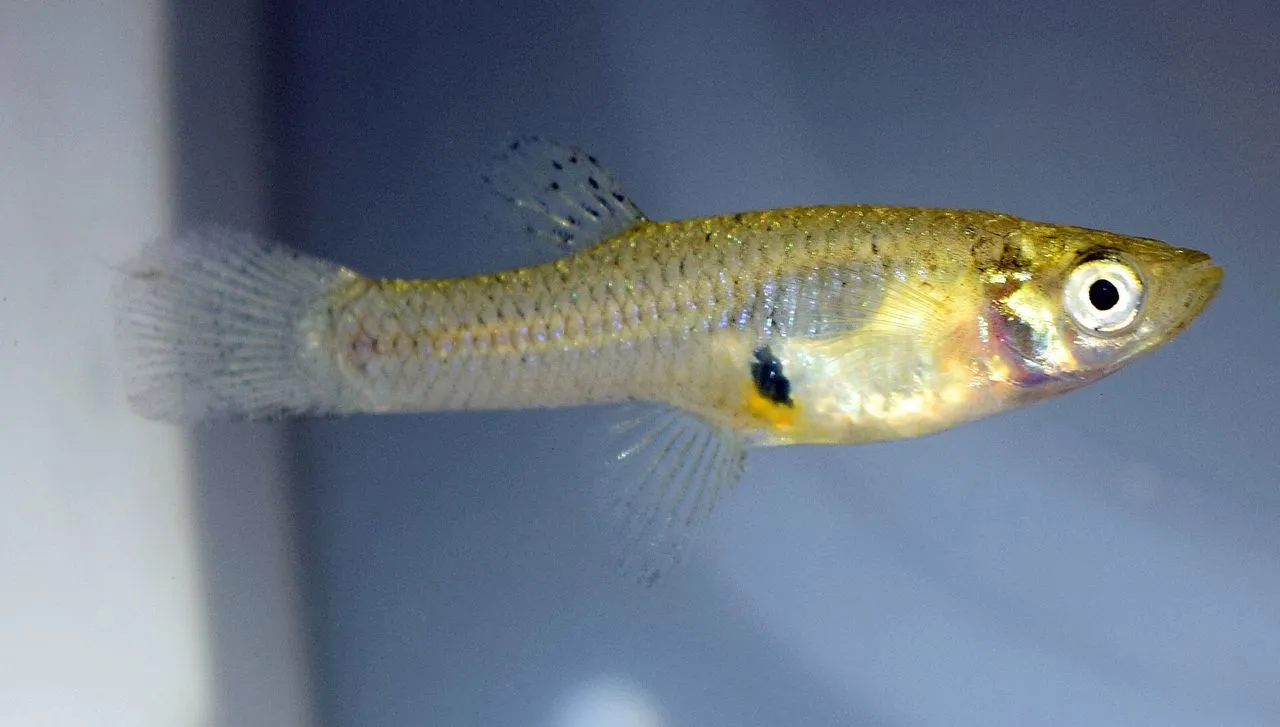
Answer: Mosquitofish (Gambusia affinis/holbrooki) is a small tough Gambusia with a large ecological footprint. It is aggressive, fin-nipping, invasive in many regions, and rarely a good ornamental community fish. Keep it at GH 8–25 °dH, KH 5–15 °dH, pH 7.0–8.4, 18–28 °C, with mature filtration, oxygen, and compatible hard-water tankmates. Plan for rapid broods and legal restrictions; livebearers rarely remain at the number purchased.
Gambusia affinis/holbrooki is the fish sold as the mosquitofish, western and eastern mosquitofish, two similar North American livebearers widely released for mosquito control. It belongs in the complete livebearers guide, where internal fertilisation, sperm storage, hard-water chemistry, and trade hybridisation are treated across the group.
Identification
Plain grey, upturned mouth, robust body, and constant surface activity. It lacks the colour appeal of guppies but has stronger predatory and nipping behaviour.
| Character | Practical reading |
|---|---|
| Adult size | Males 3–4 cm; females 5–7 cm |
| Best temperature | 18–28 °C |
| Water chemistry | GH 8–25 °dH, KH 5–15 °dH, pH 7.0–8.4, 18–28 °C |
| Social structure | Aggressive groups; species tank preferred |
| Breeding pattern | Lecithotrophic broods, repeated in warm months |
Males are identified by the gonopodium unless the species is one of the non-poeciliid specialists. In poeciliids the gonopodium is a modified anal fin, not a decorative point, and it allows internal fertilisation. Females are deeper through the abdomen, retain a fan-shaped anal fin, and may produce fry after weeks without a male because sperm storage is normal.
Origin & Habitat
Native to parts of North America but introduced widely, often harming native fishes and amphibians.
The aquarium translation is mineral stability rather than a chase for a single pH number. A tank at GH 14 °dH, KH 8 °dH, pH 7.8, and conductivity near 500 µS/cm is safer for most common livebearers than a soft planted community at GH 4 °dH and pH 6.8. If the tap supply is soft, use GH and KH explained before adding buffers or salts by habit.
Aquarium Husbandry
Keep only where legal, in secure aquaria or ponds with no release risk. A lid and overflow protection are responsible husbandry.
Cycle the aquarium before stocking. Livebearers tolerate nitrate better than ammonia, but they do not tolerate new-tank nitrite spikes; cycling a new aquarium is prerequisite reading. New imports should spend four weeks in quarantine, especially guppies and mollies from high-density farms. The quarantine tank protocol is cheaper than medicating a display after the first dead fish.
Hard-water planting is possible. Vallisneria spiralis provides vertical cover and fry shelter; Anubias nana is useful on wood or stone where digging and grazing disturb rooted stems less.
Tankmates & Behaviour
Avoid with guppies, bettas, and slow fish. They nip fins and outcompete timid species.
Do not mix by colour alone. Electric yellow cichlids share alkaline water but not social pace; they are Malawi mbuna, not livebearer companions. Siamese fighting fish are a poor match because long fins, slower feeding, and softer-water expectations conflict with active livebearers. Where a tetra is desired, x-ray tetra is more plausible than soft-water species such as black skirt tetra, although chemistry should still be checked.
Diet
Insect larvae, crustaceans, fry, prepared foods, and surface prey.
A useful routine is two small feeds daily, one protein-rich and one plant-rich, with one fasting day each week for adult mollies and platies in heavily stocked tanks. Fry need finer food more often, but water quality must not be sacrificed to growth speed.
Breeding
Females produce repeated broods and fry are predatory early. Do not distribute surplus casually.
Because females store sperm, a "female-only" tank assembled from shop stock may still produce fry. If breeding is not intended, separate sexes before maturity and keep spare tanks unavailable rather than relying on predators to remove surplus. If breeding is intended, label lines honestly and avoid mixing with close relatives such as guppy, Endler's livebearer, platy, or swordtail where hybridisation is plausible.
Common Problems
The main problem is ecological, not husbandry. Never release unwanted fish.
Chronic wasting, bent spine, or unexplained losses in guppy and molly lines should raise suspicion of mycobacteriosis. Mycobacterium marinum and related species are zoonotic; use gloves if there are skin breaks and do not share nets from suspect tanks. Ragged fins should be separated into social damage versus infection with the fin rot diagnosis guide.
Practical Setup Notes
For this species, the safest aquarium is built around predictable minerals and low social pressure. Test the replacement water before it enters the tank; matching GH and KH matters more than forcing a dramatic pH number. A weekly 30–40% water change is usually enough when stocking is restrained, but livebearer colonies grow quickly and the maintenance schedule must grow with them. If nitrate climbs above 20–30 mg/L between changes, reduce numbers, improve plant growth, or increase water-change volume rather than adding more chemical products.
Arrange the tank so weaker fish can disappear without leaving the feeding area entirely. Tall Vallisneria, branching wood with Anubias attached above the substrate, and open front swimming space work better than a bare tank with one ornament in the centre. Fry refuge should be dense but not filthy; mulm packed into plant bases can shelter young fish while also trapping waste. Rinse mechanical media in old tank water and preserve mature biological media unless medication or confirmed mycobacterial disease forces disinfection.
Buying stock is part of husbandry. Choose fish with full bellies, steady posture, clear fins, and normal spines. Avoid tanks containing dead fish, shimmying mollies, clamped guppies, or individuals breathing hard at the surface. Transport slowly in cold weather, acclimate to matched temperature, and quarantine before mixing lines. Most failures blamed on “sensitive livebearers” begin with weak farm stock placed directly into soft or immature water.
See Also
Frequently Asked Questions
What water parameters does Mosquitofish need?
Mosquitofish should be kept around GH 8–25 °dH, KH 5–15 °dH, pH 7.0–8.4, 18–28 °C. Ammonia and nitrite must be 0 mg/L, and nitrate is best held below 20 mg/L with regular water changes.
Can Mosquitofish live in a soft-water community tank?
It tolerates a range, but hard alkaline water is safer than acidic water.
How can I sex Mosquitofish?
Males are smaller with a gonopodium; females are larger and plain.
Is Mosquitofish suitable for beginners?
No for community tanks. It is hardy but behaviourally difficult and may be illegal to move or release.
Sources & References
- Meffe, G.K. & Snelson, F.F. (1989). Ecology and Evolution of Livebearing Fishes (Poeciliidae). Prentice Hall.
- Baensch, H.A. & Riehl, R. (1991). Aquarium Atlas, Volume 1. Mergus Verlag.
- FishBase species account. https://www.fishbase.se/
- Catalog of Fishes — Fricke, Eschmeyer & Van der Laan, California Academy of Sciences.