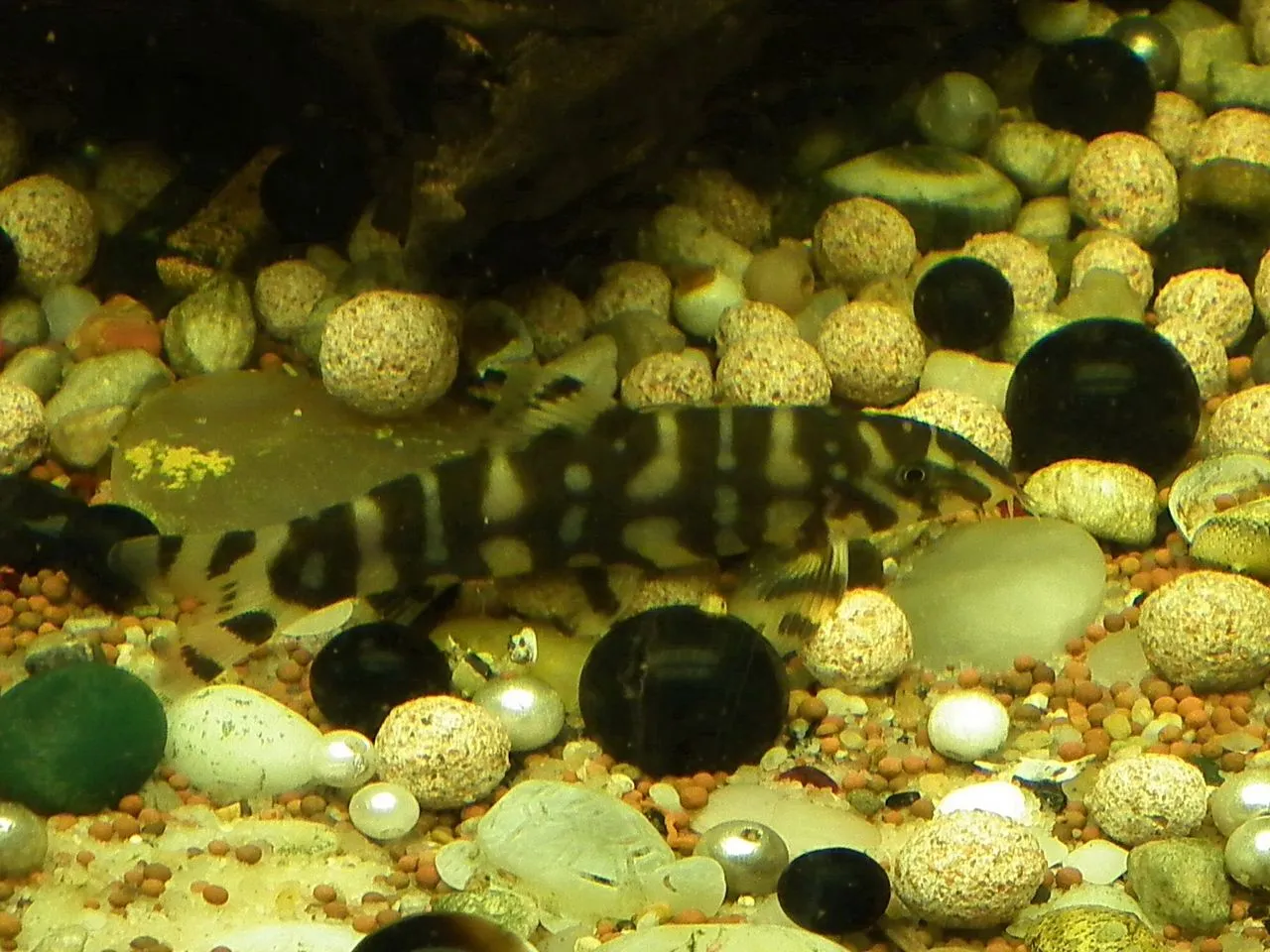
Answer:
Loaches are Cobitoidea: barbel-led substrate foragers, river clingers, burrowers, and social botiids rather than a single care type. Most need sand or rounded stone, mature filtration, high oxygen, and company. Kuhli loaches suit quiet planted tanks; clown loaches require very large long-term housing; hillstream loaches need cool, fast, biofilm-rich water.
Cobitoidea, the loach superfamily, contains some of the aquarium trade's most misread fishes: Chromobotia macracanthus (clown loach) sold as a charming juvenile that may outlive its keeper, Pangio kuhlii (kuhli loach) mistaken for a miniature eel, and flattened hillstream loaches treated as algae tools rather than cool-water stream specialists.
I have kept loaches in planted aquaria for more than thirty years, mostly in Southeast Asian systems where leaf litter, sand, and crypt thickets let their behaviour make sense. The recurring lesson is simple: loaches are not ornaments for the bottom pane. They are sensory, social, often rheophilic fishes whose welfare is decided by substrate, oxygen, group size, and adult identity.
Taxonomy
Kottelat's 2012 Conspectus Cobitidum remains the essential modern reference for loach taxonomy. Aquarium loaches sit within Cobitoidea, a cypriniform radiation separate from catfishes despite the shared presence of barbels. The aquarium-relevant families are not interchangeable.
| Family | Aquarium genera | Typical form | Husbandry consequence |
|---|---|---|---|
| Cobitidae | kuhli loach, weather loach, horse-face loach | Eel-like or elongate burrowers | Fine sand, low abrasion, food delivered after lights dim |
| Botiidae | clown loach, yoyo loach, zebra loach, polka-dot loach | Deep-bodied social loaches with suborbital spine | Groups of five or more, robust cover, careful netting |
| Nemacheilidae | sumo loach, some stone loaches | Small stream-bottom fishes | Current, oxygen, territories broken by rocks |
| Balitoridae and related hillstream lineages | hillstream loach, reticulated hillstream loach | Flattened suction-like body | Cool water, strong flow, mature biofilm |
Trade names lag behind taxonomy. The dwarf chain loach now appears as dwarf chain loach (Ambastaia sidthimunki), not the older Botia sidthimunki. Skunk loaches are skunk loach (Yasuhikotakia morleti), and tiger loaches belong in Syncrossus. These changes are not decorative: genera carry clues about social behaviour, aggression, current preference, and adult size.
Identification
Loaches share inferior or subterminal mouths, barbels, and a strong relationship with the substrate, but the body plan tells the aquarist what to build. Eel-shaped Pangio use narrow bodies to enter root tangles, leaf litter, and sand. Weather loaches and horse-face loaches dig with more force and need a deeper sand bed. Botiids are heavier, more muscular, and socially interactive; they investigate caves, chase, click, spar, and form dominance patterns. Hillstream loaches are dorsoventrally flattened and use broad paired fins to press themselves to stone in current.
The most important handling character is the botiid suborbital spine. In clown, yoyo, zebra, polka-dot, banded, skunk, and tiger loaches, a switchblade-like spine under the eye can erect when the fish is stressed. It tangles in fine nets and can lacerate skin. Move botiids with coarse nets or containers, never by pulling a stuck fish backwards through mesh.
| Lookalike problem | Reliable separator | Husbandry risk |
|---|---|---|
| Kuhli loach vs freshwater spiny eel | Kuhli has multiple barbels and loach mouth; spiny eels have a pointed proboscis and predatory habits | Eels eat small fish and require different feeding |
| Hillstream loach vs pleco | Hillstream lacks loricariid armour and sucker mouth; fins form a gripping disc | Hillstreams need cool current, not just algae wafers |
| Clown loach juvenile vs small community loach | Clown reaches 25–30 cm and can live for decades | Juvenile purchase creates an adult housing problem |
| Skunk loach vs dwarf chain loach | Skunk has a dark dorsal stripe and stronger aggression | Small peaceful communities may be bullied |
The comparison article kuhli loach vs eel confusion covers the common eel-shaped mistakes in more detail.
Behaviour & Ecology
Loach behaviour is dominated by sensory feeding and social context. Barbels sample sand, leaf litter, stone film, crevices, and detrital pockets. A loach kept over coarse gravel loses access to much of its natural foraging behaviour even when the water tests look acceptable. A loach kept alone may eat and survive, but many botiids become either withdrawn or abrasive because the social pressure that belongs inside a group is redirected or suppressed.
Clown loaches have the strongest social warning. Captive groups show pyramid hierarchies: a dominant individual leads movements and subordinates trail or cluster around it. Loss of a dominant fish can unsettle the group for weeks, with feeding reduction and increased disease susceptibility. A group of five is a minimum, not an ideal; eight or more gives a hierarchy that does not depend on one or two fish.
Kuhli loaches follow a different logic. They are not aggressive, but they need conspecific presence to become visible. A single kuhli in a bright tank often disappears for months. A group of ten in a leaf-littered aquarium with cryptocoryne wendtii may forage openly at dusk. Weather loaches are tactile, cool-water diggers that respond to pressure changes; hillstream loaches defend grazing stones; Schistura may hold miniature territories like cichlids compressed to the stream floor.
Water Chemistry & Habitat
No honest loach guide gives one parameter range. The family-level spread covers peat forest, monsoon rivers, cool Chinese streams, Indian hill torrents, and floodplain mud.
| Group | Temperature | GH | KH | pH | Conductivity |
|---|---|---|---|---|---|
| Kuhli and many Pangio | 24–28 °C | 1–8 °dH | 0–3 °dH | 5.5–7.0 | 40–180 µS/cm |
| Medium Botia | 22–27 °C | 3–12 °dH | 1–6 °dH | 6.4–7.6 | 120–400 µS/cm |
| Clown loach | 25–30 °C | 2–12 °dH | 1–6 °dH | 6.0–7.5 | 100–350 µS/cm |
| Weather loach | 10–22 °C | 4–18 °dH | 2–10 °dH | 6.5–8.0 | 150–650 µS/cm |
| Hillstream and many Schistura | 18–24 °C | 3–12 °dH | 1–6 °dH | 6.6–7.8 | 100–350 µS/cm |
Read water hardness: GH and KH explained if those ranges are not yet practical units rather than abstract numbers. Loaches are often more sensitive to oxygen and dissolved waste than to a pH value within the correct broad band. Ammonia and nitrite must remain 0 mg/L; nitrate should stay below 20 mg/L for most species, and below 10 mg/L for hillstream systems where heavy feeding and high oxygen demand intersect.
Aquarium Husbandry
Build loach aquaria from the substrate upward. Sand-burrowing species need fine rounded sand; botiids need sand plus caves; hillstream loaches need rounded stones, mature biofilm, and current. The substrate selection decision is therefore a welfare decision, not an aesthetic afterthought.
Filtration should be mature before loaches arrive. Many loaches feed where detritus settles, so unstable cycling punishes them first. If the aquarium is new, cycling a new aquarium should precede any loach purchase. Quarantine is equally important: wild-caught loaches may carry internal worms, external protozoans, or bacterial damage from crowded holding. The quarantine tank protocol is especially relevant for botiids because treating a large planted display after introduction is difficult.
Tankmates must match both temperament and water. Kuhli loaches suit quiet Southeast Asian or soft community tanks with pearl gourami, honey gourami, cardinal tetra, or a warm german blue ram system where substrate is sand. Medium Botia fit faster, more robust communities, not long-finned slow fish. Hillstream loaches can share cool, oxygenated rockwork with some small danionins, but not warm anabantoid blackwater tanks. Compare substrate-feeding catfish in the complete catfish guide, bronze corydoras, and sterbai corydoras before mixing bottom dwellers.
Planting works when plants match the fish. Tough rhizome plants such as java fern and anubias nana tolerate botiid investigation. Crypt thickets suit kuhli loaches. Delicate foreground stems planted into shallow gravel do not suit digging weather loaches or horse-face loaches.
Feeding
Loaches are not leftover processors. Kuhli loaches need food that reaches them after lights dim. Botia and Yasuhikotakia need sinking foods rich in invertebrate protein, with vegetable matter included but not used as a complete diet. Hillstream loaches graze biofilm continually and should enter mature aquaria with visible stone film. Newly scrubbed river tanks starve them.
Snail eating is real but often overused in advice. Yoyo, zebra, dwarf chain, and clown loaches may crush small snails, but buying a future 30 cm clown loach to solve a ramshorn problem is poor ethics. Reduce overfeeding, quarantine plants, and remove excess snails manually before choosing a fish with decades of care attached.
Buying, Quarantine & Acclimation
Loaches deserve a stricter buying inspection than most community fishes because their losses often begin before they reach the aquarist. Avoid any specimen with a pinched belly, red barbel bases, cloudy eyes, frayed fins, or a rocking posture in still water. A thin kuhli loach may hide for weeks before dying; a thin hillstream loach may continue grazing movements while losing condition because there is no digestible biofilm left in the holding tank. Botiids with clamped fins, grey patches, or laboured respiration should be left at the shop even if the pattern is attractive.
Quarantine should match the fish's ecology. A bare glass box is easy to clean but not always humane or diagnostically useful. Kuhli and horse-face loaches need at least a shallow tray or dish of clean sand so the skin is not stressed by constant exposure. Botiids need pipes, caves, or inert shelters large enough that one fish cannot trap another. Hillstream loaches need current and high oxygen even during quarantine; a small sponge filter alone is rarely enough unless the tank is cool and lightly stocked. Use mature media, observe for two to four weeks, and feed deliberately. A loach that eats only after the room is dark may be healthy; a loach that never rounds out after repeated appropriate feeding is not.
Acclimation should be calm rather than elaborate. Temperature equalisation and gradual mixing are sensible where conductivity differs strongly, but hour-long dripping into cold, oxygen-poor bag water is counterproductive. Once moved, keep lights low for the first day and resist rearranging the tank to check whether the fish are visible. Loaches learn the shelter map. Constant disturbance delays feeding more than it reassures the keeper.
Health Problems Specific to Loaches
The classic loach failure pattern is not a dramatic disease outbreak but slow attrition. One fish disappears, another loses weight, and a third develops eroded barbels. The cause is usually a combination: immature filtration, abrasive substrate, food trapped in gravel, and a group too small to behave normally. Medication cannot repair that environment. Correct the surface, oxygen, and feeding schedule first.
White spot disease is common after import, especially in botiids — clown loach recurrent ich explains why clown loaches keep picking up the parasite even in long-established tanks. Treat only after diagnosis, maintain high aeration, and remember that warm-water acceleration is unsuitable for cool hillstream or weather loaches. Raising a hillstream tank to tropical treatment temperatures can lower dissolved oxygen and worsen the problem. Salt also deserves restraint. Weather loaches tolerate a wider mineral range than many soft-water species, but chronic salt is not a normal requirement for Cobitoidea and is poor practice for planted loach systems.
Skin injuries come from chasing and handling. Fine nets catch suborbital spines; coarse nets or submerged containers are safer. If a botiid locks its spine into mesh, cut the net. Pulling damages the eye region and turns a minor handling mistake into a lasting wound. For large clown or tiger loaches, move the fish underwater in a rigid container whenever possible.
Designing by Loach Type
A practical way to plan is to choose the loach first and then design the aquarium around its body plan.
| Aquarium concept | Suitable loaches | Unsuitable loaches | Design notes |
|---|---|---|---|
| Quiet soft planted tank | Kuhli loach, dwarf chain loach | Tiger loach, skunk loach | Sand, leaf litter, shaded plants, gentle feeding after dark |
| Large warm river community | Clown loach, polka-dot loach, yoyo loach | Weather loach, most hillstream loaches | Long footprint, strong filtration, big social group, robust tankmates |
| Cool high-flow stone tank | Hillstream loach, reticulated hillstream loach, some sumo loaches | Kuhli loach, pearl gourami companions | Powerhead flow, polished stones, bright biofilm, high oxygen |
| Sand-burrower display | Horse-face loach, weather loach, kuhli loach by scale | Sharp-stone Schistura setups | Deep rounded sand, open surface, secure lid, low competition |
This design-first approach prevents the two common compromises: warm, still community tanks that starve hillstream loaches of oxygen, and decorative gravel tanks that deny burrowers the one behaviour they most need. It also prevents social understocking. Five clown loaches require a much larger aquarium than one clown loach, but one clown loach is not an ethical shortcut. The correct stocking unit is the group.
Conservation and Trade Ethics
Several loaches in the trade come from restricted or pressured habitats. Dwarf chain loach is the obvious example: wild populations in Thailand declined severely, and captive-bred fish should be preferred whenever available. Hillstream loaches are often collected from specialised stream habitats that are vulnerable to sedimentation, damming, and seasonal disruption. A fish that arrives cheaply still represents a habitat with finite resilience.
Ethical purchasing is practical husbandry. Captive-bred botiids and dwarf chain loaches usually arrive fatter and less parasite-laden than stressed wild imports. Wild-caught fish are not automatically unethical, but they require correct identification and mature aquaria. Refuse unidentified eel-like loaches, tiny clown loaches sold for nano tanks, and hillstream loaches displayed in warm tanks with no current. Demand adult size in centimetres. If the answer is an adjective, the fish has not been identified well enough.
Breeding Overview
Loach breeding ranges from plausible to rarely documented. Kuhli loaches occasionally scatter adhesive greenish eggs among plants or mops in mature soft-water aquaria, though controlled breeding remains uncommon. Weather loaches spawn seasonally in cool-water conditions and are produced commercially. Many botiids in the trade are pond-produced or hormone-induced; regular availability does not imply easy home spawning. Hillstream loaches, especially Sewellia, have bred in mature current tanks where rounded stones, fine fry foods, and stable oxygen were present.
For the aquarist, the useful breeding method is excellent maintenance rather than tricks: feed varied invertebrate-rich diets, keep groups old enough to mature, provide seasonal water changes within the species' tolerance, and avoid predatory tankmates. Eggs and fry are vulnerable to adult foraging. If fry appear in a hillstream tank, protect biofilm and provide microscopic foods rather than scrubbing the aquarium clean.
Notable Species
- Kuhli loach (Pangio kuhlii) — eel-shaped, peaceful, nocturnal burrower for soft planted tanks.
- Clown loach (Chromobotia macracanthus) — large, long-lived, highly social botiid with adult-size shock.
- Yoyo loach (Botia almorhae) — active Indian loach with changing juvenile pattern.
- Zebra loach (Botia striata) — smaller, calmer Indian botiid for groups.
- Weather loach (Misgurnus anguillicaudatus) — cool-water digger and barometric responder.
- Hillstream loach (Beaufortia kweichowensis) — Chinese high-flow grazer for cool oxygen-rich tanks.
- Reticulated hillstream loach (Sewellia lineolata) — patterned Vietnamese stream specialist.
- Dwarf chain loach (Ambastaia sidthimunki) — small social Thai loach with conservation concerns.
- Polka-dot loach (Botia kubotai) — Myanmar botiid whose pattern changes with age.
- Burmese border loach (Botia histrionica) — striking medium Botia from Myanmar-border drainages.
- Tiger loach (Syncrossus hymenophysa) — large boisterous loach for specialist robust aquaria.
- Sumo loach (Schistura spp.) — territorial stream loaches needing current and stone territories.
- Horse-face loach (Acantopsis dialuzona) — sand-burying Southeast Asian loach with a long rostrum.
- Banded loach (Botia rostrata) — cooler-tolerant botiid with narrow banding.
- Skunk loach (Yasuhikotakia morleti) — small but assertive Thai loach with a dark dorsal stripe.
Common Confusions
| Confusion | Correct reading | Practical result |
|---|---|---|
| Loach equals bottom cleaner | Loaches are fish with species-specific diets | Feed deliberately and remove waste normally |
| Any loach can live alone | Most aquarium botiids and Pangio need groups | Plan bioload and tank size around the group, not one fish |
| Hillstream loach equals pleco | Hillstream loaches are cypriniform stream fishes | Provide cool current and biofilm, not warm pleco caves |
| Clown loach stays small if tank is small | Stunting is pathology, not husbandry | Do not buy juveniles without adult housing |
| Snail-eating loach solves overfeeding | Snails indicate excess food or plant hitchhikers | Correct the cause before adding livestock |
See Also
- Kuhli loach — the standard peaceful sand-burrowing loach for planted soft-water tanks.
- Clown loach — adult size, hierarchy, and lifespan before purchase.
- Hillstream loach — cool-water current systems and biofilm feeding.
- Kuhli loach vs eel confusion — separating loaches from spiny eels and swamp eels.
- The Complete Catfish Guide — substrate-feeder comparisons and barbel health.
- Substrate Selection — sand and stone choices for bottom-dwelling fishes.
Quick answer: are loaches easy to keep?
Many loaches are hardy once the tank is mature, but they are not all beginner fish. Small species such as kuhli loaches fit peaceful planted tanks. Large species, especially clown loaches, need far more space. Clean water, soft hiding places, and sinking foods matter more than chasing one perfect number.
What loaches need in the tank
Give loaches places to disappear. Smooth caves, leaf litter, driftwood gaps, and dense plants help them settle instead of pacing the glass. Use sand or rounded gravel for species that sift the bottom, and avoid sharp substrate that can damage barbels.
Feeding bottom-dwelling loaches
Loaches should not live on leftovers. Drop food after the lights dim if faster fish steal everything. Sinking wafers, frozen foods, and the occasional vegetable treat usually work well. This Amazon search for loach sinking foods and aquarium hiding caves can help you compare useful basics without buying random decor first. As an Amazon Associate, we earn from qualifying purchases, at no extra cost to you.
FAQ: loach care
Do loaches need to be kept in groups?
Most social loaches do better with their own kind. A lone kuhli or clown loach may hide constantly or act stressed. Check the species profile before buying, because group size and adult size vary a lot.
Why is my loach hiding all day?
Some loaches are naturally shy, especially in bright tanks. If the fish is eating, breathing normally, and coming out at night, hiding may be normal. Sudden hiding with clamped fins, fast breathing, or weight loss means you should test the water and check for bullying.
Frequently Asked Questions
Are loaches community fish?
Some are. Kuhli, zebra, dwarf chain, and many hillstream loaches can work in carefully matched communities. Clown, tiger, skunk, and large Botia species need robust tankmates and proper groups. Chemistry, oxygen, adult size, and social structure matter more than the word loach.
How many loaches should be kept together?
Most botiid loaches need at least five, with eight or more better for clown and polka-dot loaches. Kuhli loaches should be kept in groups of six to ten. Some Schistura are territorial rather than shoaling, so identify the genus before applying a group rule.
Do loaches eat snails?
Many botiids eat small snails, but they should not be bought as disposable snail control. Clown loaches and tiger loaches become large, social, long-lived fish. Use feeding control, manual removal, and quarantine before using a fish to solve a husbandry problem.
What substrate is safest for loaches?
Fine rounded sand is safest for kuhli, horse-face, weather, and many Botia loaches. Hillstream and Schistura loaches need rounded stones and current. Sharp gravel damages barbels, traps waste, and prevents natural burrowing behaviour.
Sources & References
- Kottelat, M. (2012). Conspectus Cobitidum: an inventory of the loaches of the world. The Raffles Bulletin of Zoology, Supplement 26.
- FishBase — Cobitoidea and species accounts. https://www.fishbase.se/
- Fricke, R., Eschmeyer, W.N. & Van der Laan, R. Catalog of Fishes. California Academy of Sciences.
- Baensch, H.A. & Riehl, R. (1997). Aquarium Atlas, Vol. 1. Mergus Verlag.
- IUCN Red List — freshwater fish species assessments. https://www.iucnredlist.org/