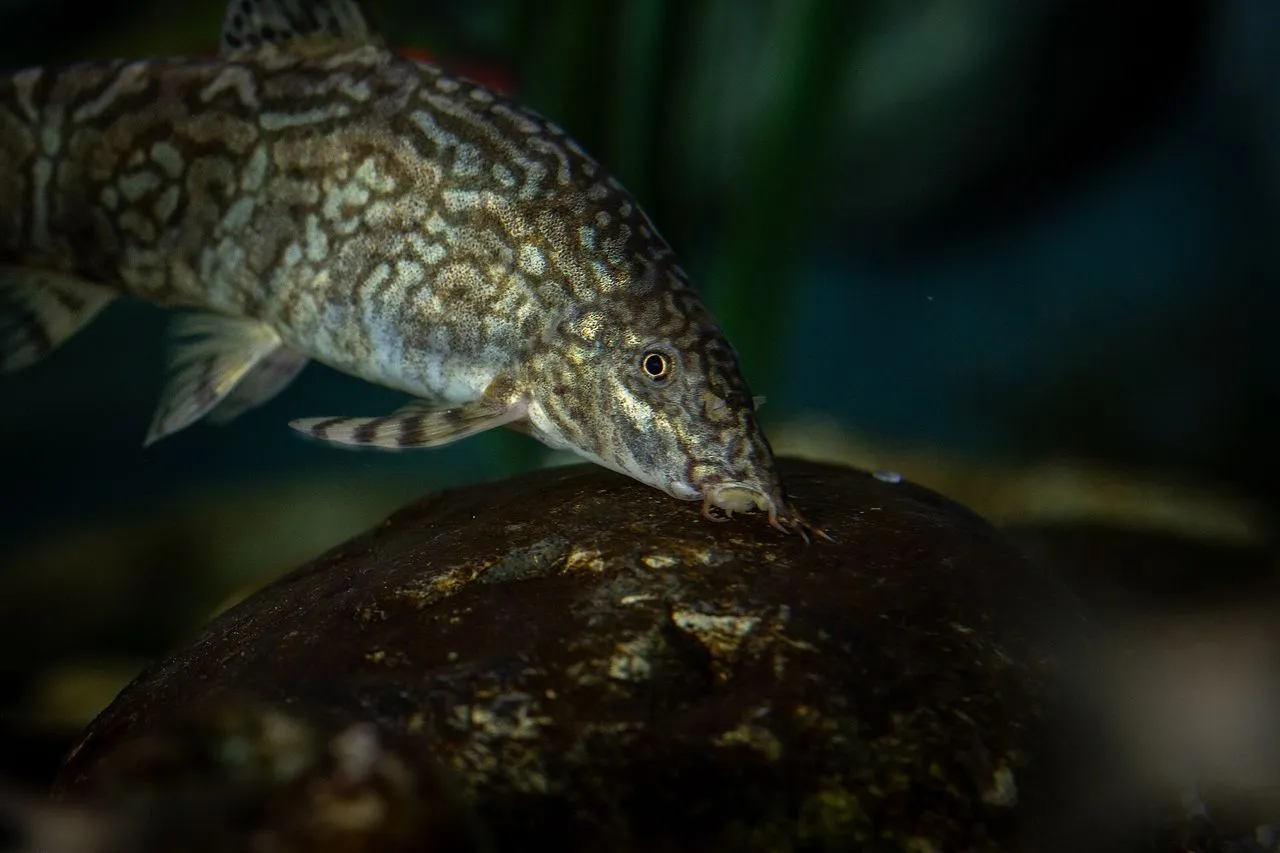
Answer: Kuhli loaches are not eels. Pangio loaches are small, barbelled cobitids that sift sand and leaf litter in groups. Spiny eels such as Macrognathus and Mastacembelus are predatory mastacembelids with pointed snouts; Asian swamp eels are larger synbranchids. Confusing them leads to wrong tank size, diet, and tankmate choices.
Pangio kuhlii (kuhli loach), Macrognathus spiny eels, Mastacembelus spiny eels, and Asian swamp eels are all elongate fishes, but they are not close aquarium equivalents. The confusion begins in dealer tanks where anything brown, striped, and snake-like may be labelled an eel. It ends badly when a peaceful 9 cm sand-sifting loach is replaced by a nocturnal predator.
Part of the Complete Loaches Guide.
The Short Version
Kuhli loaches are loaches: small, social, barbelled, and built for sand and leaf litter. Spiny eels are mastacembelids: pointed-snouted, more predatory, and often larger. Asian swamp eels are synbranchids: air-breathing eel-like predators that belong outside ordinary community aquaria. Body shape alone is not enough; look at the mouth, barbels, fin structure, and feeding behaviour.
| Feature | Kuhli loach (Pangio kuhlii) | Spiny eel (Macrognathus, Mastacembelus) | Asian swamp eel |
|---|---|---|---|
| Adult size | 8–10 cm for common kuhli types | 15–100 cm depending on species | Often 60 cm or more |
| Mouth | Small, downward, with barbels | Pointed snout, protrusible predatory mouth | Large predatory mouth |
| Social care | Groups of six to ten | Usually singly or carefully spaced | Specialist solitary predator |
| Diet | Small worms, crustaceans, sinking foods | Worms, shrimp, fish prey in larger species | Fish, crustaceans, amphibian-sized prey |
| Community safety | High with peaceful small fish | Species-dependent; risk to small tankmates | Poor |
Identifying Pangio Loaches
The kuhli loach has a narrow eel-like body, but the head reveals the truth. Several short barbels frame a small mouth used for sifting fine food from sand and litter. The fish moves by quick wriggling bursts, then settles under cover. It does not stalk fish. It does not need feeder fish. It should be kept in a group on fine sand at 24–28 °C, GH 1–8 °dH, pH 5.5–7.0, with shaded cover from plants such as cryptocoryne wendtii or java fern.
Kuhli loaches are commonly confused with horse-face loach juveniles as well. Horse-face loaches have a longer rostrum, become much larger, and bury more completely in open sand. Both are loaches; neither is a spiny eel.
Identifying Freshwater Spiny Eels
Spiny eels in the aquarium trade usually belong to Macrognathus or Mastacembelus. The dorsal fin is preceded by separate short spines, giving the group its name. The snout is pointed and mobile. The mouth is suited to worms, insect larvae, crustaceans, and small fish in larger species. Some smaller Macrognathus can be kept responsibly by specialists, but they need secure lids, sand, meaty foods, and tankmates too large to swallow.
The most dangerous advice is to call a spiny eel a cleanup fish. It is not. It is a nocturnal predator or micro-predator, depending on species. A tank containing cardinal tetra, small rasboras, shrimp, or young honey gourami may work for kuhli loaches and fail with spiny eels.
Identifying Asian Swamp Eels
Asian swamp eels, usually synbranchids, are a different problem again. They have elongated bodies, reduced fins, air-breathing ability, and a predatory adult size far beyond the normal loach aquarium. They are escape artists and can move through damp conditions. A juvenile may be sold as an oddball eel; an adult is a powerful predator with no place in a peaceful planted community.
If an eel-like fish has no obvious loach barbels, a heavier head, and a large predatory mouth, do not buy it as a substitute for a kuhli loach. Ask for a scientific name. If none is available, walk away.
Husbandry Consequences
The identification matters because the aquaria differ.
| Requirement | Kuhli loach setup | Spiny eel setup | Swamp eel setup |
|---|---|---|---|
| Tank style | Quiet soft-water planted tank | Covered predator or oddball tank | Large specialist predator system |
| Substrate | Fine rounded sand | Sand, often deeper | Robust, escape-proof, species-specific |
| Feeding | Fine sinking foods after dark | Worms, shrimp, meaty foods | Large meaty foods |
| Tankmates | Peaceful small fish | Too large to swallow, calm | Usually none or very robust |
Kuhli loaches pair well with soft-water community fish and careful substrate-feeder planning. Compare bronze corydoras for another peaceful sand forager, and read substrate selection before choosing gravel. Spiny eels require a different mental category: more like an oddball predator than a loach.
Buying Checklist
Ask three questions before purchase. First, what is the scientific name? Second, what adult size is expected in centimetres? Third, what does the fish eat when settled? A seller who answers "small eel, eats leftovers" has not identified the animal well enough.
For kuhli loaches, buy several at once, all with rounded bellies and intact barbels. For spiny eels, buy only after species identification and escape-proof planning. For swamp eels, do not purchase for a normal home community aquarium. Quarantine any eel-shaped import because wild-caught nocturnal fishes often arrive thin, parasitised, or damaged by abrasive holding tanks; the quarantine tank protocol applies strongly here.
One final test is behaviour at feeding. A kuhli loach threads through sand and litter, taking tiny items without lunging at tankmates. A spiny eel tracks scent and may strike decisively at worms or shrimp. A swamp eel behaves like a larger ambush predator even when young. Watching a fish feed for two minutes often reveals more than the label on the tank.
See Also
- The Complete Loaches Guide — family-level loach identification and care.
- Kuhli Loach — full profile of the peaceful Pangio loach.
- Horse-Face Loach — another sand-burying loach often mistaken for an eel.
- Weather Loach — larger cool-water cobitid with a different care profile.
- Substrate Selection — safe sand choices for burrowing fishes.
- The Complete Catfish Guide — comparison with true barbelled catfish.
Frequently Asked Questions
Is a kuhli loach a freshwater eel?
No. A kuhli loach is a cobitid loach with barbels, a small downward mouth, and a peaceful micro-predatory diet. Freshwater spiny eels are mastacembelids with a pointed snout and more predatory feeding.
Will spiny eels eat small fish?
Many will eat fish or shrimp small enough to swallow, especially at night. Kuhli loaches do not behave like miniature predators and are safe with small peaceful tankmates that cannot harass them.
How do I identify an Asian swamp eel?
Asian swamp eels have a much heavier eel-like body, reduced fins, no loach barbels, and a predatory adult size unsuitable for ordinary community aquaria.
Can kuhli loaches and spiny eels live together?
It is usually a poor match. Spiny eels compete for nocturnal foods and may prey on small loaches depending on species and size. Kuhli loaches are better kept in groups with peaceful soft-water fish.
Sources & References
- Kottelat, M. (2012). Conspectus Cobitidum: an inventory of the loaches of the world. The Raffles Bulletin of Zoology, Supplement 26.
- FishBase — Cobitoidea and species accounts. https://www.fishbase.se/
- Fricke, R., Eschmeyer, W.N. & Van der Laan, R. Catalog of Fishes. California Academy of Sciences.
- Roberts, T.R. (1986). Systematic review of Mastacembelidae and Synbranchidae records from Southeast Asia.