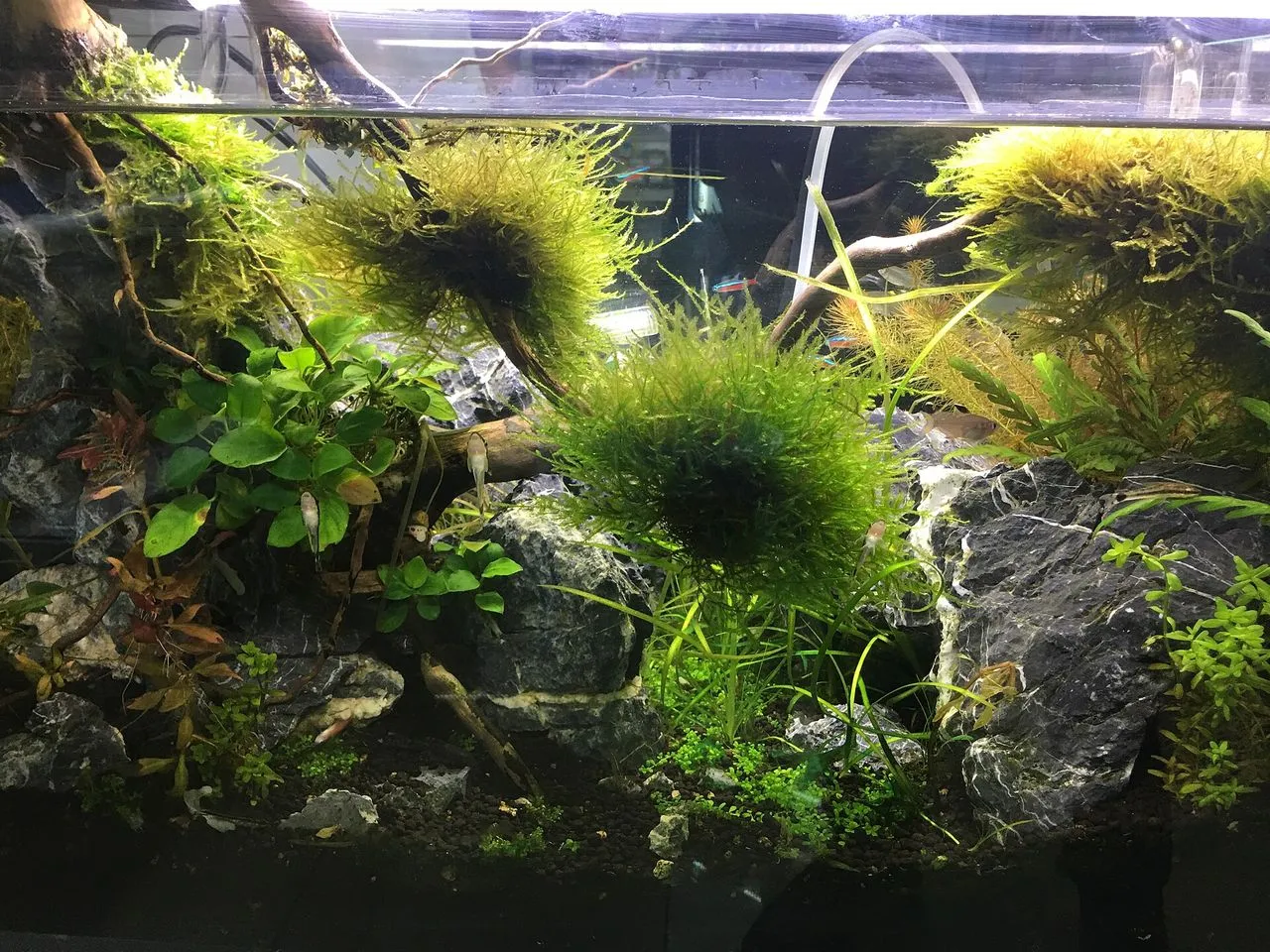
Answer: Yellow aquarium water has two main causes. Tannin staining from driftwood, Indian almond leaves, or peat produces a warm amber tint that is biologically harmless and often desirable for blackwater species such as discus, Apistogramma, or chocolate gourami. Dissolved organic carbon accumulation from insufficient water changes produces a similar tint alongside rising nitrate and a strain on the biofilter — this one needs attention. Identify which you have before acting.
Yellow aquarium water is rarely a sign of danger on its own — but the cause matters. Tannin staining and dissolved organic carbon accumulation look similar at a glance but have opposite implications: one is a natural process worth embracing in the right tank, the other signals that maintenance has fallen behind and the biofilter is under strain. Unlike cloudy water, yellow water is a dissolved colour compound, not suspended particles, so it does not settle out on its own.
Part of the Complete Aquarium Care Guide.
Main Causes
There are five causes worth knowing. The first two account for the vast majority of cases.
| Cause | Visual signature | Typical timing | Concern level |
|---|---|---|---|
| Tannin staining — driftwood, catappa leaves, alder cones, peat | Warm amber to tea-brown; water clear, not hazy | Days after adding wood or botanicals; deepens with each addition | None — often desirable |
| DOC accumulation — fish waste, uneaten food, decomposing plant matter | Pale yellow to yellow-brown; possible mild haze; faint odour in advanced cases | Gradual over weeks to months without regular maintenance | Real — indicates declining water quality |
| Medication residue — acriflavine, some antibiotics | Yellow to orange tint; sudden onset | Immediately after dosing | Temporary — clears with carbon and water changes |
| Exhausted activated carbon | Gradual return of previous amber tint or general yellowing | After 4–6 weeks of continuous carbon use | Low — replace or remove the spent carbon |
| Iron-rich source water | Persistent pale yellow independent of tank contents | Present from first fill; consistent regardless of maintenance | Low to moderate — test source water separately |
Identify yours before acting. The interventions for tannins and for DOC are different, and conflating them wastes effort and can stress the biofilter.
How to Identify the Problem
Start with what is in the tank and when the colour appeared.
Driftwood, catappa leaves, alder cones, or peat in the tank: The yellowing is almost certainly tannins. Mopani, Malaysian driftwood, and spider wood are the heaviest releasers — spider wood in a 200-litre tank can produce a deep amber within 48 hours of first submersion. The tint deepens whenever new botanical material is added and fades gradually as the wood cures over months. Water will be clear, not hazy, and there will be no odour.
No wood or botanicals, gradual yellowing over several weeks: This is the profile of DOC accumulation. Check your water-change log. A tank running on fortnightly 20% changes with a moderate fish load will accumulate dissolved organics faster than the biofilter can process them. Test nitrate — readings above 40 ppm in a tank that was recently clear are a strong secondary indicator. A faint musty smell confirms it.
Yellowing appeared immediately after dosing medication: Acriflavine, used in some bacterial and fungal treatments, colours water a distinct yellow-orange. This is residue, not a water-quality problem. Run activated carbon for 48–72 hours and perform a water change once the treatment course is complete.
Yellow water from the tap: Some well water and certain municipal supplies carry iron or natural organic matter before the water reaches the tank. Test a glass of source water against a white background. If it is visibly yellow straight from the tap, the tank is not the source — read Reverse Osmosis Water for treatment options.
Risk and Severity
| Cause | Direct risk to fish | Priority |
|---|---|---|
| Tannin staining | None — slight pH and hardness shift only | Low — monitor pH if keeping alkaline species |
| DOC accumulation | Moderate — impairs biological filtration, elevates nitrate, can depress KH | High — address within the week |
| Medication residue | None at normal treatment doses | Low — cosmetic until carbon clears it |
| Exhausted carbon | Low — mainly aesthetic | Low |
| Iron-rich source water | Low at typical concentrations; harmful at elevated levels | Moderate — test source water iron |
Tannins are not a problem for most freshwater species and are actively beneficial for soft-water fish. Chocolate gourami — among the most demanding species in the hobby — require conditions closely matching their peat-blackwater Sundaland habitat, and tannin-stained water is a prerequisite for long-term success with them. Discus in a species or breeding setup often perform better in amber water than in artificially clear water, because the humic acids buffer the pH at the soft, slightly acid range the species evolved in and appear to suppress some pathogen loads.
For hard-water species — Tanganyikan cichlids, livebearers kept at higher pH — monitor pH if adding significant tannin sources, since accumulated humic acids can suppress KH over time. Read pH and Buffering for the mechanism.
DOC accumulation is the scenario that warrants prompt action. Dissolved organics fuel heterotrophic bacteria, reduce nitrifier efficiency, and draw down KH. A tank with sustained high DOC will drift toward lower pH, reduced filter capacity, and increased disease susceptibility — all without ever looking obviously dirty.
Solutions and Actions
Tannins — if you want to remove them:
- Pre-soak new driftwood in a bucket, changing the water every 1–2 days for 1–3 weeks before adding it to the tank. The initial tannin burst is the largest; cured wood releases far less.
- Add activated carbon to the filter. Replace it every 4–6 weeks. Carbon absorbs what is in solution at any given moment — it does not stop the wood releasing tannins, so it requires regular replacement.
- Increase water-change frequency temporarily. A 30–40% change twice weekly for a month accelerates clearing while the wood finishes its initial cure.
- Boiling wood is sometimes suggested but softens the structure of some species and reduces only the immediate surface load, not long-term release.
Tannins — if you want to keep them:
Nothing further is needed. The water is safe. Reduce the volume of wood or botanicals if the colour is deeper than you prefer, or leave it and enjoy the natural aesthetic. Consider Choosing a Filter if you want adequate biological capacity without chemical media stripping the amber — sponge or canister filtration without carbon maintains the tannin effect while providing the turnover the tank needs.
DOC accumulation:
- Perform a 30–50% water change with temperature-matched, dechlorinated water. This is the single most effective action. See Water Changes: Frequency and Volume for technique and scheduling.
- Vacuum the substrate during the water change. Detritus compacted in gravel or sand is a continuous DOC source — removing it cuts the problem at root.
- Clean filter mechanical media (sponges, floss) in removed tank water, not under tap. Return biological media without sterilising it.
- Reduce feeding for 5–7 days. Most community fish tolerate brief food reduction without difficulty; most DOC cases include at least some overfeeding as a contributing factor.
- Re-test nitrate 48 hours after the water change. If nitrate has dropped and nitrite remains at zero, the intervention has worked. If nitrite is detectable, the biofilter has been stressed — repeat the water change and read Nitrogen Cycle Explained.
- Establish a maintenance schedule — 25–30% weekly for a moderately stocked community tank — and maintain it consistently.
Medication residue:
Run activated carbon for 48–72 hours after the treatment course ends, then remove the carbon. A 25% water change after the carbon run clears any remaining colour. Do not run carbon during a treatment course — it will absorb the medication along with the tint.
Prevention
The best prevention is a routine that matches the tank's bioload.
- Weekly water changes of 25–30% keep DOC well below the threshold where yellowing occurs in a normally stocked community tank. Heavier stocking — large cichlids, predatory species fed daily, a grow-out system — may need 40–50% or twice-weekly changes.
- Match botanical quantity to tank size and intent. A single piece of mopani in a 100-litre tank produces a mild amber tint that fades over months. Ten pieces of spider wood with a catappa leaf litter produces a committed blackwater biotope — that is a design choice, not a mistake, but it should be a deliberate one.
- Pre-soak all wood before first use. This removes the most intense initial tannin flush outside the display tank and makes the yellow less extreme in the first weeks.
- Replace activated carbon on schedule if you use it. Exhausted carbon releases some absorbed organics back into the water — remove it once spent, or switch to a regenerable resin such as Seachem Purigen if long-term chemical filtration suits your setup.
- Test nitrate monthly. A nitrate reading that has doubled without a corresponding change in stocking is an early warning of DOC buildup, before the water colour becomes visible.
Common Mistakes
- Treating tannin staining as a water-quality emergency. Tannins are not ammonia. Running large emergency water changes and dosing chemicals into a tank that simply has driftwood in it stresses the biofilter and the fish without addressing any real problem. Test the water — if ammonia, nitrite, and nitrate are within range, the colour is aesthetic, not dangerous.
- Using "water clarifier" products. These bind fine suspended particles but do nothing for dissolved tannins or DOC, and they treat no underlying cause. The apparent clarity they produce is brief and cosmetic; the chemistry driving the colour remains unchanged.
- Stripping all tannin sources from a blackwater setup. Species such as chocolate gourami, licorice gourami, wild bettas, and Apistogramma bred for peat-blackwater conditions often fare noticeably worse in artificially clear, hard water. The urge to make the water look clean can directly harm the fish.
- Running activated carbon indefinitely without addressing the root cause. Carbon removes the visible symptoms of DOC accumulation but not the DOC at source. A tank that turns yellow again within weeks of a fresh carbon run needs water changes and substrate cleaning, not another bag of carbon.
- Skipping the nitrate test. Visual inspection cannot reliably distinguish mild tannin staining from early DOC accumulation. A nitrate test — ten minutes with a liquid kit — makes the diagnosis unambiguous and guides the response.
Frequently Asked Questions
Will tannins harm my fish?
No. Tannins are biologically inert at the concentrations produced by driftwood and botanicals in a typical aquarium. They lower pH and soften water slightly, which is actively beneficial for soft-water species. For hard-water fish such as Tanganyikan cichlids, the pH drift warrants monitoring, but the tannins themselves cause no harm.
How do I tell DOC accumulation from tannin staining?
Check when the yellowing appeared and what is in the tank. Tannin staining begins within days of adding driftwood or leaves and correlates with those additions. DOC accumulation is gradual and independent of new décor — look for rising nitrate, sluggish filter flow, a faint odour, and a maintenance history shorter than weekly water changes.
Should I run activated carbon all the time to keep the water clear?
Not necessarily. Carbon removes tannins and dissolved organics effectively but exhausts in 4–6 weeks and should then be replaced or removed. Running it permanently while the underlying cause — infrequent water changes, overfeeding, inadequate filtration — remains unresolved treats a symptom. Fix the cause first.
Can I keep driftwood and still have clear water?
Yes. Pre-soaking the wood in a separate bucket for 1–3 weeks, changing the soaking water every few days, removes most of the initial tannin load. Once the wood is in the tank, activated carbon in the filter will maintain clarity if that is your preference. Many keepers choose to keep the amber tint — it looks natural and benefits the fish.
Sources & References
- Walstad, D. (2013). Ecology of the Planted Aquarium. Echinodorus Publishing.
- Hovanec, T.A. & DeLong, E.F. (1996). Comparative analysis of nitrifying bacteria associated with freshwater and marine aquaria. Applied and Environmental Microbiology, 62(8): 2888–2896.
- Stoskopf, M.K. (1993). Fish Medicine. W.B. Saunders.
- Noga, E.J. (2010). Fish Disease: Diagnosis and Treatment. Wiley-Blackwell.