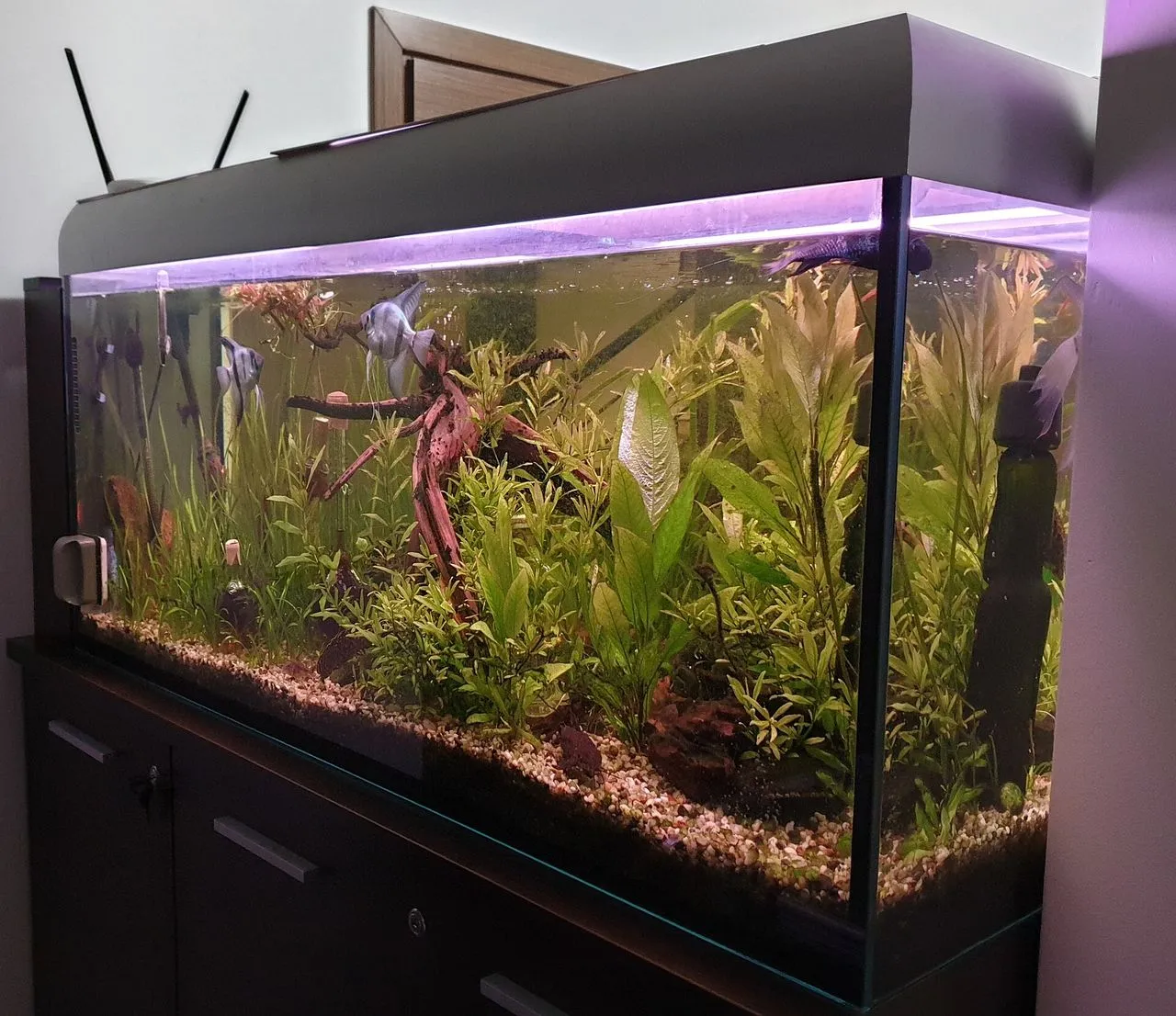
Answer: Sponge filters are best for shrimp tanks, fry rearing, quarantine, low-flow blackwater setups, and any tank under about 60 litres. Hang-on-back (HOB) filters are best for community tanks 40–250 litres with active fish that tolerate moderate flow, where the bioload exceeds what a single sponge can comfortably process. Many keepers run both.
"Sponge filter or hang-on-back" is one of the questions every new aquarist asks, and one of the few where the popular forum answer is genuinely useful. The two filter styles do different jobs well, and the right choice depends on the livestock and tank type, not the price tag.
Part of the Complete Aquarium Care Guide. For a wider look at filtration options, read Choosing a Filter.
At a Glance
| Attribute | Sponge filter | Hang-on-back (HOB) |
|---|---|---|
| Biological capacity | Excellent for tank size | Good, depends on media basket volume |
| Mechanical clarity | Modest — small particles pass | Better — polishing pads catch fines |
| Chemical capacity | Limited unless air-driven canister adapter is used | Good — activated carbon, Purigen, phosphate remover fit easily |
| Flow rate | Low and gentle | Moderate to strong |
| Shrimp / fry safety | Inherently safe | Requires intake guard |
| Noise | Air pump only (quiet to silent with quality pump) | Constant waterfall sound |
| Tank size range | <60 L solo; pairs and larger sponges scale up | 40–250 L typical, larger with multiple units |
| Cost | £6–£20 sponge + £15–£40 air pump | £20–£60 |
| Maintenance | Squeeze in tank water monthly | Rinse media monthly; replace pads quarterly |
| Failure mode | Air pump dies — sponge keeps processing for hours | Power cut + impeller dry start — risk of unprimed restart |
When Sponge Wins
Shrimp colonies. Every shrimp keeper I know runs sponges, even alongside larger filters. The reason is simple: a shrimplet less than 2 mm long does not survive a HOB intake without a prefilter. Sponges feed nothing dangerous to invertebrates. Read Cherry Shrimp and Amano Shrimp for related stocking.
Fry rearing. Same logic. Fry as small as 3 mm slip past most prefilter sponges, but they do not slip into the matrix of a sponge filter itself. The gentle current also matches fry swimming capacity.
Quarantine tanks. A bare-bottomed quarantine tank needs a filter that cycles fast on seeded media and produces no aerosol; sponges do both. The sponge can be pre-seeded by running it in a healthy display for 2 weeks, then transferred to QT on day one. See Quarantine Tank Protocol.
Low-tech blackwater setups. Wild bettas, licorice gouramis, and similar peat-swamp species evolved in still or barely moving water. A sponge filter on a quiet air supply provides oxygenation without the surface turbulence they actively avoid.
Anything under 60 litres. Small HOB units tend to either run too strong for a small tank or too weak to maintain biofilm. A single sponge filter sized to the tank is more reliable.
When HOB Wins
Community tanks 40–250 litres. This is the HOB sweet spot. Active fish — tetras, barbs, danios — tolerate the modest flow well. The mechanical polishing is noticeably better than a sponge alone, which matters in tanks with heavy feeding or live plants that shed detritus.
Tanks needing chemical filtration. Activated carbon, Purigen, and phosphate-remover packs fit easily in a HOB media basket. Adding chemical media to a sponge filter is awkward without an air-driven canister modification.
Aquascapes where the filter must be hidden. A sponge filter is visible in the tank; a HOB sits behind it. Some scape configurations have no good way to disguise an in-tank sponge.
Quick filter swaps for travel or quarantine. A HOB media basket pre-seeded in a healthy tank transfers instantly. This is a real advantage for a fishroom with rotating tanks.
When You Need Both
Most experienced keepers run both. A typical 100-litre community might use:
- A HOB as the primary biological + mechanical workhorse with carbon and a polishing pad
- A small sponge filter in the back corner as biofilter backup and shrimp / fry intake protection
This combination cycles faster (more colonised surface area), survives single-component failure, and lets you transfer mature media to a new tank or quarantine without dismantling the main filter.
Maintenance Differences
| Task | Sponge | HOB |
|---|---|---|
| Squeeze / rinse frequency | Monthly, in removed tank water | Floss pad weekly, media basket monthly |
| Carbon replacement | Not standard | Every 4–6 weeks if used |
| Pre-cycling new unit | Pre-seed in established tank for 1–2 weeks | Pre-seed media in established filter for 2 weeks |
| Power outage behaviour | Sponge media stays wet, bacteria survive 12+ hours | Media stays wet if filter is left in place; if removed and dried, bacteria die in hours |
| Restart after outage | Plug air pump in, runs immediately | Manual prime usually required; impeller dry-start can wear bearings |
Sponge filters are mechanically simpler, which means there is less to go wrong. HOB filters move more water per watt but introduce more failure modes: impeller seizure from dried bearing oil, syphon-break failures on power return, plastic intake cracks. Neither is unreliable; the failure modes are different.
Sizing Heuristics
For a sponge filter, match the sponge volume to the tank volume:
- Up to 40 L: one small single-sponge unit
- 40–100 L: one large single-sponge or one double-sponge unit
- 100–200 L: two double-sponge units or one large double + supplementary HOB
For HOB filters, ignore the manufacturer's tank-size rating (often optimistic) and target a turnover rate of 4–6× per hour for community tanks, 8–10× for fast-water species. A 200 L tank with neon tetras wants a HOB rated 800–1200 L/h. Beyond 300 litres, both sponge and HOB arrangements start to feel like workarounds — scaling up to canister or sump is usually the cleaner answer.
Common Mistakes
- Treating filter choice as a brand decision. A correctly sized sponge from any reputable maker outperforms an undersized premium HOB.
- Adding a strong HOB to a shrimp tank with no intake guard. Shrimplet losses are then blamed on water chemistry or hardness.
- Running a HOB carbon pad permanently. Carbon is exhausted in 4–6 weeks and then provides only surface area, the same as any other inert sponge — but costlier.
- Discarding a sponge filter as "starter" equipment. Many fishrooms running for decades use only sponges. They are not a beginner's tool to outgrow.
- Buying the cheapest air pump. A cheap diaphragm pump dies in months and buzzes loud enough to keep you awake. A quality piston pump costs three times more and runs ten times longer.
Frequently Asked Questions
Can I run a sponge filter on a large tank?
Yes, with caveats. A double sponge filter or several individual sponges can biofilter a 200-litre community tank, but mechanical clarity (suspended particles, fine debris) will be lower than with a canister or a strong HOB. Many keepers pair a sponge with a powerhead-driven media basket to combine bioload capacity with polishing.
Are HOB filters safe for shrimp?
Not without modification. The intake will pull in shrimplets and small juveniles. A fitted sponge prefilter or a fine stainless mesh guard solves it; without one, casualties are inevitable in a colony tank.
Do sponge filters cycle faster?
Modestly. The huge surface area of a clean sponge supports nitrifier colonisation quickly, but cycle speed is governed more by ammonia supply, temperature, and seed media than by filter type. Both filter styles cycle on the same timeline if given the same conditions.
Which filter is quieter?
Sponge filters, run from a quiet air pump, are nearly silent. Cheap air pumps buzz; quality piston pumps (Tetra, Hailea, Eheim) hum at conversational levels. HOB filters produce a constant waterfall sound that some keepers find soothing and others find intolerable in a bedroom.
Sources & References
- Hovanec, T.A. & DeLong, E.F. (1996). Comparative analysis of nitrifying bacteria associated with freshwater and marine aquaria. Applied and Environmental Microbiology, 62(8): 2888–2896.
- Noga, E.J. (2010). Fish Disease: Diagnosis and Treatment. Wiley-Blackwell.
- Walstad, D. (2013). Ecology of the Planted Aquarium. Echinodorus Publishing.
- Spotte, S. (1992). Captive Seawater Fishes: Science and Technology. Wiley-Interscience.